SOSVR Team Description Paper Robocup 2017 Rescue Virtual Robot League
Mahdi Taherahmadi, Sajjad Azami, MohammadHossein GohariNejad, Mostafa Ahmadi, Saeed Shiry Ghidary
Cognitive Robotics Lab, Amirkabir University of Technology (Tehran Polytechnic), No. 424, Hafez Ave., Tehran, Iran
Abstract This paper describes the approach used by Team SOSVR of CEIT department of Amirkabir University of Technology for participation in the 2017 RoboCup Rescue Simulation, Virtual Robot competition. We address our methods focused on the autonomous exploration of disaster sites in order to aid victims in a simulated area. Our system provides software solutions for the addressed problem based on ROS framework and uses Gazebo as a simulation environment. In 2017, the team mainly focuses on full autonomy of system which will be possible by improving vision system, robust navigation, efficient exploration and SOSVR utility packages. Same as the first year of our participation in the Virtual Robot league, our platform and its major components will be released publicly.
1 Introduction
Using autonomous robots in tough situations such as earthquakes, tornados, and urban disasters to aid victims is obviously safer, faster, and more efficient. RoboCup Virtual Robot league has challenged this problem in a simulated environment. Team SOS of CEIT department of AUT has been participating in 2D simulation league since 2002 with outstanding results. The Advent new simulation environment and ROS in the Virtual Robot league in RoboCup lead us to found a new branch of SOS team in order to work on more realistic and crucial challenges. Team SOSVR established in late 2015 within Cognitive Robotics lab of the department driven by the goal of creating a team of heterogeneous robots to be used in USAR situations[1]. The team participated in RoboCup 2016 for the first time focusing on developing a well-documented base code to be used by ROS-Gazebo community.
For RoboCup 2017, we have solved base code challenge and the main focus is on autonomy and vision based multi-agent exploration. Also, heterogeneous robots are going to be used for the first time by the team. Major additions and changes compared to previous year participation are:
- Development of various Convolutional Neural Networks to create robust victim detection system.
- Using PID control for navigation purpose.
- Improving the autonomous state machine.
- Using heterogeneous team of robots, including UAV and different UGVs.
- Development of SOSVR Exploration, a novel exploration system for autonomous efficient exploration of UGVs.
- Improving SOSVR Controller, Human-Robot interface developed in 2016 by Qt framework in order to provide a control panel for human agent to control robot team.
- Base code release, which is well documented and is available under team's GitHub repository(https://github.com/SOSVR/).
2 System Architecture
In this section, we are going to describe new developments of the previous system[5]. To reach the purpose of robust navigation and exploration, we need a reliable perception system. We have enhanced some parameters of SLAM packages we used before to fulfill our needs. We are planning to work on this part in future, for this year, we have focused on multi-robot exploration, task planning, and victim detection strategies.
2.1 Navigation
Navigation systems mainly consist of Mapping, Localization and Path planning algorithms. Same as the last year we used our previous packages[5] and configuration with some enhancement and optimization in parameters regarding to our new robot models or newly implemented methods which are going to be described below.
Autonomous Exploration Controlling the robot by a human operator for long periods of time is hard, time-consuming, inefficient, and in some cases even impossible because either a direct connection or a human operator is not available. In the multi-robot scenario, the situation gets even worse. Since each robot needs at least one operator for reliable functioning a lot of human resources are required. As a result, autonomous exploration is of great importance.
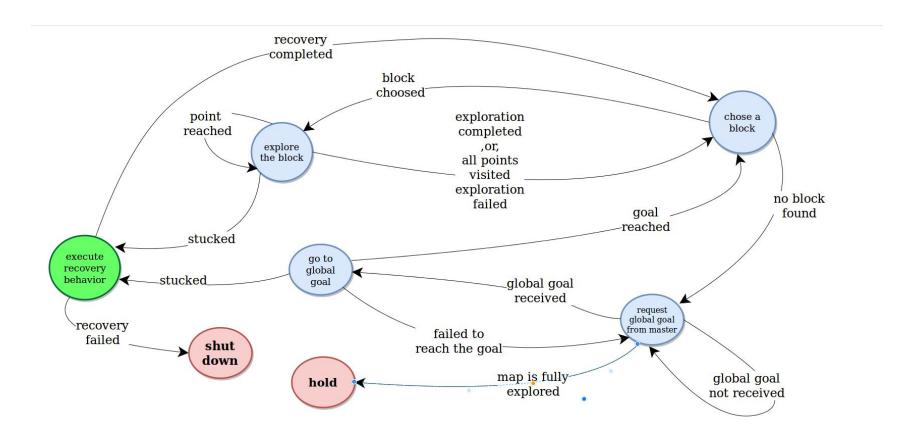
This year we have created our own autonomous exploration system which operates based on different states a robot can have and the overall situation of all other operating robots. Each state specifies the action the robot should undertake to successfully explore its surrounding area and move to the next state. Each State for a given robot depends on the percentage of the overall exploration completed, the percentage of exploration of surrounding area of the robot completed, the previous state of the robot and other factors explained below. These states can form a state machine (as shown in figure 3) which can accurately describe the planning and behavior of our robot, therefore, we have used SMACH to create the and join the state together.
The exploration system has two different modes named joint mode and direct mode. Each one will be explained separately.
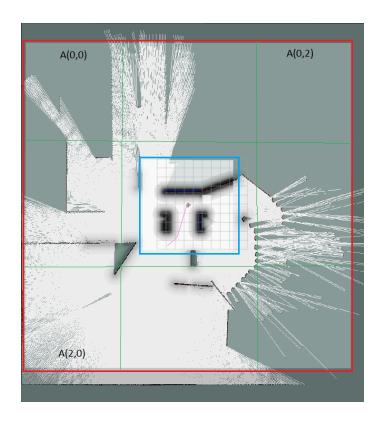
Percentage of exploration As described earlier the percentage of exploration which we denote POX from now, is an important factor for the functionality of our system. Figure 4 shows the global and local costmap of our robot used by move base. Assuming a resolution of 0.05 and width and height of 36 for global costmap it is realized that the matrix corresponding to the cost of cell in the map has 720 rows and 720 columns. Since processing this matrix needs a large amount of computational power we can break this matrix into blocks with a fewer element and smaller size. The size of smaller blocks is mostly arbitrary so we assume we have broken the matrix into 9 blocks with 240 rows and 240 columns each.
As shown in the figure 4 for the matrix A the block in the top right corner of the matrix is A(0,2) and the block in bottom left corner is A(2,0). For the block A(n,m) the Px(A(n,m)) is defined as below:
$$Px(A(n,m)) = \sum_{i=n \times 240}^{(n+1) \times 240} \sum_{j=m \times 240}^{(m+1) \times 240} G(A(n,m)_{(i,j)})$$
Where Gx is a function that returns -1 if and only if x = -1 and returns 1 otherwise. For a fully explored block Px is 57600. While for a completely unknown block Px is -57600 and for block and Px = 0 means that about half of the block has been explored. Therefore, we get the following formula for calculating POX of the block:
$$POX_{A(n,m)} = \frac{Px(A(n,m)) + 57600}{115200} \times 100$$
now that we have the POX of a block we can decide whether we need to explore the block or not. Choosing the minimum POX for a block to be considered for exploration is not somehow arbitrary but based upon the test it seems 80 percent is a good ratio.
Joint mode In the joint mode, we have a merged map for all robots and we also have the position of all the robots relative to each other. In this situation, each robot will divide the map of its surrounding area to several blocks with equal sizes. It will then compute how much of a block is explored by determining how many cells (pixels)within a block have known values. Based on the current state of the robot it may pick a block to explore. In this case, the robot will try to visit several points in the block which have been chosen by the algorithm. Different outcomes are possible and in the aforementioned state machine all these outcomes are handled and they will result in different states.
Assuming the robot does not pick a block either because it cannot find an unexplored block or its not possible to get to a chosen block or even failing to explore a block after doing all the behavior and possible actions robot will signal the master node which in response by checking the global merged map and finding a goal for the robot far out of its surrounding area and with a small number of explored cells.
Direct mode This mode is very similar to the joint mode especially when the robot tries to explore its surrounding area. Since in this mode we have neither a merged map nor the location of robots relative to each other, instead of contacting a master node and waiting for a response from the master node, the robot will now divide its global map into super blocks and tries to find a goal in an unexplored area.
However, if any time during the operation our map sharing node manages to create a global merged map for all robots then direct mode will be disabled and exploration will continue in joint mode.
Recovery Behaviors As situations encountered by the robot may be very unique or may present extremely difficult challenges without a certain strategy to overcome the problem. there is always a possibility that the exploration state machine may not be fully reliable or in some cases even operational. Therefore, the system is designed with a few safeguards. Since each state defines a set of situations, distinguishable from other situations,the system is capable of accepting new situations simply by defining them as new state and adding them to the state machine. This allows us to improve the exploration system over the time and as new experiences are gained. Another safeguard is the recovery state machine in the system. It is possible that the robot becomes stuck either due to operator errors or the weaknesses in autonomous strategy or motion planning algorithm. In the recovery state machine which is nested inside the exploration state machine depending on the orientation and speed of the robot different control policies are exploited to recover the robot back to functional state. Most of these methods are recovery behaviors existing in move base package but with some optimizations for our model using trial and error.
Map-Merging There are two approaches toward the problem of merging different maps from robots and building a globally shared map. One is when the co-ordination and orientation of robots are known. In this case we just need to put the map of each robot in the right place. The other case is when the abovementioned data is not provided. for this purpose we used a Template Matching Algorithm to find overlapping areas in maps to merge them according to their similarities.
PID Controller PID control is by far the most common way of using feedback in natural and man-made systems. [2]
This year we have exploited a PID algorithm in our control loop to minimize the error of the output.
In our concept control loop is provided by a controller which its goal is to minimize the output error by changing of a control variable u(t), in our case u(t) is the speed of robot which we are going to calculate the error arising from a sudden change in rotational speed of wheels that causes some shakes in the robot. The unstable robot may distort explored map so victim detection process will not be effective.
We used PID algorithm to minimize the error value in output of robot navigation into the Gazebo environment. this is provided by using a control loop which continuously calculates the error value between ideal output and measured one, then we have to change input values to reach the ideal set point.
these corrected input values, are obtained by proportional, integral, and derivative terms according to the PID formula below[3]:
$$u(t) = k_p e(t) + k_i \int_0^t e(\tau) d\tau + k_d \frac{de}{dt}$$

2.2 Victim Detection
Our implementation is based on Caffe[6]. Caffe is a deep learning framework and training parameters are mainly the same as in original papers. Details are in Table 1. SqueezeNet v1.1 was chosen from different versions of SqueezeNet because of less computation and it is fine tuned for our purpose. We used a Nvidia Geforce GTX 980 with 16 gigabytes of RAM to train our models.[4] To train
| Parameter | value |
|---|---|
| Iteration | 2000 |
| Batch Size | 64 |
| Base Learning Rate | 0.001 |
| Learning Rate Policy step | |
| Step Size | 500 |
| Gamma | 0.1 |
| Momentum | 0.9 |
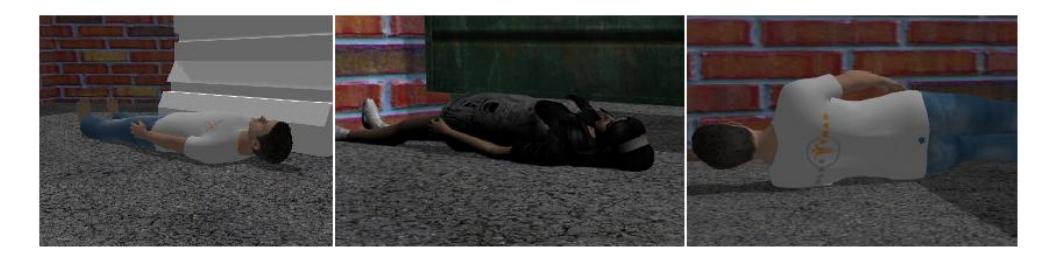
the SqueezeNet model we gathered images from three victims(see Figure 5 for samples). 500 images of each victim were selected. We also gathered 1500 random non-victim images from gazebo environment. These 1500 victim and 1500 nonvictim images were used as our dataset. We make these images publicly available and encourage others to add images of their own to help gather a large dataset of different kinds of victims for future research.
Different experiments were conducted to evaluate the performance of the model. First, victim and non-victim images were shuffled separately and 66% of each were chosen for training, the rest were chosen for the test set. Due to randomness in training procedure, the model was trained 5 times and average accuracy on the test set is 99.7%.
Time needed for every forward pass of architectures is reported in Table 2. Our measurements were on two different GPUs(GTX 980 with 2048 Cuda cores and GT 620m with 96 Cuda cores), a general purpose laptop CPU and a
| SqueezeNet | 2.13 | 16.63 | 48.55 | 173.33 |
minicomputer CPU. As expected, SqueezeNet is fast and runs in a reasonable time on robot's system.
We are planning to use and test other NN architectures like Tiny YOLO until RoboCup event in July.
2.3 Human-Robot Interface
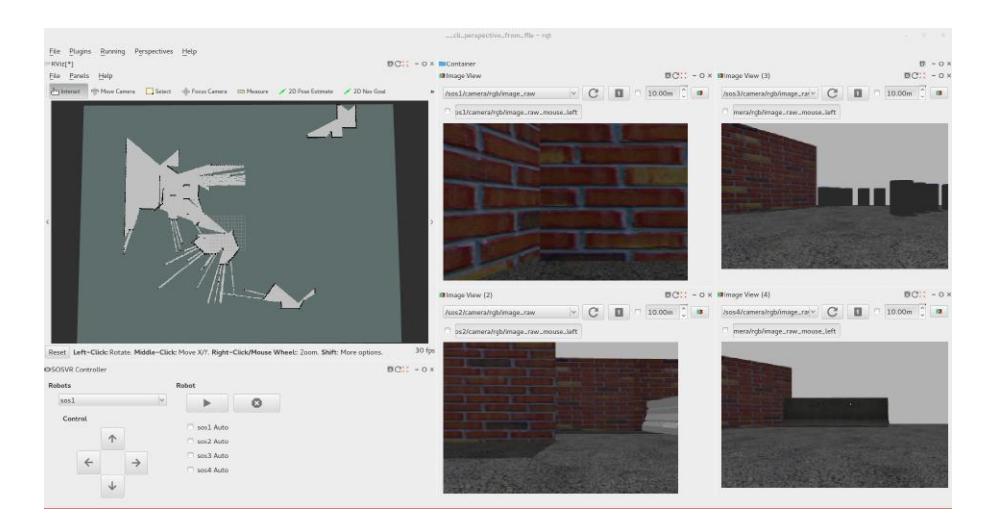
SOSVR Panel is our Control Panel visualizer which is a plugin for rqt that allows human operator to see robot state, map, camera feed, and switch between robot controllers. This year, we have updated the plugin, bug fixes have been done and it is publicly available on team's repository. Any contribution on this package is appreciated. See figure 6 for a screen shot.
2.4 Base Code Package
According to our new contributions to the base code released last year[5], this package is richer and well documented now. It contains standard robot definition(P3AT), SOSVR controller, Teleop, SLAM, SOSVR Exploration, Victim Detection, SOSVR Panel and related Launch files. As such, the new version of base code containing above-discussed works will be released after RoboCup 2017 competition.
3 Innovations
As noted in section 1, this year, we have developed a CNN based robust victim detection system and an exploration system namely SOSVR exploration. Also, we have used PID controller for navigation purpose, improved autonomous state machine and SOSVR controller. Also, we have used heterogeneous robots and their cooperation.
4 Conclusion and Future Works
After all, these new contributions are under development and they need test and improvement. Besides we have in mind to move toward new challenges like 3D mapping, object recognition and manipulation. As well we have to consider realistic wireless communication between mobile robots despite using unconstrained communication, which in near future will be added to the competition.
References
- Kohlbrecher, Stefan, Rose, Christian, Koert, Dorothea, Manns, Paul, Kunz, Florian, Wartusch, Benedikt, Daun, Kevin, Stumpf, Alexander & von Stryk, Oskar (2016). RoboCup Rescue 2016 Team Description Paper Hector Darmstadt.
- Aström, Karl Johan & Murray, Richard M (2010). Feedback systems: an introduction for scientists and engineers. Princeton university press
- Araki, M. (2009). PID control. Control Systems, Robotics and Automation: System Analysis and Control: Classical Approaches II, Unbehauen, H.(Ed.). EOLSS Publishers Co. Ltd., Oxford, UK., ISBN-13: 9781848265912, 58-79.
- Iandola FN, Han S, Moskewicz MW, Ashraf K, Dally WJ, Keutzer K. SqueezeNet: AlexNet-level accuracy with 50x fewer parameters and <0.5 MB model size. arXiv preprint arXiv:1602.07360. 2016 Feb 24.
- Taherahmadi, M., Azami, S. & Shiry, S. (2016). SOSvr Team Description Paper: RoboCup 2016, Rescue Virtual Robot League.
- Jia Y, Shelhamer E, Donahue J, Karayev S, Long J, Girshick R, Guadarrama S, Darrell T. Caffe: Convolutional architecture for fast feature embedding. InProceedings of the 22nd ACM international conference on Multimedia 2014 Nov 3 (pp. 675-678). ACM.