Robo-Erectus Sr-2011 AdultSize Team Description Paper
Liandong Zhang, Changjiu Zhou, Zhiwei Song, Ng Buck Sin, Xinyu Han, Tianwu Yang, Nguyen The Loan, Tey Chin Hock, Carlos Antonio Acosta Calderon, Pik Kong Yue
Advanced Robotics and Intelligent Control Centre (ARICC) Singapore Polytechnic, 500 Dover Road, Singapore 139651
Abstract This paper provides a brief description of Robo-Erectus Sr-2011 AdultSize soccer playing humanoid robot developed at Advanced Robotics and Intelligent Control Centre of Singapore Polytechnic. The mechanical and electrical specifications of the robot are described. This paper also covers the gait control, vision processing, force/torque sensors ZMP detection, 7-degree of freedom arm of the robot. This robot is used as a platform for competing in RoboCup humanoid league, and for our ongoing research in humanoid robot dynamic walking and navigation.
1 Introduction
Robo-Erectus Sr-2011 AdultSize humanoid robot is developed by the Advanced Robotics and Intelligent Control Centre (ARICC), Singapore Polytechnic. The objective of the project is to develop a humanoid robot with more human-like features and human-friendly character. The design concepts of RoboErectus Sr-2011 AdultSize includes modular development, compact design and emphasis on robot's ability to perform cooperative works in general and soccer (RoboCup) [1, 2, 3] (www.roboerectus.org).
RESr-I gave an outstanding exhibition in the Humanoid League of RoboCup2007 and won the 4th place in the penalty kick competition of Humanoid TeenSize League. It was also featured in CNN Live. The Robo-Erectus project has been initiated since 2002. It has 3 categories: (1) RE Junior for educational purpose; (2) RE Junior for Humanoid KidSize competition; (3) RE Senior for Humanoid AdultSize competition and also for research on full-size humanoid robotics. RESr-III is also incorporated into our R&D framework using Microsoft Robotics Studio. Force/torque control is also studied by installing ATI Force/Torque sensors Nano25 and Mini85 on the ankles of the humanoid robot REJr and RESr-III respectively [4]. The latest type now is called RoboErectus Sr-2011 AdultSize humanoid robot.
2 Hardware of Robo-Erectus Sr-2011 AdultSize Robot
2.1 Mechanical Structure of Robo-Erectus Sr-2011 AdultSize Robot
Final dimensional parameters of Robo-Erectus Sr-2011 AdultSize robot are given after repeated experiments and optimization. It has 28 Degrees of Freedom (DOFs). The joints are powered by rechargeable lithium-polymer battery matrix that can support biped walking for half an hour. The robot is controlled by a single board computer and a Sony VAIO ultra portable PC, which are in charge of robot navigation and localization and vision processing respectively.
2.2 Electrical Control Structure of Robo-Erectus AdultSize Robot
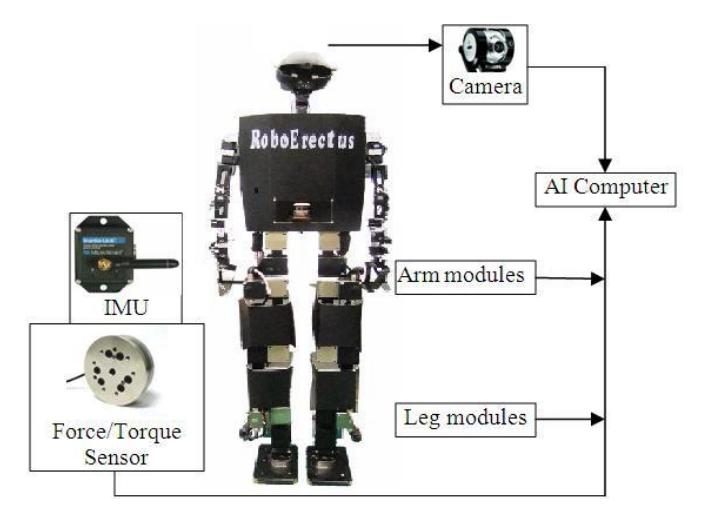
The active modules of the robot are self-contained mechatronic units with the control loop closed at the joint level. Each actuator module has its own individual motion controller. The inter-module communication is implemented using the CAN-bus protocol and the RS-485 serial interface. Low level trajectory generation and control are developed based on hierarchical control concept. Vision sensor and IMU sensor are installed in upper body to find the ball and get the tilt information and to measure the moving direction. The force/torque sensors are installed in the ankles of the robot to detect the ZMP information. The block diagram for locomotion control and vision administration is shown in Fig. 1.
3 Biped Walking Control System for Robo-Erectus AdultSize
3.1 Software Structure
This section presents the software architecture what we designed for the new robot. The architecture is a distributed system and platform-independent. Multiple executable programs can run on multiple robots or computers simultaneously and they cooperate with each other via network. The network communication and the thread management are transparent and highly encapsulated in a development kit named RobotKernel. Based on it, certain robot function module, such as motion, localization can be developed easily and the module can run on multiple platforms, such as Linux, Mac OS X and Windows. And the new module can be debugged and tested sufficiently on a remote computer before integrating them with existing modules on the robot.
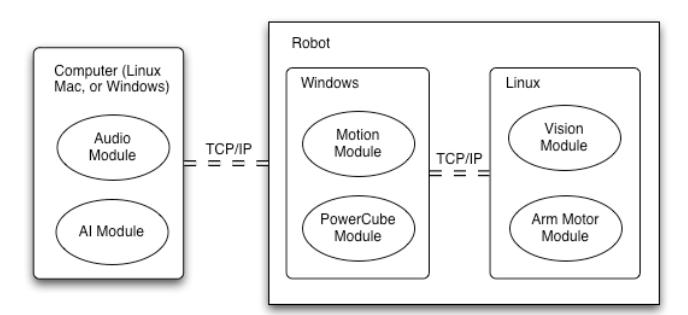
Figure 2 gives typical function modules for the robot. Two systems are embedded on the robot, one Windows and one Linux. PowerCube module and Motion module run on the Windows, while Arm Motor module and Vision module run on Linux. AI module and Audio module run on a remote computer for testing. All these modules communicate via network connection either wired or wireless.
Another interesting feature is the remote call implemented in the architecture. That means we can call the function in the Motion module, such as Walk Straight with a distance parameter of 5 meters, from AI module or any other module. The remote call can be sequential or parallel. The parallel means that we can call two or more remote methods simultaneously, for example, the robot can say hello when it is walking straight.
3.2 Control Software Design
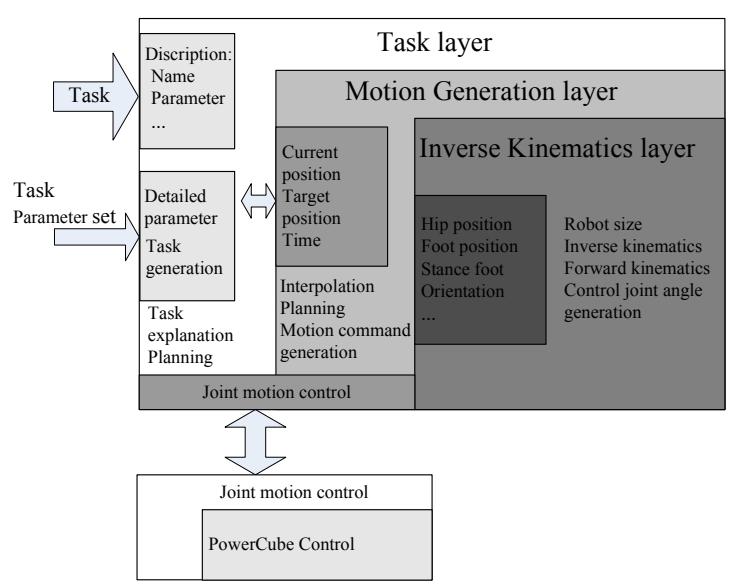
This section presents an overview of the walking control system and the online gait trajectory generation algorithm. In order to complete the given task in a soccer game, the robot should be able to localize its position, decide the motion target, plan the path, generate the joint trajectory and control the servo motor the follow the generated trajectory. Autonomous walking control and online gait trajectory generation techniques are required. Different levels of feedback control, as well as different control cycles are needed to control the humanoid robot move to the target correctly. A hierarchical architecture is used in the design of control software. Different layers are used in the control software, including the AI layer, the gait generation layer, the trajectory generation and modification layer and the joint motion control layer.
The layered architecture of the control software is shown in Fig. 3. The AI layer is used to plan the path after the motion target is given by upper modules. The motion target is explained and a serial of motion task is specified. There is a feedback loop running in this layer, to get the information from other modules such as location and then move further more if there is any error occurs.
4 Vision Detection and Recognition
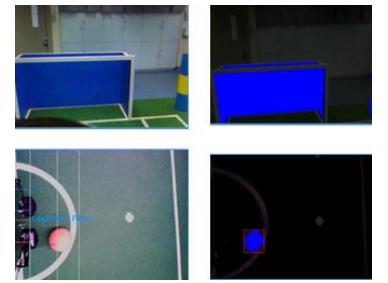
Figure 4 shows the raw images and the processed results of the processing system [5, 6].
5 Force/Torque Sensor for ZMP Control
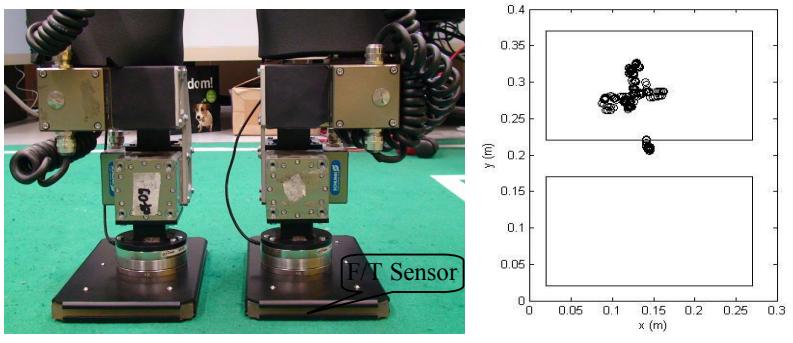
ATI Mini85 Force/Torque sensors are installed in the ankles of RoboErectus adult size robot (Fig. 5) and the ZMP detection research has been performed (Fig. 6).
6 Conclusion
The Robo-Erectus Sr-2011 AdultSize aims to develop a platform for competing in RoboCup Humanoid Adult Size League and for our ongoing research work in humanoid robot localization and navigation areas. As a part of our research, we have developed simulation software using Microsoft Robotics Studio for the study and analysis of humanoid gait generation and optimization. A Linux OS based object oriented software framework is implemented for object recognition, motion control and communication to achieve real time capabilities in terms of robot localization and navigation. A state-driven Monte Carlo localization method has been developed and has been verified by experiments. Force/Torque sensors are installed in the RESr-2011 and the ZMP is measured. During the experiments conducted, Robo-Erectus Sr-2011 AdultSize exhibited good walking and soccer skills. For more detailed information about Robo-Erectus humanoid soccer robots, please refer to the team's website www.robo-erectus.org.
Acknowledgements
The authors would like to thank staff and students at the Advanced Robotics and Intelligent Control Centre (ARICC) and higher management of Singapore Polytechnic for their support in the development of our humanoid robots.
References
- Zhou, C., Yue, P. K.: Robo-Erectus: a Low Cost Autonomous Humanoid Soccer Robot. Advanced Robotics, 18(7) (2004) 717–720
- Zhou, C., Hu, L., Zhang, L., Wu, B., Yang, T. and Yue, P. K.: Design and Control of a Humanoid Robot Using Standard Reconfigurable Modules. Proceedings of IEEE-RAS International Conference on Humanoid Robotics. Pittsburgh, USA, Nov 29-Dec 01 (2007)
- Hu, L., Zhou, C.: Gait Generation and Optimization Using the Estimation of Distribution Algorithm for Teen Size Humanoid Soccer Robot RESr-1. International Journal of Humanoid Robotics, 5(3) (2008) 437–456
- Zhang, L., Zhou, C.: Lie Group Formulation for Analysis of Kicking Motion in Humanoid Soccer Robots. International Journal of Humanoid Robotics, 5(3) (2008) 501–522
- Acosta Calderon C. A., Elara M. R., Zhou, C., Yue, P.K., Hu, L.: Integration of Robust Embedded Vision and Control for a Soccer Playing Humanoid Robot. Proceedings of the 4th Int. Conf. on Computational Intelligence, Robotics and Autonomous Systems, Palmerston North, New Zealand, Nov 28-30 (2007)
- Elara, M. R., Acosta Calderon, C. A., Zhou, C., Yue, P. K., Hu, L.: Using Heuristic Evaluation for Human-Humanoid Robot Interaction in Soccer Robotics Domain. IEEE-RAS International Conference on Humanoid Robots (Humanoids 2007), Pittsburgh, USA, Nov 29-Dec 01 (2007)
- Sven Behnke: Online Trajectory Generation for Omnidirectional Biped Walking. Proceedings of IEEE International Conference on Robotics and Automation (ICRA 2006). Orlando (2006) 1597–1603