Kwangwoon University ROBIT (Adult Size League) Team Description Paper
YongHo Na, Dong Ho Park
Kwangwoon University, Wolgae-Dong, Nowon-Gu, Seoul, Republic of Korea
Abstract This document describes both hardware and software specifications and practical functions of the humanoid robot Stepper Adult, developed by team ROBIT as a platform for research in bipedal locomotion, robot self-localization and multirobot cooperation. The robots will be used to participate in Humanoid League (Adult Size) of ROBOCUP 2013.
1 Introduction
The ROBIT is a professional robot game team of Kwangwoon University in South Korea. Team 'ROBIT' has been established in November 2006. The ROBIT has participated in several domestic and international tournaments and received more than 100 awards in competitions. The team, 'ROBIT' has a five-year accumulated robot technology. We have put a lot of efforts for the 'ROBOCUP' contest to get qualified and we also have studied Robot system which would be covered during the contest.
Briefly, we use 'FIT PC' which is easy to be equipped with robot and also processes received images. The images processed through the CAN (Controller Area Network) communication system are transmitted to interface board. As you can see from the pictures below, we have developed strong and rugged robots using the SAM.
2 Overview of the System
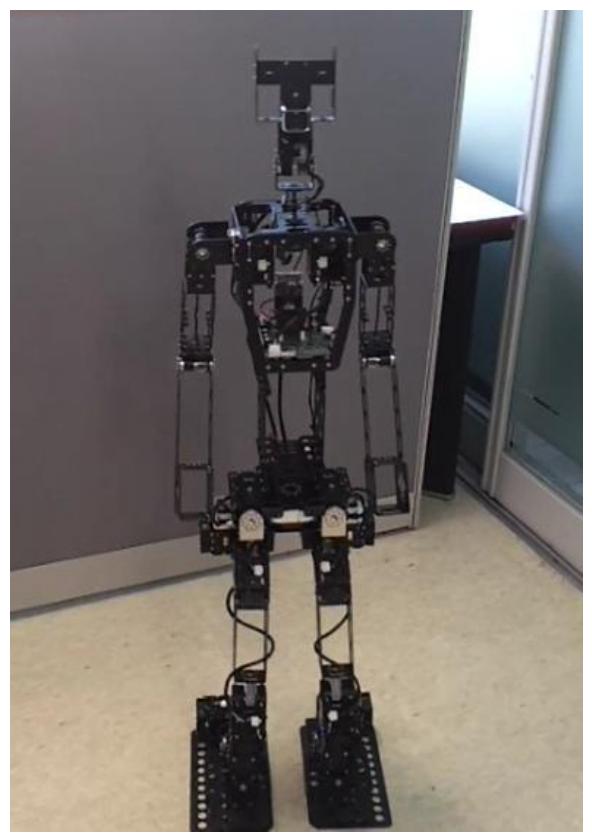
Figure.1 is our prototype robot design. This robot is not completed yet. We plan to upgrade the hardware lighter and more robust. You can find more detail from the spec.
3 Robot Specification
- Robot Name
- KW
- Height of Robot
- 131 cm
- Weight of Robot
- 13.0kg
- Walking Speed
- Walking forward : 25cm / s
- Turning Left(Right) : 40 deg / s
- Number of degrees of freedom
- Total DOF : 20DOF
- HEAD : 2 DOF
- SHOULDER : 4 DOF
- ELBOW : 2 DOF
- HIP : 4 DOF
- LEG : 8 DOF
- Type of motors
- HEAD : SAM-28 x 2 ea
- SHOULDER PITCH : SAM-160 x 2 ea
- SHOULDER ROLL : SAM-28 x 2 ea
- ELBOW : SAM-28 x 2 ea
- HIP YAW : SAM-160 x 2 ea
- HIP ROLL : SAM-210 x 2 ea
- LEG : SAM-210 x 8 ea
- SAM-28 Specification
- Torque / RPM : 28 kgfcm / 90 rpm
- Input Power : 9 ~ 24Vdc
- SAM-160 Specification
- Torque / RPM : 160 kgfcm / 55 rpm
- Input Power : 9 ~ 24Vdc
- SAM-210 Specification
- Torque / RPM : 210 kgfcm / 50 rpm
- Input Power : 9 ~ 24Vdc
- Type of sensors used (incl. type of camera(s))
- Vision Camera : MS HD-5000
- Gyrometer x 1 ea
- Acceleration Sensor x 1 ea
- Computing Unit(s)
- Built-in PC : Fit-PC3
Fit-PC3 Specifications
| CPU | AMD Embedded G-Txxx, Dual-core 64 bit x86 CPU @ 1.0-1.65 GHz |
|---|---|
| Memory | Up to 8 GB, DDR3, 1333 MHz, 64-bit (two SO-DIMM sockets) |
| Storage | Internal 2.5" hard disk Two eSATA ports, up to 6 Gbit/s |
| Display & Graphics | AMD Radeon™ HD 6xxx, Dual head DisplayPort and HDMI incl. Audio HDMI 1.3a/1.4, WUXGA (up to 1920x1200) and stereo-3D support DisplayPort, WQXGA (up to 2560x1600) DirectX 11, OpenGL 4.0, OpenCL, 1080p Blu-Ray playback support, UVD 3 engine with native H.264, VC-1, MPEG2, and DivX |
| Audio | Stereo line-out and stereo line-in, 7.1 channel S/PDIF |
| Network | 1000 BaseT Ethernet port, activity LEDs, RJ-45 connector 802.11b/g/n Wi-Fi, 2 antennas, 150 Mbit/s + Bluetooth® 3.0 |
| USB | Two USB 3.0 host ports, 5 Gbit/s Two USB 2.0 host ports, 480 Mbit/s Optional - Four USB 2.0 host ports, 480 Mbit/s in front |
| Serial | RS232 - Ultra mini serial connector |
| Expansion | Mini PCle socket, half-size Mini PCIe socket, full-size, with mSATA support Proprietary FACE Module (Function And Connectivity Extension Module): 4x PCle lanes , 6x USB2 , 2x SATA , 25x GPlOs , 2x SMBus, LPC |
| Power | Unregulated 8 to 16 volt input Power Consumption: 7W – 24W (Depend on system configuration and load) |
| Dimensions | 16 x 16 x 2.5 cm, 19 x 16 x 4 cm (ribbed case) |
4 Robot Control System
Our robot control systems are divided into three parts.
The first part of our robot systems is 'FreeScale' which controls over 20 actuators and several sensors.
The Second part is 'FIT PC' which receives information and processes image data from pictures of match situations.
The last part is teaching system making a basic robot motion such as shooting or blocking a ball.
4.1 System Diagram
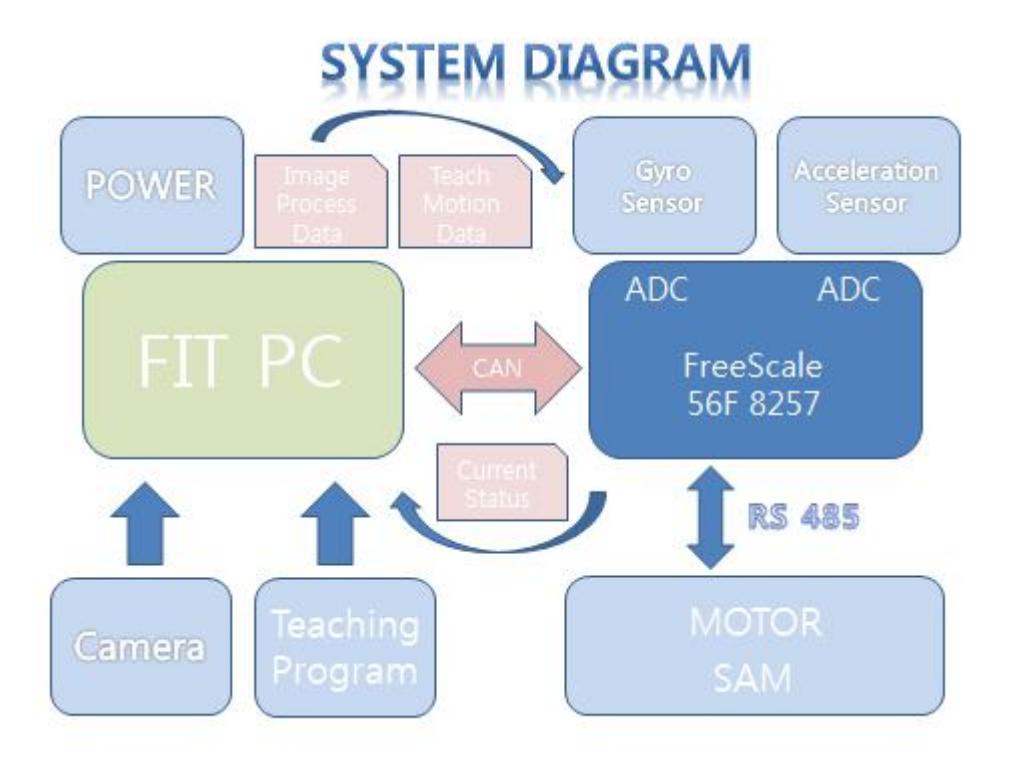
Figure.3 is a diagram of our robot system.
'FIT PC' processes image data, communicates with 'FreeScale' and uses a teaching program to make basic motions. The board of 'FreeScale' receives the processed image data from 'FIT PC' and it also makes inverse kinematics motions and controls actuators. We use gyro and accelerator sensors for correct walking motions as well.
4.2 Teaching Software
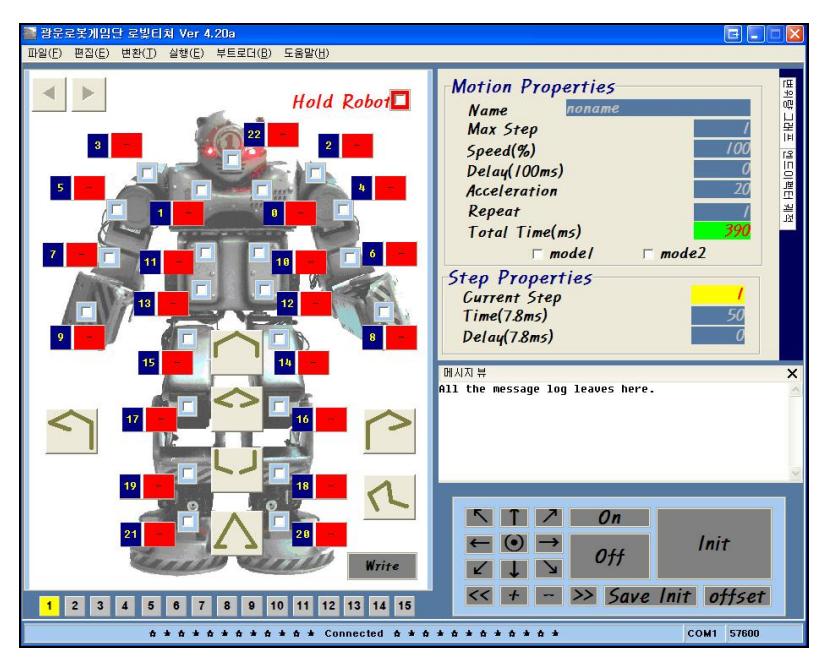
Figure.4 is a Teaching program.
The teaching program is to make fundamental motions. The motions consist of several connected slides providing that we fix specific robot body postures using different robot IDs. Then these slides reserve as data in FreeScale.
5 Image Processing & Communication
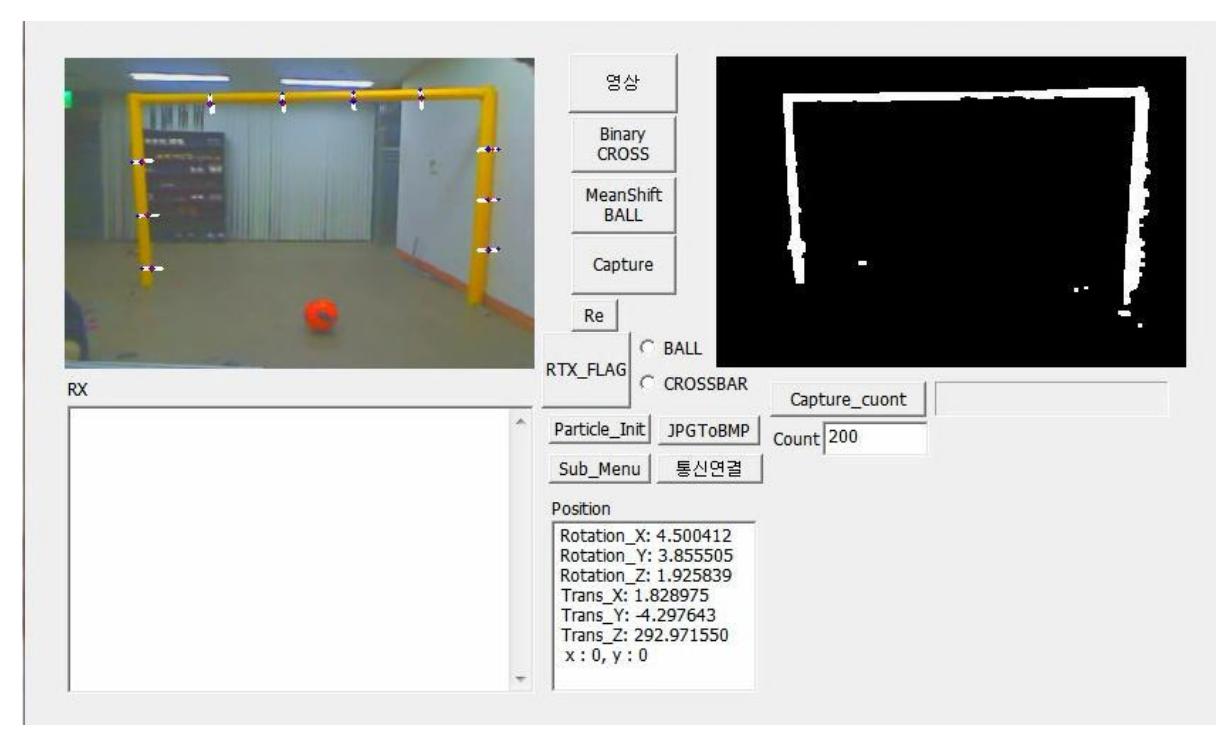
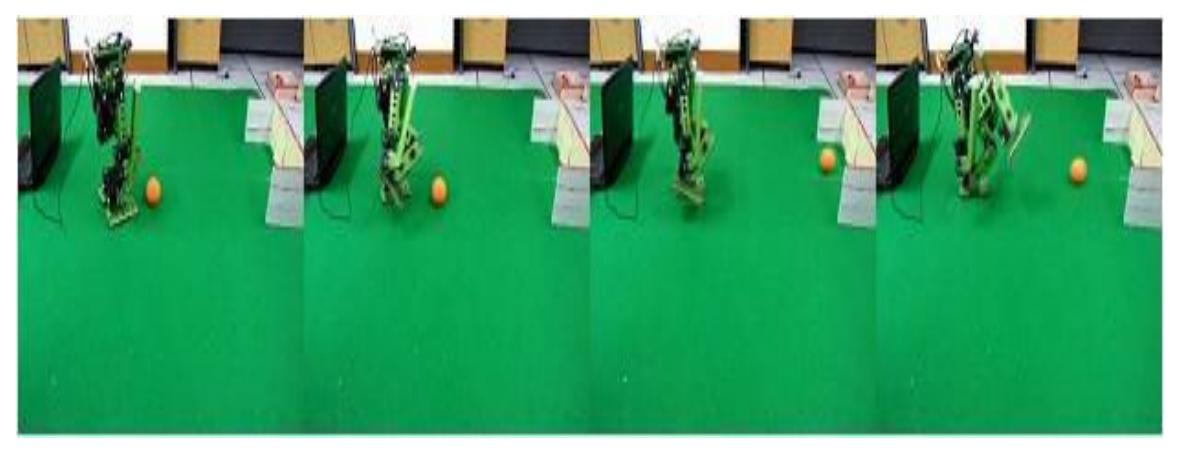
This is a trial picture which was taken by a test program.
We have developed a program to participate in ROBO CUP though OpenCV and GUI programs. For communication with robot, we used CAN(Controller Area Network)
Nowadays, we have developed a USART communication program to be easier to operate robots.
5 Walking System
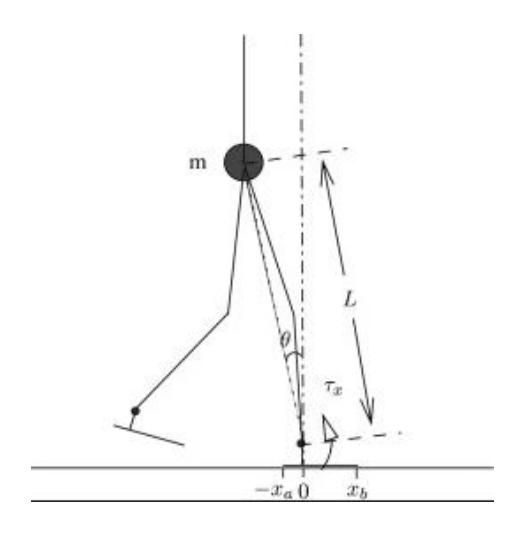
Approximately five years of cumulative experience and know-how through trial and error make robot's strength point which is fast and accurate walking motion.
Robot's walking motion was not fixed, it can vary by sensors and inverse kinematics.
The sensors mounted on the robot control relative values for finding a ball and keeping the ball moving fast and accurate. So robot can control the ball easily and shoot properly.
6 Conclusion
Our system was described in the Abstract.
Since 2006, we completed the design and built, based on our experience to try to join the 2013 ROBOCUP competition.
Higher level of robot mobility and powerful shot also accurate imaging breakthrough in tracking the movements of the robot will be able to determine.