Robo-Erectus Sr-2015 AdultSize Team Description Paper.
Buck Sin Ng, Carlos A. Acosta Calderon, Changjiu Zhou
Advanced Robotics and Intelligent Control Centre, Singapore Polytechnic, 500 Dover Road, 139651, Singapore
Abstract This paper provides a brief description of Robo-Erectus Senior (RESr) AdultSize soccer playing humanoid robot developed at Advanced Robotics and Intelligent Control Centre of Singapore Polytechnic. We are currently in the stage of building a new hardware for this year competition. The new robot, RESr Bv-MkI will be used as the platform for competing in RoboCup humanoid league, and for our ongoing research in humanoid robot dynamic walking and navigation.
1 Introduction
The Robo-Erectus project(www.robo-erectus.org) has been initiated in the Advanced Robotics and Intelligent Control Centre since 2002 and is one of the pioneer soccer-playing humanoid robots in the RoboCup Humanoid League. RESr was first introduced to RoboCup 2007 in the TeenSize category where it won the 4 th place in the penalty shootout and was featured on CNN news. Since then, the RESr has been actively participating and performing well at the competitions till 2011. Multiple research papers [1–6] were also published based on the implementation on RESr. The latest robot that last participate at RoboCup was RESr Winky (Fig. 1) which won the 1st runner-up in 2011. Table 1 shows the team's performance since 2002.
This paper is organized as follows. Section 2 describe the hardware of the robot including the mechanical and electrical design. Section 3 presents the software architecture of the robot. Lastly, in Section 4, the concluding remarks are presented.
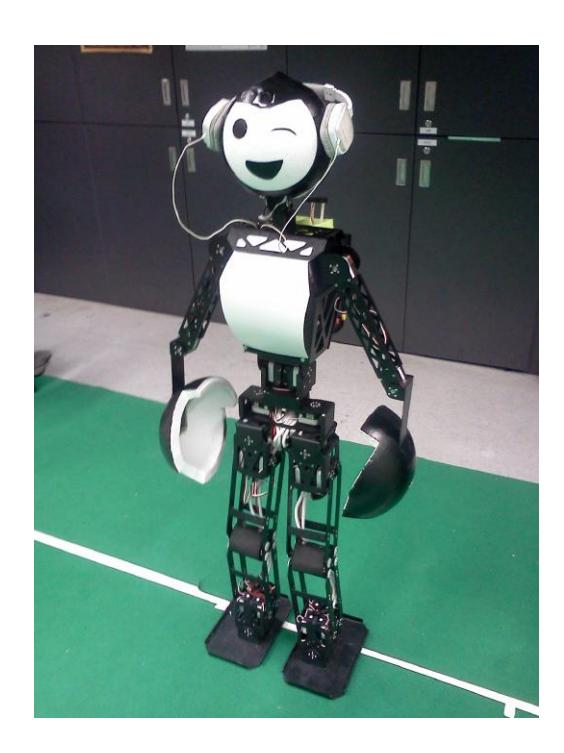
Table 1. Team performance from 2002 to 2013
| Competition Category | Result |
|---|---|
| RoboCup 2002 Humanoid Walk | 2nd Place |
| RoboCup 2003 Humanoid Free Style 1 | 1st Place |
| RoboCup 2004 Humanoid Walk | 2nd Place |
| RoboCup 2004 Humanoid Free Style 2 | 2nd Place |
| RoboCup 2004 Humanoid Kick H40 2 | 2nd Place |
| RoboCup 2004 Humanoid Kick H80 2 | 2nd Place |
| RoboCup 2007 Humanoid TeenSize | 4th Place |
| RoboCup 2008 Humanoid TeenSize | 4th Place |
| RoboCup 2010 Humanoid AdultSize 2 | 2nd Place |
| RoboCup 2011 Humanoid AdultSize 2 | 2nd Place |
2 Hardware
In this section, the mechanical and electrical design of the RESr is presented.
2.1 Mechanical Design
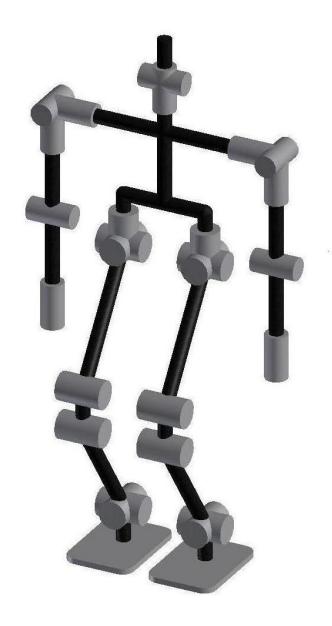
For this year competition, the team is currently in the process of building a new hardware to cater the changes in the rules. The new robot will utilize the VStone V-VS3310 which many other AdultSize teams have already adopted. The new mechanical design will take on similar configuration (Fig. 2) to the KidSize robot, Robo-Erectus Junior (REJr), with 22 degree-of-freedom (DOF) and a double parallel crank mechanism in the leg structure. Redundancy of the DOFs in the hip and ankle will facilitate the ability to do compensated walking on artificial grass. We are expecting to have the hardware completed by end of March.
2.2 Electrical System
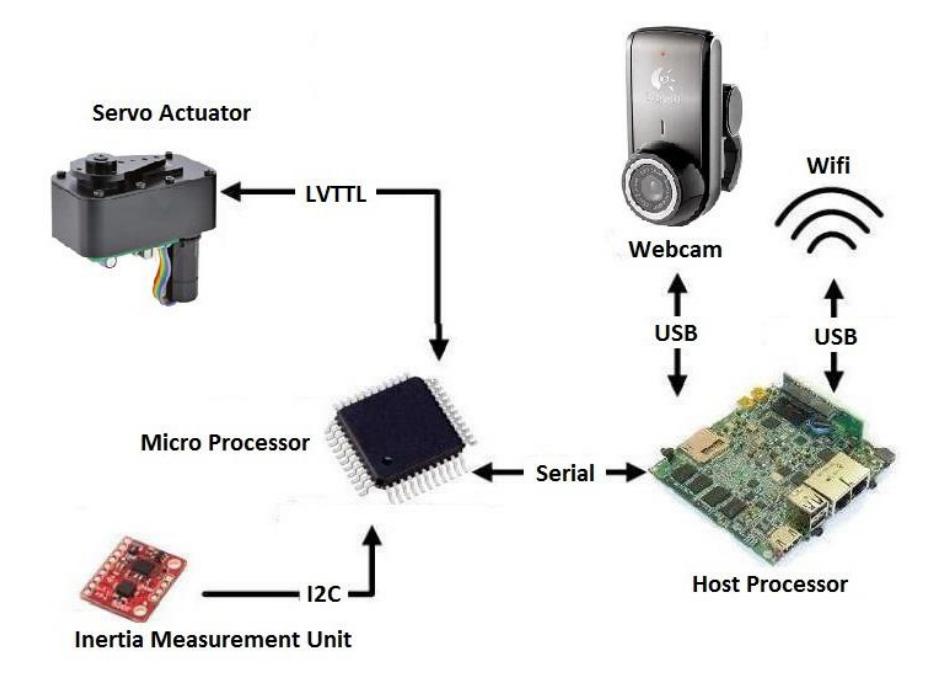
Due to the similarity of the mechanical hardware to the REJr, the RESr will adopt the same electrical system architecture (Fig. 3). This effectively reduces the development time. Plans to replace the host processor with a new processor with more computation capacity is in the pipeline.
Primarily, the electrical system consist of two processors connected to various peripherals. The two processor architecture divides the task handle by the humanoid and runs independently. The low level micro processor handles the servo actuator and inertia measurement unit whereas the high level host processor handles the web camera and wireless communication. Data exchange between the two processor is via serial.
3 Software
In this section, the software control of the RESr is described.
3.1 Software Structure
The RESr will preserve its' predecessor architecture which uses a distributed system and platform-independent structure. Simultaneously, the structure allows multiple executable programs that can run on multiple robots or computers. Communication is achieved via network in which the network communication and thread management are encapsulated in a manner that is transparent. Modules can easily be developed to run on different operating platforms without barrier. The structure provides high portability where through remote calls, multiple module can execute in parallel or sequentially as per required.
3.2 Image Processing
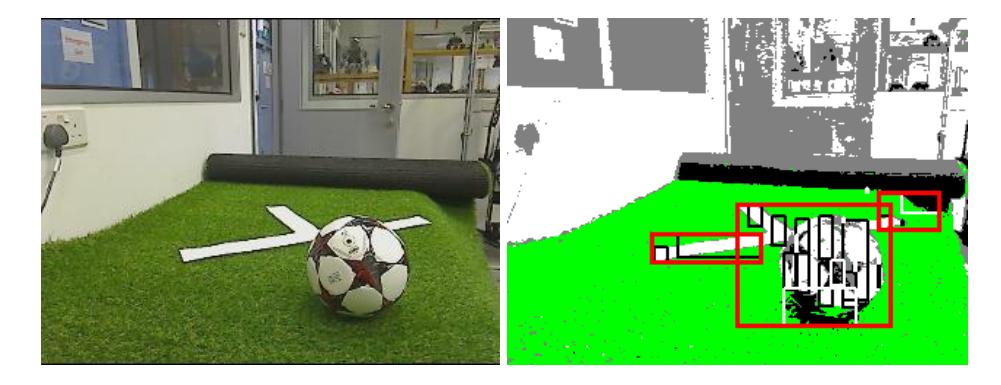
The image processing is based on colors despite the new rules of moving away from colors. Primarily, the use of colors is still computation efficient and inexpensive.
The lookup table used is determine using the YUV color space where each color is defined as a block in term of the YUV parameters in 3 dimensional. The Y color space is divided into 16 layers for better representation of the colors.
Scan lines and color segmentation are used to determine the area of interest on the image. Windows of a collective of color blobs are defined where more expensive computation such as edge detection and Hough transformations are performed. Postulation of the ball, goals, field lines and junctions are thereafter generated.
3.3 Localization
Based on the field lines, junctions and goals, the Monte Carlo localization is implemented to determine the position of the robot on the playing field. As the duration of the game is short and the starting position of the robot is fixed when the game starts, disorientation of the home and opponent goal is minimum.
3.4 Behavior Control
The RESr behavior control framework, based on hierarchical reactive behaviors, provides the functioning of the robot in autonomous mode. Interaction between the system variables are restricted to reduce complexity [1]. Three layers, skill, reactive, and planning layer, defined the control of the behaviors.
The skill layer controls the servo, monitors targets, actual positions, and motor duties. The skill layer translate actions from the reactive layer into motor commands and feedback to the reactive layer once the commands are executed.
The reactive layer implements the robot behaviors like walking, kicking, getting-up, and so forth. This layer selects the behaviors based on the desire task that the planning layer send. Corrections behaviors required due to deviation from actual task is also handled by this layer.
The planning layer use the behaviors of the reactive layer to implement soccer skills such as defending and attacking behaviors. The behaviors at the planning layer are abstract goals which are passed to the reactive layer..
4 Conclusion
In this paper, we have presented an overview of the RESr that is set to participate in RoboCup 2015 in Hefei, China. The team is confident that the new robot will be ready for RoboCup 2015 and is excited and keen to introduce and showcase our new hardware at this year competition. For more detailed information about the Robo-Erectus, please refer to the team's website www.robo-erectus.org.
Acknowledgments
The authors would like to thank staff and students at the Advanced Robotics and Intelligent Control Centre (ARICC) and higher management of Singapore Polytechnic for their support in the development of our humanoid robots.
References
- Carlos Antonio Acosta Calderon, Changjiu Zhou, Pik Kong Yue, Mike Wong, and Mohan Rajesh Elara. A distributed embedded control architecture for humanoid soccer robots. In Proc. of Advances in Climbing and Walking Robots, pages 487–496, Singapore, July 2007.
- Carlos Antonio Acosta Calderon, Rajesh Elara Mohan, and Changjiu Zhou. A humanoid robotic simulator with application to robocup,. In Proc. of IEEE Latin American Robotic Simposium, Mexico, November 2007.
- Carlos Antonio Acosta Calderon Hendra, Rajesh Elara Mohan, and Pik Kong Yue. Robo-erectus senior iii (resr-iii): A teen size humanoid soccer robot. Memory, 1(1GB):8KB.
- Carlos Antonio Acosta Calderon, Rajesh Elara Mohan, and Changjiu Zhou. Rhythmic locomotion control of humanoid robot. In MICAI 2008: Advances in Artificial Intelligence, volume 5317/2008, pages 626–635, Oct 2008.
- Lingyun Hu and Changjiu Zhou. Gait generation and optimization using the estimation of distribution algorithm for teensize humanoid soccer robot resr-1. International Journal of Humanoid Robotics, 5(03):437–456, 2008.
- Liandong Zhang and Changjiu Zhou. Lie group formulation for analysis of kicking motion in humanoid soccer robots. International Journal of Humanoid Robotics, 5(03):501–522, 2008.