CIT Brains (Adult Size League)
Joshua Supratman, Hideaki Minakata, Moeno Masuda, Masayuki Ando, Ryu Yamamoto, Ryohei Goto, Yoshiya Hayashi, Chisato Kasebayashi, Youta Seki, Yukari Suzuki, Ryoma Aoki, Akihisa Iwasaki, Satoshi Shimada, Takaharu Nakajima, Riki Hayashi, Yohei Ashino, Tomoya Fujita, Rui Kobayashi, Misaki Sugawara, Naoki Takahashi, Masakazu Tamura, Kiyoshi Irie, Shigechika Miki, Yoshitaka Nishizaki, Kenji Kanemasu, Hajime Sakamoto
Chiba Institute of Technology; Miki Seisakusyo Co, Ltd.; Nishizaki Co, Ltd.; Yosinori Industry, Ltd.; Hajime Research Institute, Ltd.
Abstract This paper describes the overall system and design of CIT Brains AdultSize humanoid robot Xega2Advanced. Beginning this year, the system for Xega2Advanced was revised to be compatible with the CIT Brains KidSize humanoid robot Dynamo Accelite. Comparing to the previous generation, the new system is easier to maintain and user-friendly. Changes have also been made in image processing, soccer strategy and walk control for overall improvement in performances.
Keywords: user-friendly, easy maintenance, image processing, AI architecture, walk control
1 Introduction
CITBrains AdultSize League is a team consists of mainly undergraduate students from Chiba Institute of Technology. The team collaborated with Hajime Research Institute to develop a humanoid robot capable of autonomously play soccer. Hajime Research Institute developed the mechanism and the control system for the humanoid robot while undergraduate students develop the computer system and the overall intelligence system, such as image recognition and behavior decision, and integrate it to the humanoid robot.
The team has previous experience with RoboCup Humanoid KidSize and TeenSize League. The team received 1st place in the KidSize 2014 and 2015 and 1st place in the technical challenge in the same year and league. The team also received 2nd place in 2009, 2010, 2012, and 2013 in RoboCup TeenSize League.
This paper will describe the overall system and improvements of Xega2Advanced, CITBrains AdultSize humanoid robot. Xega2Advanced previously participated in the RoboCup TeenSize Humanoid League as Xega2 and was later modified to participate in RoboCup AdultSize Humanoid League. This year, the overall system was revised to be compatible with CITBrains KidSize for maintenance and development ease. Furthermore, several improvements have been made in ball recognition, soccer strategy, and walk control to improve overall performance.
2 System Overview
The Xega2Advanced (figure 1) consists of a USB camera, a computer board, an Inertial Measurement Unit, 13 servo motors, a battery and several user interfaces as specified in Table 1. The USB camera captures images which are processed on the main CPU board to detect ball position and landmarks. From these data, the robot strategizes and determines its next course of action such as following the ball or evaluating whether to dribble or to shoot the ball. After deciding its action, the CPU sends action command to the servos. The overview control system is shown in Fig. 2.
All software modules developed such as perception and control are executed on a single computer board for maintenance ease in contrast to the previous generation where two computer boards were used; one for control and the remaining process on the other. The computer board used in this system has an Intel core i7 CPU with a Linux operating system. Comparing to the operating system previously used in the older generations (Windows and NetBSD), Linux has advantages in ease of installation and operation.
The CITBrains KidSize League humanoid robot, Dynamo Accelite, uses Linux OS. Due to using the same operating system, the two robots can share the same source code. In this way, users can develop on the smaller robot before implementing to the larger robot without worrying about the difficulty in handling the larger robot. New technologies can also be shared between the two leagues which increase overall development and productivity.
To summarize, the new system above has easy maintenance and user-friendly environment comparing to the previous generation.
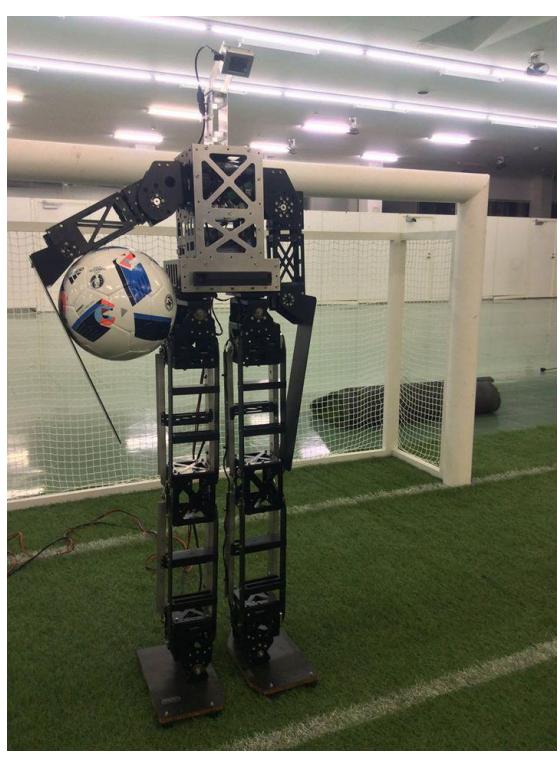
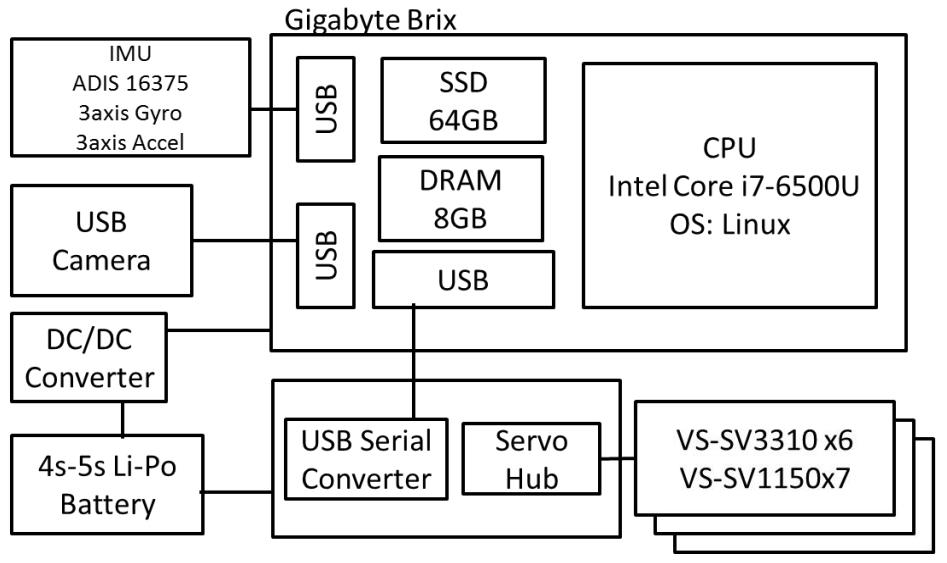
Table 1. Specification of the Robot
| Weight | 12.1 kg |
|---|---|
| Height | 1400 mm |
| Velocity (Forward) | 0.4 m/s |
| Walking Directions | All direction and rotation |
| CPU Board | Main: Brix(GB-BSi7H-6500) |
| OS | Ubuntu14.04 |
| Interface | Ether(100Base-TX) x 1, USB3.0 x 4 HDMI, Sound In/Out, etc |
| Servo Motor | Vstone VS-SV3310 x 6, VS-SV1150x7 |
| Battery | Hyperion Li-Po 4s-5s |
3 Mechanism
Parallel link is applied to the mechanism of the leg to increase walking stability. When walking, the mechanism keep the feet parallel to the body even if the motors has not synchronized completely. This also reduces the number of servos used comparing to the previous generation.
Large torque is required for large humanoid robot. Sliding-crank deceleration mechanism is applied to the ankle and the waist roll to supply ample torque.
4 Ball Detection Method Using Template
In RoboCup2015, the game ball was replaced with a FIFA soccer ball. The color of the new game ball is nearly identical to the goal post and the white lines thus it is extremely difficult to distinguish between objects using color. Therefore, a detection method using the template ball, proposed by Hayashibara et al. [1], is used to distinguish between objects. The sequence is as follows:
- Categorizing each pixel to a color cluster according to a preset color pickup table
- Calculating search points around the previous ball position using a particle filter
- Evaluating the degree of coincidence by comparing a template data
- Registering as the ball if the maximum value is over a threshold
The size of the template changes according to the distance of the ball. The degree of coincidence at each search point is calculated as follows:
- Randomly picking up 100 points within a rectangle of search points. The rectangle corresponds to the template and the size of the rectangle is changed according to the distance of the ball.
- Calculating the degree of coincidence $Doc_k$ by comparing a template data of each point $P_{k}$, in the k-th rectangle using the following equation:
$$\begin{split} X_k &= {C(P_{ki}) \text{is ball color}, \ P_{ki} \ \text{is inside circle}} \ Y_k &= {C(P_{ki}) \text{is ball color}, \ P_{ki} \ \text{is outside circle}} \ n(X_k), \ n(Y_k) &= {\text{implies the number of element of the set } X_k, Y_k} \ Doc_k &= \frac{n(X_k) - n(Y_k)}{n(P_{ki}|P_{ki}\text{is inside circle})} \end{split}$$
C is the categorized color which is derived by using the pickup table. If the sampled image is completely same as the template, the degree of coincidence will be 1.0. By using this method, the robot can detect the ball robustly.
5 Soccer Strategy
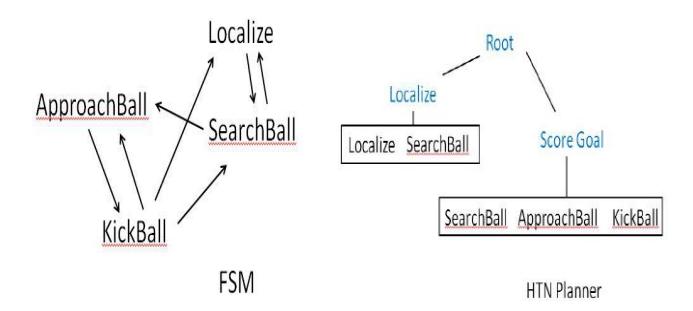
The Xega2Advanced uses Hierarchical Task Network (HTN) planner in its soccer strategy. The previous AI strategy was structured using finite state machine (FSM). The FSM however, have several limitations such as its inability to express states as a plan. In contrast, the HTN planner is a planning architecture that expresses problems as a higher level task. Tasks are decomposed through a planning process which ultimately leaves with a series of atomic task. In this way, the robot's action can be planned ahead with the given situation. Therefore, to overcome the limitation of FSM, HTN planner is used to structure the AI strategy. Figure 3 compares the two AI architectures.
6 Ball Approach
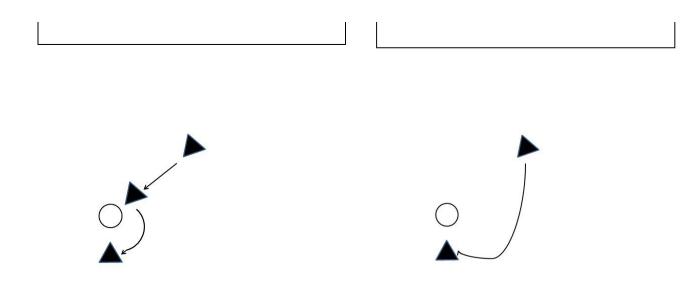
Ball approach has been improved to imitate closely to a humanistic movement. Previous method of ball approach is for the robot to approach the ball in the quickest way possible then to reposition itself toward the goal. The method has been modified as shown in figure 4 where the robot reposition itself toward the goal while approaching the ball in the quickest way possible.
7 Walk Control
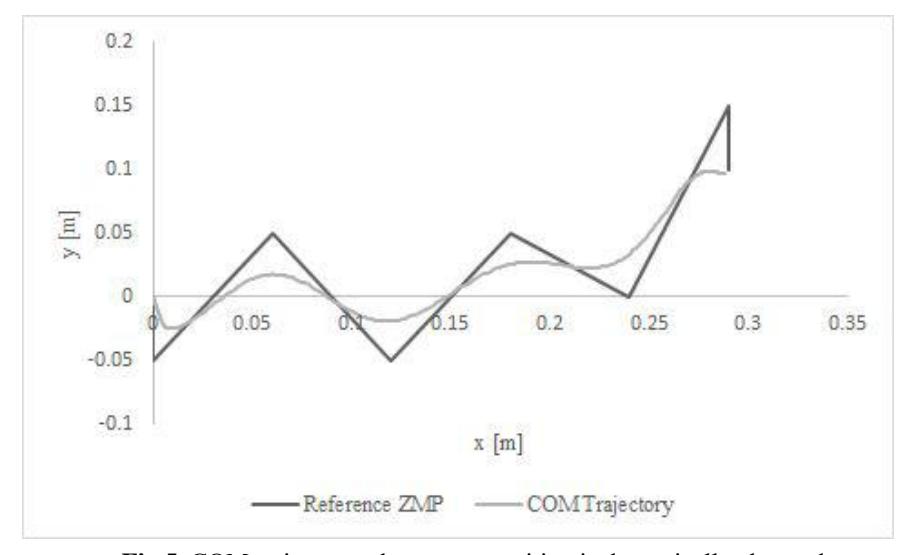
The motion control system was modified significantly comparing to the previous generation. In the previous generation, a method based on ZMP that generates gait pattern was used in Xega2Advanced. This year, the Preview Control method was applied to the COM trajectory generation method as proposed by Kajita et al. [2]. In this method, it is possible to generate a stable COM trajectory in real time by using target values a few steps ahead. Even if the target position is dynamically changed, it is still possible to recalculate the COM trajectory depending on the current state of the robot as shown in figure 5.
8 Conclusion
In conclusion, this paper describes the overall system and design of Xega2Advanced, CITBrains AdultSize humanoid robot. The overall system was revised to be compatible with CITBrains KidSize for maintenance and development ease and several changes have been made to improve ball recognition, soccer strategy and walk control.
References
- Hayashibara, Y., Minakata, H., Irie, K., Maekawa, D., Tsukioka, G., Suzuki, Y., Mashiko, T., Ito, Y., Yamamoto, R., Ando, M., Hirama, S., Suzuki, Y., Kasebayashi, C., Tanabe, A., Seki, Y., Masuda, M., Hirata, Y., Kanno, Y., Suzuki, T., Supratman, J., Machi, K., Miki, S., Nishizaki, Y., Kanemasu, K., Sakamoto, H.: CIT brains KidSize Robot: RoboCup 2015 KidSize League Winner. In: Almeida, L., Ji, J., Steinbaur, G., Luke, S. (eds.) RoboCup 2015 Robot World Cup XIX. LNCS, vol. 9513, pp. 153–164. Springer, Heidelberg (2016)
- Kajita, S., Kanehiro, F., Kaneko, K., Fujiwara, K., Harada, K., Yokoi, K., Hirukawa, H.: Biped Walking Pattern Generation by using Preview Control of Zero-Moment Point. In: Proceedings of the 2003 IEEE International Conference on Robotics & Automation, pp. 1620-1626. (2003)