The Sweaty 2017 RoboCup Humanoid Adult Size Team Description
Armin Dietsche, Klaus Dorer, André Friedrich, Florian Fuchs, Kristina Förtsch, Stefan Glaser, Ulrich Hochberg, Nils-Malte Jahn, Rudi Kirn, Raphael Koger, Mathias Niederhofer, Manuel Scharenberg, Lucas Schickl, Rico Schillings, Fabian Schnekenburger, Igor Tropmann, Michael Wülker
University of Applied Sciences Oenburg, Germany
Abstract This paper describes the Sweaty II humanoid adult size robot trying to qualify for the RoboCup 2017 adult size humanoid competition. Sweaty came 2 nd in RoboCup 2016 adult size league. The paper describes the main characteristics of Sweaty that made this success possible, and improvements that have been made or are planned to be implemented for RoboCup 2017.
1 Introduction
The major research goal with Sweaty is the improvement of bipedal walking algorithms eventually allowing the robot to run. Our second robot Sweaty II suffered from several weaknesses.
- The hip was too wide which made it hard to stand on one foot.
- The software-real time kernel we used was unstable.
- The gait pattern we generated lead to a walk, which was not fast enough.
- The hands could not grasp.
- The vision program was not reliable.
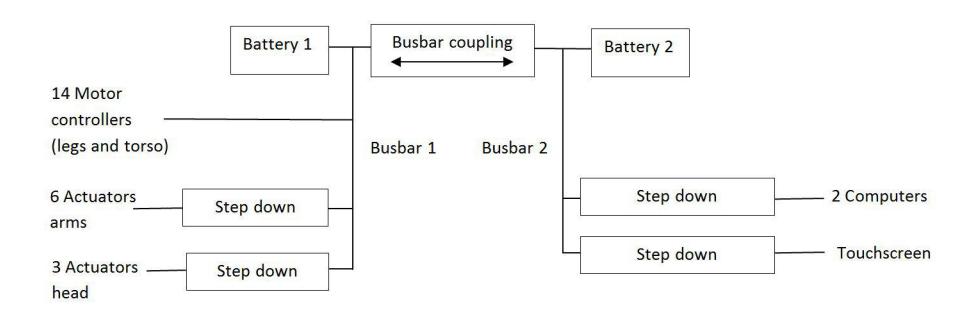
- We had to use two computers as the real time kernel was not compatible with the vision program.
- The low ESR capacitors we need for high dynamic control of the motors led to EMV-problems during start-up.
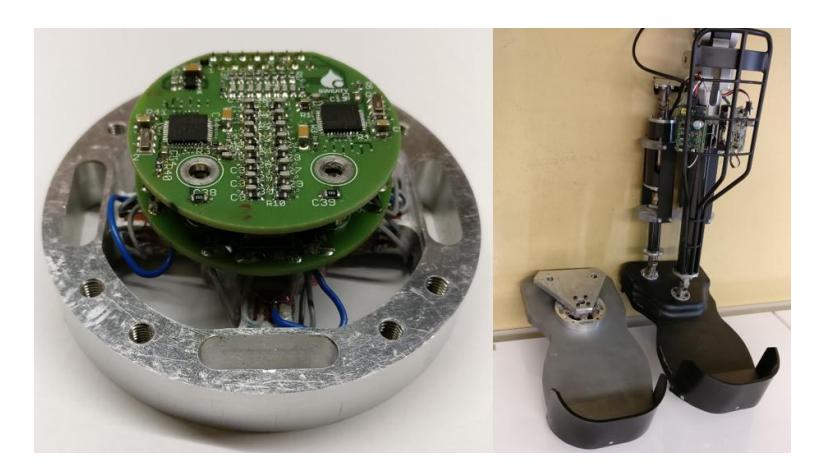
- There were no force or torque sensors to stabilize the gait.
- The trunk was controlled in an inefficient way and thus no stabilization algorithm using the trunk was effective.
- There was potential to optimize the motor controller with respect to speed and precision.
- The gait was designed to an artificial grass with long leaves, but the grass on site had short leaves.
Sweaty II.1 is designed to overcome these issues, while keeping the main advantages.
2 Robot
2.1 Mechanical design
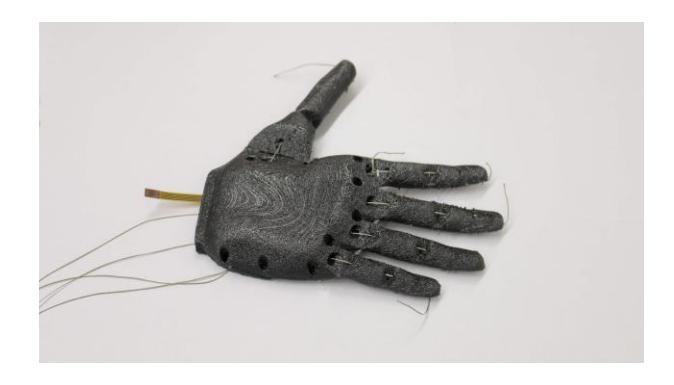
The basis of the mechanical design was the analysis of motion from motion capture data [Sch1] based on data compiled during the KoroiBot project [Ma1]. As actuators we use spindle screw drives with highly efficient motors from Maxon for the leg and torso servos, Dynamixel servos for the arms; Firgelli for the fingers and Volz servos for the head.
Hip The hip was designed with mechanical linkages to enable 3 degrees of freedom [Fr1]. In Figure 1 details of the hip are shown.
![Details of Sweaty's Hip [Fr1].](/tdps/soccer_humanoid_adult__2017__Sweaty/_page_1_Picture_4.jpeg)
2.2 Electrical layout
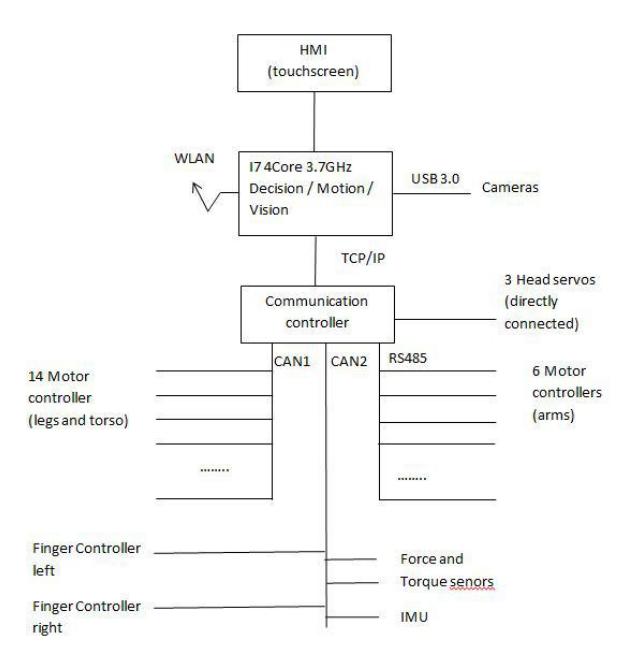
Hardware Architecture The architecture is illustrated in Figure 4. There is one main computer installed: decision, motion and vision programs are running in this machine, which is a high-end consumer PC.
For the communication with the servos and sensors there is a communication controller (STM32F4) installed, which gathers the information from the periphery and distributes the commands to the servos. The communication controller also synchronizes the servos with the main computer for the decision and motion. Each package sent to and from the communication controller includes a time-stamp so that there is no jitter. The communication with the motors in the legs, fingers and torso is done via CAN. For the communication with the motors for the arms and the head RS485 and PWM are used.
3 Vision
The visual system of Sweaty has so far been placed in a 3D-printed aluminum support frame. This could be panned, tilted and rolled with three servo motors and two push-rods. This may be replaced by a simpler arrangement with two servo motors for pan and tilt, but with improved control and less slack in the movement. The support frame houses two RGB-cameras of type UI-3241LE-C operated at a resolution of 1280x1024. Each camera is equipped with a 4 mm lens. Up to now only one camera has been used for the detection of the field and the ball. In addition a inertial measurement unit (IMU) will be rigidly linked to the cameras. The IMU provides 3-axis accelerometer and 3-axis angular rate measurements. In this way the oculo-vestibular coupling of humans is imitated. A full size field of play is still available for testing. The artificial lawn (Greenelds FT XP 32) comes in a width of 4.12 m and the rolls are laid out across the field with alternating directions.
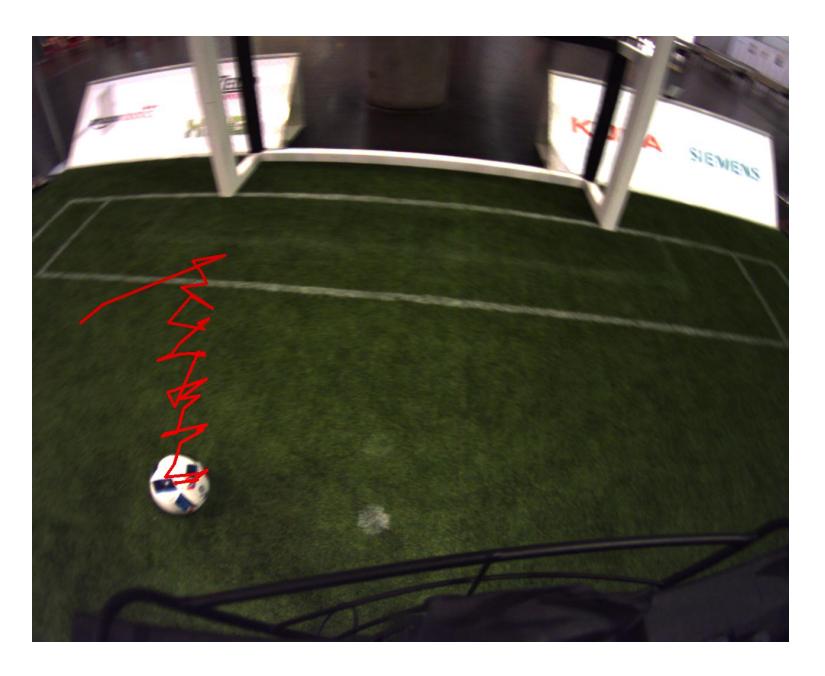
The vision software is based on openCV and uses criteria of homogeneity and color space to separate the field of play from the surrounding background. Within the field of play white areas are taken as candidates for the ball. The outer field lines are identified by the change in brightness. White line segments are distinguished by a shape criterion. If this method is applied to the full field of play a frame rate of 3 Hz results. The frame rate was increased to 15 Hz by limiting the ball search to a region around the ball's previous position. Tracking of the ball is possible for almost the whole field of play (see Fig. 6 from the RoboCup 2016 in Leipzig).
For the investigation of color thresholds and shape criteria tiles can be extracted from stand-still frames. With the help of four manually chosen reference points the field lines visible in the field of view are "superimposed" on the image. After this representative features of the field of play like lawn areas, straight lines, corners, T-junctions and X-junctions of lines et cetera are extracted. Similarly, tiles for different balls at different positions and also for the ball moving are stored. For the various categories of such tiles statistical analysis allows to pinpoint relevant detection criteria and cuts.
4 Software
High level software The high level software for decision making and soccer playing is written in Java and commonly used for the 3D soccer simulation league team magmaOenburg and our Sweaty II robot. It consists of a runtime and a set of tools to visualize the state of the robot and to design strategies or motions.
Mid level software For the motion control we use Matlab/Simulink. Code is generated offline and downloaded to the PC. We use 6D foot trajectories to define walk or kick movements and use inverse kinematics to calculate the corresponding joint angles. Since our actuators use a rod and lever system, the joint angles have then to be mapped to motor angles. For some joints like the ankle this involves a two dimensional mapping of pitch and roll angles to two motor angles for the actuating part and vice versa for the sensing part. The communication to the high level software is done via TCP/IP, as well as the communication to the actuators and sensors.
Low level software The software for the communication controller and for the motor controller is written in C. Basic routines for the controllers are adopted from STMicroelectronics, the LwIP-stack was adopted from Adam Dunkel and the software for the motor controllers was basically developed for other projects at the University of Oenburg.
5 Formals
- Referee: According to the rules our team will make a person with sufficient knowledge of the rules available as a referee.
- Previous Achievements: Sweaty II came 2 nd place in RoboCup 2016. Sweaty I participated in RoboCup 2014 humanoid adult size league reaching 5th place.
- Use of Software: The software for decision making, modeling the environment and some tools are used from our own 3D soccer simulation team magmaOenburg. The vision system uses openCV and ROS.
- Use of Hardware: We thank maxon motor GmbH for their sponsorship.
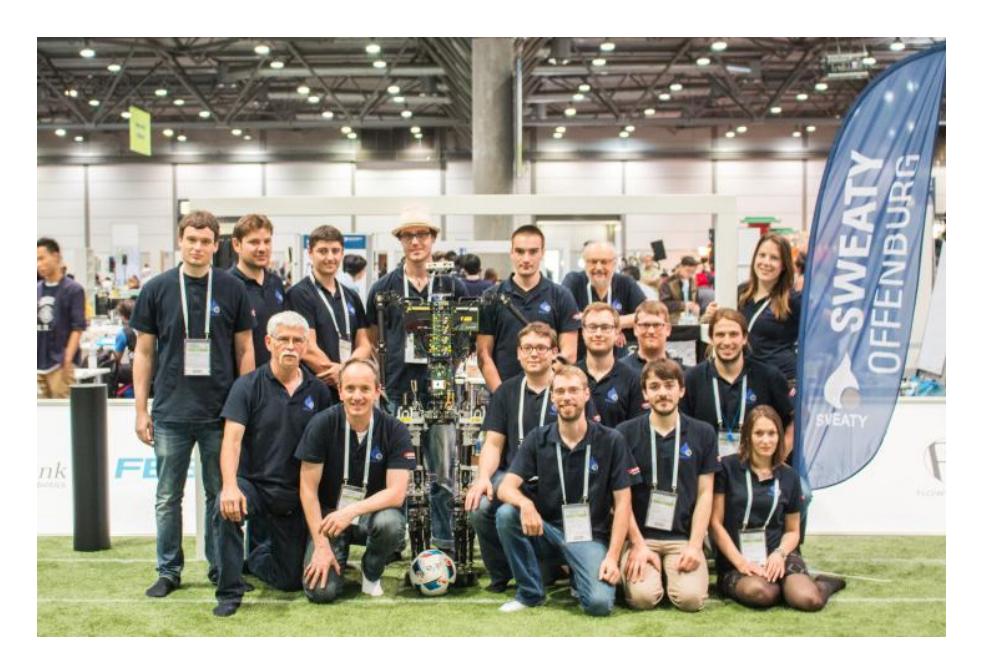
Team Photo
References
- Dorer K: Modeling Human Decision Making using Extended Behavior Networks. Baltes J et al. (Eds.): RoboCup 2009, LNAI 5949, pp. 81-91. Springer, Heidelberg, 2010
- Hochberg U, Dietsche A and Dorer K: Evaporative Cooling of Actuators for Humanoid Robots. In Proceedings of the 8th Workshop on Humanoid Soccer Robots, IEEE-RAS International Conference on Humanoid Robots, Atlanta, October 2013.
- Schickl L, Dorer K, Wülker M, D'Antilio Y, Hochberg U: Development of a Six-Axis Force and Torque Sensor for the Humanoid Robot Sweaty. In Proceedings of the 11th Workshop on Humanoid Soccer Robots, IEEE-RAS International Conference on Humanoid Robots, Cancun, November 2016.
- Kurth M: Steuerung eines simulierten Roboters mit Hilfe von Motion Capturing Files. Bachelor thesis, Hochschule Oenburg, 2011
- Scharenberg M, Hochberg U, Dorer K, Friedrich A, Wülker M (2015) Improving Torque and Speed of Joints by Using Rod-and-Lever Systems for Electrically Driven Humanoid Robots. In Proceedings of the 10th Workshop on Humanoid Soccer Robots, IEEE-RAS International Conference on Humanoid Robots, Seoul, November 2015. http://www.ais.uni-bonn.de/humanoidsoccer/ ws15/papers/HSR_2015_Scharffenberg.pdf
- Schultz G, Mombaur K: Modeling and Optimal Control of Human-Like Running. IEEE/ASME Transactions on Mechatronics, Vol. 15, No. 5 (2010) pp. 782-792.
- Frei W: Design and Development of a New Hip for the Humnaoid Robot Sweaty. Bachelor thesis, Hochschule Oenburg, 2015.
- Mandery C, Terlemez O, Vahrenkamp, N, Asfour T: The KIT whole-body human motion database. International Conference on Advanced Robotics (ICAR) (2015) pp329-336.
- www.maxonmotor.ch
- www.robotis.com
- www.opencv.org
- www.volz-servos.com
- www.tekscan.com
- www.st.com
- www.linear.com/designtools/software/
- www.openbionics.com
- Chao Yuan and Lu-Ping Luo and Quan Yuan and Jing Wu and Rui-Jun Yan and Hyeonguk Kim and Kyoo-Sik Shin and Chang-Soo Han: Development and evaluation of a compact 6-axis force/moment sensor with a serial structure for the humanoid robot foot. Measurement, Vol.70, (2015) pp. 110 - 122.