Tsinghua Hephaestus 2017 AdultSize Team Description
Haitao Wang, Rongge Zhang, Siyuan Yu, Ka Deng, Kaidan Yuan, Guangjun Hei, Yicheng Kang, Xueheng Zhang, Mingguo Zhao
Tsinghua University, Beijing, China
Abstract This document describes both hardware and software specifications and practical functions of the humanoid robot Strider S1, developed by team Tsinghua Hephaestus as a platform for research in bipedal locomotion, robot selflocalization and machine learning in real robotic appication. The robot will also be used to participate in AdultSize competition in Humanoid League of RoboCup 2017, Nagoya.
Introduction
The Tsinghua Hephaestus is a RoboCup Humanoid League team running at Dept. of Automation, Tsinghua University, China, since July 2006. Our current research interest is focused on bipedal locomotion[1][2][3][4], robot self-localization[5][6] , reinforcement learning and model predictive control . The humanoid team had taken part in the RoboCup 2007-2008 both in KidSize and TeenSize. In the RoboCup2008, our TeenSize team got the 2nd place and our KidSize team went into the Round Robin2. Moreover, our TeenSize team got the 3rd place in Robocup 2009 and 2010. From 2011 and on we started to participate in Adultsize. We got the 3rd place in RoboCup2011, 2rd in Robocup2012, 3rd in 2013 and 2014 and 4th in 2016. Now we have been getting prepared for Robotcup 2017 with our new designed Adultsize Humanoid robot Strider S1. We developed an AdultSize humanoid soccer robot (THU-Strider) in RoboCup 2011 to RoboCup 2015. Strider Pro(the 4th place in 2016, Leipzig) is just an upgrade version of THU-Strider, but Strider S1 is a qualitative leap forward. Our goal is to develop a stable and fast walking soccer robot. A gait algorithm based on passive dynamic walking (Virtual Slope Walking) has been adopt for walking gait generation and ZMP based Model Predictive Control is adopted for kicking and path planning. This document will give a general view of the robot.
The Robot Design
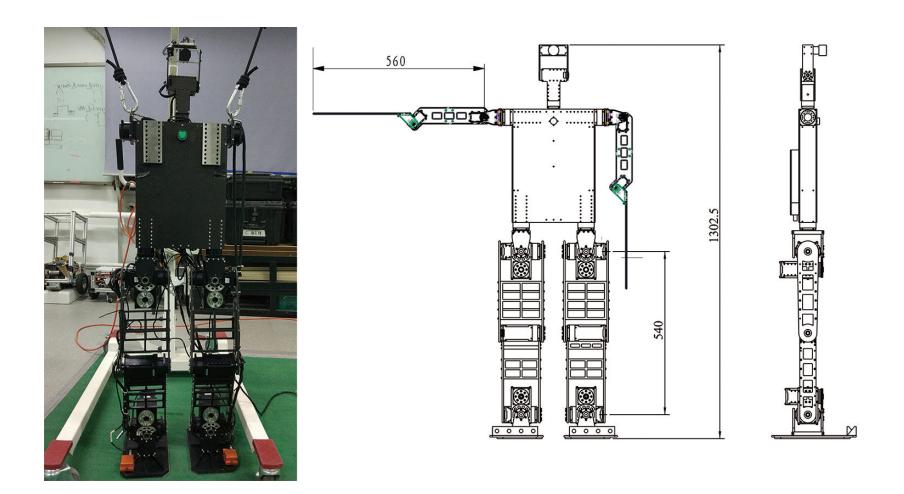
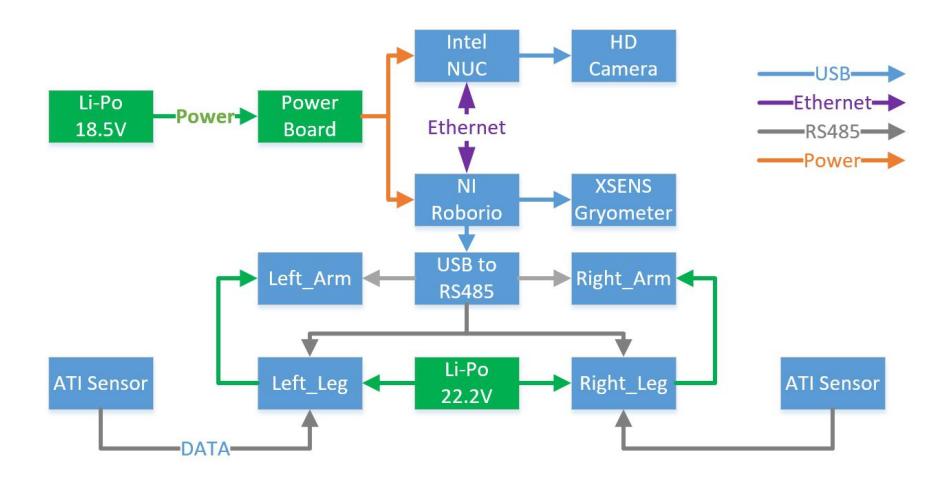
Fig 1-1) shows our Strider S1 robot in practice. The robot has a height of 1300 mm, and weights 34Kg, including batteries. The detailed dimensions are shown in Fig. 1-2). The robot has 20 DOFs: 6 in each leg, 3 in each arm, 2 in the head. For Strider S1, Robotis Dynamixel Pro H54-100-S500-R/H54-200-S500-R high power and accuracy servo motors are used as actuators for legs and 8 Robotis MX106R are used for arms. We use use an Intel NUC as the Main Controller of the robot, with two USB ports, one for the motion-control, another for the gyro and the USB camera. Specifically, an Mti28A83G25 Gyro is mounted on top of the robot head, while a PointGrey USB camera accompanied located in the robot head is employed as our visual sensor. Buttons and LEDs, located on the front, are set to control and indicate the robot state. The motors of upper body and lower body (leg) are connected in series on a RS-485 bus. The details of the control system are shown in Fig. 2.
Software Architecture
The software architecture is developed on Robot-Operating-System(ROS) and the distribution used is ROS Indigo. The whole software system consists of three main modules: Cognition, Behavior and Motion. Each module runs several different nodes in parallel to realize a specific function. Modules are arranged so that they are independent from each other.
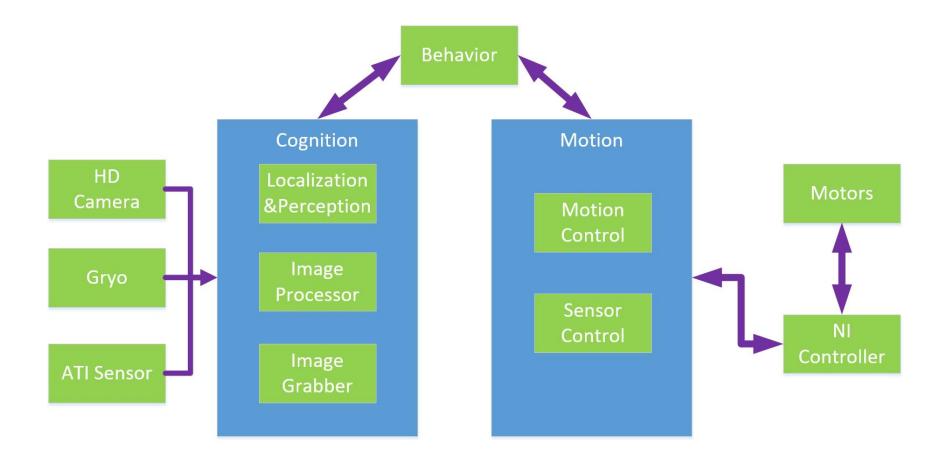
Both Cognition module and Motion module interchange data with "Behavior" through ROS messages or services. Cognition module is responsible for information gathering from both Camera and Gyro, self-localization and perception. Motion module is responsible for gait planning and motor controlling, while "Behavior" acts as the brain of the robot, analyzing the data from Cognition module and sending orders to Motion module. Module configurations and data flows are shown in Fig. 3.
Image Grabber grabs images from the vision sensor and generates related information of the image and the pose of the camera. Image Processor processes the incoming images grabbed by Image Grabber, and yields information needed for Localization and Behavior Control. Localization& Perception implement the Particle Filter localization algorithm, manages position information of robots and the ball, so as to be used by Behavior Control. Behavior controls the game process and makes behavior decisions. Motion Control manages all the actuators of the robot, and controls locomotion or any other actions of the robot according to the requests from Behavior. Sensor Control manages other sensors, and interacts with the Sub-Controller.
Vision
A Point Grey camera is employed as our visual sensor. The Vision module has two tasks: object recognition and relative position estimation. We first map the RGB pixels to 8 color space simultaneously. Then, we resize the original image into a smaller one and use it for the detection of our objects, thus saving computational resources. This procedure takes full advantage of the tools the newly applied ROS middle-ware provides us with.
Object Recognition
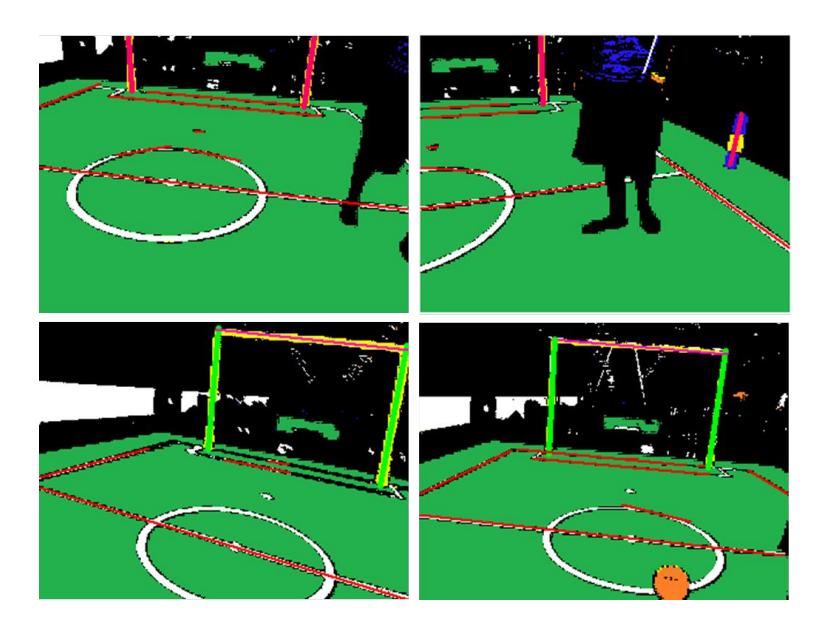
Features, characteristic series of colors or a pattern of colors, are used for object recognition, e.g., a sequence of some white pixels is an indication of a ball. Fig. 4 shows the recognized ball, goal and obstacles in the image.
Ball detector After Color Segmentation, Breath First Search (BFS) is used in order to find candidate regions of the ball. Then for each candidate regions, the convex set of the region is calculated and three points are sampled randomly on its edge. At last, a circle is fitted with these points and the fitting error is evaluated. If the error is less than a certain threshold, this region is accepted as a ball.
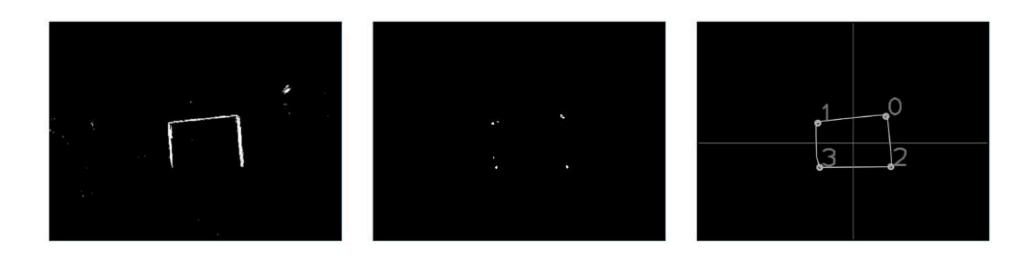
Goal detector Goal is a reasonably large rectangle area with yellow pixels (maybe white this year), whose main character is four corner points. The goal detector first searches all the connected domains in yellow and find the contours of these domains. Those contours in relatively small size will be considered as noise and ignored. Afterwards, convex hull of these contours is calculated, and then, corner points of the hull is calculated using Harris algorithm[8]. Where corner points concentrate in is regarded as the corner of the goal. The result is shown in Fig. 5
Field and Obstacle detector After the field is detected using its characteristic green color and already known shape, we look for black or dark colored objects that interrupt the field pattern and categorize them accordingly, calculating their width and distance.
Field Line detector A square frame with a specific width is the area in which we detect whether white spots exist. Since the penalty spot is isolated, if there is no white spot in a square frame, while its central point is white, this central point will be regarded as one pixel of the penalty spot. The result of penalty spot detector and the information of the boundary line of the field are used in the same time to detect the field line and the method is Hough transformation.The result of recognition is shown in fig. 4.
Localization&Perception
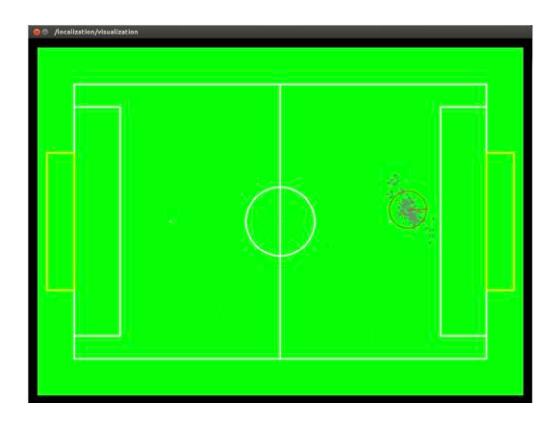
Apparently, in the game, the position of the robot is indispensable in making a proper decision of behaviour control. We implement an algorithm of localization based on Particle Filter (Monte Carlo Localization), using the information through our visual, gyro sensors as well as odometry data from the movement commands given.
One of the key ideas of the algorithm is Bayes Filter. Recursively applying the Bayes formula, P(B|A) = P(B∩A)/P(A) , we can update the belief of each state, i.e. the probability P(A) of the position of the robot, in real time. Therefore, we are able to estimate the position by the method of maximum likelihood.
However, in practice, its impossible to calculate the posterior by an infinite number of parameters, so the alternative idea is to perform an approximation, which is implemented by the particle filter. It uses a finite number of particles to represent concrete instantiations of states in real time, with a positive weight denoting the possibility of the position. In that way, we can approximate the belief of each state recursively by constructing the particle set X^t from the set X^(t-1).
Hence, we can derive the position of the robot effectively from the mean pose of the particles.
Behavior Control
The data provided by the sensors and localization modules is used to plan a more complex behavior series. And the module of Behavior Control takes charge of this task. The main task is separated into subtasks until they can be described as a set of basic behaviors which can be executed by the robot. All this is done by a hierarchical state machine described in XABSL (Extensible Agent Behavior Specification Language). The basic motion actions are transferred to and interpreted by the motion module, while other basic actions are processed in further modules.
It can output the following variables: 1) A motion request of basic behaviors to inform the motion module of the robot's next action. 2) A head motion request of head mode to inform the motion module of the robot's next head action. 3) 3 LED's state. An XABSL behavior specification is comprised by a set of behavior modules called options and a set of different simple actions called basic behaviors. Each option consists of various numbers of states or subordinate options. Each state has two parts of information, decisions and actions. Decisions describe the conditions whether to jump out or stay in the current state according to the input variable, while the actions consist of the outputs such as the basic behaviors, LEDs etc.
Gait Planning
For low level motion control, we implemented legged locomotion for our robot in both passive and active way. A state-machine for gait control is designed for handling switching of different gaits.
Passive Gait
The implementation of passive forward walking is applying Virtual Slope Walking in the sagittal plane with the Lateral Swing Movement for lateral stability[1]. We have achieved a maximum forward walking speed of 0.6m/s on Strider S1. The side-walking and turning are realized by carefully designing the key frames. The entire gait is generated by connecting the key frames with smooth sinusoids.
Active Gait
A ZMP based online motion generation scheme is adopted for kicking gait and small steps motion design and control. Kinematic teaching is used to enable fast, flexible motion generation[9]. Human motion captured from Kinect is modified to ensure the static balance during the robot playback.We further enable the algorithm to run online, with dynamic balance using a hierarchal approach: Firstly use an IP model for pattern generation, then use a full-body model for whole-body motion control.
Gait planning is mainly done by the ROS program running on the NUC. When we get basic motion requests from a higher in hierarchy module, motion is translated into instructions for each joint actuator. Instructions keep being sent out to every motor at 200Hz so as to make robot move as expected.
Conclusion
Our AdultSize robot Strider S1 is a completely autonomous humanoid robot, with 1 camera, 1 gyro and 20 actuators integrated on body, controlled by a NUC directly. In this paper we present the specifications and functions of the Strider S1, as well as some related works on vision, localization, gait planning and control.
Tsinghua Hephaestus commits to participate in RoboCup 2017 in Nagoya and to provide a referee knowledgable of the rules of the Humanoid League.
References
- M. Zhao, J. Zhang, H. Dong, Y. Liu, L. Li and X. Su, Humanoid Robot Gait Generation Based on Limit Cycle Stability, In the proceedings of the RoboCup Symposium 2008., LNAI 5399, pp. 403-413, 2009.
- M. Zhao, H. Dong and N. Zhang, The instantaneous leg extension model of Virtual Slope Walking, IEEE/RSJ International Conference on Intelligent Robots and Systems, pp. 3220-3225, Oct. 2009.
- H. Dong, M. Zhao, J. Zhang andN. Zhang, Hardware design and gait generation of humanoid soccer robot Stepper-3D, Robotics and Autonomous Systems, vol. 57, no. 8, pp. 828-838, 2009.
- H. Dong, M. Zhao and N. Zhang, High-speed and energy-efficient biped locomotion based on Virtual Slope Walking, Autonomous Robots, vol. 30, no. 2, pp. 199-216, Jan. 2011.
- Y. Cai, M. Zhao, Z. Shi and W. Xu, "An Experimental Comparison of Localization Methods in Robocup Four Legged League", Robot, 2007, Vol. 29, No. 2, pp167-170.
- Z. Liu, Z. Shi, M. Zhao and W. Xu, Mobile robots global localization using adaptive dynamic clustered particle filters, IEEE/RSJ International Conference on Intelligent Robots and Systems, pp. 1059-1064, 2007.
- Z. Liu, M. Zhao, Z. Shi and W. Xu, Multi-robot Cooperative Localization through Collaborative Visual Object Tracking, In the proceedings of RoboCup 2007 Symposium, LNAI 5001, pp. 41-52, May. 2008.
- C. Harris and M. Stephens, "A Combined Corner and Edge Detector", Proc. of Fourth Alvey Vision Conference, pp. 147-151, 1988.
- Y. Hou and M. Zhao "Follow My Step: A Framework for Biped Robots to Imitate Human Walking," 2014 IEEE International Conference on Robotics and Biomimetics, pp. 2471-2476, 2014.