HERoEHS, Team Description Paper 2019
Jeakweon Han, Cheon-Yu Park, Yi-Taek Kim, Dongha Yoo, Injoon Min, Dong-Kuk Yoon, Younseal Eum
Hanyang University, 55, Hanyangdaehak-ro, Sangnok-gu, Ansan-si, Gyeonggi-do, Republic of Korea
Abstract This paper describes Team HERoEHS and their humanoid adult size robot 'ALICE'. Team HERoEHS was organized by Jeakweon (JK) Han and Younseal (Sheal) Eum in 2017. HERoEHS built the robot ALICE to participate in the RoboCup. HERoEHS have won two games and lost two games in Robocup2018. Based on those experiences, HERoEHS researchers are now working hard to make ALICE faster, smarter and more stable to participate in Robocup2019. This paper shows how to upgrade the second version.
1 Introduction
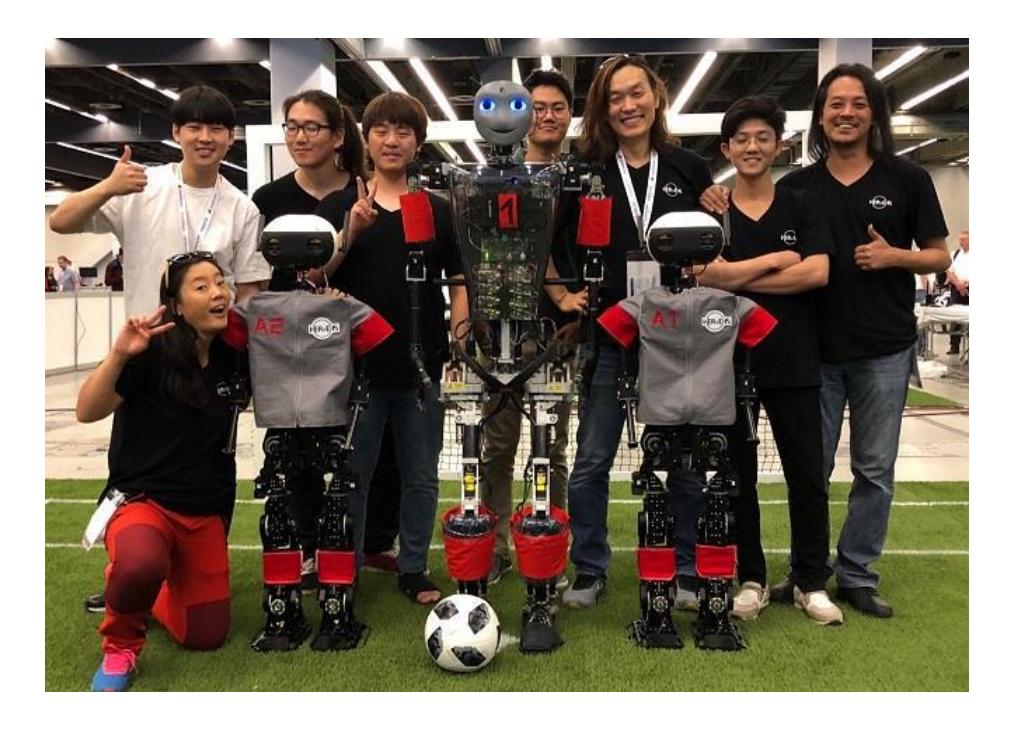
Team Heroes was organized to develop robots contributing to human society by Jeakweon (JK) Han and Younseal (Sheal) Eum in 2017. Jeakweon (JK) Han was a team leader of Team CHARLI that won the Best Humanoid Award at Robocup 2011. Younseal (Sheal) Eum has designed many robots such as CHARLI, Bioloid, DIANA and ALICE. Currently she is studying HRI (Human-Robot Interaction) as a Ph.D student in Hanyang University. Also, the graduate students and researchers of Hanyang University in Shouth Korea have been developing many robots as team HERoEHS members.
Team HERoEHS develop the robot 'ALICE' to participate in the RoboCup for the first time in 2018. HERoEHS won two games and lost two games in Humanoid adult size league for total in 2018. Based on those experiences, HERoEHS researchers are working on developing the second version of ALICE. The second version will be faster, smarter and more stable humanoid robot. In this paper, the weakness of previous ALICE will be discussed, then the upgrading methods will be explained.
2 Designs
2.1 Mechanical Design and its Exterior Design
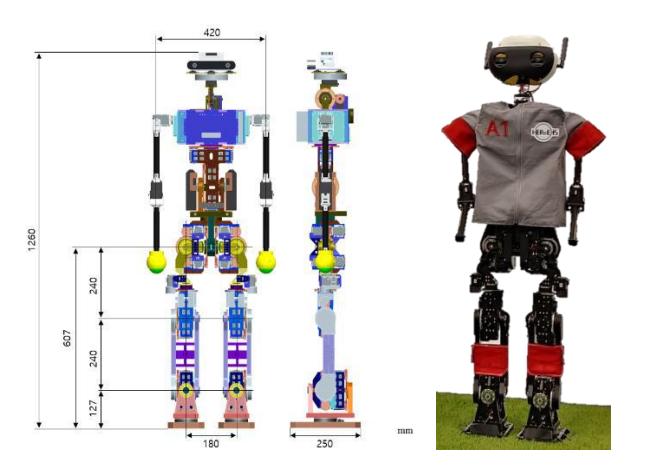
The humanoid robot, ALICE version 1, was born on June 1, 2018. Its mechanical structure follows Robocup rules. She has 12DOF legs, 6DOF arms, and 2DOF head, 20DOF for total. The height is 135 cm, and the weight is 25 kg. Figure 2. shows her 3D CAD design and actual appearance.
She has a 6-axis IMU sensor installed on the pelvis to compensate against disturbances of bipedal walking, and two 6-axis FT sensors of a foot each to measure ZMP. Those sensors make her stable on the grass ground during walking. A stereo camera (ZED) is installed on the head to allow both object recognition and distance measurement at the same time.
The main joint is composed of two pairs of Robotis Dynamixel MX-106, and the two motors are connected to one spur gear for further reduction. This structure is like the structure of CHARLI used in the 2011 RoboCup. It's because that CHARLI's mechanical designer JK Han mechanically designed ALCIE. The robot design also inherited the DNA of the robot CHARLI. This is because Sheal Eum, who designed CHARLI's exterior, designed ALCIE too. She has upgraded to a more robust and stronger design while maintaining the chest curve characteristic of CHARLI. [1]
The walking speed of the first version, however, was too slow to win a game. Its maximum speed without falling in 10m was about 4cm/sec. The reason for the slow walking speed was that the torque of each joint was too week and maximum angular velocity of joint was slow as well. Thus, the second version of ALICE is designed to increase the joint speed and to lose the weight of her upper body. In addition, some aluminum frames will be replaced to carbon fiber frames to lose the weight. The target of the walking speed is 14cm/sec to be able to move 4 m for 30 seconds.
2.2 Electronics
The second version of the electrical system will be almost same to previous ALICE, but the power board is expected to improve. The main concept of the electronics is to use two computers such as NVIDIA TX2 for image recognition and NUC for controls. Both computers use LAN to communicate each other. The power board will be customized to deal with various voltages efficiently. Also, the emergency electronic system will be installed on the power board and the fast battery switching system will be developed to replace batteries in a short period time.
3 Vision
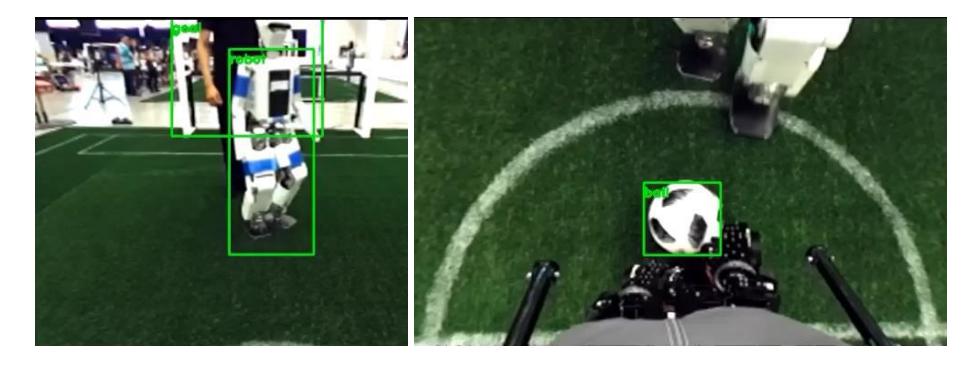
ALICE used CNN (Convolutional Neural Network) for vision recognition, which has recently achieved excellent results in the AI (Artificial Intelligence). CNN seemed to be a good way to distinguish objects that should be recognized in Robocup games, such as balls, goals, and other robots. It worked very well in recognizing objects. Figure 3. shows how ALICE distinguished a ball, a goal, and the other robot.
The data set was made with several thousands of photographs that have balls, goals and robots. Those photos were collected in prior Robocup game videos. The image format must be adapted to Detectnet. The dataset labels were made using the kitti format. The data set consisted of 80% train data and 20% validation data. The accuracy of recognition increased when other labels such as humans, chairs and tables were added. As a result, she can recognize balls, goals and robots with an accuracy of 80% in Robocup2018. This accuracy seemed to be good enough for playing games.
However, the recognition ability itself was limited in finding out exactly where the goal was. This is because CNN recognizes all objects in a box shape. If a robot looks at the goal on the side line, especially near to the corner, the goal looks like a trapezoid. If the trapezoid is recognized as a rectangle, the position error in the center of the goal becomes considerably large. It makes robot's kick inaccurate. Since the error increases as the trapezoid is distorted, the goal should be recognized as a trapezoid rather than a rectangle.
To solve these inaccurate position problems, ALICE version 2 will be using FCN (Fully Convolutional Network). FCN recognizes the object shape itself using segmentation. [2] Thus, the framework will be replaced to the Caffe network that is known as the most suitable one to use FCN.
4 Bipedal Walking
4.1 Framework
The framework to make ALICE walk is basically based on ROS system. Various sensors and devices send and receive data through ROS topic. In addition, behavior control commands were generated in the main algorithm node. [1]
4.2 Walking pattern generation
To move ALICE, a foot patterns need to be generated. The pattern command of a given foot is generated by inverse kinematics and inverse dynamics calculation, and the angle and angular velocity commands of each servomotor are generated. [3] Upper body movements are created by playing motion already stored in a given situation. [1]
4.3 ZMP compensation
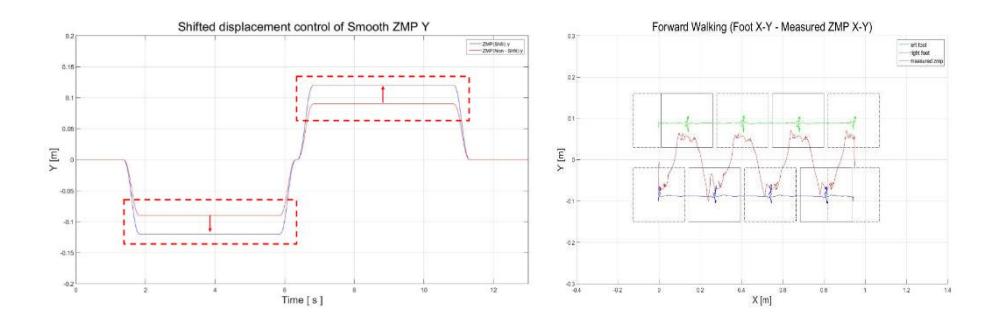
ALICE is using ZMP preview walking method but the square shape ZMP reference curve, which many humanoid robots are using, makes her rapid movement, so she had to suffer from a lack of motor torque. Thus, we changed the reference curve from square shape to the 5th polynomials shapes that can control beginning and final velocities. These smooth reference ZMP curves made ALICE move more naturally but increase instability with the opposite benefit. However, that instability could be compensated using IMU sensors in most cases. The bigger problem was that she was not able to reach the target ZMP position. It makes her fall to inside during a single stance status. Thus, we decide to shift ZMP reference curve to the outside about 30 mm. It made her more stable. Figure 3. shows the modified ZMP reference curve and the measured actual ZMP movement during forward walking.
4.4 Walking Experiment
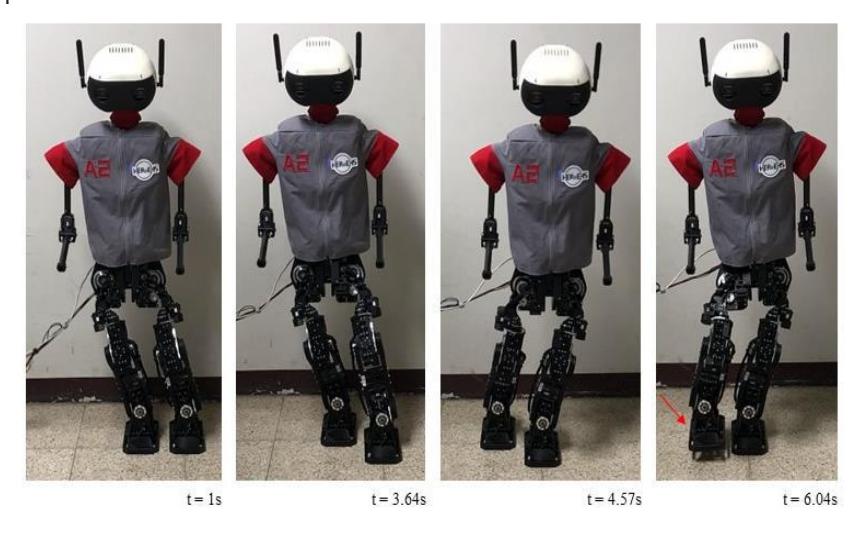
Figure 5. shows ALICE's bipedal walking. Currently, its walking speed is about 4cm/sec without falling in 10m, but it plans to increase up to 14cm/s until Robocup2019.
5 Conclusion
Team HERoEHS had four matches in RoboCup 2018. Through experience of two games win and two games lost, we found that ALICE had many things to improve such as vision recognition, bipedal walking, and localization. Based on this experience, ALICE version 2 is being developed, so the faster, smarter and more stable robot will be developed. We hope that the newly developed technologies will be used in RoboCup 2019 and have a good game with other great teams.
References
- Jeakweon Han et al. 'Robocup2018 humanoid adult size league, HERoEHS Team Description Paper,' Jan. 2018.
- Jonathan Long, Evan Shelhamer, Trevor Darrell, 'Fully Convolutional Networks for Semantic Segmentation,' The IEEE Conference on Computer Vision and Pattern Recognition (CVPR), 2015, pp. 3431-3440
- Kajita, Shuuji et al. 'Introduction to Humanoid Robotics,' Springer Tracts in Advanced Robotics.