The Sweaty 2019 RoboCup Humanoid Adult Size Team Description
Klaus Dorer, Ulrich Hochberg, Michael Wülker
Univ. Appl. Sci. Offenburg, Badstrasse 24, 77652 Offenburg, Germany
https://sweaty.hs-offenburg.de
Abstract Sweaty has already participated four times in RoboCup soccer competitions (Adult Size) and came second three times. While 2016 Sweaty needed a lot of luck to be finalist, 2017 Sweaty was a serious adversary in the preliminary rounds. In 2018 Sweaty showed up in the final with some lack of experience and room for improvements, but not without any chance. This paper describes the intended improvements of the humanoid adult size robot Sweaty in order to qualify for the RoboCup 2019 adult size competition.
1 Introduction
The adult size humanoid robot Sweaty is described in detail in previous team description papers [1], [2], [3].
Sweaty was the tallest of all robots participating in the Humanoid Adult Size League in Montreal, which turned out to be a disadvantage when the robots touch in close actions. Another problem are the wide shoulders, which obstruct the field of vision in case the ball is very close and not right in front of Sweaty. Considerable wear, particularly in some universal joints, caused slackness in the upper body movements. On top of this the motors to move the head add to the uncertainty determining the position of the cameras and the IMU in the head. There is also no rotational degree of freedom of the torso along the body axis. Other mechanical issues are the large number of parts complicating disassembly and assembly, the wear of cables and a structure to place the team markers.
From the computational viewpoint, the PC hardware of Sweaty is no longer available and the old GPU hardware is not supported any more by new versions of the neural network software. The Matlab/Simulink-, Python- and Java-based software modules for the motion, the vision and the decision modules need complex start-up procedures and make maintainance and versioning complicated. The vision module misinterpreted the head of white robots with dark eyes as the ball. In addition the white balance of the cameras is not very well controlled. The decision module did not always deal well with the play near the side lines and close to the sides of a goal.
2 Vision
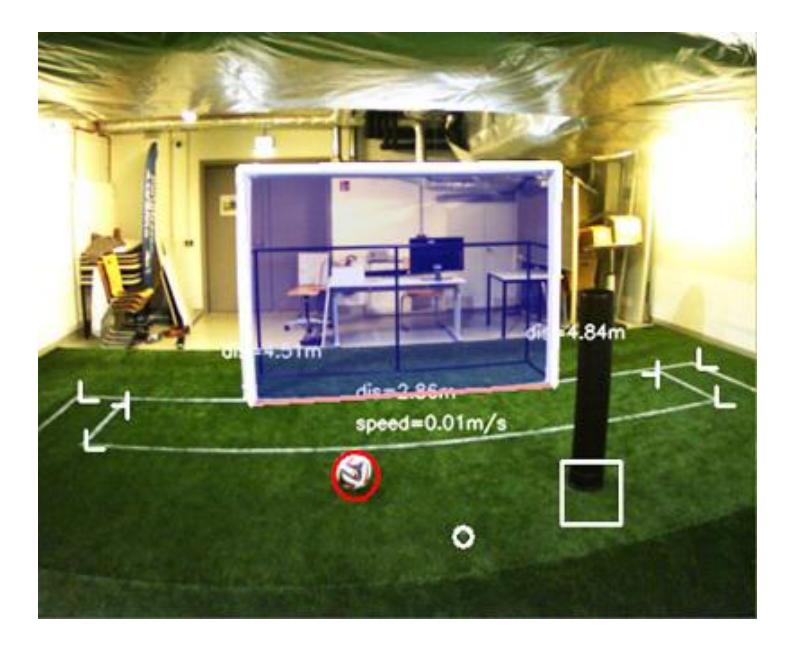
The Vision module is still based on the same single Fully Convolutional Neural Network we used last year [1], [6]. We intend to further improve the detection of opponents and implement detection of teamcolor and playernumber. For the detection of opponents the use of both cameras of Sweaty would allow to get depth information, particularly in close vicinity. This requires very careful calibration, intrinsically as well as extrinsically. A new calibration setup has been installed sofar and needs to be put into operation. Furthermore the related software and parameter files need to be organized more systematically.
Since the field of play will be bigger, it needs to be investigated, how well the vision systems scales. There might be the need to increase the image size and related performance issues need to be determined. Another problem is, that a larger field of play does not fit the local premisses.
3 Software
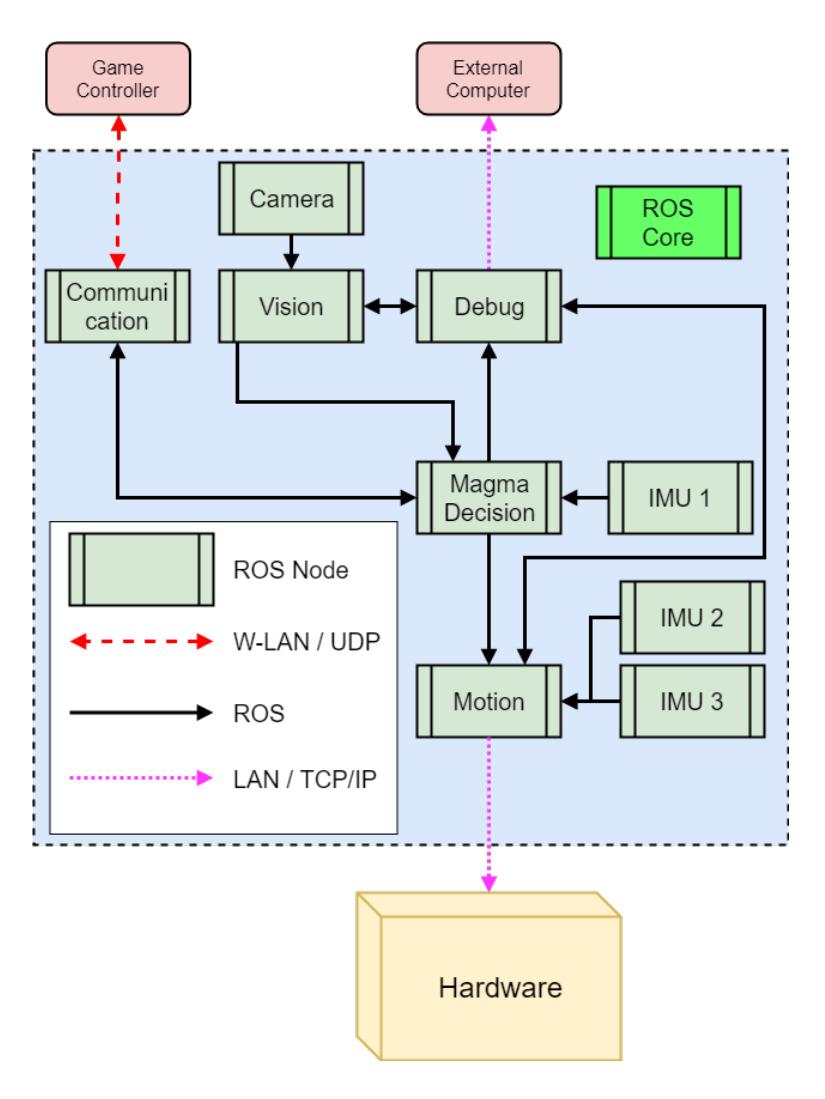
The structure of the software will be changed dramatically. One of the biggest weaknesses were the poor logging and debugging possibilities: One of the reasons why we lost the final in 2018 was discovered not earlier than one month after the final game. Therefore it was decided to reorganize the software structure of Sweaty. We are now going to use ROS for the communication between the different programs as well as for logging.
The new structure is visualized in Fig. 2. The main advantage we can take is the option of ROS to easily log and replay the overall communication via the rosbag package (not shown in Fig. 2 for convenience). Logging has been possible with our existing software, but the different logging channels have not been synchronized in a timely manner. The main routines will basically not be modified, but ROS nodes will be integrated in those routines. The camera and the IMUs are shipped with ROS software, so this equipment can be easily integrated. Other architectural nodes have to get new software.
Communication
In order to also have the game controller information in the rosbags, a specialized ROS adapter for the game controller communication is currently developed to run this communication inside a ROS node.
Sweaty Vision
This node will distribute detected objects in ROS messages, to which the decision and debug nodes will subscribe to.
Sweaty Debug
This software provides a webserver, where external computers can easily hook on and visualize information available in ROS. This information can be heat maps provided by Sweaty Vision, information concerning the decisions of Sweaty provided by Magma Decision or even detailed information of Sweaty's hardware like coil temperatures of the motors provided by Sweaty Motion. This webserver also provides and interface to change configurations during runtime in Sweaty Vision (e.g. for the calibration of the camera), in Magma Decision (e.g. to trigger different strategies or behaviours) and in Sweaty Motion (e.g. parameters to adopt the gait to the actual turf).
Magma Decision
This package includes the artificial intelligence of Sweaty, the world and robot modeling and high level decision making.
Sweaty Motion
Sweaty Motion is a code-generated Matlab/Simulink program to read the sensors of Sweaty, which are developed by us (like the force and torque sensors [5]) and to control Sweaty's actuators. As the control of the actuators needs to be in hard real time with short cycle time, the control signals will not be transferred via ROS.
Sweaty Hardware
Sweaty hardware includes the communication controller, developed by us, as well as the actuators and sensors, which are connected to the communication controller via CAN and RS485.
4 Hardware
4.1 Sweaty's Appearance
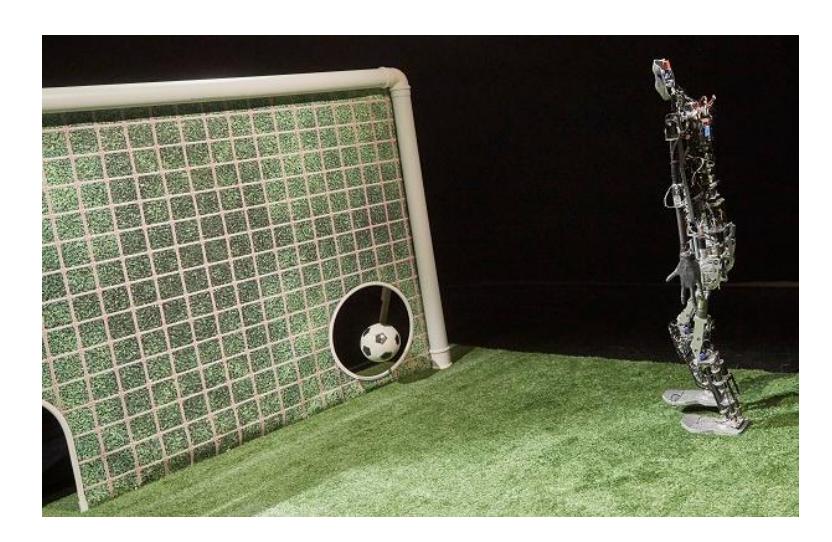
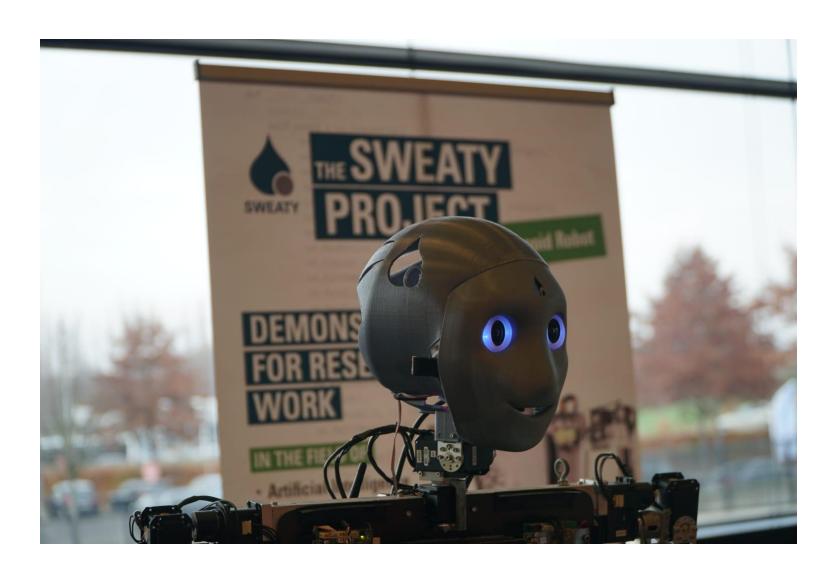
Sweaty's appearance was poor Fig.3. It looked rather like a scarecrow than a humanoid robot. The team markers had to be fixed provisionally during the competition. We intend to give it a more robot-like appearance. We started with the design of the back of the head, which we think already looks attractive Fig.4.
4.2 Position Sensors and Motor Controllers
The compliance of Sweaty's joints is actually realized in the motor controllers by manipulating the stiffness [4]. We need to have better knowledge of the joint speeds to be able improve the compliance. Therefore we intend to install additional sensors to read the position and the speed of the joints. The actual maximum frequency for their the update 200 Hz, we want to increase this figure to at least 2000 Hz.
4.3 Cardan Joints
The clearance of Sweaty's cardan joints increases with time, the mechanical stress during a kick is quite high and the jerk is tremendous. This is even worse in case Sweaty misses the ball. We will replace the joints by stronger ones, which has an impact on the overall mechanical design as they are larger and heavier.
4.4 Force and Torque Sensors
The force and torque sensors [5] have poor performance during a kick. The motors have an internal inductivity of less than 50 µH and the current is about 40 A. The requirements concerning EMC are therefore quite high, as we almost have hard switching conditions. Therefore we have to redesign the electric circuitry of our force and torque sensors.
5 Team Members
Beside the team members mentioned as authors, scientists, employees and students of the University of Applied Sciences are involved in this project. They are in alphabetic order: D. Curticapean, A. Friedrich, T. Friedrich, M. Giessler, S. Glaser, B. Heitz, S. Hirtes, D. Kindler, R. Kirn, S. Lutz-Vogt, N. Jahn, R. Koger, D. Maehl, V. Neumann, M. Niederhofer, M. Scharffenberg, D. Schätzle, L. Schickl, R. Schillings, S. Schmidt, and F. Schnekenburger.
6 Formals
Referee: According to the rules our team will make a person with sufficient knowledge of the rules available as a referee.
Previous Achievements: Sweaty II came 2nd place at RoboCup 2016, 2017 and 2018. Sweaty I participated in the RoboCup 2014 Humanoid AdultSize League reaching 5th place.
Use of Software: The software for decision making, modeling the environment and some tools are used from our own 3D soccer simulation team magmaOffenburg. Sweaty Vision is based on Pytorch, Sweaty Motion on Matlab/SIMULINK and Sweaty Decision on Java. The software framework is ROS.
Use of Hardware: We thank maxon motor GmbH, Becker & Müller GmbH and Hobart GmbH for their sponsorship.
References
- Akbas, M.S., Burkhart, M., Dorer, K., Friedrich, A., Higel, L., Hochberg, U., Jahn, N.M., Kirn, R., Niederhofer, M., Sattler, M., Scharffenberg, M., Schickl, L., Schillings, R., Schmidt, S., Schnekenburger, F., Wlker, M.: The Sweaty 2018 RoboCup Humanoid Adult Size Team Description. Humanoid League Team Descriptions, RoboCup 2018, Montreal (Jun 2018)
- Dietsche, A., Dorer, K., Fehrenbach, M., Frei, W., Friedrich, A., Frtsch, K., Glaser, S., Hochberg, U., Jahn, N.M., Kirn, R., Koger, R., Nguyen, D., Niederhofer, M., Scharffenberg, M., Schickl, L., Schnekenburger, F., Tankeu, U., Tropmann, I., Weiler, D., Wlker, M., Zakaroshvili, A.: The Sweaty 2016 RoboCup Humanoid Adult Size Team Description. Humanoid League Team Descriptions, RoboCup 2016, Leipzig (Jul 2016)
- Dietsche, A., Dorer, K., Friedrich, A., Fuchs, F., Frtsch, K., Glaser, S., Hochberg, U., Jahn, N.M., Kirn, R., Koger, R., Niederhofer, M., Scharffenberg, M., Schickl, L., Schillings, R., Schnekenburger, F., Tropmann, I., Wlker, M.: The Sweaty 2017 RoboCup Humanoid Adult Size Team Description. Humanoid League Team Descriptions, RoboCup 2017, Nagoya (Jul 2017)
- Scharffenberg, M., Schnekenburger, F., Wlker, M., Hochberg, U., Dorer, K., Jahn, N.M.: A New Motor Controller for Overloading BLDC-Motors of Low Inductivity, Lightweight and Ready for Admittance and Impedance Model Predictive Control. Proceedings of the 12th Workshop on Humanoid Soccer Robots, 17th IEEE-RAS International Conference on Humanoid Robots, Birmingham (Nov 2017)
- Schickl, L., Dorer, K., Wlker, M., D'Antilio, Y., Hochberg, U.: Development of a Six-Axis Force and Torque Sensor for the Humanoid Robot Sweaty 2.0. Proceedings of the 11th Workshop on Humanoid Soccer Robots, IEEE-RAS International Conference on Humanoid Robots, Cancun (Nov 2016)
- Schnekenburger, F., Scharffenberg, M., Wlker, M., Hochberg, U., Dorer, K.: Detection and Localization of Features on a Soccer Field with Feedforward Fully Convolutional Neural Networks (FCNN) for the Adult-Size Humanoid Robot Sweaty. Proceedings of the 12th Workshop on Humanoid Soccer Robots, 17th IEEE-RAS International Conference on Humanoid Robots, Birmingham (Nov 2017)