PIONEROS MEXICO Team Description Paper ROBOCUP 2009 Graz, Austria
Adrián Torres Navarrete, Roberto Carlos Ramírez Márquez, Gerardo Ithiel Morales Vázquez, Luis Alfonso Tornero Romo, Efraín Hernández Franco, Luis Fernando Espitia Orozco, Javier Herrera Padilla, Jonathan Alcántar Márquez
Universidad Panamericana Campus Guadalajara.
http://www.up.mx · http://www.pionerosmexico.org
Abstract Here we describe the design and realization of humanoid robots designed and manufactured by students that plays soccer, able to make several tasks, as walking, identifies objects like a soccer ball and approaches to it and kicks it. Also there will be described not only its primary functions, but all the constraints presented along and characteristics of our design like sizes, components, specifications and design of the structure and electronic system. Because we are presenting two robots, we use two different program codes, one for the player and the other for the goal keeper and second player. This could be the third time we participated in this League and we are presenting a totally new design.
1 Introduction
From the beginnings of robotic men had been trying to emulate the movements of human beings. The actual challenge of robotic is to equal the mobility of the human beings, making movements of great complexity and precision. With this project we pretend to develop prosthesis with the objective and possibility that an invalid person could walk again and recover great part of mobility.
Because of the necessity of automation, technology and control have been developed because a lot of tasks or processes are performed via robots, replacing men and keeping always the simplest and most comfortable way to do things, many ideas can be achieved thanks to these machines.
As robots are flexible enough to develop many or specific challenges, it's design, manufacturing and testing are important points to take care of.
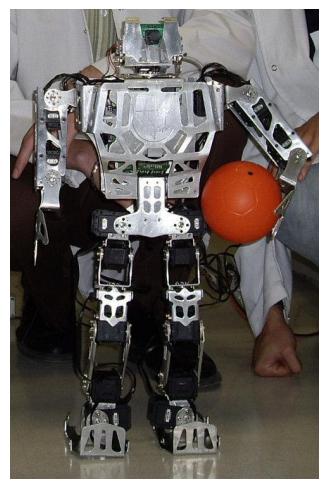
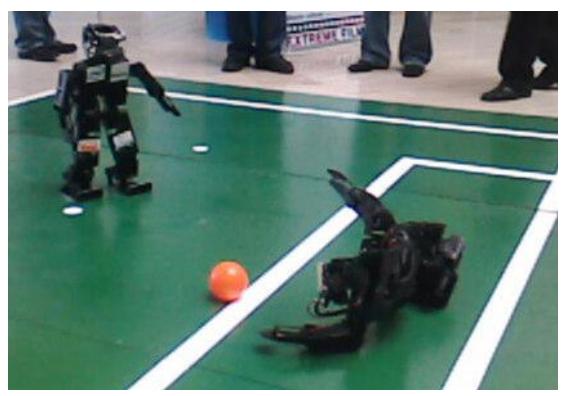
2 Images Of The Robots.
[Images and demonstrations of the robots.]
3 Mechanical Design
Our robots are build with CAD designed custom-made aluminium parts, powered by Dynamixel [1], Hitec [2] and FUTABA [3] servomotors. Each robot has twenty one degrees of freedom:
Head: 2 servomotors, therefore we have 2 (DOF).
Arm: 3 servomotors in each arm, therefore we have 6 (DOF).
Waist: 1 servomotor, therefore we have 1 (DOF).
Ingle: 3 servomotors, therefore we have 6 (DOF).
Knee: 1 servomotor in each knee, therefore we have 2 (DOF).
Ankle: 2 servomotors in each ankle, therefore we have 4 (DOF).
For Hero 1 and Hero 2 robots we used the FUTABA S3003 with a torque of 3kg-cm and the second one is a HITEC HSR-5995TG_Schematic_Front with a torque of 24 kg-cm, both with a speed of 60°/0.19 sec.
We decide to use the HITEC HSR-5995TG_Schematic_Front with24 kg-cm of torque in the lowest part of the robot, because is where he needs more force to walk, kick and stand up in case of falling.
By the opposite we use the FUTABA S3003 with a torque of 3kg-cm in the upper part of the robot.
For Turco we used Dynamixel RX64 in the lower part of the body and the Dynamixel RX10 for the upper part of the robot, this for the same reasons explained above.
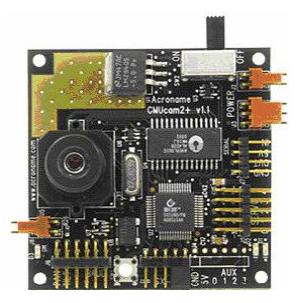
The servomotors in the head are controlled directly by the CMUcam2 [2] this allowed us to track objects independently of the movement of the arms or legs.
We are developing the movement sequence with quaternion manipulation, and our goal is that the robot compute it's gravity center using this method.
4 Electronic Specifications
Electronic system specifications and control architecture.
4.1 Control system
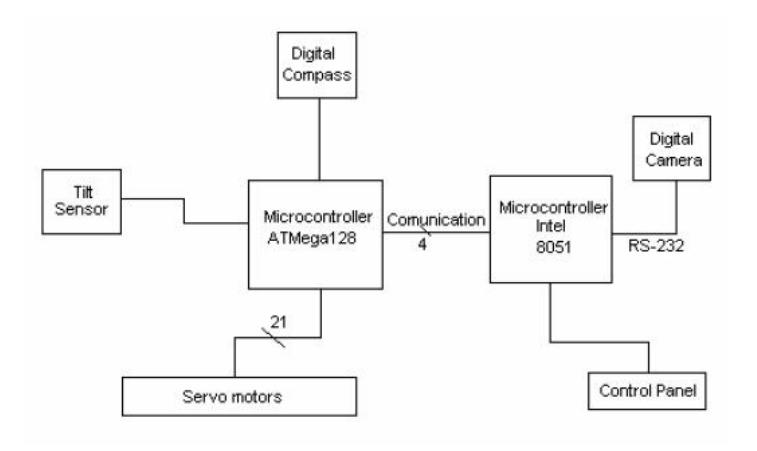
The control system of the Hero 1 and Hero 2 robots is composed by two microcontrollers with several sensors connected, that way the necessary information to assure the correct operation is provided, As shown in Fig.4.1. The brain is a microcontroller ATMega128 that store in memory all the algorithms necessary for the movements in a soccer game, like walk, turn, kick the ball, stand up and others.
An 8051 family microcontroller works independent with the digital camera that send via serial all the information of an image in front of the robot, this image is analyzed in order to find the ball and the different goals. We choose this element because of his low price, easy programming and because of the four ports of 8 bits of entrance and exits for handling data. The program code was made in assembler language in order to reduce the memory space in each microcontroller.
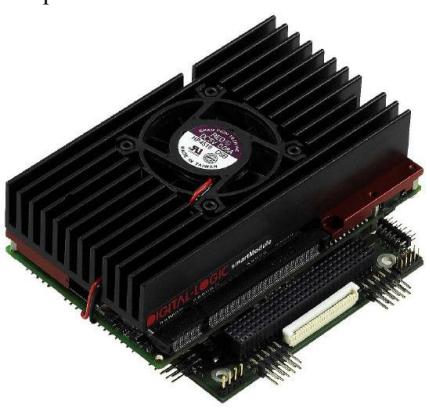
Turco is controlled by a smartModule855 PC [4], see Fig.4.2. with a Windows Xp® embedded operative system, designed specifically for this application.
The features of the smartModule 855 are:
- Powerful PENTIUM-M of 1.6GHz
- BIOS ROM
- DDRAM 128-1024MByte SODIMM 200pin
- 1024/2048kByte second level cache
- Timers
- DMA
- Real-time clock with CMOS-RAM and 10 year battery buffer
- LPT1 parallel port
4.2 Camera system
The main sensor placed on the robot's head is the camera CMUcam2 [5] and it consists of a SX52 microcontroller interfaced with an OV7620 Omnivision CMOS camera on a chip that allows simple high level data to be extracted from the camera's streaming video, see Fig. 4.3. The board communicates via a RS-232 or a TTL serial port and has the following functionality:
- Track user defined color blobs at up to 50 Frames Per Second
- Track motion using frame differencing at 26 Frames Per Second
- Find the centroid of any tracking data
- Gather mean color and variance data
- Gather a 28 bin histogram of each color channel
- Transfer a real-time binary bitmap of the tracked pixels in an image
4.3 Digital compass
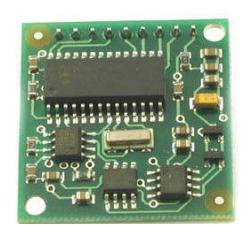
We also are using a Digital compass that provides information about the orientation of the robot, so it can know at all time were the opposite goal is in a soccer game 2 vs 2; we are using the Devantech R117-Compass [6] designed by "Robot Electronics" specifically for use in robots to aid navigation, see Fig.4.4.
5 Conclusions
In our last participation in the tournament, Robocup 2007, we realized that we could improve mechanical, electronic and control features. The result of those improvements is Turco. We began its development in 2007, and we are ready to achieve in Graz a better result.
This project made us realize the great complexity of the human nature, not only in its body, but also in its behavior. Trying to emulate a human person has been a great challenge. We gain experience in many science fields like: mathematics, electronics, control and mechanics. It let us discover our different capabilities as well as our weaknesses.
The teamwork is our better strength because we had a lot of problems along the project that we had to solve sometimes briefly, and the way we solved them, which we consider the best one, was the teamwork, since although we were divided in three parts; control system, electronics and mechanics; we helped each other in difficult situations and we never forgot that we were a team. This is not an easy project and it demands many time and sacrifice.
It also help us to understand more about development of prothesis and the advantages that this offers to does people that need to recover their movements. A very important thing is the fact that we received complete support from our University, part of the budget was supported by them and other resources like electronics and tool labs, computers, software. Another part of the budget was support by the members of the team and some sponsors. It was a really good thing counting with their help all this time, and we are very thankful of.
References
- Dynamixel servomotors, http://www.robotis.com/
- Hitec servomotors, http://www.robotshop.us/hitec-hsr-8498hb-robot-servo.html
- FUTABA servo motors, http://www.futaba-rc.com/
- smartModule855, http://www.digitallogic.com/index.php
- CMUCam2 vision sysytem, http://www.cmucam.org/
- Compass, http://www.acroname.com/robotics/parts/R117-COMPASS.html
- Diseño en ingeniería mecánica / Joseph Edward Shigley
- Electrónica : teoría de circuitos y dispositivos electrónicos / Robert L. Boylestad, Louis Nashelsky
- Mecanismos y dinámica de maquinaria / Hamilton H. Mabie, Charles F. Reinholtz
- CMUcam2 User manual
- Humanoid League Rules 2009