Team Description 2009 for Team RO-PE
Chee-Meng Chew, Bo Tian, Bingquan Shen, Junwen Fong, Renjun Li, Wenhao Loh, Yuanwei Chua
National University of Singapore, 119260 Singapore
http://guppy.mpe.nus.edu.sg/legged-group
Abstract This paper presents a brief description on one of the series of humanoid robots, RO-PE-VI. It was developed by the RO-PE research team from the Legged Locomotion Group of the National University of Singapore. Technical details on its design as well as the hardware and software implementation are included. In addition, comparisons with previous generations of robots are made to highlight the various improvements in RO-PE-VI.
1 Introduction
RO-PE (RObot for Personal Entertainment) is an ongoing humanoid robot project that is researched by the Legged Locomotion Group (LLG) from the Control & Mechatronics Lab (COME Lab) of National University of Singapore (NUS). In tandem with the growing interest in humanoids amongst the robotics research community in recent years, this project was initiated in 2001 with the aim of building a series of small humanoid robots (RO-PE-I through RO-PE-VI) which acts as a test bed for research in bipedal walking and artificial intelligence. Results of our RO-PE research team have thus far been highly encouraging. In 2004, RO-PE-II made its maiden appearance in the RoboCup humanoid league. It was ranked 5th overall and 2nd in the H80 Category among 13 participating teams. In RoboCup 2005,we were ranked 2nd in the Penalty kick event and overall 3rd in the kid size category. Last year and the year before, RO-PE was ranked overall 4th, and we will also be participating in the coming RoboCup 2009 competition. Much effort has been spent on improving the system, in terms of its mechanical structure as well as its intelligence. With each generation of robot exhibiting greater dexterity and intelligence, RO-PE is set to break new grounds and set its own new high in this year's competition.
2 Specifications Of RO-PE-VI
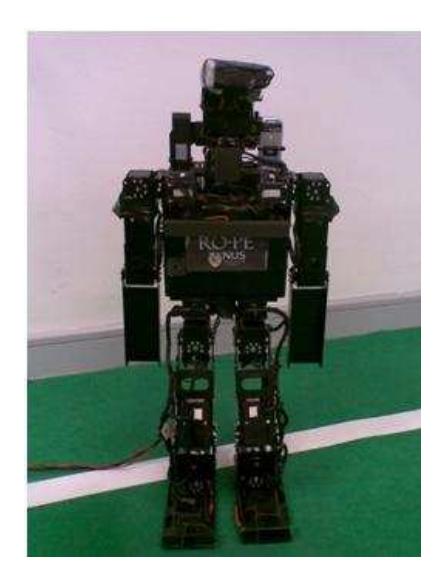
RO-PE-VI is a fully autonomous humanoid with 19 degrees of freedom. Like many other robots [1]-[2], it has six degrees of freedom on each leg. Anything less than that would deny the robot from achieving some basic human actions [3]. It weighs 3.5kg and has a physical height of 57cm. The main structure of RO-PE-VI consists of mainly aluminium alloy, and its actuators are manufactured by Robotis. This year, RO-PE V will be de-commissioned and replaced by RO-PE VI. The older version of DX-117 will be replaced by RX-28 with enhanced mounting structure, stronger gear tolerance and thrust bearing.Fig. 1 shows RO-PE-VI in its standing position.
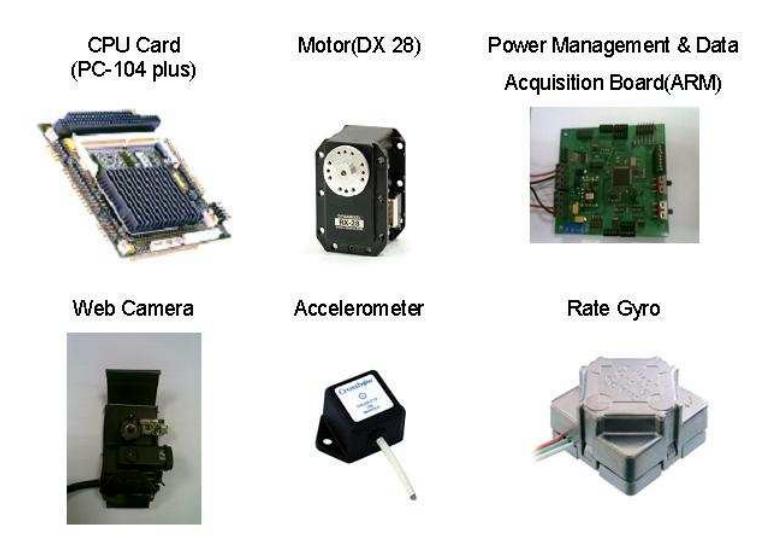
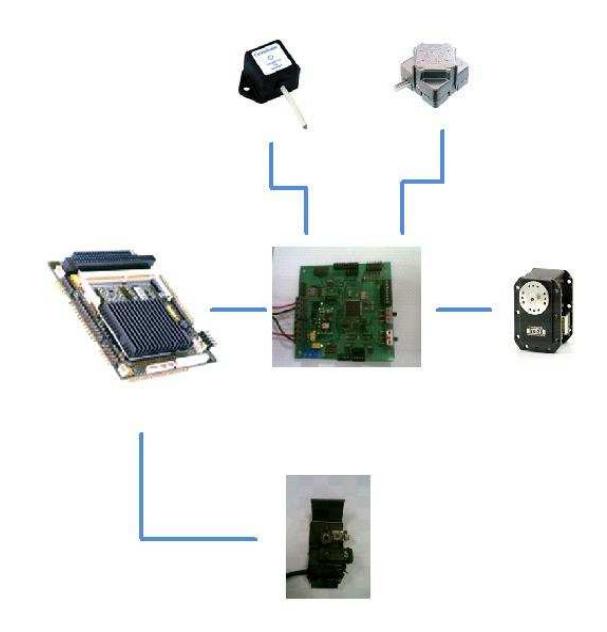
For a robot to be fully autonomous, sensors as well as processing unit are required in order to identify the surroundings and to process the information. The main processing unit is the PC-104 Plus and the sensors that are attached to it are the web camera, the rate gyro and the accelerometer. The web camera is attached to a Pan and Tilt system and is in compliance with the rule where the field of view of the camera sensor has to be lesser than 180 degrees. The DAQ board that was used previously was replaced by the ARM board, with integrated accelerometer. Fig. 2 shows the components on RO-PE-VI while Fig. 3 shows the connections between these components.
3 Research Through RO-PE-VI
RO-PE-VI is a humanoid built by the LLG as a platform for research on multiple areas. These areas include mechanical design, machine vision, walking gaits generation and motor control.
3.1 Walking Gait Generation
In order to develop a fast and stable walking gait, the Zero Moment Point (ZMP) theory is used as a basic criterion to examine the stability of the robot motion. A model of linear inverted pendulum model is used as a trajectory generator. The trajectory generator will take in the step length for next step as the input, and output the hip and ankle trajectory to the robot. The movement of each individual servo is calculated based on inverse kinematics. Information from rate gyro and accelerometer is used to correct the motion.
3.2 Machine Vision
The primary vision system that RO-PE-VI will be using this year is the Pan and Tilt system. This is different from the two camera system that was used during the competition last year, where the tilt servo is not utilized. In order to implement this new camera system, considerable efforts were spent in controlling the new pan and tilt system. In addition, a web camera of higher resolution is used with the aim of achieving better object recognition at longer range.
3.3 Finite State Machine
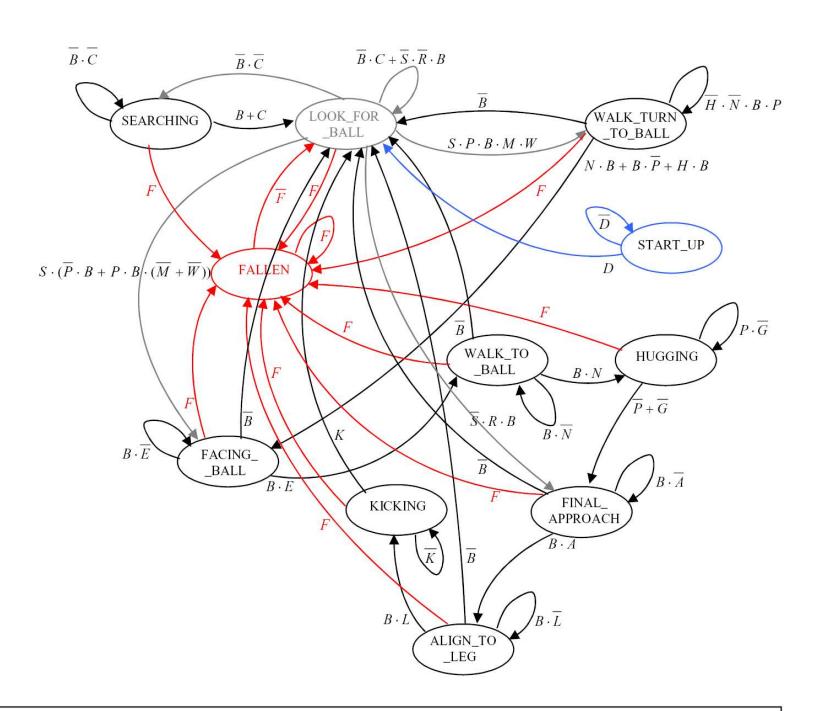
During competitions, ROPE VI frequently went into deadlocks and had to to removed from the field for resetting. To improve the decision making system, we implemented a finite state machine(FSM) system. FSMs have high degree of predictability. Given a set of inputs and a known current state, the state transition can be predicted, allowing for easy testing. This helps programmers to debug new functions more effectively. The structure of FSMs makes further expansion of the current program easier as the programmer only needs to declare a new state and add in the state transitions later. Furthermore, FSMs can be represented easily with the use of state transition diagrams, aiding new developers in the understanding of the flow of program. Fig 3 shows the state transition diagram of ROPE VI.
Fig. 4. Finite State Machine.
| Condition | Description | Condition | Description |
|---|---|---|---|
| A | True if $pMsg \rightarrow ballX \ge X_BENT$ | L | True if ball is aligned to leg |
| В | True if ball found | N | True if pMsg → ballR < R_UPRIGHT |
| C | True if ROPE is at the centre of the field | M | True if ball distance required for WALKTURN_TO_BALL Is satisfied |
| D | True if dip switch is down | P | True if goal found |
| E | True if ROPE is facing the ball | R | True if ball is in the region required for FINAL_APPROACH |
| F | True if ROPE has fallen | S | True if ROPE's body is straight |
| G | True if ROPE is facing the goal | W | True if angle required for WALKTURN_TO_BALL is satisfied |
| Н | True if ball is in between ROPE and goal and that all 3 are collinear | ||
| K | True if kick is complete |
4 Conclusion
Significant improvements are made in the latest generation robot of the RO-PE series. These include the Pan and Tilt camera system as well as a new Walking gait method. In addition, the programs that are used for calibrating the vision as well as the motion are improved in order to perform the operation more efficiently. The reduction in time consumption on these activities will allow for more focused and in-depth research and development in other more important aspects of humanoid engineering.
References
- K. Hirai, M. Hirose, Y. Nakamura, and T. Takenaka: "The Development of Honda Humanoid Robot," in Proc. IEEE Int. Conf. Robotics and Automation, 1998, pp. 1321-1326.
- T. Ishida, Y. Kuroki and J. Yamaguchi: "Mechanical Systems of a Small Biped Entertainment Robot," in Proc. IEEE Int. Conf. Intelligent Robots and Systems, 2003, pp. 1129-1134.
- L.S. Tay: "Design and Fabrication of a 3D Bipedal Robot," B. Eng. Thesis, National University of Singapore, Singapore, 2003.
- R.Benosman, S.B.Kang, "Panoramic Vision: Sensors, Theory and Applications", Springer, 2001.