SItiK KIT
Kazuma Hosokawa, Kenji Ishida, Yusuke Okuda, Shuji Ichikawa, Hidenari Kobayasi, Shohei Takesako, Yasuki Asano, Kosei Demura
Factory for Dreams and Ideas. Kanazawa Institute of Technology 7-1 Ohgigaoka, Nonoichi, Ishikawa 921-8501, Japan; Department of Robotics, Kanazawa Institute of Technology 7-1 Ohgigaoka, Nonoichi, Ishikawa 921-8501, Japan
Abstract This paper describes a hardware and software system on the KidSize humanoid robots of the team SItiK in RoboCup 2009. These robots are about 60cm tall and 5kg in weight, and equipped directional cameras, 3D motion sensors, tiny laptop computers (SONY, VAIO Type U), and have 20 DOFs. These big and heavy robots are designed and made by ourselves that can perform a physically strong play. The robot can walk twice faster and kick a shoot three times stronger compared with our old robots.
1 Introduction
Kanazawa Institute of Technology, KIT, established Yumekobo to encourage students to create things and make character building in 1993 [1]. The most important activity of Yumekobo is to support student projects called Yumekobo Projects whose purpose is to improve technology and teamwork. During actives in Yumekobo projects, students experience the process of creating things, i.e., planning, investigating, designing, manufacturing, analyzing, and evaluating. In addition, they learn how to organize and managing their projects. Yumekobo is not only a place for learning knowledge and new skills, but also for character building, A student develops a good character which includes independence, creativity, ethical behavior, teamwork, and international awareness.
The WinKIT team which is one of the Yumekobo projects has been participating in the RoboCup Middle-Size League (MSL) since 1999. The team has experienced a lot, especially, robot vision and self-localization. Finally, it showed some good results in MSL. After that, the Yumekobo project decided to participate in the Humanoid League.
The team name, SItiK, comes from "Stand Impact" and our university name, "KIT". "Stand Impact" is the coinage that means the following; the first means that clashes with each member's identities, and the second means that gives big impacts like anyone are stand up or stop to walk.
RoboCup Japan Open 2007 was our first participation, when our team name was "demura.net". The vision system was developed based on our MSL team. The vision system needs high performance computer, thus the robot equipped a tiny laptop computer, VAIO type U, as a main processing system. The performance of the robot improved compared with the robot in 2007, because we improved a vision system, a walking control, and a motion control every day. As the result, we achieved the third place in the Japan Open 2008. Therefore, we aim to win the first round robin games of RoboCup 2009 in Graz.
2 Hardware
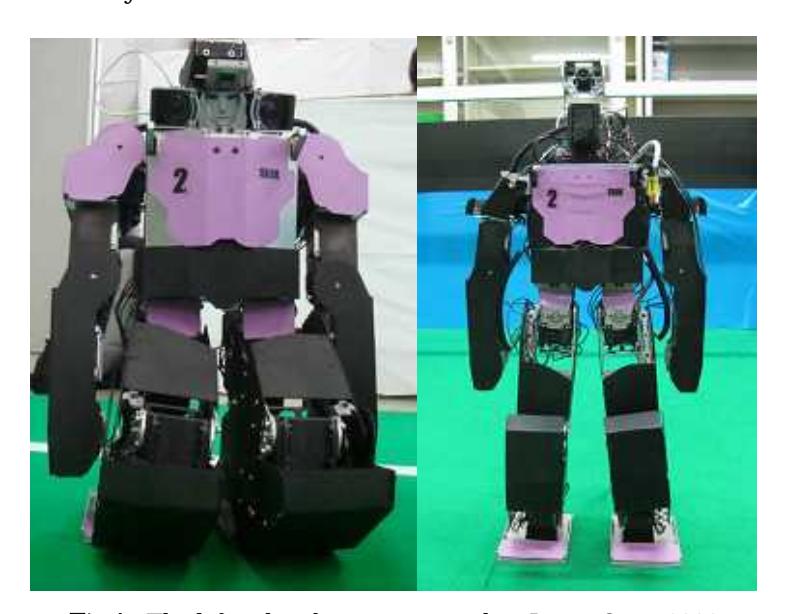
Table 1 shows specifications of our robots and Fig 1 shows two robots that the left side robot was participated in Japan Open 2008 Numazu, and the right side robot is the new generation for RoboCup 2009. These robots are designed and developed by students. The characteristics of the new generation robot are lightweight and safety compared with the old generation. We changed batteries from lithium polymer to Lithium Ferrite sulfide for safety reason.
Table 1. Specifications
| Type 2008 | Type 2009 | |
|---|---|---|
| Height [cm] | 59.5 | 59.5 |
| Weight [kg] | 5.5 | 5.0 |
| Walking Speed [m/s] | 0.10 | 0.22 |
| Actuator: | Robotis, Dynamixel | |
| RX-64 RX-28 |
||
| Torque [kg-cm] | 77.2 | 28.3 |
| Speed [sec/60°] | 0.157 | 0.167 |
| Degrees of freedom | 22 in total with | 20 in total with |
| 6 in each leg | 6 in each leg | |
| (RX64×6, RX28×1), |
(RX64×5, RX28×1), |
|
| 3 in each arm | 3 in each arm | |
| (RX28×3), | (RX28×3), | |
| 2 in the waist | 2 in the neck | |
| (RX64×2), | (RX28×2) | |
| 1 in the neck | ||
| (RX28×1) | ||
| Sensors: | ||
| Camera: | Point Grey Research, Firefly MV, FFMV-03MTC-CS | |
| Resolution | 640 x 480 | |
| Color space | YUV, HSV | |
| Frame rate [fps] | 60, 30, 15, 7.5 | |
| NEC Tokin, 3D motion sensor, MDP-A3U9S | ||
| Position(Geomagnetism, Accelerometer, |
||
| Gyroscope) | ||
| PC: Manufacturer |
SONY, VAIO typeU | |
| Processor [GHz] | Core Solo 1.20 | |
| Network | IEEE802.11a | |
| Batteries [V] | K&S A123 Systems |
|
| TP2100-3SPL Li-Po | Cells:18650 Li-Fe | |
| 18.5 | 18.8 |
2.1 Specification
The significant features are as follows:
The robot is equipped with a tiny laptop computer, VAIO type U, for a data processing, especially robot vision, because robot vision needs high computer performance.
The robot is fully developed by students. The students designed the robot using 3D CAD software (Autodesk Inventor), made it using a CAM machine (Original Mind mini-CNC), and developed software with C++ language.
2.2 Mechanical configuration
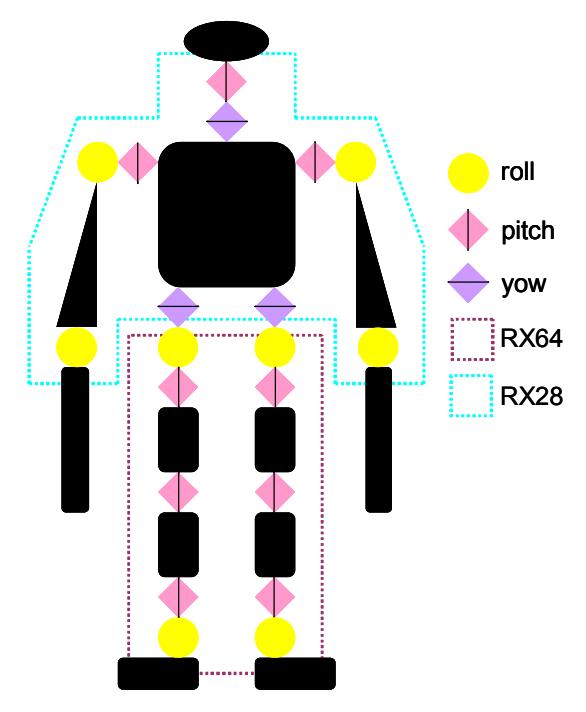
Fig 2 shows a configuration of the actuators. The robot has totally 20 DOFs: 6 DOFs in each leg, 3 DOFs in each arm, and 2 DOFs in the neck for tracking objects by one camera.
2.3 Controller
The main controller of robot is a tiny laptop computer, VAIO type U, that is a SONY product. VAIO processes an image data from the camera and information (feedback value) of the other sensors. The main controller and actuators communicate each other by sending and receiving data of angle, temperature, and so on. The interface is RS485.
2.4 Sensor
The robot has 2 types of sensors.
- Image sensor (IEEE1394 Camera) This sensor, Firefly MV, captures an environmental image data in front of the robot. It is controlled by main controller via IEEE1394 interface.
- 3D motion sensor
This sensor is combined of three sensors: a 3-axis terrestrial magnetism sensor, a 3-axis acceleration sensor, and a 3-axis gyro sensor. The interface between the main controller and the sensor is USB 1.1.
3 Software
3.1 Vision System
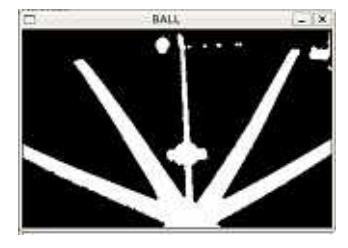
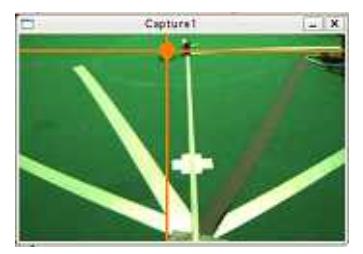
The image from the camera to VAIO is obtained in YUV format and white balance, and then converted into HSV format. In order to detect objects by extracting colors, the images in YUV and HSV are binarized using upper and lower thresholds and the two images are conjugated logically. This method and an illumination-invariant color space method improve robustness and accuracy of the color extractions in various lighting conditions [2, 3]. Furthermore we are trying to find a ball with its shape. Firstly, robot creates a binary image which displayed color of the field (green color) from the acquired image as shown in Fig 3.(a). Secondly, robot reverses this image and labels each object which is in this binary image. Thirdly, robot calculates peround each object and compares this. Peround F is ratio of square the circle to circumference.
$$F = \frac{4\pi \times S}{L^2}$$
L: circumference S: square the circle
Finally, a ball is recognized by the value of F as shown in Fig 3.(b).
3.2 Walking Control
We adopted the simply Linear Inverted Pendulum Mode (LIPM) for the method of controlling to walk of the robot. The LIPM can keep the height of the center of gravity constant. Therefore if the robots have an individual specificity, we can easily change the setting of the parameter of center of the center of gravity, and the robot came to be able to do a steady walking.
3.3 Motion Control
The motion performance has been improved in response to the change of the hardware of the robot. Three parameters (the orbit of the motion, transition time of the posture, maximum speed to which the motor can be put out) have been adjusted.
As the result, the maximum distance of the shoot has greatly improved from 2.0m to 6.0m.
4 Conclusion
We have developed three new humanoid robots with 20 degrees of freedom and equipped with VAIO typeU for RoboCup 2009. We changed the mechanical design to improve motion performance, robustness, and safety. As the result, the robot can walk twice faster and kick a shoot twice stronger. The most important change is safety. We used Lithium Polymer batteries which sometimes causes accidents such as fires and explosions due to overcharge or damage of batteries. Thus, now we use Lithium Ferrite batteries which are safer than the batteries.
We will continue to develop a vision system more robustly and improve a motion performance. Moreover, the localization will be implemented in the robots in the future.
References
- K. Demura, M. Tani, Y. Hattori: The Yumekobo Project Education at Kanazawa Institute of Technology (in Japanese), Journal of Society for Engineering Education, pp.128-135, 2006
- K. Azeura, G.Ivan: Color Sampling with Omni-Directional Camera in Robot Soccer (in Japanese), Proceedings of the 24th Annual Conference of the of Robotics Society of Japan, CD-ROM 1B25, 2006
- H. Kambayashi, K. Demura: Evaluation of Illumination-Invariant Color Space (in Japanese), Proceedings of the 25th Annual Conference of the of Robotics Society of Japan, CD-ROM 2N24, 2007