TH-MOS: Humanoid robot
Jiwen Zhang, Qiang Yi, Ken Chen, Li Liu, Hongbo Zhang
Department of Precision Instruments and Mechanology Tsinghua University Beijing, China, 100084
http://www2.pim.tsinghua.edu.cn/robocup/
Abstract This paper describes the mechanical, electrical and software design of the humanoid robot systems by TH_MOS in KidSize competition RoboCup. The improved MOS_III and newly designed MOS2007 perform as test bed for multiple research fields in the lab, such as locomotion, dynamical vision processing, robot behavior control. A gait planning strategy is proposed and a vision processing method is implemented, and well organized software structure put the algorithm into been.
1 Introduction
The Robocup scenario stands as the extraordinary challenge and the test bed for design, control of robots. Humanoid Team focuses on both stability of locomotion and artificial intelligence. These research fields extend as 3 parts: Online motion planning with real-time adaptation and stability; precise and robust object identification with vision system; decision making ability in a rapid changing environment and target.
TH_MOS from robot and automation lab Tsinghua University has developed many strategies in both design and control of humanoid robot; MOS series (MOS_I MOS_II MOS_III) have won RoboCup2005 China championship, and RoboCup2006 China Open, and been able to participate RoboCup2006 Bremen.
For Robocup2007 we do not only improve the ability of MOS_III, but also design a new generation of Kid Size robot MOS2007, which exceeds in all aspects of MOS_III.
MOS2007 got the fifth place in the Technical Challenge in Humanoid group of 2007 RoboCup in Atlanta. MOS2007 also got 2st place at 2V2 Humanoid group of 2007 RoboCup China Open Tournament, and 1st place in the Technical Challenge in Humanoid group of 2007 RoboCup China Open Tournament.
A short view of the hardware and software concepts is as follows.
2 Mechanical Designs
The skeleton of MOS2007 is constructed by aluminum to reduce weight and keep rigidity. Actuators are all servos, though diversified in Torque and Speed. In these robot weight and actuators are well distributed to meet the rigor requirement of biped robot.
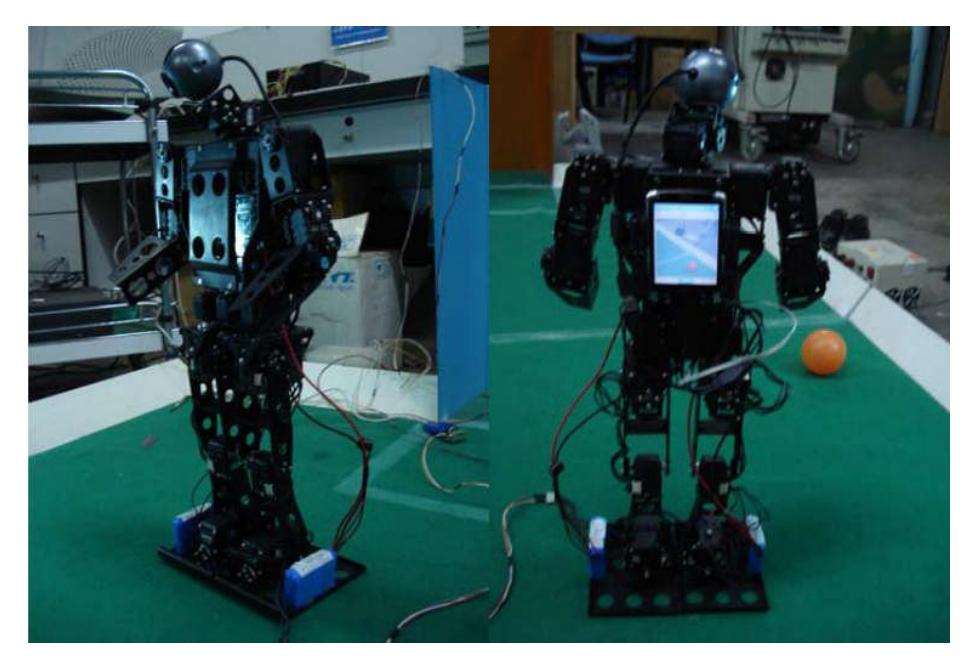
MOS2007 is driven by 21 servo motors: 6 in each leg, 2 of which constitute ankle joint, 1 in knee joint and 3 in hip joint; 1 in waist; 3 in each arm and 2 in neck. All these DOF allow flexible movement, and fulfill the locomotion request. Figure 1 shows the outline of MOS2007.
3 Control System
To meet the requirement of an autonomous robot and space for future development in both locomotion and decision making, we devise 2 robots in concept of distributed system composed with 2 controllers, namely locomotion layer and decision-making layer. The locomotion layer masters all kinds of movements, and the functions are gait storage, online posture adjustment, servo control and all types of feed back. The decision-making layer processes vision information and generates movement commands to locomotion layer. These two layers communicate with each other and share information.
MOS2007 is equipped with TMS320C2812F based controller, clocked at 150MHz, as its locomotion layer. It is interfaced with RS485 converter and semiduplex TTL to overrule the servos. Its A/D converters read 8 data series from force sensors located at foot, and that of dual-axis from integrated accelerator. SRAM and flash expansion facilitates this layer to store as many as gait origination, and the fast speed of DSP core allows high density of calculation to execute online modulation of gait and posture as well. The decision-making layer is a Pocket PC with operating system of Windows Mobile 5.0 and ARM processor at 400MHz, which processes frames from USB webcam, and receive necessary instructions through WLAN outside the play filed. Two layers communicate with each other through RS232 at baud rate of 115200.
In addition to the 2 main controllers, as mentioned above, we also add multiple sensors classified as electronic components, such as USB webcam, accelerators, and FSR force sensors. Moreover, the DX117 dynamical module utilized in MOS2007 is capable of feeding back angle, speed, load, and thus performing as joint sensors, too. Details about the robot system are listed as Table 1.
Table 1. MOS2007 robot system specification
| Type | MOS2007 | |
|---|---|---|
| Servos : | DX117 | AX12 |
| Torque[Nm] | 3.61 | 1.65 |
| Speed[rad/s] | 7.480 | 5.102 |
| Sensors: | ||
| Camera | Logitech QuickCam 5000 | |
| Resolution | 240×320 | |
| Color space | RGB | |
| Frame rate [fps] | 15 | |
| Accelerometer | 2 axes | |
| Force sensor | FSR | |
| Degree of freedom | 21 | |
| Height [cm]: | 58.8 | |
| Weight [kg]: | 3.00 | |
| Walking Speed[m/s] | 0.16 |
4 Software and Algorithm
Robot for Robocup competition is an autonomous agent; functions can conclude as gait planning and modulation, vision processing, decision-making or behavior, and communication and information share.
4.1 Gait Planning
Biped walking is a periodic phenomenon, including two walking phases: doublesupport phase and single-support phase. During the double-support phase, the COG or ZMP moves from one foot to another. In our method of gait planning, single-support phase for each walking pattern is divided into five key posture phases according to the positions of the swinging foot. Using these posture phases we achieved a uniform gait generation method.
4.2 Vision Processing
The multicolor image segmentation is the most important part in vision processing. To be robust enough to deal with the complex environment of robotic soccer, the vision processing does not only make use of traditional algorithms to deal with the multicolor image, but also uses a very fast segmentation algorithm.
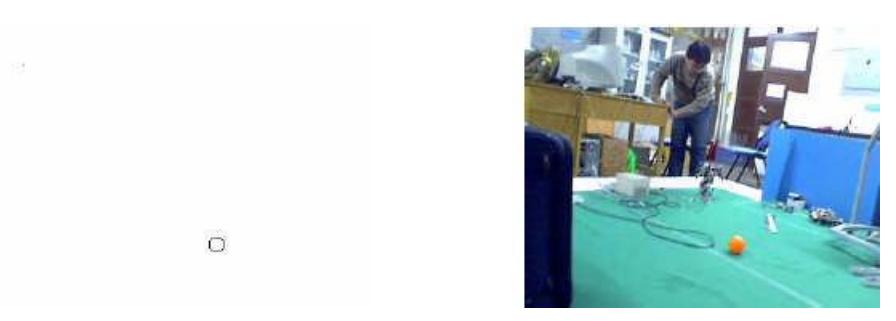
The traditional algorithms we used are two value translation, cauterization and bulge, median filtration, and brim distill. By using the traditional algorithms, we gain an image having an approximate circle. Then we use two steps to detect the circle in the image. First, we compose a circle using several conjoin pixels approximately. The number of the pixels is decided by experiments. The second step is to recompose a circle using appropriate brim segments which are decided by assembling genus. The algorithm is efficacious, clipping and credible. When the ball is partly hidden or the image is distortion, the algorithm can detect the circle all the same. Figure 2 is a compare of the result and an original image.
4.3 Behavior
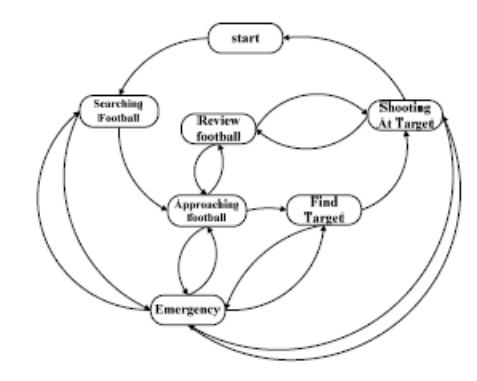
Behavior module is constructed with finite state machine, considering the endless changing environment while playing football. Basic states include start state, searching football, searching shooting target, walking toward football, shooting at target, and emergency. Vision information and robot posture feed back join to supply resources for state adjustment, making the robot perform according to various circumstances. Fig.3 shows the example of state flow of 3v3 or penalty kick strategy.
4.4 Communication
Communication module includes information share between different robots and instruction and feed back between robots and human operator. It depends on WLAN for hardware and UDP transmitting protocol for software; in this part, client and server model is introduced; a network platform aimed at gap-less information, especially synthesization of environment fuzzy description is on research based on MOS2007, for efficient information share will make cooperation possible within a team.
5 Conclusions
In this paper, the new generation of KidSized robot MOS2007 are investigated in specification. We also proposed a uniform gait generation method based on genetic algorithm; the two-step method of football reorganization is developed and put to use in MOS2007. MOS series have outstanding performance in China Soccer Robot Competitions, and he has helped our team win the first place continuously in these competitions. We hope to test the MOS2007 designed in new concept, and thus show our strongpoint in this round.
References
- Yu Zhong, Xu Wenli, Chen Feng. A two-step method of arc fitting using segmented edges J Journal of Computer-Aided Design & Computer Graphics,2005,2(2) (in chinese).
- Wu Zhongke, Jiao Haixing, Dai Guozhong. An algorithm of approximating line segment and circular arcs and its application in vectorization of engineering drawings J. Journal of Computer-Aided Design & Computer Graphics, 1998,10(4):328~332(in Chinese)
- Shu Zhilin, Qi Feihu. A novel algorithm for fast circle detection using randomized Hough transform J . Computer Engineering, 2003,29(6):87~89(in chinese)
- Yuan Weipeng, Shi Pengfei. A new improvement of randomized Hough transform based on fuzzy theory J . Journal of ShanghaiJiaotong University, 2002,36(12): 1825~1828(in chinese)
- Zhao Liu, Ken Chen, Li Liu, A Uniform Gait Generation Method for RoboCup Humanoid Robot Based on Genetic Algorithms, Proceedings of 2006 IEEE International Conference on Mechatronics and Automation