Team BSRU
Mr. Pakorn Butngam, Mr. Chokchai Pengyasa, Mr. Settawut Babyang, Mr. Totsapon Keawsri, Mr. Nitipat Thavornnat, Mr. Arthit kaoropwuttikul, Mr. Kissada Ridde, Mr. Wuttiwaat Sutseu, Mr. Nachapol Buutsorn, Mr. Buncha sukpitak, Mr. Weerayut Sawasdee, Mr. Khunit Siramee, Miss. Apinya Boonprakob, Mr. Weera Pitutacha, Mr. Theerathawan Panklang, Mr. Prajin Palangsantikul, Ms. Rattanasuda Supadanaison, Mr. Warinthorn Nualtim, Mr. Chalit Wanichayanan
Bansomdejchaopraya Rajabhat University, 1061 Soi Isaraphab 15, Isaraphab Rd., Dhonburi, Bangkok 10600 Thailand
http://student.bsru.ac.th/robotics
Abstract In this paper, we describe on our system for the RoboCup soccer kid size humanoid league. The system we developed has some features. They are high mobility, strong, well-designed control system, position estimation by one camera and user-friendly interface. The robot can walk speed and robustness. The maximum speed is approximately 0.3m/s. It also has a feedback system with gyro and acceleration sensors to prevent falls. The robot has two control boards. One is for walk and another is for image recognition, behavior determination and so on. The CPU board is light weight and high performance. Its operation system is Windows XP professional. The robot detects the positions of landmarks by image processing. From the positions, the robot can also estimate own position. Last feature is user-friendly interface to help strategy development. Our robot has wireless LAN interface to communicate outer PC. The robot sends data including measured positions and status of robot. The PC can store and analyze them to improve the rule of behavior.
Introduction
Because of Bansomdejchaopraya Rajabhat University has offered computer technology and electronics courses. And taught about robots in history, evolution and development of various kind robots. A variety of robots for students to study Teaching students to design robots. Of robots to study the structure and principle of the robot. Has to compete in robot soccer, and has a 1 in 24 teams from around the world to compete in the World Robocup 2010 in Singapore. Competition for Thailand Humanoid Robot Soccer Championship 2010 team won the third BSRU robot soccer. And reward talent in robotics. (robot dancing). This year, the team has BSRU wish to develop and sustain knowledge about the robot would need to apply to compete in this World Robocup 2011.
Hardware Design
Mechanical Design
The BSRU project aims to develop a low-cost fully-autonomous humanoid platform so that educators, students, and researchers are able to build humanoid robots quickly and cheaply, and to control the robots easily. The previous generations of humanoid soccer robots have provided a robust knowledge about the hardware and software design. This Section provides an inside to the latest development.
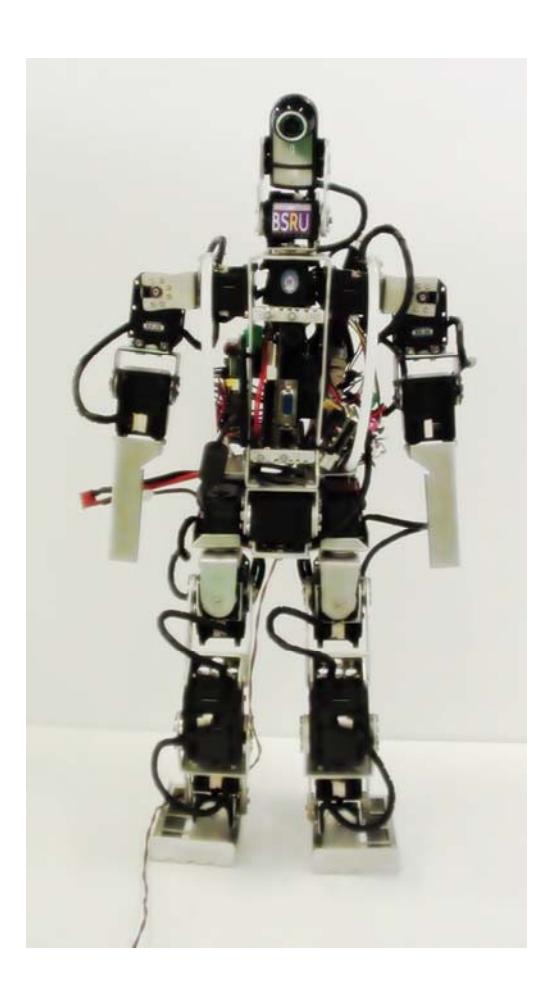
BSRU is a fully autonomous humanoid with 21 degrees of freedom. It has six degrees of freedom on each leg, anything less than that would deny the robot from achieving some basic human actions. It weighs 3.1kg and has a physical height of 56cm and foot diameter 6.9x11.4cm. The main structure of BSRU is made of both aluminum alloy and Perspex, together with motors from Robotis. Fig. 1 shows BSRU in its standing position.
Actuators
The actuators used in our robot are "Dynamixel RX-28" and "Dynamixel RX-64" servomotors, produced by Robotis Inc. Each actuator has its own microcontroller which implements adjustable position control using potentiometer position feedback. It also calculates many other parameters such as rotation speed and motor load which can be accessed through a single-bus, high-speed serial communication protocol. This facilitates the construction of an extendable network of motors which can be individually accessed and controlled by a single microcontroller.
Some of the parameters of the actuators are the following:
Dynamixel RX-28
– Weight: 72 g
– Gear Reduction Ratio: 1/193
– Max Holding Torque: 37.7 kgf.cm (@16V) – Speed: 0.126 sec/60 degrees (@16V)
Dynamixel RX-64
– Weight: 125 g
– Gear Reduction Ratio: 1/200
– Max Holding Torque: 64 kgf.cm (@18V) – Speed: 0.162 sec/60 degrees (@18V)
Sensors
- Image sensor: one Logitech Webcam C905 camera is chosen to be the vision sensor and is located in the robot head. The sensor captures environment image data around the robot.
- Acceleration sensor: This sensor detects acceleration vector when the robot is movement. There are two applications with the sensor. One is recognizing whether it is standing or lying down and the robot gets up automatically. And the other to keeping the acceleration effect for ZMP feedback control.
- Gyro sensor: This sensor detects angular velocity of the robot. The application of the sensor is keeping the stability of the robot on the level when robot is moving.
- Potentiometer: This sensor detects the rotation angle of the actuator. In this case is a Dynamixel RX-28 servomotor.
Processors and communications
Fig. 2 shows the network of sub-processor and the main devices that controls the BSRU. The use of sub-processor for particular tasks improves the performance of the system. Table 1 shows the specification of these CPU boards. Each processor is dedicated to different tasks:
- The main processor coordinates all behaviors of the robot. Collects the image sensor information and sends the data to the sub-processor. Communicates by WIFI with the other robots and the main PC.
- The sub-processor receives the posture commands from the main processor. These commands are validated and finally send to the servomotors by RS485. The motor feedback is collected and send it back to the sub-processor. The data of servomotors are updated every 20 ms.
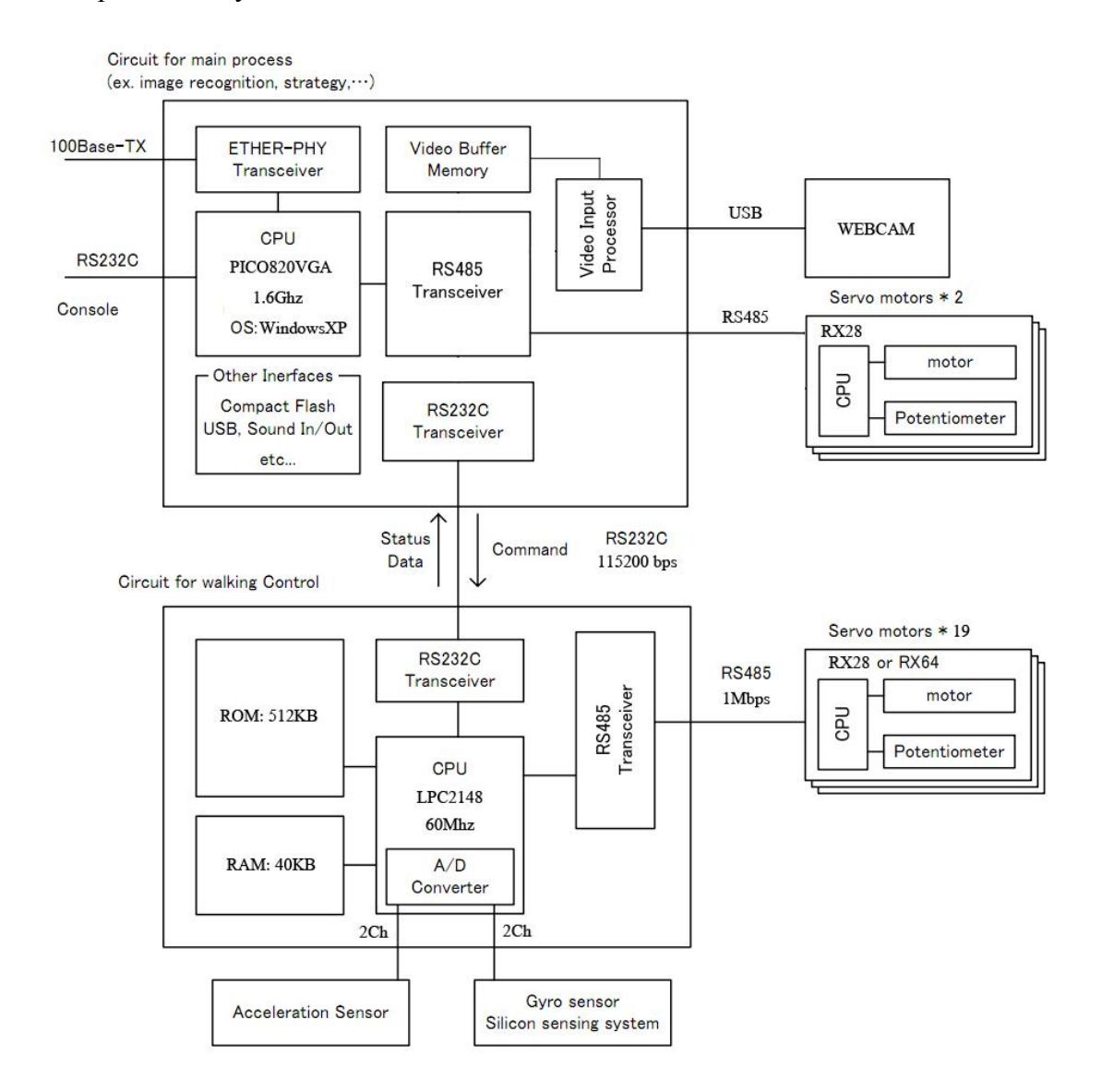
Table 3: Specifications of the boards
| Features | Main Processor | Sub-Processor |
|---|---|---|
| Processor | PICO820VGA-Z530 | ARM7 LPC2148 60MHz |
| Speed | 1.6Ghz | 60Mhz |
| Memory | 2GB | 40KB |
| Storage | 8GB | 512KB |
| Interface | RS232, RS485, WIFI | RS232, RS485 |
Software Design
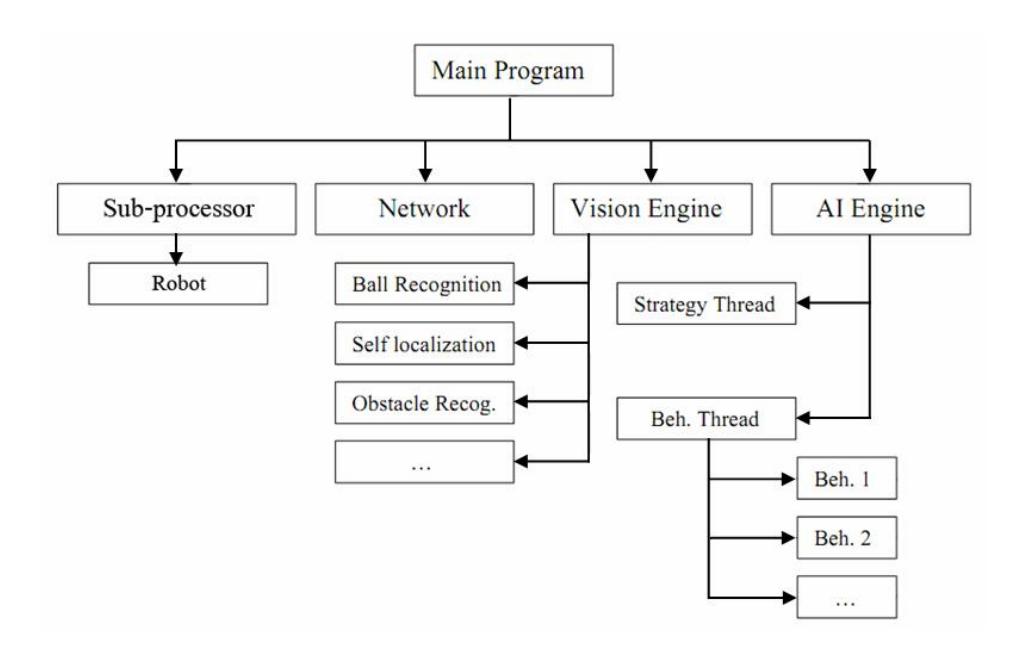
Fig. 3 shows the block diagram of the software which runs in the robot's main computer. The program consists of 4 sub-blocks:
- Sub-processor: The only part of the control program directly connected to the hardware. This part is responsible for all of the hardware related tasks, i.e. power management and accessing actuators and sensors.
- Network interface: Mainly responsible for the wireless communication of the robot with the other robots.
- Vision engine: contains all image processing algorithms, acquires images from the camera, and calls different recognition functions for calculating and updating visionbased sensory data for the rest of the program.
- AI engine: The behaviors of the robot are programmed in the AI engine. Each behavior can access the data provided by different sources and send proper commands to the sub-processor through the hardware interface.
control and stabilization
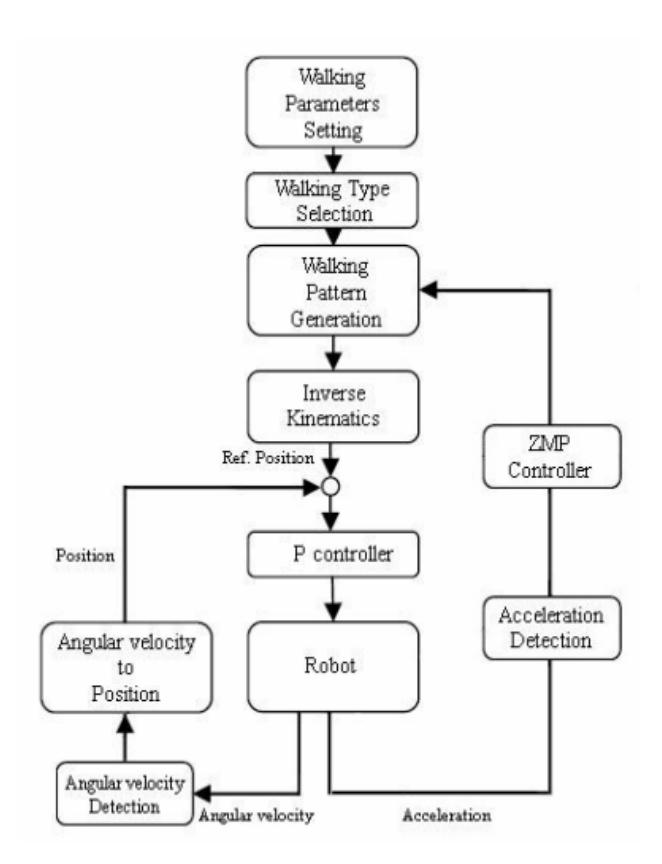
The movement of the robot is implemented in two ways: real-time trajectory computation with Inverse kinematics and predefined motion pattern.
- Real-time trajectory computation: When the goal position changes, the robot must normally stop walking and then start to walk to the new goal. However, this method wastes the time when the robot stops and walks again. In order to decrease the time, the robot computes it own walking trajectory real-time and computes the trajectory again when the new goal position is given.
- Predefined motion pattern: The method to make motion such as shooting the ball and moving hand depends on the feeling of the human heavily. Therefore we use computer software on PC to make these motions.
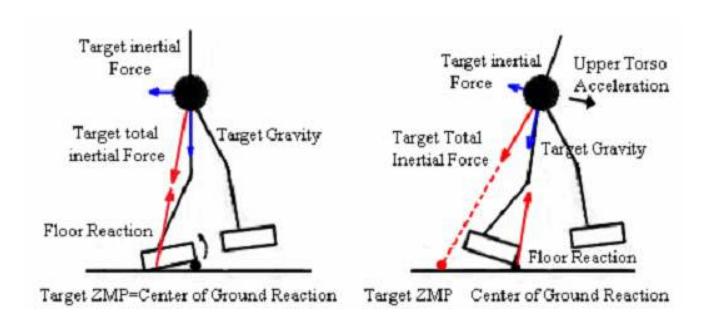
The kid size and compact humanoid robot system can walk stable fast with the ability to treat the impact force that may de-stabilize the walking locomotion. There are two sets of the control scheme which are designed to help stabilizing the walking pattern at before, during and after the foot placement as shown in Fig. 4
Vision
The main source of information about the environment for the robot is the camera. The camera is mounted on a pan-tilt system that allows the robot to scan 240± wide. The gaze control has been optimized by using an attention system that uses a fovea as main area. The computer vision software detects the ball, the goals, the corner poles, and other players based on their color in HSI space. Using a look-up table, the colors of individual pixels are classified into color-classes that are described by HSI range of colors. Each image line is scanned pixel by pixel. During the scan, each pixel is classified by color. A characteristic series of colors or a pattern of colors is an indication of an object of interest which has to been analyzed in more detail. In a multistage process we discard insignificant colored pixels and detect colored objects. Recognition algorithms for the most important features (e.g. lines, landmarks, and the ball). We estimate their coordinates in an egocentric frame (distance to the robot and angle to its orientation). The objects are also merged with previous observations, which are adjusted by a motion model, if the robot is moving. This yields a robust egocentric world representation.
Conclusion
In this paper, we introduced the state-of-art of the BSRU project. BSRU is an autonomous humanoid robot with a network of two CPUs, 21 degrees of freedom, and several kinds of sensors that serves as a platform of education, and research issues. The latest version of the BSRU holds several advantages in contrast with the previous generations (e.g. faster, robust control, gait improvement, vision). The new features prepare the BSRU for the RoboCup 2011 competition, not only for the 2 vs. 2 Soccer Games but also for the Technical Challenge.
New development tools were conceived from the gained experience of the previous versions of the BSRU. In addition, the improvement in the robot platform allows a more robust and efficient performance of the robot in the autonomous mode. Research with this platform has lead to develop a new approach to optimization of walking gaits. Our research challenge lies in the interpretation of transition probability models for biped locomotion so that we can progress toward better understanding for human locomotion and extend the results to better control of humanoid robots in particular for RoboCup.
References
- Sawasdee, W., et al, "Locomotion control scheme for fast walking humanoid soccer robot", 10th International conference on Climbing and Walking Robots (2007).
- Kajita, S. et al., "The 3D Linear Inverted Pendulum Mode: A simple modeling for a biped walking pattern generation", Proceedings of the 2001 IEEE/RSJ International Conference on Intelligent Robots and Systems, Vol. 1, pp. 239-246 (2001).
- Nagasaki, T., et al, "A Running Experiment of Humanoid Biped", Proceedings of 2004 IEEE/RSJ International conference on intelligent robots and systems, Vol. 1, pp. 136-141 (2004).
- Zatsiorsky, V.M., Kinetics of Human Motion, Human Kinetics (2002).