UURT Humanoid Robot Team Description for Humanoid KidSize League of RoboCup 2011
G. Rezazadeh, K. Rashvand, H. Yazdanjouei, F. Tofigh, A. Oveysi, A. Zaynali, A. Jenabi, M. J. Hosseini, A. Rashvand
Urmia University Robotic Team, Engineering Faculty, Urmia University, Urmia, West Azarbayjan, Iran
http://www.urmia.ac.ir/fanni/roboticstudentteam
Abstract This paper describes the design of humanoid robot systems of Urmia university robotic team (UURT) in KidSize competition RoboCup 2011, Istanbul, Turkey. It presents our current version of robot specifications and capabilities. The main research of the team focuses on Wireless communication between robots and controlling all three players in contact with each other. We also worked on the other areas such as mechanical structure, Image processing unit, controlling unit, Robot AI and behavior learning to have best action in the game. The project is described in two main parts: Hardware and Software. The hardware consists of the mechanical and electrical structure. The software consist of self localization based on vision and object recognition, role engine that based on fuzzy logic, Trajectory Planning, Motion Controller and Network. Each robot is able to walk, pass, kick and dribble when it catches the ball.
1 Introduction
UURT is a student robotic team of Urmia University, established in 2005. This team has several branches consist of Line Follower Group, Deminer Group, and Autopilot Group and has awarded some successes in robotic competitions in Iran.
Recently we established a new branch in UURT working on humanoid KidSize league. It consists of several graduated and undergraduate students from Electrical and Mechanical Engineering Departments. It is organized independently but supervised by the engineering faculty.
This team description paper provides a brief overview of our current work that is about to become used during the next RoboCup competition in Turkey. According to our time schedule we are about to participate in IranOpen 2011 before RoboCup 2011.
2 Team members
Associated Prof: Ghader Rezazadeh (Team leader)
M.S Students: Kaveh Rashvand (contact person), Hossein Yazdanjouei, Ali Jenabi, Mohammad-Javad Hosseini
B.S Students: Farzad Tofigh¹, Amir Oveysi, Ahmad Zaynali, Armin Rashvand²
¹ Has awarded 4th place in Deminer technical challenge IranOpen 2009 with Qartal team
² Has awarded 1st place in Mixed Reality IranOpen 2010 and 3rd place in RoboCup 2010 with MRL team
3 Mechanical and Electrical Designs
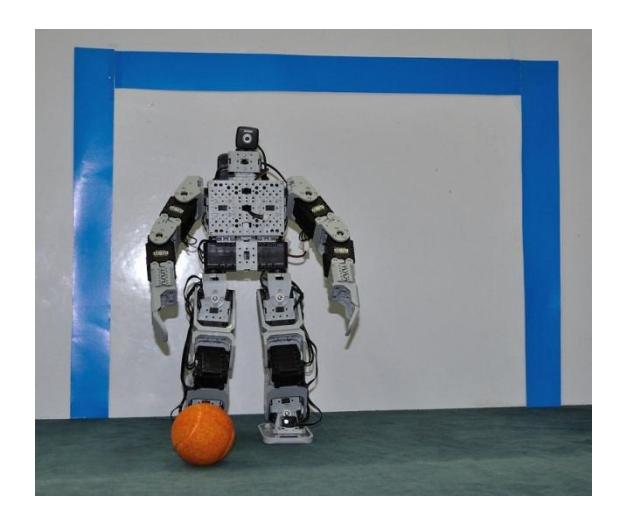
The basic set of the "Bioloid Premium Kit" was enhanced by one 3.5 Megapixel camera and 3-axis acceleration sensor. Legs and arms have been modified for better movement and stability. The Robot has 20 Degrees of Freedom totally. Each Leg has 6 Degrees of Freedom, 3 Degrees for each arm and 2 Degrees for neck.
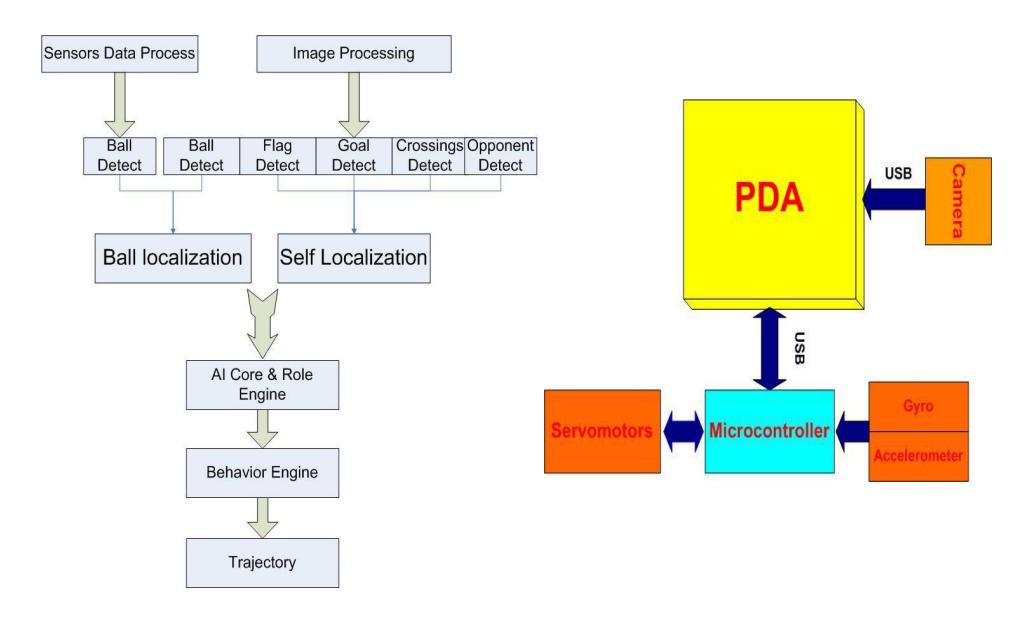
The robot is controlled by 2 processors. Main control is done by a RoBoard RB-110. RB-110 has a DM&P Vortex86DX Processor and uses 256MB RAM. It is equipped with EW-7811Un wireless adapter. RB-110 is powered by a Li-Polymer battery with 2000mAh. A combination of Gyro, acceleration and IR sensors has been used to facilitate the control of robot. All sensors are monitored using ATmega8 AVR microcontroller and data packets are sent to RB-110 via RS232 Communication.
The actuators are Dynamixel AX-12 and the camera is A4tech pk-836MJ USB webcam equipped with a pan/tilt. Actuators are powered by an additional Li-Polymer battery and communicate with RB-110 through USB2Dynamixel via TTL communication. The webcam is connected to RB-110 using USB port.
Physical specifications of robots are 40 cm height and 1.8 kg weight which is classified in KidSize according to RoboCup rules.
4 Software Design
(Section contains subsections)
4.1 Image Processing Software
One of the primary tasks for the vision system is to detect a particular object and calculate the robot's position in relation to it. Utilizing a camera, each time the processor on each robot performs the processing of the current frame and calculates the position of the robot.
It also determines the position of the opponent robots as well as the position of the ball. Image processing software is divided into two parts: a common pre-processing stage and an object recognition algorithm.
In the preprocessing stage some filters like mean filter and median filter is used to reduce noise.
In the second stage at first RGB color space is converted to HSV color space. Then special colors have been searched filtering special ranges in Hue and Value matrices. After that some features like the distances between the points on the boundary of objects and center of them are extracted from the images and artificial neural networks have been used to recognize ball, goals, opponent and teammate robots.
An additional detection algorithm using Hough transform is used to identify the lines on the field. By knowing the lines we are able to detect specific marks on the field "crossings". Based on the found object and an internal model, the robot will try to localize itself on the field.
4.2 Role Engine
According to the ball, goals, opponents and our robots positions, determination of the play state is done by fuzzy inference system.
Then the role engine module receives information from this system and then selects a role. These roles are some linguistic commands that are submitted to behavior engine.
4.3 Behavior Engine
The data provided by the role engine is used to control more complex behaviors that are needed for playing soccer autonomously.
Total functions about Robot behavior such as walking, shooting, dribbling, standing up, turning camera and etc are controlled in this section.
4.4 Trajectory
The current motion module is mainly used to calculate walking trajectories. In this section according to the position of our robots, opponents and the ball a path will be suggested for the robot.
5 Conclusion and Future work
According to this article our robot can stand up autonomously from lying on its back or its front side, walk forward and backward, turn right and left, and kick the ball. A camera and sensors are integrated so that the robot can obtain the environmental information to decide the action behavior. We try to make the robot more stable and reliable as the result of our researches.
Further information's are presented on our homepage.
References
- Rath, C., techn, B.: Self-localization of a biped robot in the RoboCup League domain. Master's Thesis, Institute for software Technology, Graz University of Technology, (2010)
- Kasaei, A., Kasaei, H., Kasaei, M., Taheri, M.: Design and Implementation a Robust Structure and Fuzzy Rule-Based Motion Controller for a Humanoid Soccer Robot. in Proc. of the Intl. Conf. on Man-Machine Systems (ICoMMS), Batu Ferringhi, Penang, Malaysia, (2009).
- Chang, S., Chang, W., Hsia, C., Ye, F., and Chiang, J.: Efficient Neural Network Approach of Self-Localization for Humanoid Robot. Intl. Conf. on Pervasive Computing (JCPC). Tamsui, Taipei, (2009).
- Laue, T., Jeffry, T., Jeffry de Haas, T., Burchardt, A., Graf, C., Rofer, T., Hartl, A., Rieskamp, A.: Efficient and Reliable Sensor Models for Humanoid Soccer Robot Self-Localization. in Proc. Workshop on Humanoid Soccer Robots of the 2009 IEEE-RAS Intl. Conf. on Humanoid Robots, Paris, France, (2009).
- Friedmann, M., Petersen, K., von Stryk, O.: Adequate Motion Simulation and Collision Detection for Soccer Playing Humanoid Robots. in Proc. Workshop on Humanoid Soccer Robots of the 2007 IEEE-RAS Intl. Conf. on Humanoid Robots, Pittsburgh, PA, USA, (2007).
- Friedmann, M., Kiener, J., Petters, S., Sakamoto, H., Thomas, D., von Stryk, O.: Versatile, high-quality motions and behavior control of humanoid soccer robots. in Proc. Workshop on Humanoid Soccer Robots of the 2006 IEEE-RAS Intl. Conf. on Humanoid Robots, Genoa, Italy, (2006).
- Furusho, J., Masubuchi, M.: A Theoretically Motivated Reduced Order Model for the Control of Dynamic Biped Locomotion. ASME J. Dyna., Syst., Meas., Contr. 109, 155-163 (1987).
- Robotis Co., Ltd. Smart Actuators. http://www.robotis.com
- Darmstadt Dribblers KidSize Humanoid Robot Team. http://www.dribblers.de