AUTMan Humanoid Kid-Size Robot Team Description Paper
Soroush Sadeghnejad, Saeed Salavati Dezfuli, Hafez Farazi, Farzad AhmadiNejad, Mojtaba Karimi, Mojtaba Hosseini, Majid Jegarian, Donya Rahmati, Dr. Saeed Shiry Ghidary, Prof. Mohsen Bahrami
Humanoid Robotic Laboratory, Amirkabir Robotic Center, Amirkabir University of Technology
Abstract This document describes AUTMan kid-size humanoid robots team for participating in humanoid robot league in RoboCup 2012, which is going to be held in Mexico City, Mexico. Our humanoid kid-size robot team is a renowned humanoid team in Iran and actively integrates research groups working on different RoboCup leagues at Amirkabir University of Technology (AUT). The focus is to use experience of our previous year participation in RoboCup2011 and also using the Soccer Simulation 3D team and SPL team experiences, which is closely related to the humanoid robot league. For this year, we are going to use new version of our robots which will be introduced in advanced. A brief history of Team AUTMan and its research interests will be described. Future work based on the humanoid kid-size robots will also be discussed. Our main research interests about the humanoid robots lay within the scope of robust real-time vision and object recognition, machine learning for adaptation and architectures for humanoid decision-making.
Research Overview
The research of the AUTMan in humanoid robotics involves
- Central Pattern Generator (CPG), [1-3]
- Gait generation (Walking Pattern), [4-5,13]
- Object Recognition with Cortex like Features, [6]
- Biped Walking Using Truncated Fourier Series, [7]
- Emotional Control, [8]
- The Kick Action, [10]
- Flexible and reusable software and architectures, to be used on many other types of robots
Mechanical Structure
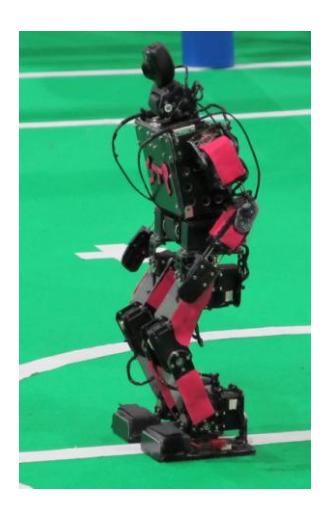
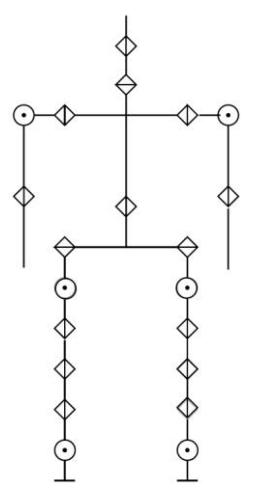
In this section, we describe the mechanical structure of AUTMan Humanoid Robots. Our new designed and manufactured robot has 21 degrees of freedom (DOF). The design is such that urged us to use 6 degrees of freedom for each leg, 3 degrees of freedom for each arm and one degree of freedom for its waist. Adding one degree of freedom to the waist of the robot cause to have a better control on the robot which leads to have a more stable and fast walking. On the other hand, our robot's camera will be hold by 2 servo motors as a pan-tilt mechanism (Fig. 2). Our research also indicates that a more powerful knee joint make the robot act better and faster. So we have used more powerful actuators for knee joints, and also a more powerful actuator for waist joint. All our robots have the same mechanical structure. It will help us to design and construct each of the robots fast and cause to use them in different missions without any difficulty.
Table 1. Physical dimensions of the robot
| Robot System STP | |
|---|---|
| Weight (kg) | ~3.80 |
| Height (cm) | 58 |
| Degrees of Freedom | 21 in total with 6 in each leg, 3 in each arm,1 in meddle, 2 in neck |
| Actuators | RX-64, RX-28 |
| Camera | Logitech C905 wide 2 MP - 640x480 @ 30 fps |
| Main Processor | MaxData QutePc3020 1.6Ghz dual-core intel processor, 2 GB DDR2 memory, SSD 40 GB |
| Operating System | Customized Windows XP SP3 |
| Battery | Li-Po 18.5 V 2000 mAh |
Actuators
As mentioned before, 21 Servo motor is used to construct every robot:
- 6 Robotis Ax-12 (in hands and neck)
- 3 Robotis Rx-64 (in knee joints and waist joint)
- 12 Robotis Rx-28 (in shoulders and other joints)
The specification of these servo motors are illustrated in Table 2.
Table 2. The parameters of the actuators used in AUTMan robots
| Actuator | Weight (g) | Gear Ratio | Max Torque Kgf.cm | Speed rpm | Resolution degrees |
|---|---|---|---|---|---|
| Dynamixel AX-12 | 53.5 | 1:254 | 15 | 59 | 0.29 |
| Dynamixel RX-28 | 72 | 1:193 | 37 | 79 | 0.29 |
| Dynamixel RX-64 | 125 | 1:200 | 77 | 63 | 0.29 |
Controllers
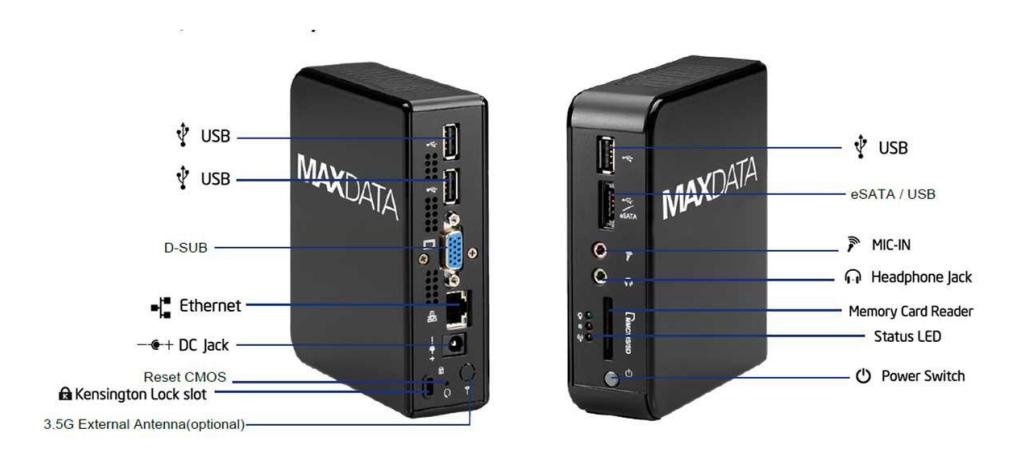
The brain of the robots is an embedded computer system, Max-Data QutePc3020 (Fig 3).
QutePc3020 is a light-weight board with 1.6GH Intel Atom x64 processor, which makes it a good choice for robotics.
Many of the functions needed to communicate with actuators and sensors (such as I2C, RS232, RS485, PWM, etc.) have been included in other microcontroller-based boards and connected to the main processor through a USB port.
Sensors
For having a human like sensation, we have used and implemented four types of sensors in each robots. Each robot has a camera for its visual perception, a three axis accelerometer, three axis gyroscope for dynamic balanced control and built-in actuators sensors. Using these sensors on a robot will make some robust features which will be introduced in this paper.
The Accelerometer (ADXL345) and the Gyroscope (IDG650 and ISZ650)
The Accelerometer (ADXL345) and the Gyroscope (IDG650 and ISZ650) are used together in dynamic balancing of the robot. The robot will get the feedbacks of these sensors, remove the noise then process the result to further control robot's motions.
Built-in actuators sensors
Each Dynamixel servo motor has many built-in sensors including temperature sensor, position sensor, load and voltage sensor.
The Camera
The Camera is a Logitech USB webcam (C905) produced by Logitech company, USA. The 6404803 bytes of raw data per a frame is processed to find desired objects in the environment.
Communication Module
The communication is established through the Wi-Fi modules connected to the main processor of each robot. Each robot will be connected to referee-box network and get both referee-box data and other teammates data.
Vision Module
Computer vision plays an important role in humanoid robots. The task of this module is to determine relative position of ball, goals, landmarks, penalty markers, field lines, teammates, and opponents in the input camera images based on the current position of robot. We generate an estimation of the distance of robot to the detected object using size of the object and the position of detected object on the frame considering the head tilt position. Afterward this information will be used to generate robots world model and high-level decisions including robot behavior and task. In addition, the information derived from vision module is used for localization purpose.
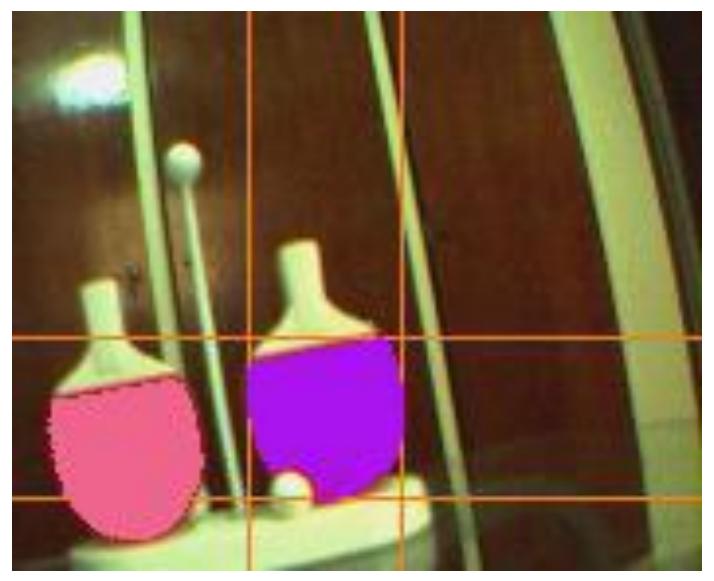
In this module, we apply color base labeling to detect objects in the environment. We have used HSV color space, which is considered to have less sensitivity to illumination changes, since hue is independent on intensity values. In addition, for better modeling of the target color, instead of determining some thresholds on the H, S and V parameters, we have utilized a color look-up table. Classifying each pixel based on the color will produce a black and white image. Each connected component in this image will be considered as an object. As you can see in Fig 4, two detected objects are labeled with purple and pink colors. Since the object with purple color has bigger size, it is considered as target.
Motion
We programmed an application to develop some common moves for robots, for example standing up, walking, shooting, diving etc. We save motors' positions, combine them, create states, and by putting states together, we have some static moves.
Walking Algorithm
The procedure of walk is based on gait selection and trajectory generation for each selected gait. The walk process is generated differently for forward and sideward directions. Each walk process (forward and sideward) produces angles for each joint by means of inverse kinematics. By combining outputs of walking processes on each joint, the capability of Omni-directional walk will be acquired. Hence the robot can walk with various speeds (up to 20cm/s) towards different directions. It also can rotate while walking. This enhanced system of walking is very helpful in such situations that the robot needs to reposition itself faster or track the ball easier and more robust.
Decision algorithms
A simple but useful algorithm is implemented on our robots to score and win. It is
a) Localize b) Find the ball c) Recognize if there is a closer teammate or not c.1) If not, go close enough to the ball d) Find opponent's goal e) Go to "Fine Position" for shooting f) Call "Shooting" Procedure
For the goalkeeper:
a) Be ready for falling b) Find the ball c) If it's too close to goal then go to "Fine position" for diving d) Guess the direction of diving
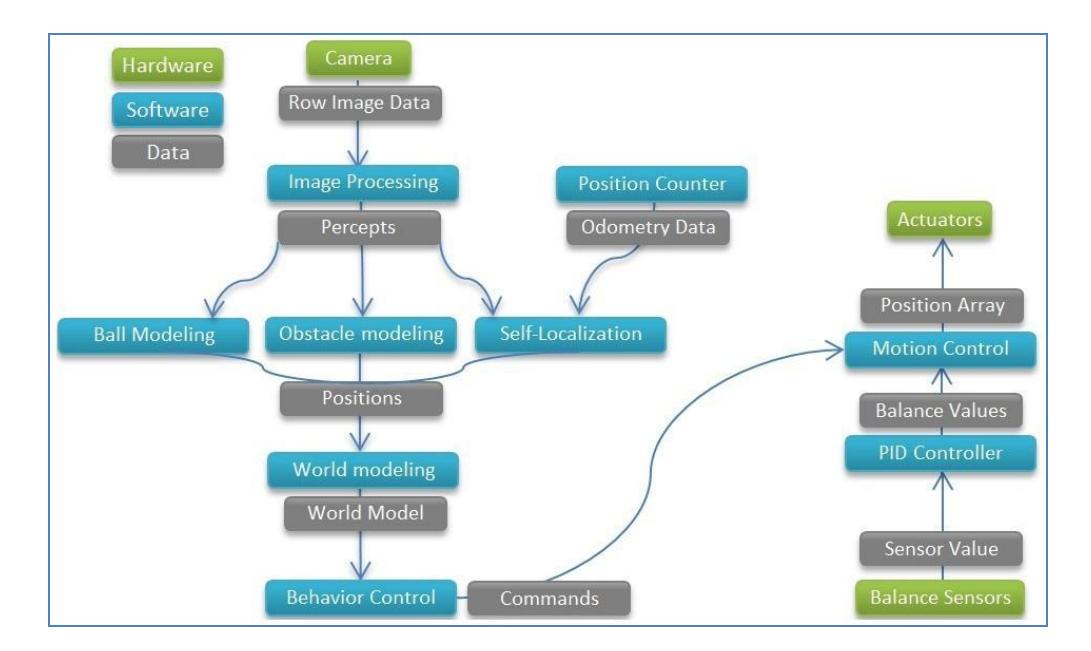
This diagram illustrates the overall Software Algorithm of the robots.
Localization
Knowing the position of a robot in complex environments like field of humanoid league is a challenging subject. To solve this problem, we use Monte Carlo Localization algorithm which propose a common and fast solution. In this algorithm, a large number of hypothetical random points will be used for posterior estimation.
The Kick Action
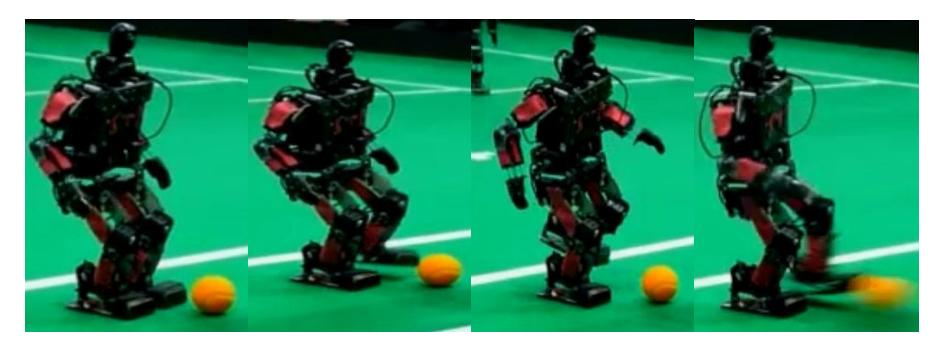
Generating adaptive and online trajectories for special actions of a robot is an important and challenging issue in humanoid robots. We have applied a novel method for online generation of an adaptive trajectory for the kick action of a humanoid robot using reinforcement learning. We obtained important joints for a kick action by visual inspection of human kick and statistical analysis of kick actions of humanoid robot models in a simulated 3D environment. We reduced the search space of the applied reinforcement learning algorithm by imposing some simplifications and restrictions. Finally we are employing a neural network to estimate the value function of the reinforcement learning algorithm.
Conclusions and Acknowledgments
This report described the future technical plans and also works done by the AUTMan Humanoid Kid-Size Robot Team for its entry in the RoboCup2012 Humanoid Kid-Size League which has been supported by Amirkabir Robotic Center at Amirkabir University of Technology (Tehran Polytechnic). Our focus for the second year of RoboCup competition has been on developing new generation of our robots, localization, motion behavior, and vision module due to our past and relevant experience of our SPL researches as well as other researches in various RoboCup leagues which will be appropriate in Humanoid Kid-Size League and can be useful by some changes. We look forward to continuing and expanding our above research with the new humanoid robots. For further information and to be familiar with our previous and new publications and recent activity done in the humanoid community and also for seeing more pictures and videos, please see our official website.
References
- Inada, H. and K. Ishii, K.: A Bipedal Walk Using a Central Pattern Generator. In Brain-Inspired IT I, pages 185 188. Elsevier, (2004).
- Matsuoka, K.: Mechanisms of Frequency and Pattern Control in the Neural Rhythm Generators. Biological Cybernetics, 56:345 353, (1987).
- Kennedy, J., Eberhart, R.: Particle Swarm Optimization. Proceedings of IEEE International Conference on Neural Networks. IV. pp. 1942–1948.
- Kajita, S., Matsumoto, O. and Saigo, M.: Real-time 3D Walking Pattern Generation for a Biped Robot with Telescopic Legs. Proc. of the 2001 ICRA, pp.2299- 2308, (2001).
- Salavati Dezfuli, S., under supervision of Prof. Bahrami, M.: Design and Manufacturing of a Humanoid Robot. B.Sc. Thesis in Persian, (2008).
- Malmir, M., Shiry, S.: A Model of Object Recognition for Home Robots Inspired by the Primate Visual Cortex. RoboCup Symposium 2009, June 30-July 3, Austria, (2009).
- Shafii, N., Mohamad Nezami, O., Aslani, S. and Shiry Ghidary, S.: Evolution of Biped Walking Using Truncated Fourier Series (TFS) and Particle Swarm Optimization (PSO). RoboCup Symposium 2009, June 30-July 3, Austria, (2009).
- Hadi Valipour, H., Shiry, S.: Optimization of Emotional Learning Approach to Control a Biped Robot. Under review.
- Cheng, H.D. et al,: Color Image Segmentation. Advances and Prospects Pattern Recognition 34, 2259, 2281, (2001).
- The Parsian3D team members,: Polytechnic-Parsian3D RoboCup2010 Team Description Paper RoboCup2010. Singapore, Singapore, (2010).
- AUTMan team members,: AUTMan Standard Platform Robot League Team Description Paper, RoboCup2011, Istanbul, Turkey, (2011).
- www.robotis.com
- Salavati Dezfuli, Saeed et al. "Feedback Linearization Control of Zero Moment Point of a Biped Robot ", RoboCup IranOpen 2011 Symposium.