Robo-Erectus Jr-2012 KidSize Team Description Paper
Buck Sin Ng, Carlos A. Acosta Calderon, Changjiu Zhou
Advanced Robotics and Intelligent Control Centre, Singapore Polytechnic
Abstract This paper provides a brief description of Robo-Erectus Jr-2012 that is set to participate in the KidSize category in the Humanoid League of Robocup 2012. Robo-Erectus Jr-2012 is the latest version of humanoid developed in the Advanced Robotics and Intelligent Control Centre of Singapore Polytechnic.
1 Introduction
The Robo-Erectus project (www.robo-erectus.org) started as early as 2002 in the Advanced Robotics and Intelligent Control Centre (ARICC) of Singapore Polytechnic and has been active in the field of Humanoid research and developments since. The aim of the Robo-Erectus team is to develop a humanoid platform that can be used for research and education [1].
Robo-Erectus is one of the pioneer soccer-playing humanoid robots in the RoboCup Humanoid League, having participated in Robocup 2002 Fukuoka when the league first begins. Robo-Erectus came in 2nd place in the Humanoid Walk competition in Robocup 2002 and 1st place in the Humanoid Free Performance competition in Robocup 2003. In 2004, Robo-Erectus won the 2nd place in Humanoid Walk, Penalty Kick, and Free Performance. In 2007, it finished 6th on the 2 vs 2 games, and 3rd on the technical challenge. In 2010 and 2011, Robo-Erectus managed to pass to the second round robin stage in the competition.
This paper is organized as follows. In Section 2, the mechanical and electrical designs are presented. Following, the motion control system, image processing and robot behavioral control system are described respectively. In Section 4, the concluding remarks are presented. Finally, a statement of commitment for the RoboCup 2012 is presented in Section 5.
2 Hardware Design
2.1 Mechanical Design
Figure 1 shows the design of the humanoid robot REJr-2012 (codename Bv-Mk2). The robot is constructed using customized aluminum brackets to provide the necessary structural support without comprising on the robustness, the mechanical structure is similar to that of the REJr-2011, only minor modifications to brackets were made. REJr-2012 adopts a polygon link structure in the leg that increases the number of joints but simplifies the locomotion manipulability (See Table 1).
Robo-Erectus Junior has a total of 22 degrees of freedom; 14 in the legs, 6 in the arms and 2 in the head. Table 2 describes the associated degrees of freedom. Each degree of freedom is actuated by a Kondo Digital Servomotor ; the upper body employs the Kondo KRS-4014 S-HV and lower body employs the Kondo KRS-6003 HV servomotor. Table 3 provides the servomotor's specifications.
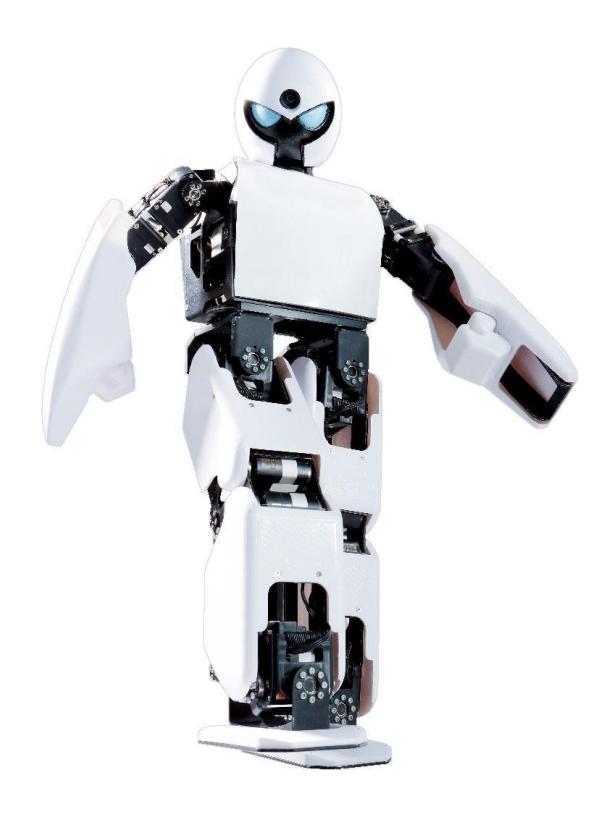
Physical Specifications of the REJr-2012.
| Weight Height | Dimensions | Speed | ||||
|---|---|---|---|---|---|---|
| Width | Depth | Walking | Running | |||
| 4.4kg | 560mm 240mm 120mm 30cm/sec 50cm/sec |
List of Degrees of Freedom for the humanoid robot REJr-2012.
| Body Part Roll Pitch Yaw | |||
|---|---|---|---|
| Head | X | X | |
| Shoulder | X | X | |
| Elbow | X | ||
| Hip | X | X | X |
| Knee | X | ||
| Ankle | X | X |
Specifications of the actuator.
| Actuator | Torque | Speed | ||
|---|---|---|---|---|
| KRS-4014 S-HV 40.8 kg.cm @ 10.8v 0.19 sec / 60 deg @ 10.8v | ||||
| KRS-6003 HV | 67.0 kg.cm @ 11.1v 0.22 sec / 60 deg @ 11.1v |
2.2 Electrical Design
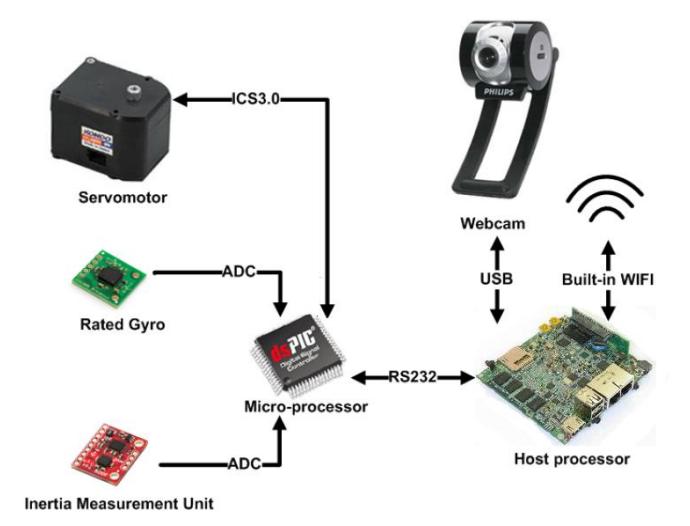
Figure 2 shows the electrical architecture of the Robo-Erectus Junior. Robo-Erectus Junior adopts a decentralized system in which the task are sub-divided and assigned to two level of processors; high level host processor and low level micro-processor. Table 4 shows the specification of these processors.
- The high level host processor consist of a single main processors that processes and coordinates behavioral aspect of the robot. High complexity or computational demanding task such as image processing and behavioral control are handled by the host processor.
- The low level micro-processor handles task that requires real-time handling. These task include motion control, sensor feedback and communication with the main processor.
Robo-Erectus Junior is equipped with four type of sensors. Table 5 shows the specifications of the sensors employed.
- An USB camera running at 30 frame per second to capture images is connected to the host processor.
- An inertia measurement unit IMU, consisting of 2-axis gyros and 3-axis accelerometers, is used to measure the tilt of the robot during play.
- A rated gyro is connected to the micro-processor to give orientation information during the absence of localization information from the camera.
- Each servomotor is embedded with a positioning sensor to provide angular positions feedback for each joints.
Communication between the host processor and micro-processor utilizes the standard RS232 serial link. For communication with its teammate, Robo-Erectus Junior uses a wireless network. The host processor has a built-in WIFI module that allows information exchange to and from the robot.
Robo-Erectus Junior is powered using a single 3-cells high-current Lithium polymer rechargeable battery which allows 15-20 minutes of operation. The battery is encase in the body with proper fail-safe electronics for safety and protection.
Specifications of the processors
| Features High Level Host Processor Low Level Micro-Processor | ||
|---|---|---|
| Processor | fitPC | dsPIC |
| Speed | 2000Mhz | 80Mhz |
Specifications of the sensors
| Sensor | Details | ||
|---|---|---|---|
| Camera | 640x480 Resolution 30fps. | ||
| Gyro (IMU) | $\pm 500^{\circ}/sec$ angular rate. | ||
| Accelerometer(IMU) | $\pm 3g$ | ||
| Rate Gyro | $\pm 300^{\circ}/sec$ angular rate |
3 Software Specifications
3.1 Motion Control
Robo-Erectus Junior employs Estimation of Distribution Algorithm EDA [2, 3] and Factorized Distribution Algorithm FDA based gait optimization method to generate biped gaits that satisfy a criterion. The EDA speeds up the searching in a highly dimensional coupling space constructed by the permutation of the optimization parameters to establish a periodic orbit in biped locomotion whereas the FDA, based on the maximum entropy principle, helps to better understand how information are transferred between these parameters [4].
This year, to increase the robustness of the Robo-Erectus Junior's locomotion, an approach using neural oscillator as Central Pattern Generator for a biped robot locomotion [5] with compliance control [6] was implemented. Simulations show that this approach helps the robot achieve better stability in walking.
3.2 Image Processing
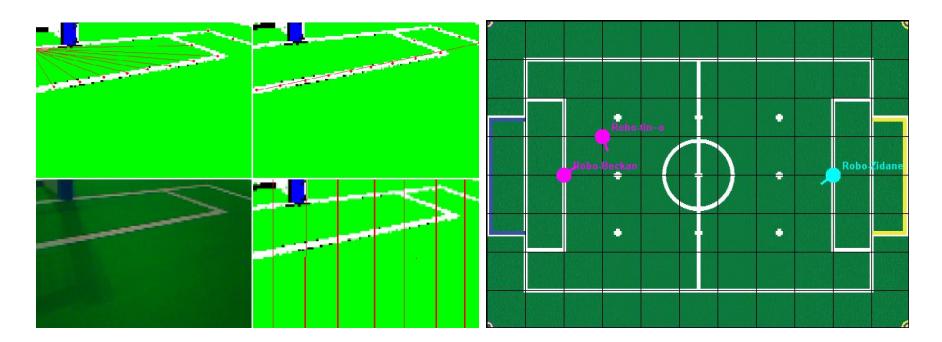
The computer vision software on-board Robo-Erectus Junior detects the ball, the goals, the corner poles, field lines and other players using the YUV color space. A predefined look-up table segments the image obtained from the camera in the YUV range for object recognition.
Segmentation of the image is performed using scan lines that are distributed across the image to reduce the processing time. A characteristic series of color or pattern of color segments is an indication of an object of interest.
Following in a multistage process, relevant colored objects are detected (See Fig. 3) and important features(lines, landmarks, and the ball) are recognized [7]. The position of each object is estimated to an egocentric frame and merged with previous observations to yield a robust egocentric world presentation. A motion model is used to adjust the observation when the robot is moving.
3.3 Behavior Control
The behavior control module, consisting of a framework of hierarchical reactive behaviors, provides the functioning of the robot in autonomous mode. This structure restricts interactions between the system variables and thus reduces the complexity [8, 7]. The control of the behaviors happens in three layers: skill, reactive, and planning layer.
The skill layer controls the servo, monitors targets, actual positions, and motor duties. The skill layer translate actions from the reactive layer into motor commands and feedback to the reactive layer once the commands are executed.
The reactive layer implements the robot behaviors like walking, kicking, getting-up, and so forth. This layer selects the behaviors based on the desire task that the planning layer send. Corrections behaviors required due to deviation from actual task is also handled by this layer.
The planning layer use the behaviors of the reactive layer to implement soccer skills such as defending and attacking behaviors. The behaviors at the planning layer are abstract goals which are passed to the reactive layer.
3.4 Dynamic Role Assignation
In a robot soccer game, the environment is highly competitive and dynamic. The proposed approach conceived the team as a self-organizing strategy-based decision making system, in which the robots are able to perform a dynamic switching of roles in the soccer game. The changing of roles will be filtered based on three criteria; Strategy, Game Time and Goal Difference respectively [9].
- Strategy, the strategy to be used for the game will be selected before kick-off and half time of the game. The strategy defines the final objective of the team, and specifies if team should be more offensive or defensive in their play.
- Game Time, the time of the game, 10 minutes for each half of the normal game, and 5 minutes for each half of extra time when required.
- Goal Difference, defined as the difference of own team goal score and opponent team goal score.
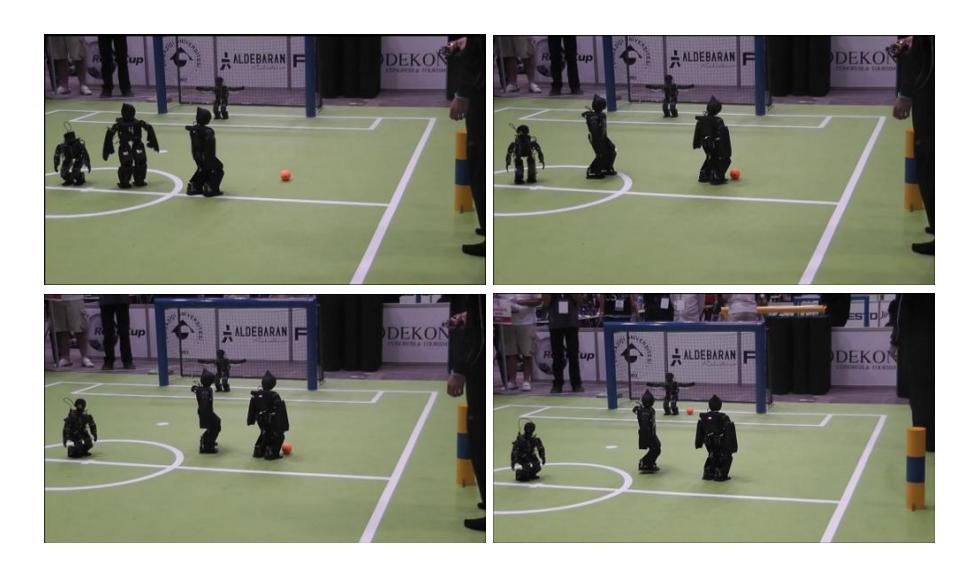
At several points during the robot soccer game, the robots need to communicate with one another. This may involve informing agents of events or responses, asking for help or information, and negotiating to iron out inconsistencies in information or to agree on a course of action. Negotiation will be necessary when changing of roles is required. In review of the dynamic roles design, the ball approach method should be taken into consideration. Team formation change may be based on the positions of the three robots. This could be useful when two robots required negotiating for a particular role. The proximity and approach to the ball could be used to determine which robot would get the role. Besides, the ball approaching and ball possession is important to coordinate the robots during the game. During a game there could be situations where a team must play with substitute robots, and occasionally the team must play with fewer players. To deal with these situations, the proposed formations roles with priorities. These priorities indicate which roles must be filled first. Figure 4 presents the approach to ball and team coordination with two robots. Since both robots have striker role, both will try to approach the ball. However, once one striker reach the ball and takes possession of the ball, the second striker will keep a distance. This coordination has been further explore to pass the ball.
Formations and priorities of the roles per formation.
| Formation | Highest | High | Low |
|---|---|---|---|
| Defensive | Goalie | Defender Defender | |
| Normal | Goalie | Defender | Striker |
| Offensive | Goalie | Striker | Striker |
| Super Offensive Defender | Striker | Striker | |
| All Out | Striker | Striker | Striker |
4 Conclusion
In this paper, we introduced the state-of-art of the Robo-Erectus Jr-2012 humanoid robot. In compare to its predecessors, the latest version of the Robo-Erectus has significant improvements to its speed, stability and reliability and is prepared for the Robocup 2012 competition. For more detailed information about the Robo-Erectus, please refer to the team's website www.robo-erectus.org.
5 Statement of Commitment
Our Team Robo-Erectus is committed to take part in the Humanoid League, KidSize category, at the RoboCup 2012. Our Team consists of professional staff and students so that we can perform our best in the competition. Robo-Erectus Team commits that a member of the team will be proficient to serve as referee during the KidSize competition. The Team commits that the member that will act as referee will be able to act as main referee, assistant referee or Referee Box Controller. Robo-Erectus Team also understand the implication of failing to any of these commitments for future participation in the Humanoid League.
Acknowledgments
The authors would like to thank staff and students at the Advanced Robotics and Intelligent Control Centre (ARICC) and higher management of Singapore Polytechnic for their support in the development of our humanoid robots.
References
- C. Zhou and P.K. Yue. Robo-Erectus: A low cost autonomous humanoid soccer robot. Advanced Robotics, 18(7):717–720, 2004.
- L. Hu, C. Zhou, and Z. Sun. Estimating probability distribution with Q-learning for biped gait generation and optimization. In Proc. of IEEE Int. Conf. on Intelligent Robots and Systems, 2006.
- L. Hu, C. Zhou, and Z. Sun. Hybrid estimation of distribution algorithm with application to biped gait generation. Information Sciences, 2006.
- Carlos Antonio Acosta Calderon, Rajesh Elara Mohan, Lingyun Hu, Changjiu Zhou, and Huosheng Hu. Generating human-like soccer primitives from human data. International Journal of Robotics and Autonomous Systems, 57(8):860–869, 2009.
- Carlos Antonio Acosta Calderon, Rajesh Elara Mohan, and Changjiu Zhou. Rhythmic locomotion control of humanoid robot. In MICAI 2008: Advances in Artificial Intelligence, volume 5317/2008, pages 626–635, Oct 2008.
- Masaki Ogino, Hiroyuki Toyama, Sawa Fuke, Norbert Michael Mayer, Ayako Watanabe, and Minoru Asada. Compliance control for biped walking on rough terrain. In RoboCup 2007: Robot Soccer World Cup XI, volume 5001/2008, pages 556–563, July 2008.
- Carlos Antonio Acosta Calderon, Changjiu Zhou, Lingyun Hu, Pik Kong Yue, Mohan Rajesh Elara, and Huosheng Hu. A modular architecture for humanoid soccer robots with distributed behaviour control. International Journal of Humanoid Robotics, 5(3):397–416, 2008.
- Carlos Antonio Acosta Calderon, Changjiu Zhou, Pik Kong Yue, Mike Wong, and Mohan Rajesh Elara. A distributed embedded control architecture for humanoid soccer robots. In Proc. of Advances in Climbing and Walking Robots, pages 487–496, Singapore, July 2007.
- Carlos Antonio Acosta Calderon, Rajesh Elara Mohan, and Changjiu Zhou. Robot Soccer, chapter Distributed Architecture for Dynamic Role Behaviour in Humanoid Soccer Robots, pages 121–138. IN-TECH, 2010.