AUTMan Humanoid Team Description Paper <RoboCup 2013 Humanoid Kid-Size Robot League>
Hafez Farazi, Mojtaba Karimi, Mojtaba Hosseini, Majid Jegarian, Donya Rahmati, Farzad Aghaeizadeh, Dr. Soroush Sadeghnejad, Dr. Saeed Shiry Ghidary
Humanoid Robotic Laboratory, Amirkabir Robotic Center, Amirkabir University of Technology. No424, Hafez Ave., Tehran, IRAN. P. O. Box 15875-4413.
http://www.arc.aut.ac.ir/autman
Abstract This document introduces AUTMan Humanoid team for participating in Humanoid Kid-Size Robot League in RoboCup 2013 in Eindhoven, The Netherlands. Our humanoid kid-size research is mainly based on the other active research groups working on different RoboCup leagues in Amirkabir University of Technology. After getting more experiences via participating in many competitions and being among teams of quarter final of RoboCup 2012 and also first rank of Iran Open 2012, AUTMan is getting ready to focus on software implementation for this year. We are also going to make a person, with sufficient knowledge of the rules, available as referee during the competition. A brief history of Team AUTMan and its research interests will be described. Future work based on the humanoid kid-size robots will also be discussed. Our main research interests within the scope of the humanoid robots are robust real-time vision and object recognition, localization, path planning and odometry.
1. Introduction
Study of humanoid robots and their stability have been the focus of too many researches in the last decades. A perfect application for developing humanoid robots that can interact with humans is RoboCup. RoboCup is pursuing the goal which states "By the year 2050, develop a team of fully autonomous humanoid robots to win against the human world cup champion team". Amirkabir Robotic Center of Amirkabir University of Technology (ARC) has been remarkably participating in Humanoid League of RoboCup competitions from 2011. Reaching to quarter final of Robocup 2012, standing first place in IranOpen 2012 and also AUTCup 2012, and by achieving experience through participating in various national and international competitions, AUTMan is stepping toward new field of study on humanoid robots. To state one of our active research projects on biped robots, we have been working on a new approach for generating a new walking algorithm. AUTMan have reached to a stable walking algorithm with an outstanding speed. For this year we are going to use this good condition through implementation of localization and path planning. AUTMan Humanoid Kid-Size Team has optimized his previous year designed robot hardware and will use new version of them for the coming competition in Eindhoven. This team description paper provides a brief overview of our relevant research since our participation in RoboCup Competitions and of current works which are imminent to be used during the competitions.
2. Hardware Design
This section describes the hardware design of the AUTMan platform.
2.1. Mechanical
Mechanical structure of our new 2013 platform is like 2012 with some modification "AUTMan STP" model. We have also some changes in electrical system and structure of hip and foot motors. AUTMan new robot kinematic structure is with 21 degree of freedoms. It is shown in figure 1. The design is such that urged us to use 6 degree of freedoms for each leg, 3 degree of freedoms for each arm and one in waist. Robots camera will be hold by 2 servo motors as a Pan-Tilt mechanism. For more performance and energy efficiency, our knee and waist motors are more powerful than the other joints.
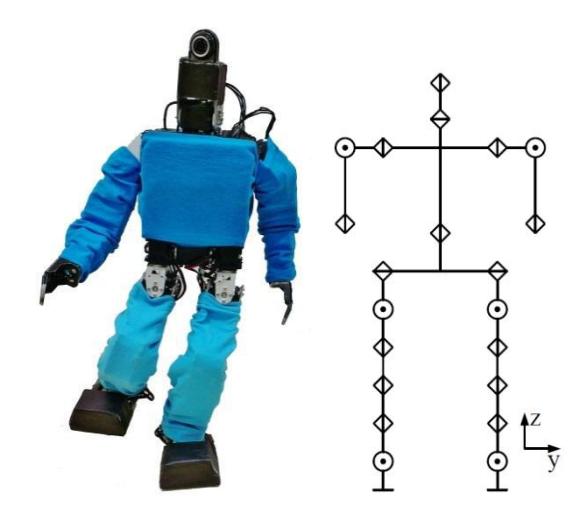
Table 1. Physical dimension of the robot
| Robot System | STP |
|---|---|
| Weight (kg) | ~3.80 |
| Height | 58 |
| Degree of Freedoms | 21 in total with 6 in each leg, 3 in each arm, 1 in meddle and 2 in neck |
| Actuators | RW-64, RX-28 |
| Camera | Logitech C905 wide 2 MP – 640x480 @ 30 fps |
| Main Board | MaxData QutePc3020 1.6 GHz dual-core intel processor, 2 GB DDR2 memory, SSD 50 GB |
| Operation System | Customized Windows XP SP3 |
| Battery | Li-Po 18.5 V 2000 mAh |
All our robots have same mechanical structure, it will help us to design and construct each of the robots fast and cause to use them in different missions without any difficultly, also this job help us to calculate one and same camera matrix of robot kinematic for high level software structure for localization task. Table.1 shows AUTMan 2013 robots hardware structure.
2.2. Electronic & Sensors
Many of the functions needed to communicate with devices like actuators and sensors in different method such as I2C, RS484, Serial TTL, ADC and etc. So in our new platform we have designed two interfaces which used to USB to serial FTDI chip for communicating between PC based main controller.
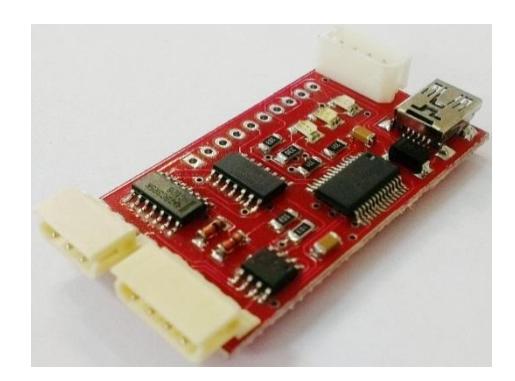
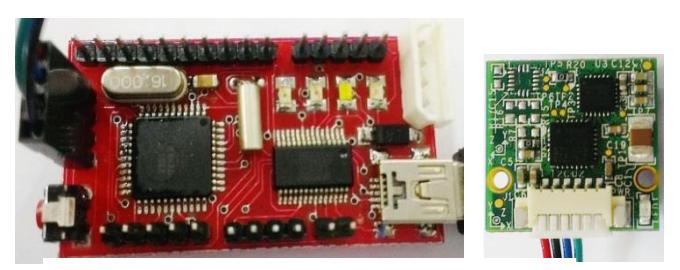
It uses one ARM® Cortex M3 microcontroller working on 72 MHz for low level processing of gyro and accelerometer data that provided by RM-G146® IMU sensor module from ROBOARD®.co. IMU module and RM-G146 module is shown in figure 2. AUTMan IMU module can provide changing in 3angle of rotation (Pitch, Roll and Yaw) in 200Hz sample rate of filtered orientation data and rotation speed of the robot in quaternion space for our high level DCM (Device Communication Manager) controller level. AUTMan IMU named GnMPU [1] is 9 DOF Motion Processing Unit which is designed and produced by team members.
For communicating with Dynamixel® motors which are in different type of communicating system like Serial TTL and RS485 port, we design new USB2Dynamixel module able to communicate with both of TTL level and RS485 level at same time. By this module (figure 3), using of different type of Dynamixel® actuator is available for our new humanoid platform.
3. Software design
This section describes the software design components of the AUTMan system.
3.1. Vision Module
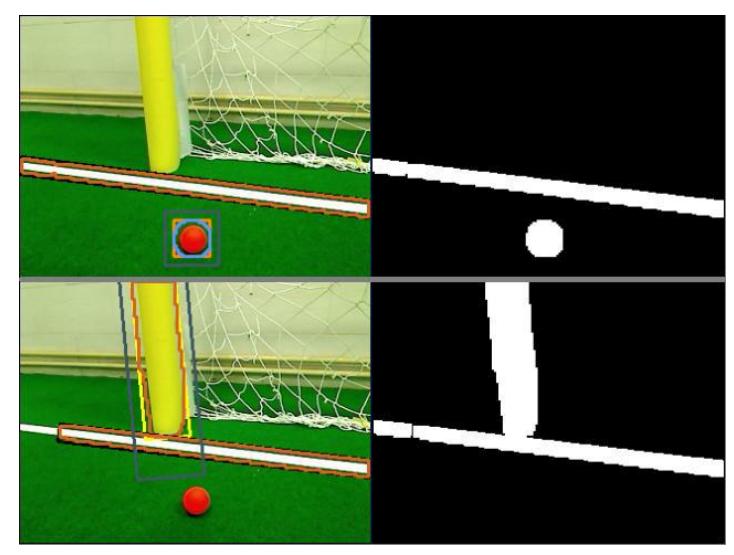
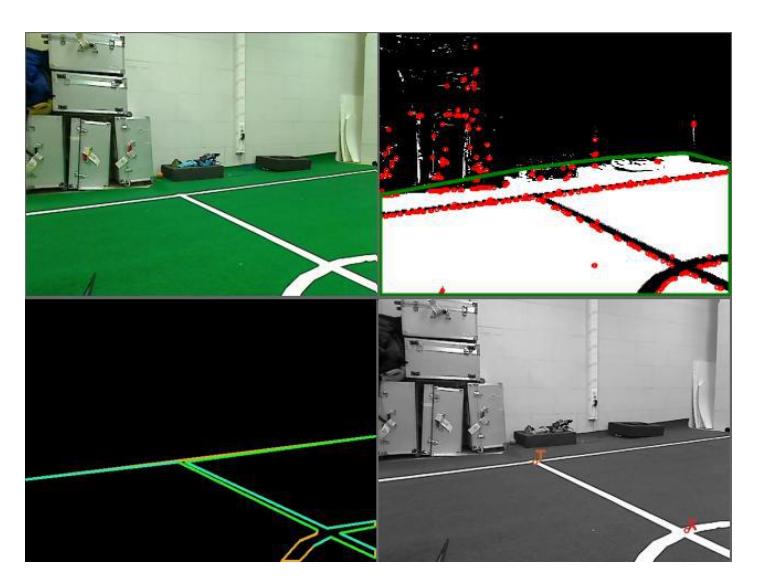
Computer vision plays an important role in humanoid robots. The task of this module is to determine relative position of ball, goals (figure 4), landmarks, penalty markers, field lines (figure 5), teammates, and opponents in the input camera images based on the current position of robot. We have generated an estimation of the distance of robot to the detected object using size of the object and the position of detected object on the frame considering the head tilt position. Afterward this information will be used to generate robots world model and High-Level decisions including robot behavior and task. In addition, the information derived from vision module is used for localization purpose. In this module, we apply color base labeling to detect objects in the environment [2].
3.2. Motion Control
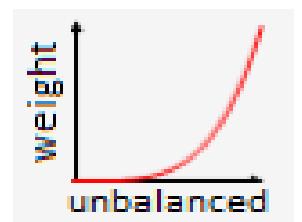
This year, for RoboCup competitions, we have made some improvements on the robot locomotion and its optimization in terms of quickness, flexibility, and stability. Due to its robust mechanical structure, the optimizations that we have made on the walking system, has improved the maximum speed of forward walking to 46cm/s. We are using the same trajectories and gait patterns represented in [3] for robot's limbs. But we dynamically change the gains of some of them during walk. A good omni-directional walking skills are essential for winning games. The optimization of the robot's balance, i.e. the optimization methods use the limbs trajectory and gait inputs to reach a good and fast response [4]. So our major task was to ensure the maximum speed for any direction during walk. In order to achieve this we presented a new method of balance controlling behavior. We name our method the combined-method of balance controlling. What we have done is to determine which methods of balance stability controls are better to implement, then we have combined them giving a weight to each of them. The weights are experimentally hand-tuned for the flat field of the RoboCup competitions. Here we have presented our balance stability controlling methods, which are:
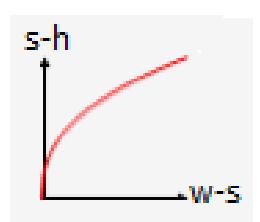
Dynamic Step-Height Trajectory Controller: On our robots, the height of every step is dynamic and depends on the speed of walking. This feature results the best balance while the robot's walk speed is less than the maximum speed. For The lower speeds, lower step-height is generated. The relation between walk-speed and stepheight is shown in figure 6.
3.3. Localization
In soccer environments lots of algorithm has successfully tested in the past ten years, including Extended Kaman filter [5], Particle Filter [6] and Rao-Blackwellized [7]. We applied Monte-Carlo localization [5] which is based on Baysian filter, in order to estimate the current absolute position of the robot in the field. In localization module, to estimate (x, y, phi) of each robot, were x and y represent robots position on the field and phi denotes the orientation of the robot body, we need a combination of the odometry and visual landmarks like goal and ball and lines. The visual landmarks came from motion module and visual landmarks are directly fetched from vision module. MCL recursively calculate the posterior probability of the robot's pose [6]:
$$p(x_t | z_{1:t}, u_{0:t-1}) = \eta \cdot p(z_t | x_t) \cdot \int_{x_{t-1}} p(x_t | x_{t-1}, u_{t-1}) \cdot p(x_{t-1} | z_{1:t-1}, u_{0:t-2}) dx_{t-1}$$
Where is the Bayes's rule normalization constant, is the motion command sequences up to time t-1, is the observation sequence. The term of ( | ) is represent motion model and shows the probability of being in the state after executing command in the state . ( | ) is the likelihood of observing in the case of being in the position. MCL uses a random set of initial particles; each particle denotes a belief of the current robot position. In order to solve the kidnaped robot problem (lifted robot with handler) we replace a few fixed numbers of samples with random particles.
3.4. Path Planning
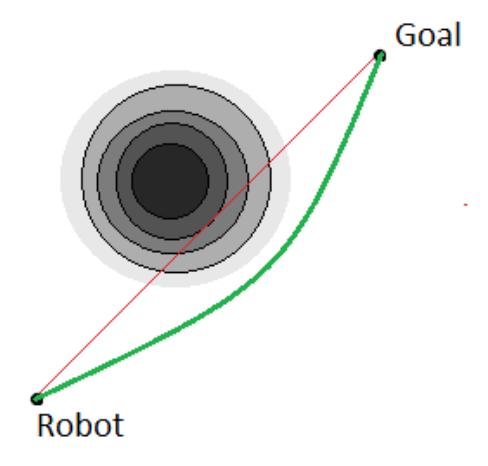
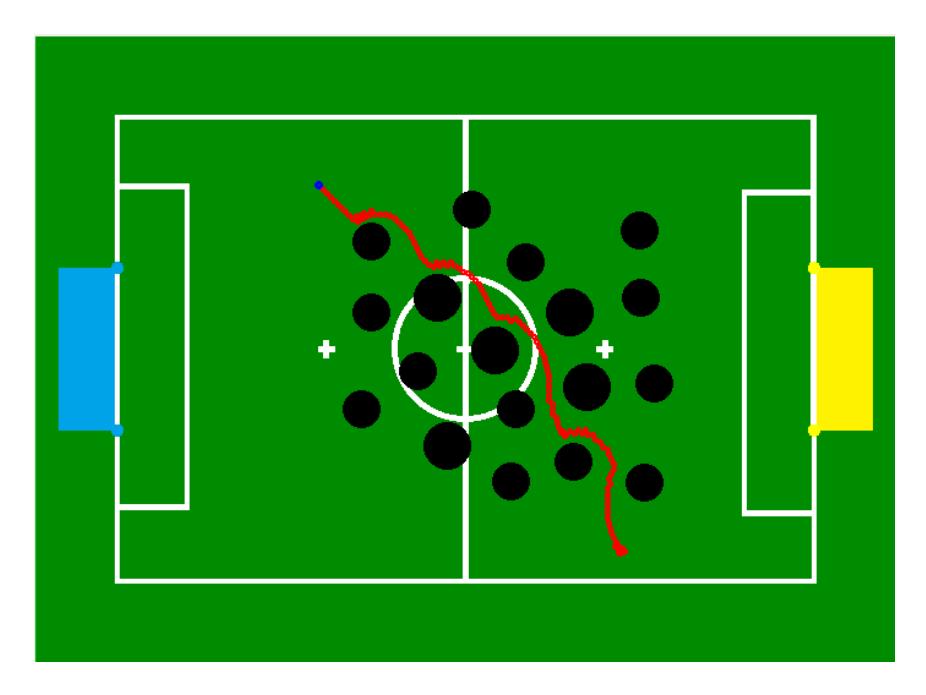
We use Potential Field (PF) as an efficient and robust path planning algorithm. We model each obstacle i.e. opponent robot as a 2D Gaussian were each axes correspond to the estimated error [8].
4. Conclusions and Acknowledgments
This report described the future technical plans and also works done by the AUTMan Humanoid Kid-Size Robot Team for its entry in the RoboCup2013 Humanoid Kid-Size League which has been supported by Amirkabir Robotic Center at Amirkabir University of Technology (Tehran Polytechnic). Our focus for the third year of RoboCup competition has been on developing, localization, motion behavior, and vision module due to our past and relevant experience of our SPL researches as well as other researches in various RoboCup leagues which will be appropriate in Humanoid Kid-Size League and can be useful by some changes. We look forward to continuing and expanding our above research with the new humanoid robots. For further information and to be familiar with our previous and new publications and recent activity done in the humanoid community and also for seeing more pictures and videos, please see our official website.
References
- www.arc.aut.ac.ir/autman
- Cheng, H.D. et al,: Color Image Segmentation. Advances and Prospects Pattern Recognition 34, 2259, 2281, (2001).
- Gait Pattern Generation and Stabilization for Humanoid Robot Based on Coupled Oscillators Inyong Ha, Yusuke Tamura, and Hajime Asama 2011 IEEE/RSJ International Conference on Intelligent Robots and Systems September 25-30, 2011. San Francisco, CA, USA
- Gait Optimization on a Humanoid Robot using Particle Swarm Optimization Cord Niehaus, Thomas Rofer, and Tim Laue (page 1, introduction)
- Team Edinferno Description paper for robocup 2012
- SPQR robocup 2009 standard platform league qualification report
- The university of Pennsylvania robocup 2011 spl nao soccer team description paper
- Li, X., Zhang, S., & Sridharan, M. (2009). Vision-based safe local motion on a humanoid robot. In Workshop on Humanoid Soccer Robots.
- H. Strasdat, M. Bennewitz, , S. Behnke, and S. Behnke, "Multi-cue localization for soccer playing humanoid robots," in In Proceedings of 10th RoboCup International Symposium. Springer, 2006.
- Dellaert, F., Fox, D., Burgard, W., Thrun, S.: Monte Carlo localization for mobile robots. In: Proc. Of the IEEE Int. Conf. on Robotics & Automation (ICRA). (1998)
- MaxData Cooperation ,http://www.maxdata.de
- Robotis Cooperation ,www.robotis.com