Team Description Paper for Team I-KID Robocup2014
Bi Junxi, Xie Ning, Chen Shuo, Ren Kaike, Shang Tian, Lou Xiaoping, Yan Bixi, Zhu Lianqing
Beijing Information Science&Technology University, Beijing, China
Abstract In this Team Description Paper, we describe the main changes of our humanoid robot for RoboCup 2014 Brazil. We mainly illustrate the new designed architecture of our robot, the improvements of hardware, mechanical structure and algorithm that aim to improve the performance of the robot.
Introduction
Team IKID is organized by a group of challenging undergraduates and graduates in BISTU (Beijing Information Science & Technology University) where Team Water, who won the first place of Mid-size league in the RoboCup 2010 Singapore , RoboCup 2011 Turkey, and RoboCup 2013 Eindhoven, comes from [1]. Team members devoted themselves to the research field of humanoid robot since 2010. The first time team IKID took part in RoboCup is China Open 2011, and it becomes one of excellent teams in China with fast pace. After that, with little experience in world champion, team IKID finally reached the elimination round in RoboCup 2012 Mexico(scored 12 goals) and RoboCup 2013 Eindhoven. For RoboCup China Open 2012 and 2013, we also won several honors. Based on these field competitions, we are stepping to upgrade the hardware as well as relevant algorithms including vision processing, world modeling, behavior and motion control. This year, we also designed a type of new robot by ourselves with great enhancement in computing capability and phased-out the old robot which is not competitive for the time being.
Overview of the System
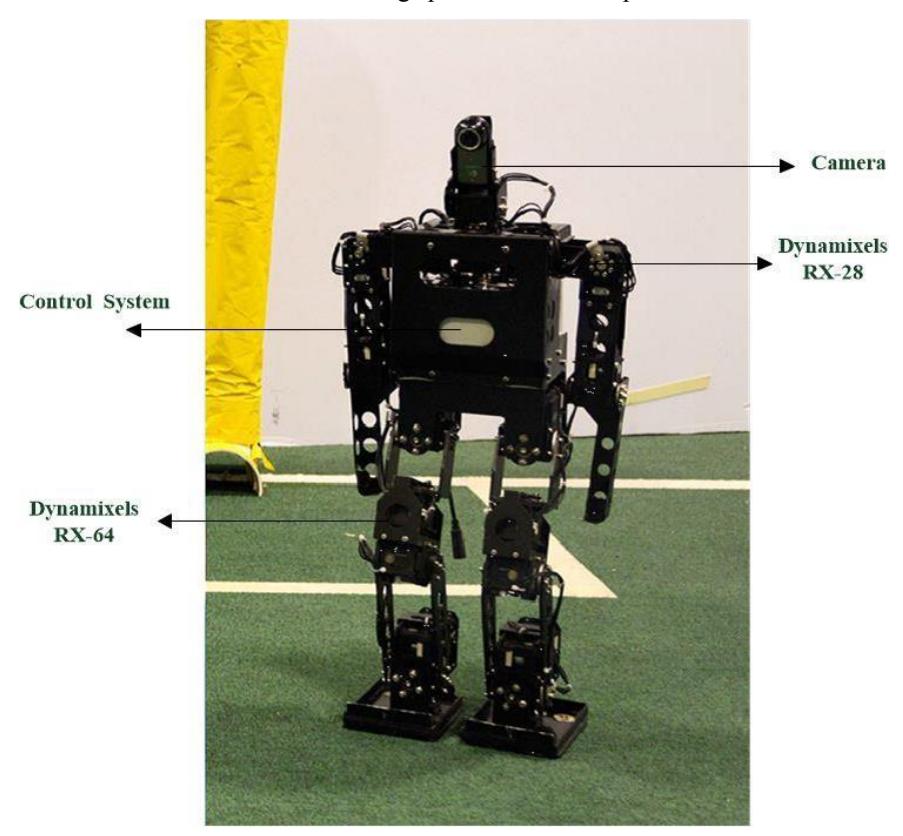
Our new robot is shown in Fig.1. It has twenty degrees of freedom (DOF), six RX-64 in each leg, three RX-28 in each arm and two RX-28 in the neck. Compared with old robot, the new one removes the DOF in waist, this change makes mechanical structure more stable and achieve a faster walking speed with 20% improvement.
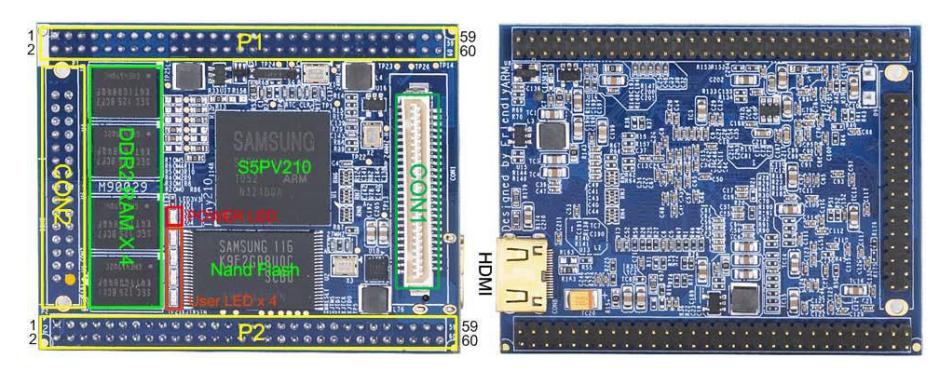
The newly designed robot makes a significant improvement with the computing speed. PC104 computer is replaced with a cortex-A8 based CPU Samsung S5pv210, depicted as Fig.2. The processor clocked at 1GHz does not only exceed in frequency, but also in power consumption. 512MB memory combined with 1G FLASH is sufficient to load any algorithms for soccer, such as fast image processing, particle filter based world modeling. High data load on USB bus with YUV space image, which means noise vulnerable for transfer, is exchanged with smaller sized JPEG alternatives.
While on PC104 computer, the time consumption for JPEG decompression is unable to fit system requirement. S5pv210 is capable to decode the image at little cost, powered by its hardware JPEG codec.
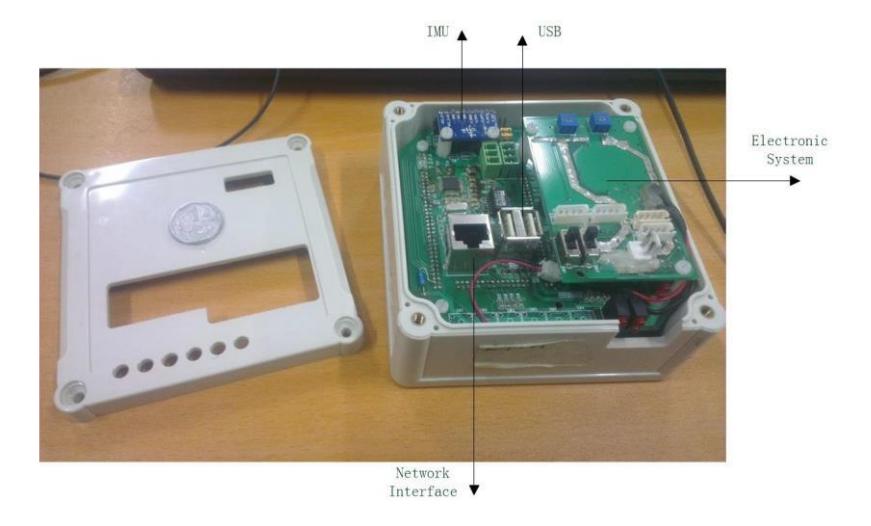
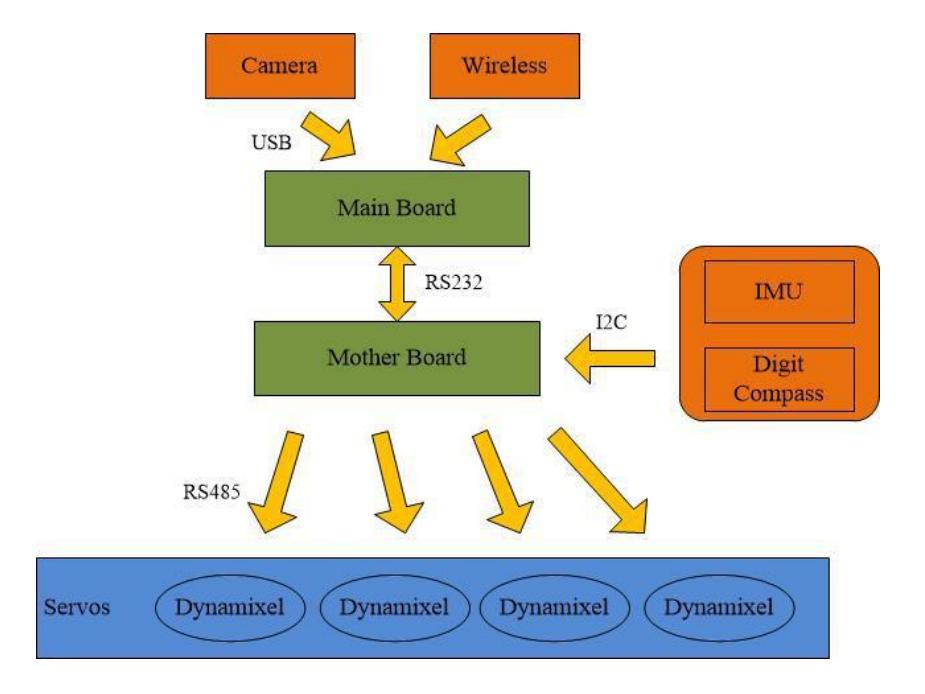
The mother board where the CPU is seated, is composed of a microcontroller as a gait controller, USB ports, an Ethernet for updating program, a power conversion module, a RS232C interface for transferring data from the main board and a RS485 interface for receiving and sending commands to Dynamixels. The new controller structure is depicted as Fig 3.
The mother board where the main board seated mainly consists of an ARM-M3 CUP LPC1768 worked as a gait controller, IMU module, digital compass module, some interface and a power control system, its main job is receiving data from the main board through RS232 and sending commands to Robotics Dynamixels through RS485.
Instead of multi-boards stack mounting method with PC104 standard, which makes it heavy, less robust and hard to be cued, we adopted an encapsulation of this core CPU with backplane into a standard box. Therefore, the robot controller is exchangeable as a whole unit rather than stand-alone bare PCBs. The standard controller unit will greatly improve the robustness, and make fast treatment possible during a game play in emergency [2]. Mechanical structures are also updated to fit this controller unit, but few are changed for DOF configurations.
Improvements
Mobility
With the remove of waist DOF, the most significant improvement of our robot is mobility. It can walk robustly and speedily, its max speed can achieve 0.06m/s and still maintain stable while the old one walk at only 0.04m/s. Since the DOF changed, we redesigned the gait control system and add servo control with IMU data to prevent robot falls.
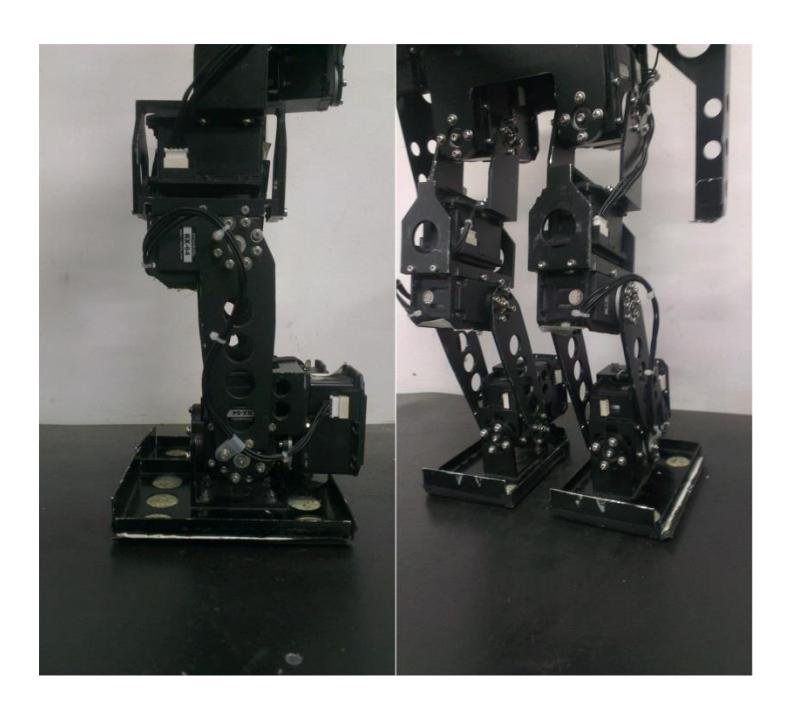
In order to adapt the change of DOF , we redesigned the mechanical structure of knee joint so that robot can maintain stable while turning around, depicted as Fig.5. In addition, this change makes robot achieve a faster rotation speed around z axis because it can turn around with less joint movement.
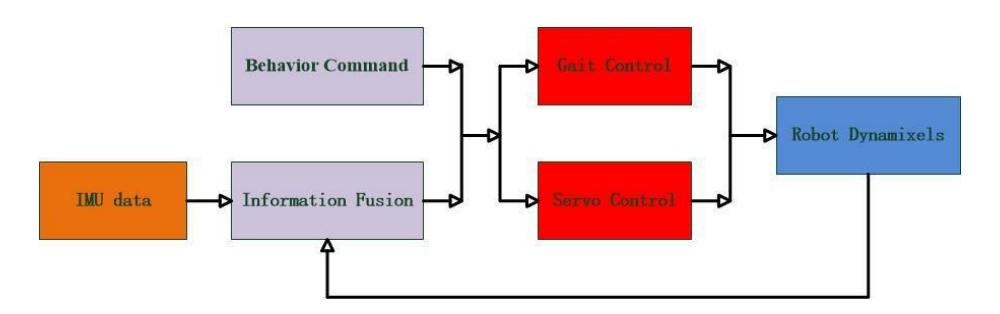
Servo gait control system
IMU plays an essential role in robot posititon detecting. This year, we introduce a new servo control system to make full use of IMU for preventing robot falls while walking.
IMU data reflects the perspective of robot's body. With gait control system which based on the Three-Dimensional Linear Inverted Pendulum and ZMP discipline, the robot can maintain stable when walking undisturbed [3]. But on the competition field the environment is dynamic and unpredictable, and collisions between robots are unavoidable. To increase stability, we enable the robot correct joints' state for every control cycle instead of control robot gait by precomputed trajectories [4].
PostureRecover()
1:
2: if | | then
3: if then
4:
5: else
6:
7: end if
8: end if
9:

10:
This program is based on the concept that using gyro data to generate robot gait by closed-loop control. depicts the compensation of the th gait control cycle, the servo gait control system is shown in Fig.6.
World Modeling
Particle Filter acts as an essential role in our world modeling procedure. In order to improve this key algorithm to reach a much more precise and stable result, we updated the particle filter algorithm in two aspects: elimination of the unnecessary resampling, and a new strategy to dealing with kidnapping and localization fault recovery.
The resampling used to take place every cycle of iteration, and increase the risk of losing particle diversity, and thus make a worse description of the distribution. To fix this shortcoming, current resampling happens depending on the variance of the importance weights.
Instead of resampling every cycle the robot maintains the importance weight in memory and updates them as follows if the variance of important weights of the particles is within the threshold.
$$w_t^{[m]} = \begin{cases} 1 & \text{if resampling took place} \ p(z_t|x_t^{[m]})w_{t-1}^{[m]} & \text{if no resampling took place} \end{cases}$$
This is based on the concept that the variance of weights relates to the efficiency of the sample based representation [5].Resampling should happen only when the particles suffer from representing inefficiency, as depicted as Fig 7.
![Fig. 7. Resampling required time [5]](/tdps/soccer_humanoid_kid__2014__I-KID/_page_6_Figure_5.jpeg)
![Fig. 7. Resampling required time [5]](/tdps/soccer_humanoid_kid__2014__I-KID/_page_6_Figure_6.jpeg)
Conclusion
In this paper we described the hardware architecture of our new robot, the mechanical structure improvement and the servo gait control system that we will use to improve the mobility and stability of the robot.
IKID will provide a referee knowledgeable of the rules of the Humanoid League during RoboCup 2014 Brazil and will participate in this game as schedule.
References
- Bi Junxi, Tan Xiaofeng, Guo Yunkai, Xie Pengcheng, Zhang Jiwen, Lou Xiaoping.: I-KID: Team Description Paper for Team I-KID RoboCup2013(2013).
- Thomas Rofer, Tim Laue, et al: B-Human Team Report and Code Release 2011(2011), http://www.b-human.de/
- Feng Xue. Biped Locomotion Control in Indoor Environment. University of Science and Technology of China, 2012.
- D. Gouaillier, C. Collete, C. Kilner. Omni-directional Closed-loop Walk for NAO, 2010 IEEE-RAS International Conference on Humanoid Robots. Nashville, TN, USA, 2010, pp. 448-454.
- Sebastian Thrun, Wolfram Burgard, Dieter Fox.: Probabilistic Robotics. The MIT Press Cambridge, Massachusetts, London (2005)