Application from Hamburg Bit-Bots for RoboCup 2015
Marc Bestmann, Juliane Bödeker, Fabian Fiedler, Timon Giese, Judith Hartfill, Marcel Hellwig, Maxim Holand, Jessica Jobski, Robert Keßler, Maike Paetzel, Martin Poppinga, Dennis Reher, Bente Reichardt, Nils Rokita, Robert Schmidt, Oliver Sengpiel, Daniel Speck, Lars Thoms
Department of Informatics, Universität Hamburg, Vogt-Kölln-Straße 30, 22527 Hamburg, Germany
http://data.bit-bots.de/application2015WC.mp4 · http://youtu.be/1Keofpf7LxA · http://www.bit-bots.de
Abstract This Team Description Paper describes the humanoid robot team Hamburg Bit-Bots, from its history over currently used software and hardware to the research interests and achievements in RoboCup.
1 Introduction
The team Hamburg Bit-Bots consists of a group of students from the Department of Informatics at the University of Hamburg, Germany. It was founded in 2011 as a group of former participants of the official RoboCup bachelor project participating as RFC St. Ellingen in the SPL league. The new team was founded with the goal to integrate knowledge from different fields of our studies in a more practical approach. It was explicitly created for the participation in the humanoid league and thus started from scratch with new robots and a newly developed codebase.
The team is financially supported by the university and its Department of Informatics. Apart from that Hamburg Bit-Bots are an independent work group led and organised solely by students. All team members are currently computer science related students and are working on their bachelor's or master's degrees.
1.1 Prior performance in RoboCup
In 2012 we participated in the German Open and were placed third. Furthermore, we took part in the WorldCup in Mexico City and were dropped out in the second round robin, but successfully finished the Throw-In Challenge. Apart from that we joined the RoBOW 12.1, 12.2 and 12.3 in Berlin to push the interconnectedness between the European RoboCup teams and to take part in a research exchange.
In 2013 we participated in the German Open (second place) and organized a Mini RoBOW in Hamburg. The WorldCup in the Netherlands was a good view of our ongoing development progress and despite the fact that we missed the quarter finals, we were very pleased with In 2014 we participated in the German Open (placed third), the IranOpen and the WorldCup in Brazil. We were able to show our latest developments in hardware in Brazil and furthermore made close contact to another RoboCup Team from our home town which competes in the SPL. This gave us the opportunity to host the RoHOW jointly with them that brought together twelve international teams from the RoboCup SPL and humanoid leagues.
1.2 Further dedication in RoboCup
Apart from the participation during championships we have many projects to make robotics and RoboCup accessible to people. For example we participated in "Robots on Tour" in Zurich 2013, in the "Hamburg Night of Knowledge" and "Berlin Night of Knowledge". In cooperation with a school we created a yearly course in robotics for high school students which is a great success since 2013. Furthermore, in 2014, we started to provide practical lectures in robotics at our university which are highly attended by students.
2 Current Research
2.1 Construction of new feet
The feet of the robots in the HKSL are flat and stiff. Humans don't have flat and stiff feet. The sole of the human foot has a structure that only in some parts touches the ground and others parts that don't. This makes the standing more stable. The human foot is also flexible in itself which helps to adapt to the surface the foot is standing on. Regarding the change from carpet to artificial grass, more stability in the walking and the foot's adaption to the ground will be necessary.
2.2 Joints, muscles and tendons
In the human body there exists a hard skeleton and a lot of muscels that are used to move the skeleton. The construction of our robots is different. The motors work as muscles and are a part of the robot's skeleton. This causes much pressure on the motors. Therefore we try to add ribbons with motors working like muscles and tendons similar to the human joints. We hope that the load on our motors will decrease and the joints themselves will become smaller without losing any degree of freedom.
2.3 Localisation with Rat-SLAM
To enable the localisation in the RoboCup Soccer context, the algorithm Rat-SLAM, which does simultaneous localisation and mapping, was ported into an existing RoboCup framework. The algorithm was extended to use data from the existing image processing and to improve thereby the position matching. The use of the distances to the goal posts and of the lines in relation to the robot were examined. It was shown that these additional data can improve the matching of the RatSLAM algorithm. [1]
2.4 Bioinspired Pathfinding of Humanoid Robots
We are testing an approach of combining classic potential fields and bio-inspired learning algorithms for robot navigation to perform efficient path planning to the ball while aligning to the enemy goal [2]. With evolutionary training we create neuronal networks and use them as a dynamic layer of a potential field. We expect better results in contrast to the often used hard coded pathfinding.
2.5 Continuous simulation and evaluation of tryouts
To test our robot's behaviour we plan to set-up a continuous integration system which is simulating our source code in a virtual environment on nightly basis. Currently we are adapting the vrep simulation framework for our needs. With this set-up we would like to raise our software quality and give it a measurement.
3 Software
3.1 General Architecture
The software framework (released, [3]) in general is a cyclic program with several modules performing different tasks. In general we have developed a set of basic modules which does the general tasks which are necessary when a new frame from the camera is available or if there is new input from the team communication network stream. Those general modules have dependencies and produce data which is necessary for the behaviour. The behaviour itself is described below.
Next to the high level module based structure we have a different piece of software which provides a motion control architecture. The motion software is acting as a service to the high level module structure and can take commands for animations, positioning of motors and furthermore encapsulates the walking algorithm. We are using python and cython as well as C++ ranked from high level programming of behaviour down to low level sensor/motor control and fast implementations of algorithms.
3.2 Team Communication
For the Team Communication we use the mitecom library developed by the team FUmanoids. The shared protokoll of mitecom enables us to build mixed teams with other teams from the Humanoid League. We have already played a successful test game together with the team Bold Hearts in a mixed team at the WorldCup in Brazil.
3.3 Localisation
We had rewritten our localisation in 2012 to be based on the Kalman Filter and line tracking to localise the robot. However the results did not satisfy us, so another rewrite is scheduled. This time we are working on some artificial learning algorithm [1].
3.4 Behaviour
Based on the data from a world model and information of the mitecom (inter robot communication) we use a decision tree-like structure to determine the robots behaviour. We use elements of actions and decisions which we put on a stack-like structure which holds the current path in the decision-tree. These leafs of the tree are the actions, which determine the robots actions of movements. This leafs are on top of the stack. Elements on top of the stack are called in each iteration of the framework and remove themselves when done. Further other elements in the stack have the ability to register themselves for recalculation, so they will also be called to check the presumptions and if necessary remove parts of the current stack.
With this structure in the one hand we define different roles of players like defender, striker or goalie, which are able to change dynamically. So each role has their own part of the decision tree for their behaviour so they can switch roles with other players who might be in a better position. On the other hand the structure also determines the roles behaviour like moving to the ball, going to a specific position or passing the ball to another player. Because we look at information from the mitecom it is possible to create actions which involve multiple robots.
3.5 Vision
Camera setup: The camera is set up independently from our vision framework. The framework is connectable to various "camera" types. Usually we use a USB camera but we can also use a simulator as image source or a prepared set of test images. The camera configuration is mostly done by hand but the camera exposure is adjustable at runtime. We avoid the auto exposure to keep our colour lookup tables relatively stable for the green detection.
Colour detection: To decide the colour of a pixel we use a lookup table for the main RoboCup soccer field colours green, yellow, magenta, cyan and red. The calibration of the green colour mask is done dynamically at runtime, the remaining colours need to be pre configured.
Field contours: We use the assumption of the green carpet as mostly present colour to determine the field contours. Any feature detected outside this contour can be ignored. We use vertical scan lines to calculate a convex hull of the field contour. Furthermore we are able to give additional information into the vision framework based on knowledge of the camera position when taking the image. This way we can reduce the number of considered pixels for case we know they can't belong to any feature on the field.
Object recognition: For the object recognition we use colour separation. Considering only pixels of a given colour we do some shape recognition to extract the ball, the goal or the field lines out of the image. To determine huge obstacles we use out layers of the calculated horizon convex hull.
Vision basis: Our image processing image access is based on randomly pre generated point clouds. The point clouds differ in the density functions of the pixels. So we can choose the area of highest considered pixel density depending on an image. This makes it easier to recognize small objects like the ball even when it's far away and reduces the number of pixels seen on a ball very close to the robot.
3.6 Code from other Teams
Right now all of our code base is written by members or former members of our team. We include a shared developed c team communication libary named mitecom which is also used by other teams. Our Walking is heavily influenced by the Team DARwIn.
4 Hardware
4.1 Mechanical Structure
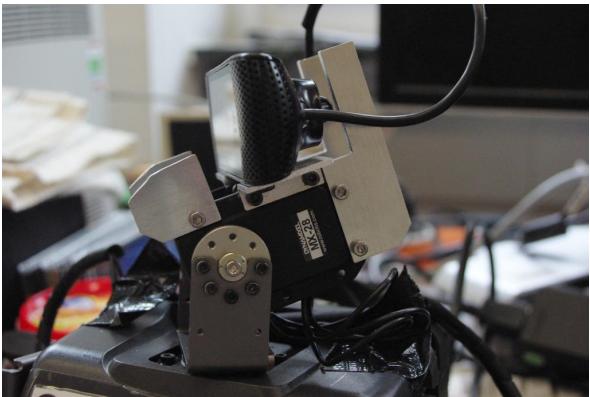
For RoboCup 2012 and 2013 a standard Darwin-OP robot was used by the Hamburg Bit-Bots. Learning from the flaws in the Darwin-OP, a modified Darwin-OP was used for the RoboCup 2014 competition. The main change is the new head construction, that provides a better camera protection and more reliable image data.
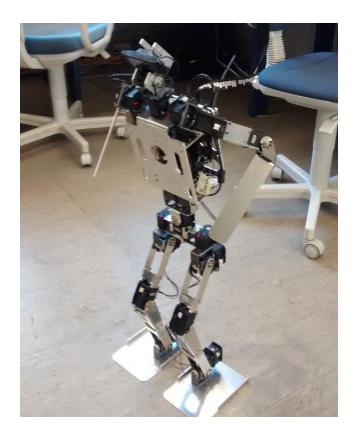
In addition the team worked on a new robot platform, named GOAL, a 24 DOF robot which was brought for inspection to the RoboCup 2014, but was not used because of software issues during the competitions.
Main differences to the Darwin-OP robot are the increased height of 86cm, pitch and roll servos for the torso and a yaw servo for the shoulder to provide more human like movement.
4.2 The modified Darwin-OP
The Darwin-OP robot has the following electronics:
- Actuators: The Robotis Dynamixel MX-28 servos have hall sensors to measure the position of the joint and measurement of voltage, current and the temperature inside the servo.
- IMU: The CM 730 board provides a 3 axis accelerometer and a 3 axis gyroscope that is used for the robots stabilization.
4.3 GOAL
GOAL has the following electronics:
- Actuators: The Robotis Dynamixel MX-28 and MX-64 servos have hall sensors to measure the position of the joint and measurement of voltage, current and the temperature inside the servo.
- IMU: GOAL has 2 MPU6050 chips with 3 axis gyroscope and accelerometer per chip. It has more accuracy than the one built in the Darwin-OP robot and enhances the stability of the robot.
- Camera: The robot is equipped with a "Logitech HD Pro Webcam B910". A resolution of 800x600 is used at 20 frames per second.
- Computer: The main computing board is a Odroid XU3 Lite, with an octacore processor by Samsung, this helps with the rising requirements due to the new environment with white goals and white ball in RoboCup 2015. The subcontroller is a selfmade board with three independent buses for the servo communication and a direct UART communication between the ARM Cortex M4 with 168Mhz processor on it and the Odroid board.
5 Publications
Team coordination in RoboCup soccer based on natural language
Bachelor thesis about a new strategy for robot to robot communication during RoboCup games [4]. In the last years the coordination based on the wireless network was error-prone because of the unstable network during the championships. Particularly with regard to "2050" the solution is a new communication protocol that is adapted to natural language. Robots should exchange their most important information via speech production and language processing.
Ball recognition based on probability distribution of shapes
Bachelor thesis in which a process was developed to determine whether a given shape would match the soccer ball or not. It uses an elaborate edge detection algorithm in combination with the probability distribution of the position of edges to calculate the possibility of a given shape in the presented image [5].
Behaviour based coordination of a multi robot scenario realized by BDI-agents
Bachelor thesis on the modelling of a behaviour for a logistic scenario [6]. The behaviour is realized by software agents according to the believe-intention-desire model and then transferred to a multi robot system.
Estimation of optical-flow fields in multispectral images
Bachelor thesis in which an algorithm was developed, to robustly estimate the optical-flow in an image sequence using additional information provided by color gradients.[7] The algorithm can be used for better tracking of the ball once it is located.
Ball verification
Article about a ball verification, developed for the object recognition tool for the NAO robot in the Standard Platform League 2011 [8].
6 Statements
We assure to participate in the RoboCup 2015 Humanoid League. We further assure that we have a person with sufficient knowledge of the rules and that this person will be available as referee during the competition.
7 Video & Website
The following resources provide access to our team application video for the tournament:
Further material can be found at our offical homepage http://www.bit-bots.de.
8 Conclusion
We gained a lot of experience in last RoboCup seasons and are working hard to improve our software for the coming years. We were able to begin lot of cooperations with other teams participating in our league as well as managed to improve our software in many aspects. Next to the software we focused on the main aspect of our league and invested a lot of time and resources into the hardware development. We hope that we can provide our first self designed humanoid robot to participate as a goal keeper in the tournament.
We are looking forward to see how our robots acquit themself on this years WorldCup in China, which is also another opportunity to exchange our experiences with other students and researchers from all over the world and improve our cooperation with other teams as well as contribute to the success of humanoid robotics.
We sincerely hope to again become part of this great event.
References
- Bestmann, M.: Biologically Inspired Localization On Humanoid Soccer Playing Robots. Bachelor's thesis, Universität Hamburg, Department of Informatics, Germany (2014)
- Poppinga, M.: Intelligente Wegfindung humanoider Roboter am Beispiel des RoboCup. Bachelor's thesis, Universität Hamburg, Department of Informatics, Germany (2014)
- Hamburg Bit-Bots. Hamburg Bit-Bots Coderelease 2013, 2014. Available online at: http://data.bit-bots.de/Hamburg Bit-Bots Release V2.9.3 2013.tar.gz
- Paetzel, M.: Spielerkoordination in RoboCup-Fußballspielen mittels gesprochener Sprache. Bachelor's thesis, Universität Hamburg, Department of Informatics, Germany (2013)
- Schröder, S.: Ball recognition based on probability distribution of shapes. Bachelor's thesis, Universität Hamburg, Department of Informatics, Germany (2012)
- Richter, A.: Verhaltensbasierte Koordination eines Multi-Roboter-Szenarios mittels BDI-Agenten. Bachelor's thesis, Universität Hamburg, Department of Informatics, Germany (2012)
- Bestmann, O.: Konzeption und Implementierung eines Verfahrens zur Messung von Verschiebungsvektoren in Multispektralbildern. Bachelor's thesis, Universität Hamburg, Department of Informatics, Germany (2012)
- Einig, L., Peikert, K., Richter, A.: Ballverifikation. Projektbericht, Universität Hamburg, Department of Informatics, Germany (2012)