AE-Human Kid Size Robot Team Description Paper
Amir Arab, Sina Salimiyan, Mohamadmehdi Heydari, Mohamadreza Vatandost, Danial Zabandan, Arshiya Majidi
Department of Robotics, Humanoid Robots Lab, Atomic Energy High School No. 23, Janbazan Ave., Shahid Abtahi St., North of Amirabad St. Tehran, IRAN
http://www.aehighschool.com/?p=Humanoid
Abstract This document describes AE-Human robots team for participating in humanoid kid size robot league in RoboCup 2016. AE-Human's present and future works for entry to RoboCup 2016 Humanoid Kid Size league are discussed. Our main research interests within the scope of the humanoid robots are robust real-time vision and gait generation for the first year and also developing a new child size robot hardware.
Introduction
Increasing demand for use of various types of robot, which can ease the life of human, has been declared, recently. Amongst the wide range of verity of robots, biped robots are the focus of researches nowadays. Humanoid robots, which are really involved in todays' human technologies and lives, have better mobility, sense of emotion and similarity to human than conventional wheeled robots. Organization of various competitions all around the world, for Kids and Adults, especially RoboCup, shows that the future of the robotics is based on existence of these humanoid ones, as the goal [1]. RoboCup is a perfect application for developing humanoid robots that can interact with humans. The goal of RoboCup is "By the year 2050, develop a team of fully autonomous humanoid robots to win against the human world cup champion team".
Increasing interest for humanoid researches in Iran, due to successful participation of Iranian teams in the RoboCup humanoid league in prior events and also existence of scientific research groups, whom focused on this topic, is changing the future of robotics activities in Iran. To strategically make a successful plan for the future of robotics and RoboCup, schools can play an important role. Introduction of various junior leagues and participation of at least thousand elementary and high school students revealed this fact. Atomic Energy High School robotic department is an organization supported by Iran's 1st rank high school in scientific level and one of the best high schools in the research fields. In recent years, the aforementioned robotics department attracts talented and motivated students in robotic sciences and provide those required facilities and financial support to satisfy their sense of curiosity and help them use their innovation in the way that they can best choose their exact future research pathway among the fields, they are interested in. Being a part of RoboCup future goal at 2050, AE-Human humanoid kid-size team founded in 2016, with the purpose of providing a research bed for starting humanoid robotics activities.
Atomic Energy High School has been remarkably participated in past RoboCup competitions. Atomic Energy robotic team became champion in RoboCup IranOpen 2012 in rescue co-space league and succeeded to qualify for RoboCup 2012, in Mexico and won the 2nd place of the main league and the 3rd place of technical team presentation. Winning the championship in RoboCup IranOpen 2013, 2014 and 2015 Atomic Energy robotic team became the first team winning 4 championships in a row in co-space league. In RoboCup 2015, Hefei China, Atomic Energy robotic team became the world champion in co-space league.
After those successes in junior leagues and gaining lots of experience, Atomic Energy Robotic Department decided to start activities in senior fields but with junior students! With the hardworking of the creative Atomic Energy team students, they won the 3rd place of RoboCup IranOpen 2015 in soccer 2D-simulation in the first year of participation in a senior league. At the same year, they succeeded to qualify for RoboCup 2015 and won the first place of new team in soccer 2D-simulation. Now, the team is looking forward to start its second research in humanoid kid size robot league, which is the ultimate goal of the RoboCup and looking forward to be successful in RoboCup 2016, Leipzig, Germany.
Team Members
AE-Human Humanoid Kid Size team consists of junior high school and graduate high school students in the Atomic Energy High School as follows:
Junior high school and graduate students:
- Amir Arab (Control)
- Sina Salimiyan (Control and Gate Generation)
- Mohamadmehdi Heydari (Electronic)
- Mohamadreza Vatandost (Software)
- Danial Zabandan (Software)
- Arshiya Majidi (Software)
Research Focus and Planned Activities
For the first year of experience, the AE-Human research area is mainly focused on Gait Generation, Computer Vision and team play and also developing a new robot platform which can be used by team, compatible to the RoboCup Humanoid Robot League rulebook. In some areas, parallel researches are carried out to figure the best solution out, which also satisfies the competition requirements.
Overview of Hardware Design
For start, this team is focusing on the use of modified Bioloid robot kit by RobotisInc [2]. The motion mechanism consists of 20 degrees of freedom distributed in six per leg, three per arm and other two degrees of freedom as a pan-tilt system, holding the top camera. Since the available commercialized platforms are not compatible with the new rules and they cannot perform well, we decided to design and build our own stable platform which can match to the needs of the RoboCup humanoid kid size league. The designed procedures almost finished and now we are working hard to develop a new and optimized structure of humanoid robots to participate in RoboCup 2016.
Table 1 and Figure 1 illustrate the physical specifications of the new designed robot. The Dynamixel 28 and 64 MX series manufactured by Robotis will drive the robot joints. We will use more powerful actuators in hip and knee joints.
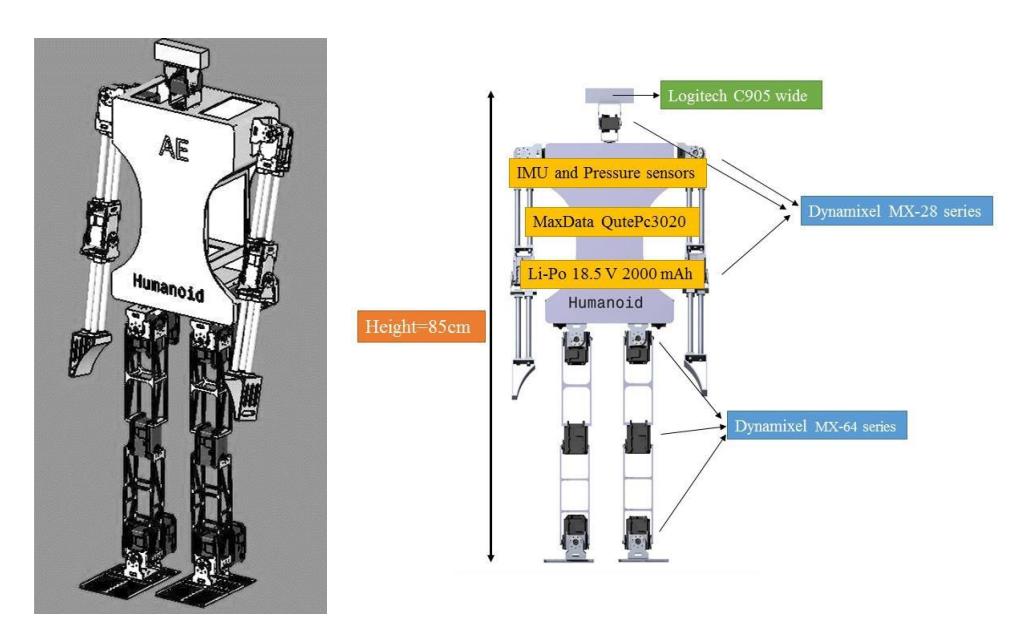
Table 1. New designed robot specification data
| Robot System | Specification |
|---|---|
| Weight (Kg) | 4.5 |
| Height (cm) | 85 |
| Degrees of Freedom | 20 in total, 6 in leg, 3 in arm, 2 in neck |
| Actuators | MX-64, MX-28 |
| Camera | Logitech C905 |
| Main Processor | MaxData QutePc3020 |
| Battery | Li-Po 18.5 V 2000 mAh |
Computer System and Sensors
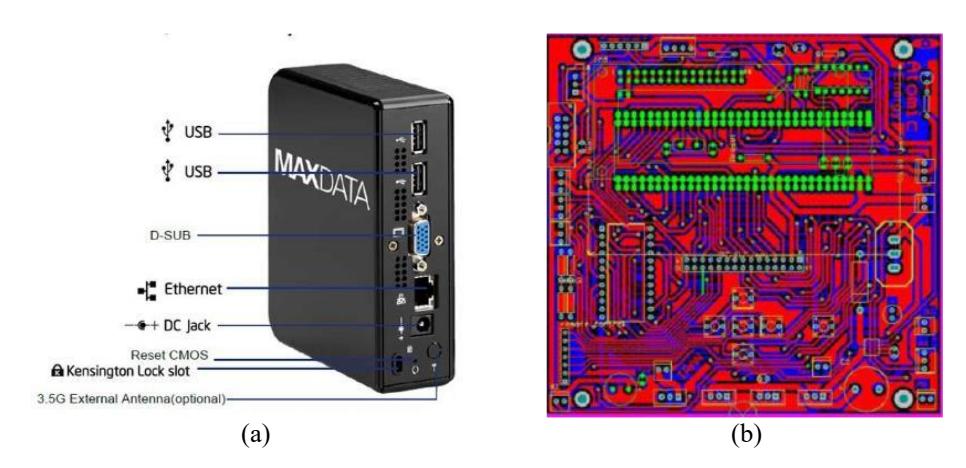
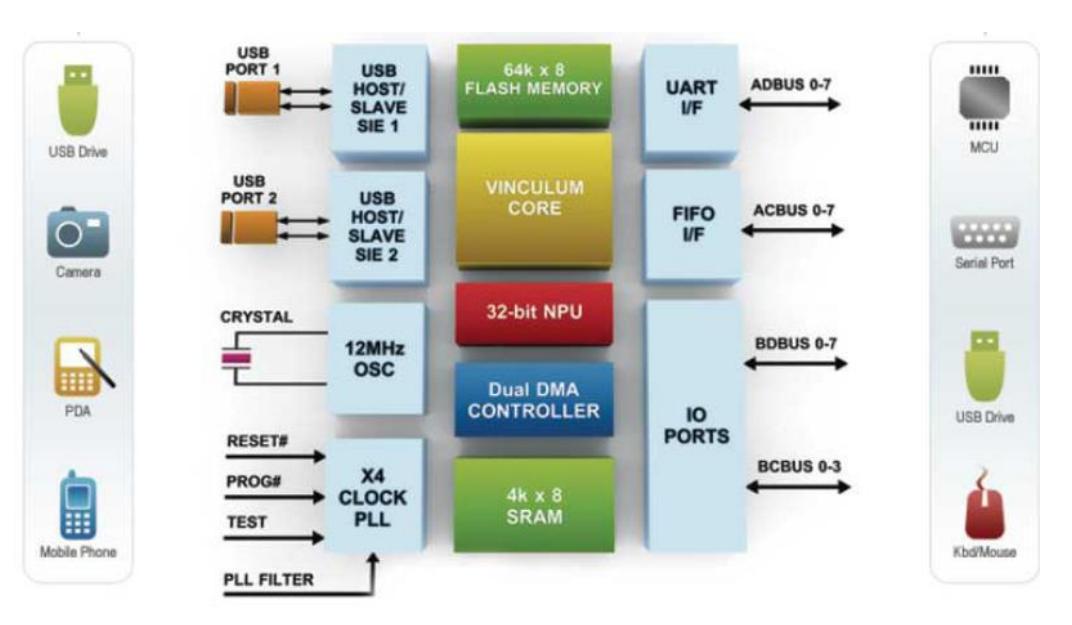
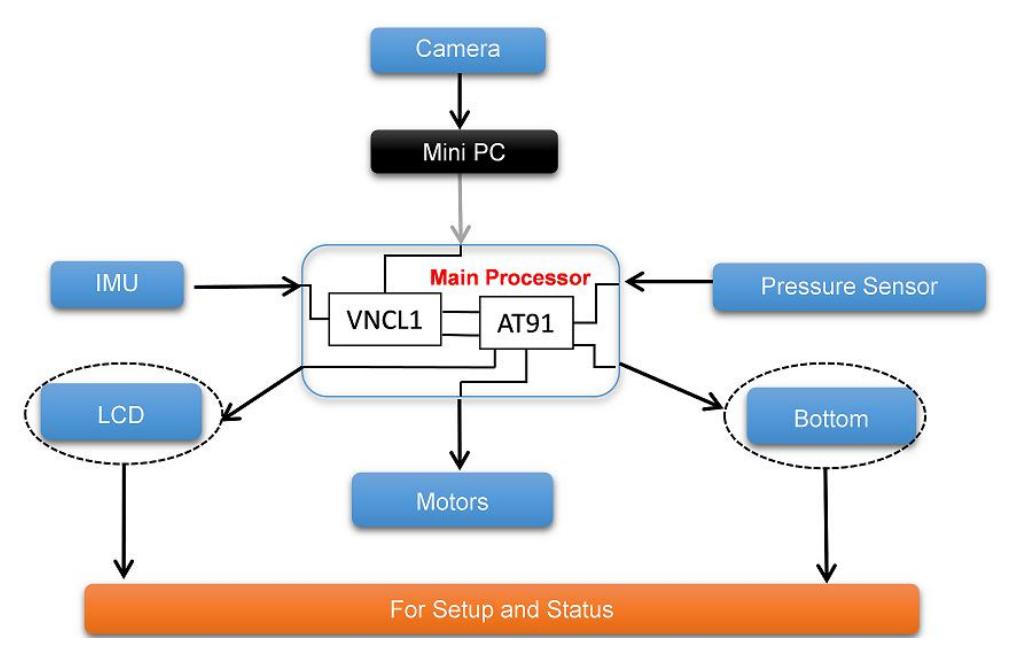
An embedded computer system, QutePc3020, is a light-weight board with 1.6GH Intel Atom x64 processor, which makes it a good choice for our new developed robot main processor, which make the robot react fast (Figure 2). A self-design microcontroller boards will be used to connect the actuators and sensors to the main processor through a USB port.
This part is of great importance in electronic design. It's duty is decision making, controlling the robot and performing algorithms. Also it acts as an interface between input and output sections. In fact, it is responsible for processor section. ARM7 family from AT91sam7x256 processors is consider to be the best microcontroller since of its availability in Iran market with reasonable price and suitable facilities.
In this robot there are two different supplying parts. One for logical circuit like processors and sensors (LM2576) and another for actuators (LM317). Any robot has an MPU6050, 6 axis accelerometer sensor located in nearest distance from center of robots mass. Therefore, ATS91sam7x256 as motion controller can read the acceleration data and use acquired information to report it to main processor.
Software Development
Placeholder for subsections
Gait generation
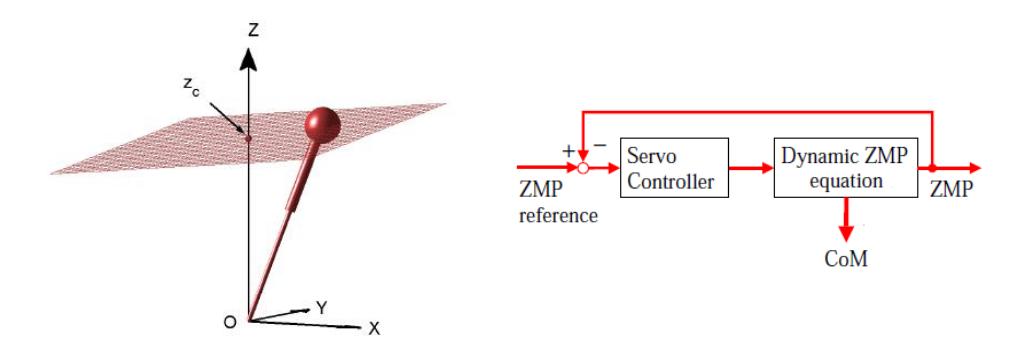
The most considered model of the humanoid robot is the inverted pendulum [3] (Figure 2). By applying a constraint control to an inverted pendulum such that the mass should move along an arbitrary defined plane, a simple linear dynamics called the Three-Dimensional Linear Inverted Pendulum Mode (3D-LIPM) [4] is obtained. We used a zero moment point (ZMP) method to produce a stable gait; i.e. by use of equations of motion for an inverted pendulum in the constraint plane and ZMP definition, the equations governing the motion of ZMP are derived. Then, we can construct a walking pattern generator as a ZMP tracking control system (Figure 3). The system generates the center of mass (CoM) trajectory such that the resulted ZMP follows the given reference. We have implemented a discretized optimal control on our robot. The objective is to minimize the time effort. The next work is to integrate the nonlinear control concepts into the robot controller in order to achieve better performance along with better disturbance rejection.
The Kick Action
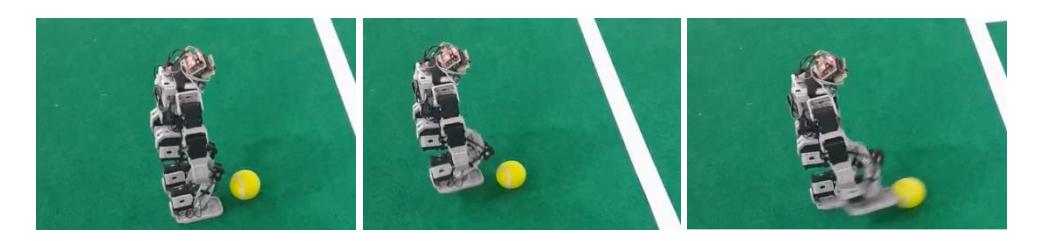
Generating adaptive and online trajectories for special actions of a robot is an important and challenging issue in humanoid robots. We apply the method for online generation of an adaptive trajectory for the kick action proposed in [5]. Using reinforcement learning, we can obtain important joints for a kick action by visual inspection of human kick and statistical analysis of kick actions of humanoid robot models in a simulated 3D environment. Finally, a neural network can estimate the value function of the reinforcement learning algorithm.
Vision Module
In vision module, we intend to receive information from the camera, process the data, recognize the ball, keep the ball in the robot's sight, in the best way, and try to keep the position while walking toward the ball, detect the goal and find the direction of diving for the goal keeper. Each of them is an integrated procedure that involves vision and other parts.
Image processing
For receiving camera data we used the powerful library of OpenCV [6]. For processing any scene, we first tried RGB method [7]. We continued for a while using this method then we found out that it is not enough reliable as it was really vulnerable against the environmental condition changes. The reason was that the field light changes effected the captured picture so R, G and B value of each pixel will change. Actually, we didn't have a light independent factor. We switched to HSV (Hue Saturation Value) [8]. So, eventually, we had a method that light could only be effective on one of the factors (value) and we can depend on other two factors.
Ball recognition
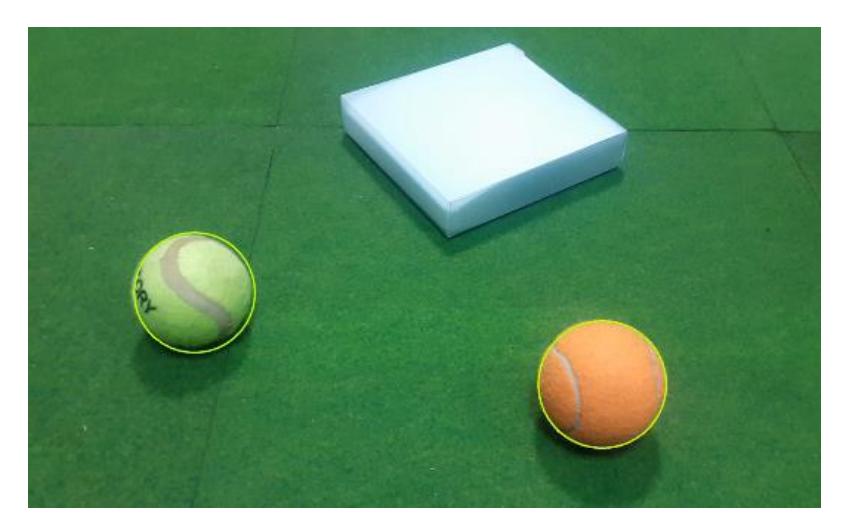
To recognize the ball, we search all the pixels of the picture, prepared in a 2D array and find all the pixels correspond to the color range defined as the ball color. Then the robot calculates an average from the positions of the founded pixels to find the approximate position of the region that has the most density of the ball color.
Following the ball
To follow the ball, we define a central point in the camera and send the ball position to the camera actuators to rotate the camera in a way that the ball stands in the central point. Then, robot rotates and goes toward the ball according to the position of the camera. It means that if the camera rotated to the right and the ball is in the central point, robot must turn right. If the ball loses the central point while walking, it would again send the camera the new data to correct the camera position. This cycle continues until the robot successfully reaches the ball.
Moving the ball forward
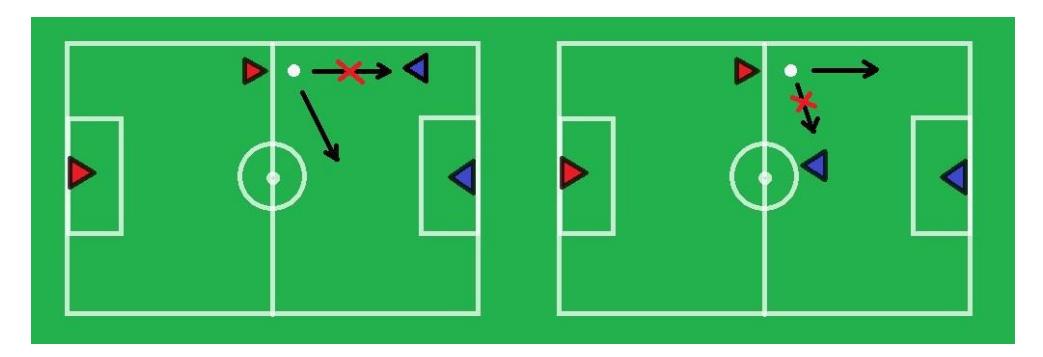
At the time that the ball is in the robot's possession and the robot is distant from the opponent's goal, it's supposed to move the ball forward by mid-force kick actions. But in which direction? A wrong direction choosing can lead to kicking the ball outside the field or toward the opponent player that would definitely lead to losing the ball. We defined three direction choices for the robot; straight forward, diagonal to the right and diagonal to the left. Our first priority is the ball maintenance in the field so the robot recognizes the field's margins and ignores the diagonal direction pointing outside the field. Secondly, the robot tries to avoid the obstacles. The recognized obstacles are usually the opponent team robots so in order not to lose the ball's possession and to send the ball somewhere far from the opponent robots, the robot chooses the opposite direction from the obstacle and eventually kicks the ball. It can somehow be considered as a basic dribbling strategy as it's clearly demonstrated in the figures bellow.
Conclusions and Acknowledgments
We briefly described about the technical achievements and future plans for EAManoids Humanoid Robot Team from Atomic Energy High School, Iran for the first entry to RoboCup 2016 Humanoid Kid Size Robot League. We hope we can develop our new designed robot and have a successful participation to this edition of RoboCup in Leipzig, Germany.
References
- Gerndt, R., Seifert, D., Baltes, J.H., Sadeghnejad, S., Behnke, S.: Humanoid Robots in Soccer: Robots Versus Humans in RoboCup 2050. Robotics & Automation Magazine, IEEE 22, 147-154 (2015)
- Han, J.-K., Ha, I.-Y., Kim, B.-S.: Educational robotic construction kit: Bioloid. In: Proceedings of the 17th World Congress of the International Federation of Automatic Control (IFAC 2008), Seoul, Korea, pp. 6-10. (Year)
- Sugihar, T., Nakamura, Y., Inoue, H.: Real-time humanoid motion generation through ZMP manipulation based on inverted pendulum control. In: Robotics and Automation, 2002. Proceedings. ICRA'02. IEEE International Conference on, pp. 1404-1409. IEEE, (Year)
- Kajita, S., Matsumoto, O., Saigo, M.: Real-time 3D walking pattern generation for a biped robot with telescopic legs. In: Robotics and Automation, 2001. Proceedings 2001 ICRA. IEEE International Conference on, pp. 2299-2306. IEEE, (Year)
- Moradi, K., Fathian, M., Ghidary, S.S.: Omnidirectional walking using central pattern generator. International Journal of Machine Learning and Cybernetics 1-11
- Bradski, G., Kaehler, A.: Learning OpenCV: Computer vision with the OpenCV library. " O'Reilly Media, Inc." (2008)
- Russ, J.C.: The image processing handbook. CRC press (2015)
- Carron, T., Lambert, P.: Color edge detector using jointly hue, saturation and intensity. In: Image Processing, 1994. Proceedings. ICIP-94., IEEE International Conference, pp. 977-981. IEEE, (Year)
- Li, H., Lavin, M.A., Le Master, R.J.: Fast Hough transform: A hierarchical approach. Computer Vision, Graphics, and Image Processing 36, 139-161 (1986)