CITBrains (Kid Size League)
Youta Seki, Yasuo Hayashibara, Hideaki Minakata, Kiyoshi Irie, Chisato Kasebayashi, Ryu Yamamoto, Masayuki Ando, Yukari Suzuki, Moeno Masuda, Joshua Supratman, Lecomte Tristan Henri Victorien, Yoshiya Hayashi, Ryoma Aoki, Akihisa Iwasaki, Ryohei Goto, Satoshi Shimada, Takaharu Nakajima, Riki Hayashi, Yohei Ashino, Yuuri Matsumoto, Tomoya Fujita, Rui Kobayashi, Misaki Sugawara, Masaharu Yokomizo, Naoki Takahashi, Masakazu Tamura, Yuta Hatakeyama, Takahiro Miyazawa, Shigechika Miki, Yoshitaka Nishizaki, Kenji Kanemasu, Hajime Sakamoto, Shuichi Yamaguchi
Chiba Institute of Technology, 2-17-1 Tsudanuma, Narashino, Chiba, JAPAN; Miki Seisakusyo Co, Ltd., 1-7-28 Ohno, Nishiyodogawa, Osaka, JAPAN; Nishizaki Co, Ltd., 1-7-27 Ohno, Nishiyodogawa, Osaka, JAPAN; Yosinori Industry,Ltd., 1-1-7 Fukumachi, Nishiyodogawa, Osaka, JAPAN; Hajime Research Institute, Ltd., 1-7-28 Ohno, Nishiyodogawa, Osaka, JAPAN; FrostyDesign
Abstract This paper describes the overall system of CIT Brains KidSize humanoid robot Accelite. In the recent RoboCup Humanoid Soccer League there are many changes to the rules towards the final goal of 2050. Such as changing the material from carpet to artificial grass and changing the ball color. The rules changes created new challenges in the field of image processing and walk control. This year we implemented deep learning and preview control to improve image recognition and walk control, respectively.
Keywords: deep learning, preview control, image processing, walk control, soccer strategy
1 Introduction
In this paper, we describe our system for the RoboCup soccer kid size humanoid league. CITBrains is a team consists of mainly undergraduate students from Chiba Institute of Technology. The team collaborated with Hajime Research Institute to develop a humanoid robot capable of autonomously play soccer. Hajime Research Institute developed the mechanism and the control system for the humanoid robot, while undergraduate students develop the computer system and the overall intelligence system, such as image recognition and behavior decision, and integrate it to the humanoid robot. In 2016, we received the third prize on 4on4 soccer and the first prize on technical challenge. This year we developed and implemented image recognition using deep learning and walking control using predictive control. Also, in order to implement the new technology, a new computer system was installed. In addition, we also improve soccer strategy.
2 Overview of the system
We do not use any software from other teams. Our robot is Dynamo Accelite (fig.1.). Table.1 is the specification of the robot. The overall system is show in fig.2 and fig.3. Fig.2 shows the software architecture. High layer programing such as strategy are described using Python language while low layer programing such as walk control and image processing are described using C language and C++ language. Fig.3 shows an overview of control system. Our robot is equipped with NVIDIA Jetson TX1(fig.4), a CPU board integrated with a graphic board. Our robot obtains information using an USB camera. Images obtained from the USB camera are processed by Jetson's CPU and GPU. The robot recognizes the class and position of the objects by using deep learning. The robot also recognizes its own posture in the real world using IMU. 19 servo motors are installed in the robot, enabling immediate and powerful operation.
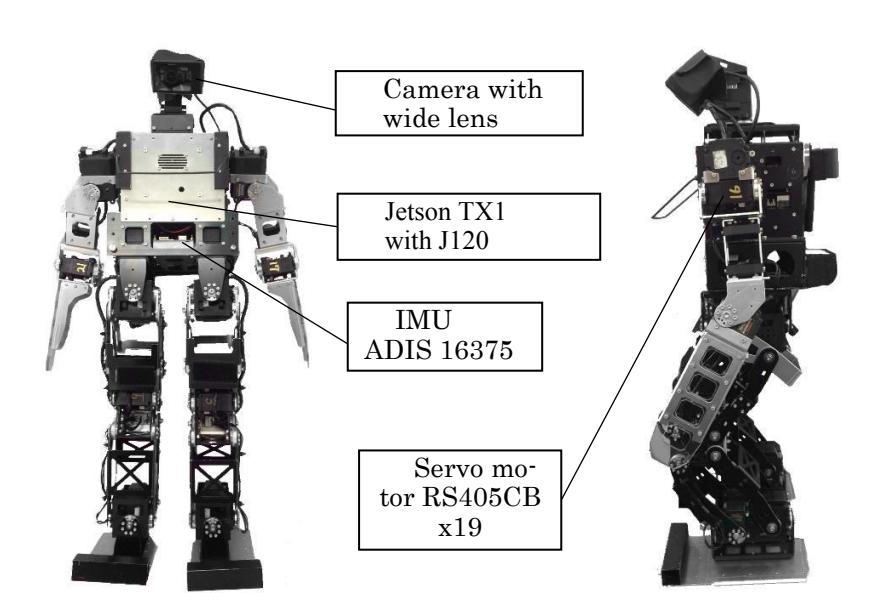
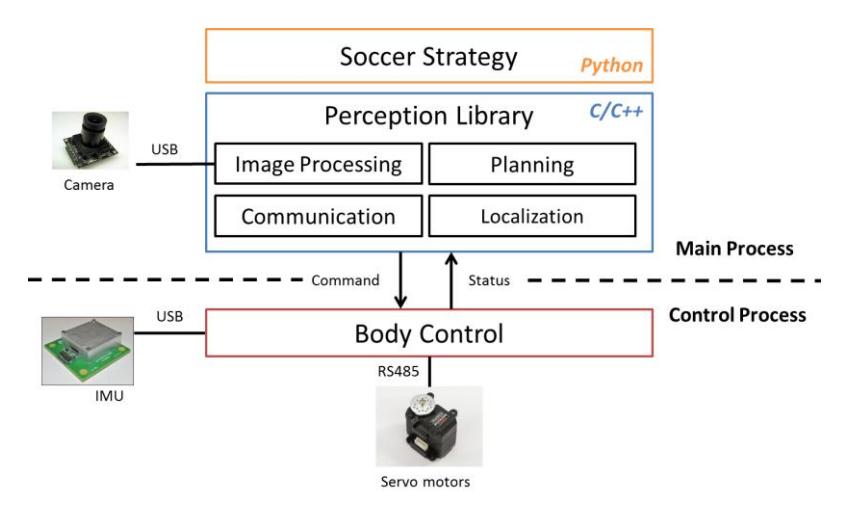
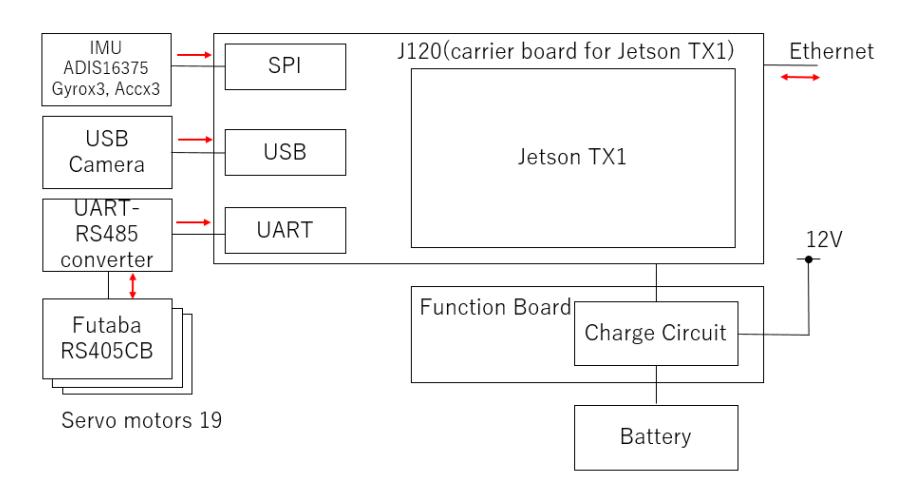
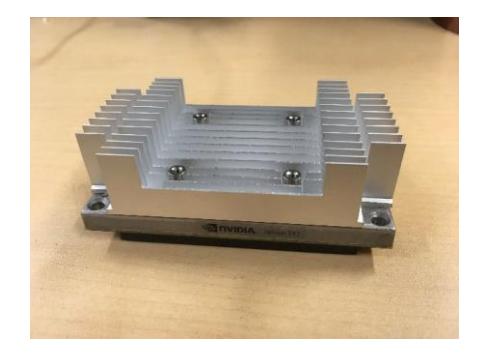
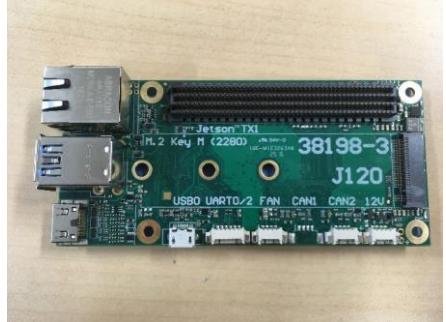
Table.1. Specification of the Robot
| Weight | 4.2kg (Including Batteries) |
|---|---|
| Height | 600 mm |
| Velocity (Forward) | 0.4 m/s (maximum) |
| Walking Directions | All Direction and Rotation |
| (Select the Angle, Stride, Period and so on) | |
| CPU Board | Jetson TX1 |
| OS | Linux (Ubuntu14.04) |
| Interface | Ethernet x 1, USB x 1, |
| Speaker, DIP switch x4, Push switch x 1 | |
| Servo Motor | Futaba RS405CB x 19 |
| Battery | 3S (11.1V, 5000mAh ) |
3 Software
3.1 Image Processing
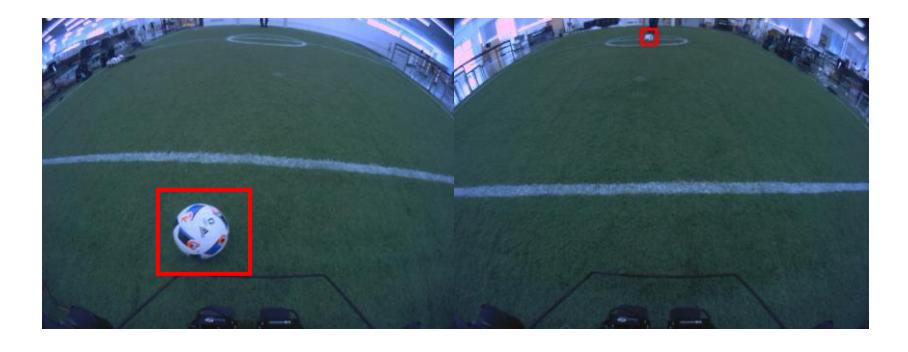
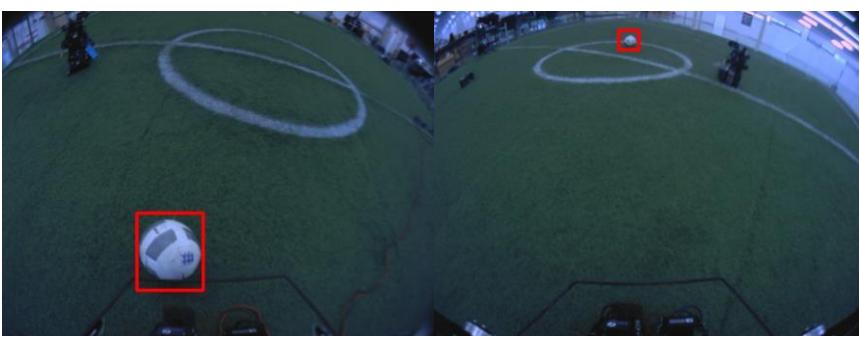
This year we have greatly changed our image processing, shifting to object recognition using deep learning. This is because we found color-based object recognition become ineffective because of recent rule changes. Our robot uses CNN to recognize balls, goal posts and opponents. Our robot can recognize balls that are about twice the distance from the previous system in our field as show in fig.6. In addition, we are currently trying to shorten the collecting time for training data using our own method. This time we train only with the ball used in the RoboCup of 2016, but we confirmed that the robot was able to detect even the ball used in RoboCup 2015(fig.7). It can be said that we were able to learn a versatile ball.
3.2 Walk Control
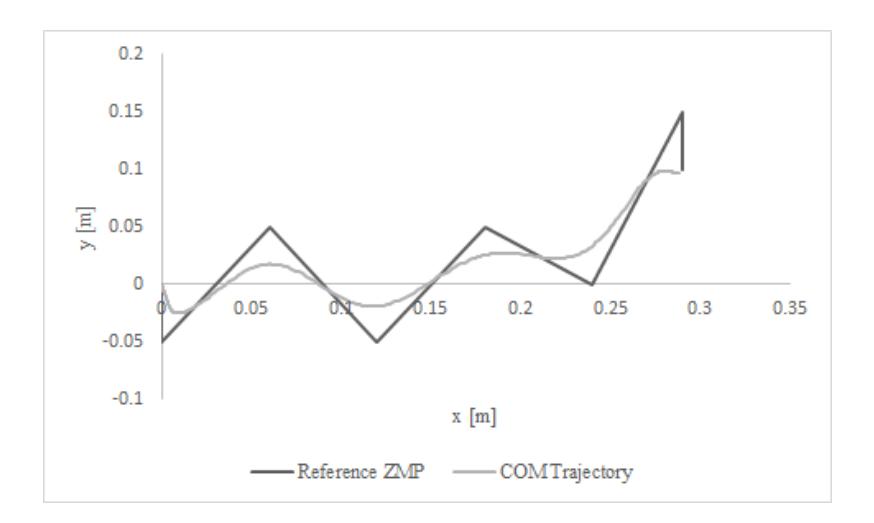
We made significant modification to the motion control system. In our previous system, we used a method based on ZMP that generates gait pattern. This year, we applied the Preview Control method to the COM trajectory generation method. In this method, it is possible to generate a stable COM trajectory in real time by using target values a few steps ahead. Even if the target position is dynamically changed, it is still possible to recalculate the COM trajectory depending on the current state of the robot as shown in fig.8.
3.3 Soccer Strategy
The architecture of our strategy is GOAP. This year we added an action to search ball that is far away. In this action, the robot searches the area that has not been searched before. Information regarding the searched area is shared among other robots. This is an effective method of finding the ball when the robot cannot detect the ball nearby.
4 Future
This year's revolutionary change is the first step to approach more intelligent, humanoid robots. Since Jetson was installed, it became possible to process at high speed. We also plan to use deep Qlearning to let the robot learn the strategy and to use predictive control to generate kick motion.
5 Acknowledgments
We are extremely grateful for NVIDIA Corporation for providing us NVIDIA Jetson TX1 and enRoute Corporation for providing us carrier board J120. Their provision allows us to successfully implement Deep Learning to our robot. We also give special thanks to Forum Engineering Inc, Futaba Corporation and Analog Devices, Inc. who sponsor us. Their support allows us to continue participating in RoboCup.
6 Conclusion
In conclusion, this paper describes the overall system of CIT Brains KidSize humanoid robot Accelite. This year we made two significant changes, image processing was changed to one using deep learning, and walking control was changed significantly to one using predictive control. Our humanoid robot become more intelligent.