WinKIT Team Description Paper
Kunimasa Kawasaki, Yuki Nozaki, Kyohei Morikawa, Keisuke Kawai, Satoshi Sugihara, Yasuki Asano, Kosei Demura
Factory for Dreams and Ideas. Kanazawa Institute of Technology 7-1 Ohgigaoka, Nonoichi, Ishikawa 921-8501, Japan
Abstract In this paper describes a hardware and software system on the KidSize humanoid robots developed by the team WinKIT in RoboCup 2017. We developing a humanoid robot (Tsumugi) focusing on kinematic performance and flexibility design since two years ago. It is High torque servo and high accuracy posture sensor provided, and it is possible to perform robust motion and adaptive attitude control. In addition, it is possible to adjust the balance of the whole body by making all parts with the 3D printer, and to flexibly arrange many parts within a small area, furthermore, it is a light weight and strong rigidity by the monocoque structure.
Introduction
Kanazawa Institute of Technology, KIT, established Yumekobo to encourage students to create things and make character building in 1993 [1]. The most important activity of Yumekobo is to support student projects called Yumekobo Projects whose purpose is to improve technology and teamwork. During actives in Yumekobo projects, students experience the process of creating things, i.e., planning, investigating, designing, manufacturing, analyzing, and evaluating. In addition, they learn how to organize and managing their projects. Yumekobo is not only a place for learning knowledge and new skills, but also for character building, A student develops a good character which includes independence, creativity, ethical behavior, teamwork, and international awareness.
The WinKIT team which is one of the Yumekobo projects has been participating in the RoboCup Middle-Size League (MSL) since 1999. The team has experienced a lot, especially, robot vision and self-localization. Finally, it showed some good results in MSL. After that, the Yumekobo project decided to participate in the Humanoid League. Moreover, I participated in RoboCup 2010.
Team WinKIT developed humanoid robot Tsumugi since two years ago. Tsumugi adopts high-performance computer, high torque servo, and high accuracy posture sensor in hardware, a software system adopts image processing and cooperation operation cultivated in the MSL, thereby capable of high-speed image processing and cooperative operation.
This paper is organized as follows. Chapter 2 and 3, Hardware overview and describe improvements, outlines the software and describes improvements. In chapter 4, we describe tools for development. Finally, the concluding remarks are presented.
Hardware
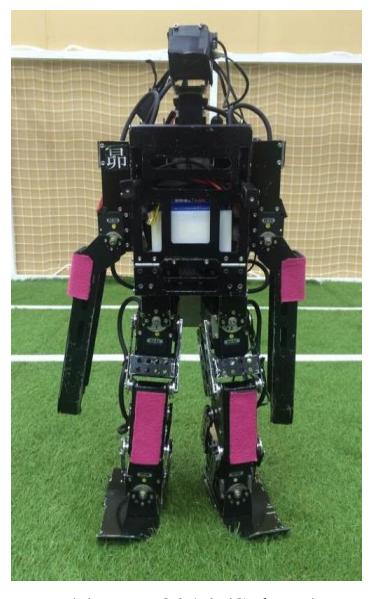
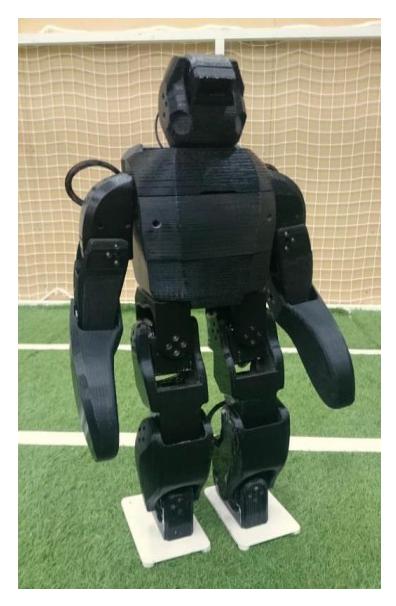
It shows the specifications of robot in Table 1. Fig. 1 shows a robot participated in Robocup Japan Open 2014 (a), and shows a new robot (b). These robots were all designed and developed by students. Features of the new robot (Tsumugi) adopt high-torque servo, a high-performance computer, more than type 2014 model. Thereby, it is possible high kinetic performance and high-speed software processing. In addition, adopted a monocoque structure for all parts, it is lightweight and maintains high rigidity.
Specifications of robot
| Type 2014 | Type 2016 |
|---|---|
| Subaru | Tsumugi |
| 54.5 | 56 |
| 4.9 | 4.6 |
| Robotics, Dynamixel | KONDO, B3M-SC |
| RX64 RX28 |
1170-A 1040-A |
| 52 37 |
78 47 |
| 15 | 20 |
| KBCR-M05VU | FCB-MA133 |
| 30 | 30 |
| InvenSense, | Slilicon Sensing Japan, |
| MPU-9150 | AMU-lite |
| LEXsystem 2I268HW | LEXsystem 2I847H |
| Intel Atom N2600 | Intel Core i7-3517UE |
| (1.6GHz) | (1.7GHz) |
| LiFe, 5S | Li-ion, 3S×2 |
| (3.3V, 2300mAh) | (3.7V, 3400mAh) |
| Li-ion, 3S | |
| (3.7V, 2500mAh) | |
Mechanical design
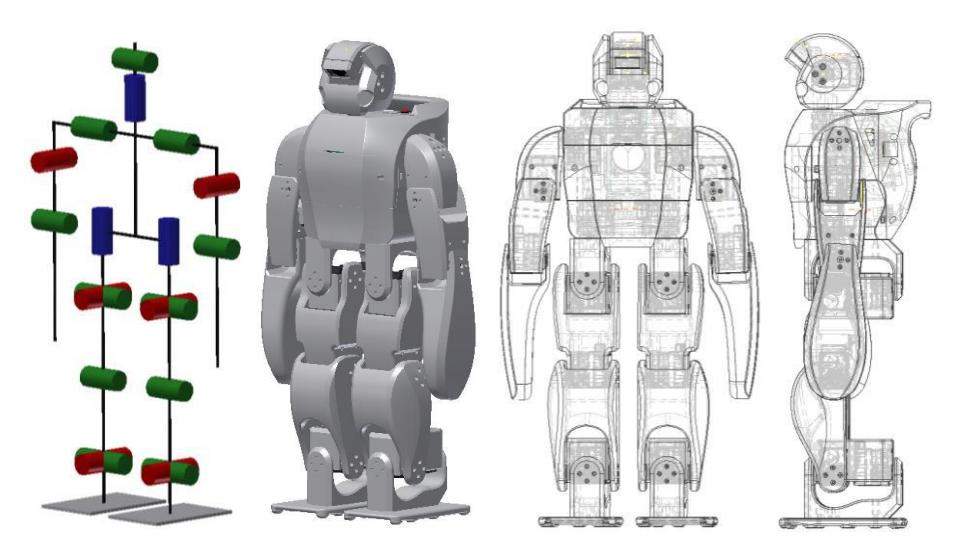
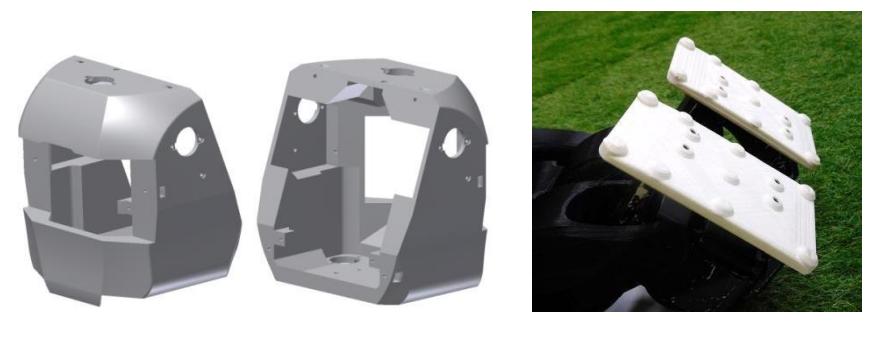
The 3D model of the robot is shown in Fig.2. Fig.3 (a) shows an example, fuselage parts of monocoque structure, and (b) shows leg with a spike. We processed all the parts with a 3D printer. As a result, we are able to design integratedly, the center of gravity position, movable range, minimal body and interface operability. In addition, in spite of the number of parts to be mounted inside the fuselage increased, the body size was reduced by 10%, and adopted the monocoque structure to keep sufficient rigidity. In order to walk on artificial grass, a spike attached the sole. And this result, our robot reduces vibration and can walk steadily.
Electrical Specifications
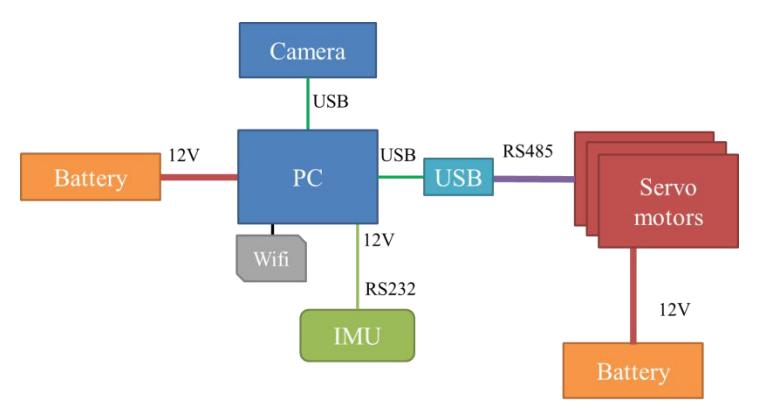
The electrical system of the robot is shown in Fig.4. All the information of camera, posture sensor and servo motors are processed by PC. This system is designed assuming sensor fusion.
Software
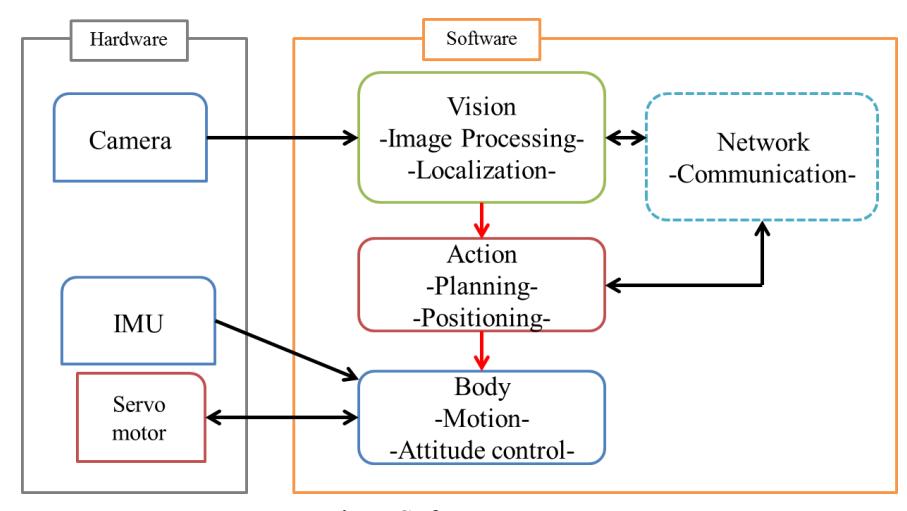
Fig.5 shows the software system. All of these codes are developed by students and written in C++. This software has been processed by the main computer. The software system is roughly divided into four processes. It is "Vision" to perform image processing, "Action" to perform action plan, "Body" to perform motion generation and attitude control, and "Network" to communicate with other robots. First, in the Vision process performs object recognition such as balls and robots, and estimate self-position using white lines and goals. Based on that information, Action process is to adjust the position for how to follow the ball or kick. In addition, it has also been described high-level strategy behaviors such as cooperative operation cultivated in the MSL. In subsequent Body process, it is to calculate the attitude to realize the action determined in Action process. Furthermore, attitude control is performed by feedback control of the attitude sensor.
Vision system
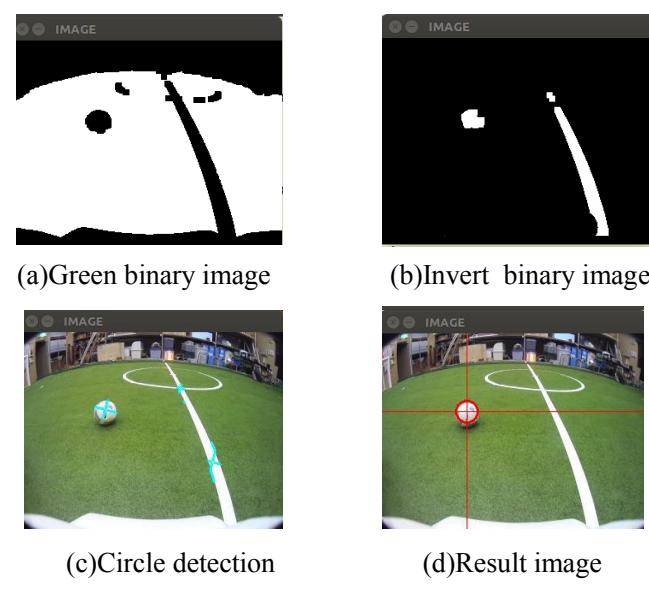
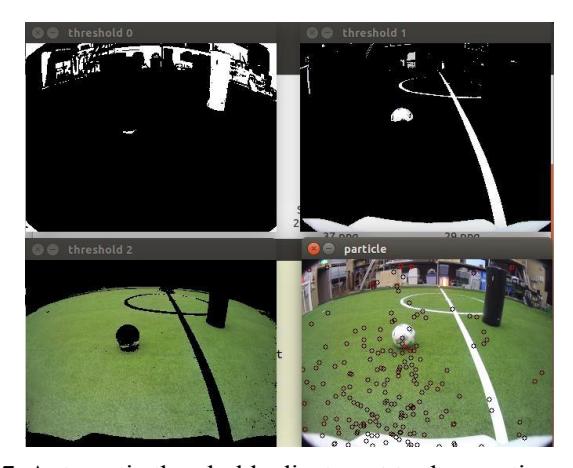
Recognition of the ball and the robot are subjected to image processing by using YUV color space. A detection system of the ball is shown in Fig.6. The flow for detecting the ball binarized the green region from the image obtained by the camera according to a predetermined threshold value. Next, it is applying contraction processing after invert the green region image, and obtains the white line and a ball image. The ball detection method detect whether the region in the image has a circle characteristic that the diameter is constant. Furthermore, it performs a moving speed estimation of the ball from an image using Kalman filter, is performed improved approaches to a moving ball. Object detection used threshold for is determined by an automatic threshold adjustment tool by using a particle filter. This tool was developed by team WinKIT. Figure 7 shows the execution result of this tool.
Attitude control
In order to achieve stable walking, feedback control is performed using an attitude sensor. A specific posture control method corrects the fuselage and ankle posture using inverse kinematics that determines the fuselage and ankle posture and position.
Tools
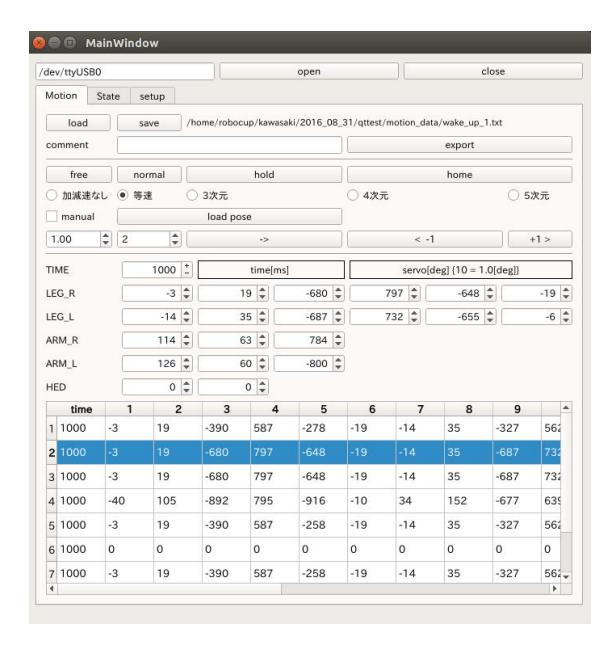
We developed tools for motion development. The motion editor is a tool that can interactively create motion such as getting up. By using this tool, the time required for motion creation was reduced to 1/2. Figure 8 shows the execution state of this tool.
Conclusion
In this paper, we describe the specifications of our robot, and improvement. We developed a humanoid robot focusing on hardware such as kinematic performance and flexibility design. Currently, we will continue to develop a software system more robustly and improve a motion performance for Robocup 2017.
References
- Yumekobo establishment reference