Barelang FC Team Description Paper Humanoid Kid Size League of RoboCup 2018
Eko Rudiawan Jamzuri, Hendawan Soebhakti, Susanto, Gobar Bethara Agung, Akhbar Ferdeansyah, Fadhlul Azmi, Andrey Karona Sitepu, Febry Alwan Putra, Jony Arif Ricardo
Department of Electrical Engineering Politeknik Negeri Batam
Abstract This paper describes the robot system designed by Barelang FC team from Politeknik Negeri Batam, Indonesia, as a qualification requirement of RoboCup Humanoid Kid Size competition in Montreal, Canada 2018. Full details of our robots including robot architecture, mechanical design, and vision processing system will be discussed. The robots upgraded on mechanical design and vision processing system to improve performance. Improvement in vision processing algorithm results in the more robust detection system and increase detection range of objects. The new mechanical design improves performance in kicking and walking speed.
Introduction
Last year is first participation of Barelang FC team in RoboCup competition. This team managed to get semi-final position. The robots got several problems during the game. The first problem is unstable walking on artificial grass because of the artificial grass on the RoboCup field thicker than the field in our laboratory. The vision system also failed to recognize the white ball in long range because of captured image resize in small resolution to meet computational performance of minicomputer. Therefore, the optimization of the vision system becomes a big task in RoboCup 2018 competition.
Robot Architecture
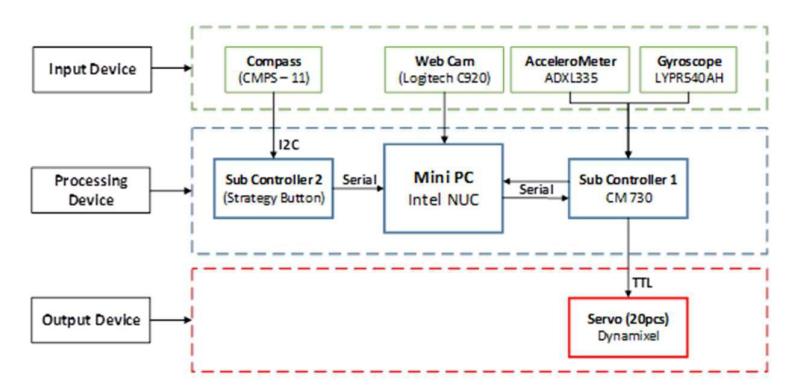
The architecture of the robot system divided into software and hardware part. Fig. 1 illustrates the hardware system of the robot. Robots consist of 3 main parts (input device, processing device, and output device). Input devices consist to several sensors that used to collect environmental data from the robot. Sensors used in the robots are webcam as vision sensor, orientation, accelerometer, and gyroscope sensor. Vision sensor used to recognize ball and goal from image data combined with orientation sensor that provide an information of robot heading. Accelerometer and gyroscope sensor used to stabilize robot while walking in the artificial grass. Sensors connected to the main processing device via a sub-controller that used ARM Cortex-M3 microcontroller. The main processing device used minicomputer with Intel i5 processor to acquire the data from all sensors, process the data, and control the actuator. The output device consists of twenty servo motors connected to the sub-controller to manipulate the robot movement.
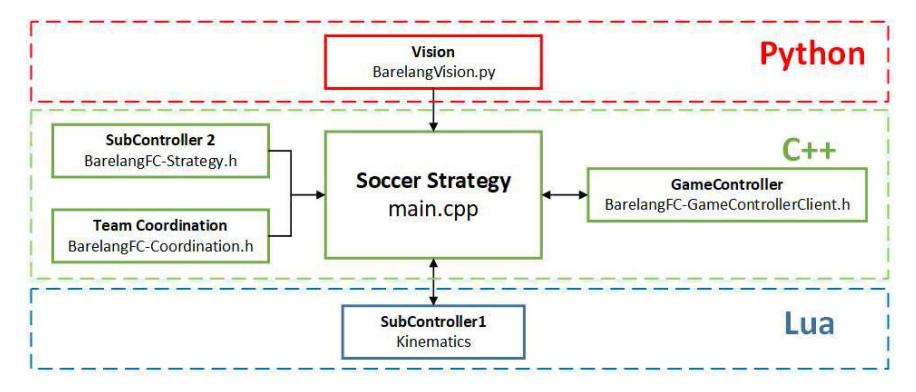
Fig. 2 show the software system applied to the robot. This part implements the robot strategy in order to act on the field. The robot strategy was developed by getting data from sensors, vision sensor, coordination data and game controller data. We used different application which runs independent to collect the sensor data, process image, make decision and generate motion.
Mechanical Design
The old robot used 5052 aluminum parts with 2 mm and 6 mm thickness as the main material. The new mechanical design used 5052 aluminum parts with 3 mm and 6 mm thickness for the main part of the robot body. The new robot design has approximately 64 cm height, while the old robot design only has approximately 58 cm height. The new leg construction used Dynamixel MX-106 series with more higher torque than the old design (Dynamixel MX-64 series), for more details can be seen in Fig. 3. The new robot becomes to have more power to act as a footballer. With the new design, our robot has an ability to run faster than before. The new mechanical design also improves the ability of the robot to kick harder than before. The ball can move approximately half of the field after being kicked. The detail of actuator that we used in the new design can be seen in Table 1.
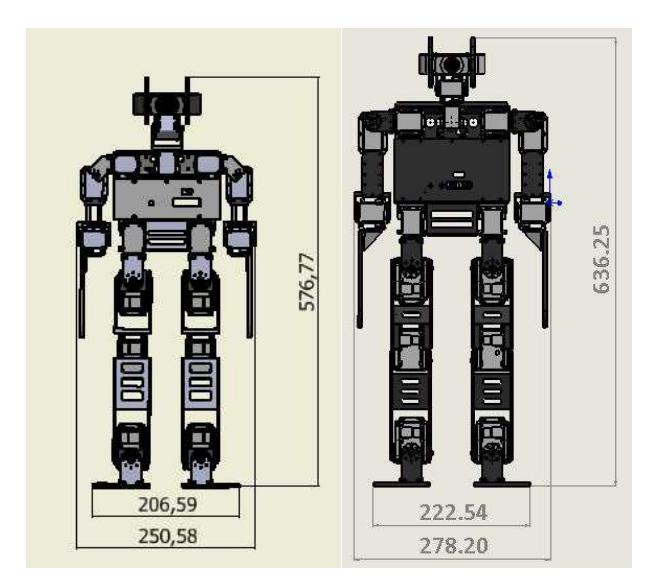
Table 1. Comparison actuator of old and new robot design.
| Sub Body | Old Design | New Design |
|---|---|---|
| Neck | MX-28, MX-28 | MX-28, MX-28 |
| Shoulder | MX-28, MX-28 | MX-64, MX-64 |
| Arm | MX-28 | MX-64 |
| Hip | MX-64, MX-64, MX-64 | MX-106, MX-106, MX-64 |
| Knee | MX-64 | MX-106 |
| Ankle | MX-64, MX-64, MX-64 | MX-106, MX-106, MX-106 |
Vision Processing System
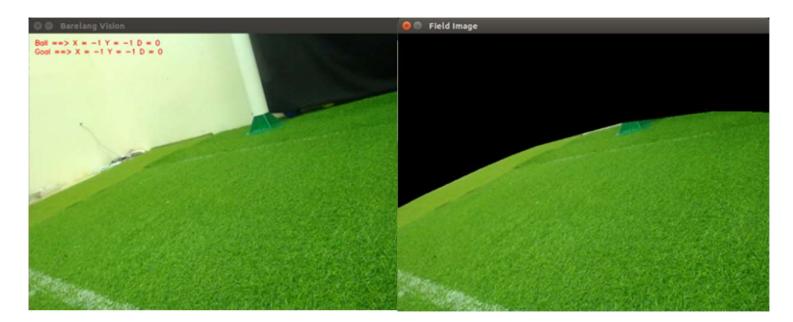
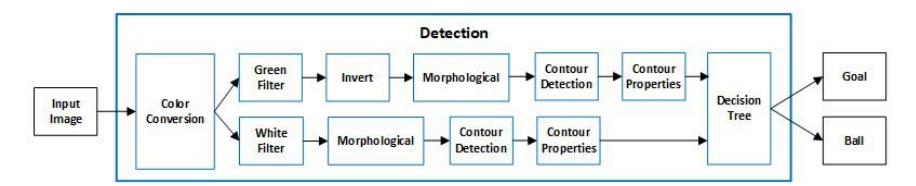
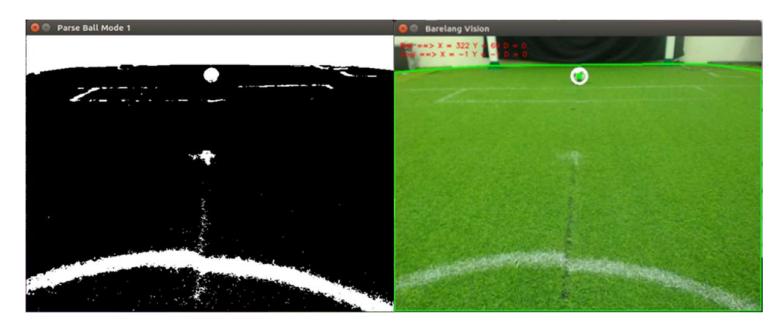
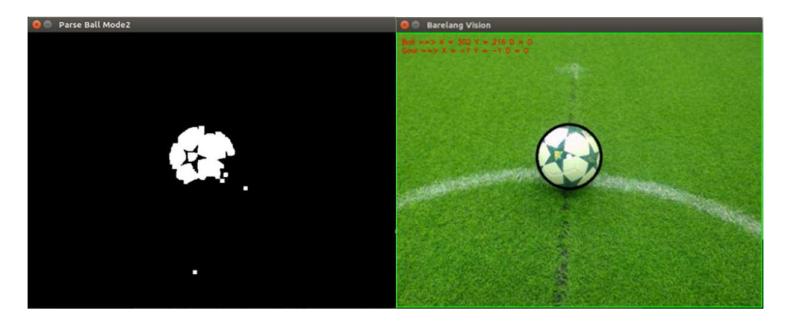
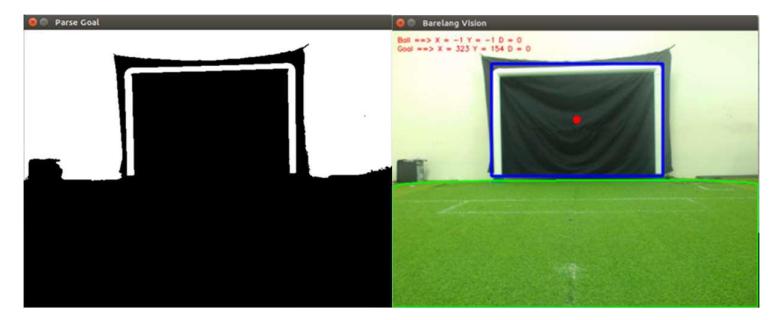
We used a vision processing system which shows in Fig. 4 and Fig. 6 to recognize the ball and goal position on the soccer field. The USB webcam Logitech C920 is used as main device of the vision sensor. Vision processing algorithm is divided into 2 parts, preprocessing and detection. Preprocessing system used to separate field area with unused image outside the field. The details of preprocessing algorithm can be shown in Fig. 4. Preprocessing algorithm start with acquiring an image from webcam, converting color space, filtering specific color, morphological process, detecting contour using convex hull and the last one is masking an image. The result of preprocessing algorithm which shows in Fig. 5.

Conclusion and Acknowledgments
This year the robot is improved on the mechanical and vision system. The result, robots can run faster and kick harder than the old one. The robust vision processing system also applied, and the detection range of ball also increased. Finally, Barelang FC team confidence to compete with other robotics teams in RoboCup 2018 Canada.
References
- RoboCup Homepage, https://www.robocuphumanoid.org/, last accessed January 2018.
- Susanto, Hendawan Soebhakti, Eko Rudiawan, Barelang FC Team Description Paper Humanoid Kid Size League of RoboCup 2017.
- Mandala, Hanjaya: "Sistem Deteksi Bola Berdasarkan Warna Bola dan Background Warna Lapangan Pada Robot Barelang FC". In: The 4th Indonesian Symposium on Robot Soccer Competition, Surabaya (2016).
- Reinhard Gerndt, Daniel Seifert, Jacky (Hansjoerg) Baltes, Soroush Sadeghnejad, and Sven Behnke. "Humanoid Robots in Soccer", IEEE Robotics & Automation Magazine, September 2015.