Bold Hearts Team Description RoboCup 2018 Kid Size
Marcus M. Scheunemann, Sander G. van Dijk, Alessandra Rossi, Daniel Barry, Daniel Polani
Adaptive Systems Research Group School of Computer Science University of Hertfordshire, UK
Abstract In this paper we describe the structure and the software of the RoboCup Humanoid Kid Size league team Bold Hearts. The development of a new platform is at the core of our work, in addition to new possibilities offered by the software. We discuss the construction and the aspects of our new robotic platform, assembled with new computational more powerful hardware and design, and highlight our solutions to vision and sensorimotor modelling. We then provide an overview of past achievements and relevant experience of our team.
Bold Hearts
The team Bold Hearts has been founded as part of the Adaptive Systems Research Group at the University of Hertfordshire in Hatfield in the United Kingdom. The team started participating in RoboCup in 2003 in the simulation leagues. In the 2013 RoboCup competition, the team made a transition to the Kidsize humanoid hardware league.
Robotic Hardware and Design
We started to use the standard DARwIn-OP robotic platform in 2013 RoboCup World Championship in Eindhoven, the Netherlands. In the following period, we adapted the DARwIn-OP framework towards a full framework with debugging tools, web-based inspection tools and other modules needed to enable the robot reacting on changes in an increasingly challenging environment with changing rules. With winning the 2016 Iran Open, in a year where the new artificial turf and white goals have already been used, we have shown that significant achievements can already be made using just the traditional DARwIn-OP hardware by judicious development of software control. However, ultimately, the need to adapt the hardware itself has become inevitable. For example, the small robot size of the DARwIn-OP made it very challenging to recognize a ball far away.
Two major factors shaped our pipeline developing our new hardware. Firstly, our team stems from Computer Science and has a strong software design and development foundation, which was a major contribution to our past successes [12].
Robotic Hardware and Design (continued)
Secondly, observing the developments of other teams in the league, we concluded that a significant risk can be involved with creating a new platform from scratch, and that it can take a long time to get such a platform to perform at a competitive level [12].
After the RoboCup 2017, the Bold Hearts therefore focused on gradually adapting the DARwIn-OP design rather than constructing an entirely new platform from scratch. This has several advantages. Firstly, the incremental nature of this technique permits the originally more software-oriented team to gain experience working with hardware, while, at the same time, having a robot operational for testing and education at all times. Secondly, due to our strong software background, incremental development on top of a working system feels more natural to us, and it makes it easier to convey the ideas and development philosophy to new members who we also mostly recruit from the Computer Sciences.
In modern software development, most notably agile processes, rapid prototyping and rapid iterations are an important aspect of development. These allows for comparing different parts and gaining trust in the design with benchmarking different software packages.
In line with this, the Bold Hearts decided to utilize 3D printing facilities for developing custom robot hardware. In spirit of our gradual adaptation philosophy, instead of determining the full morphology in advance, we iteratively update parts based on requirements and added value in response to previous changes. 3D printing technology allows us to develop parts for the robot with different grades of modification. For a team mostly having access to software facilities, 3D printing offers a cheap way to gain experiences in computer aided design (CAD) and iterating hardware development, with short turnaround times.
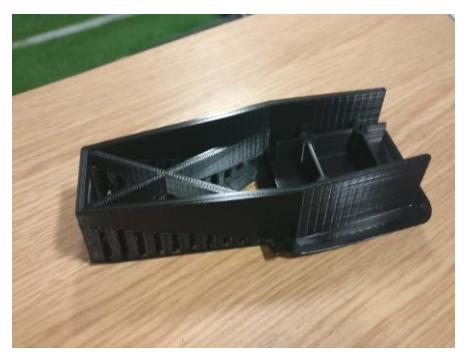
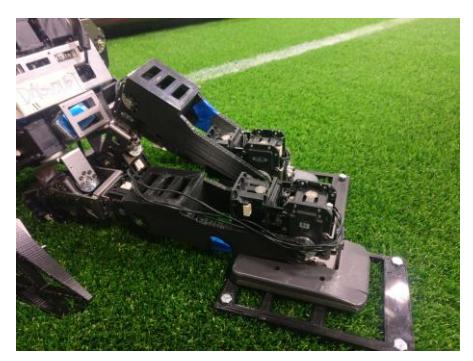
Shortly before the RoboCup 2017 competition, for example, we extended the lower part of the torso and feet to enhance our availability walking on high grass. We are currently lengthening legs and arms to help standing up and walking better in response to previous changes. Examples can be seen in Figure 1. Also, as already discussed earlier in [12], we have chosen to design our robot parts using OpenSCAD, instead of using a proprietary 3D CAD system. One of the main reasons is that the design is captured as plain text, in a parametrised and programmatic format. This allows the development of the designs to be tracked in version control (e.g. Git), to be created in any editor of choice, and be easily shared and reused. It makes it much easier to publish designs in a usable way, compared to a vendor-specific binary format, or post-processed 3D formats that remove ability to adapt a design easily such as STL. The decision for OpenSCAD was mostly driven, again, by our Computer Science background.
Another major benefit of using OpenSCAD is the ease of sharing designed parts. We intend to share our designs in the future, including models of popular components, such as a range of Dynamixel motors and control boards. These models can be used to more conveniently design and create, e.g., brackets. Figure 1 shows the new extended legs and arms, both created and designed using OpenSCAD.
Our interests also lie in experimentation with alternative sensors. Also here, we use a similar gradually increasing process as the 3D printing design. For example, we are currently experimenting several types of cameras having different frame rates.
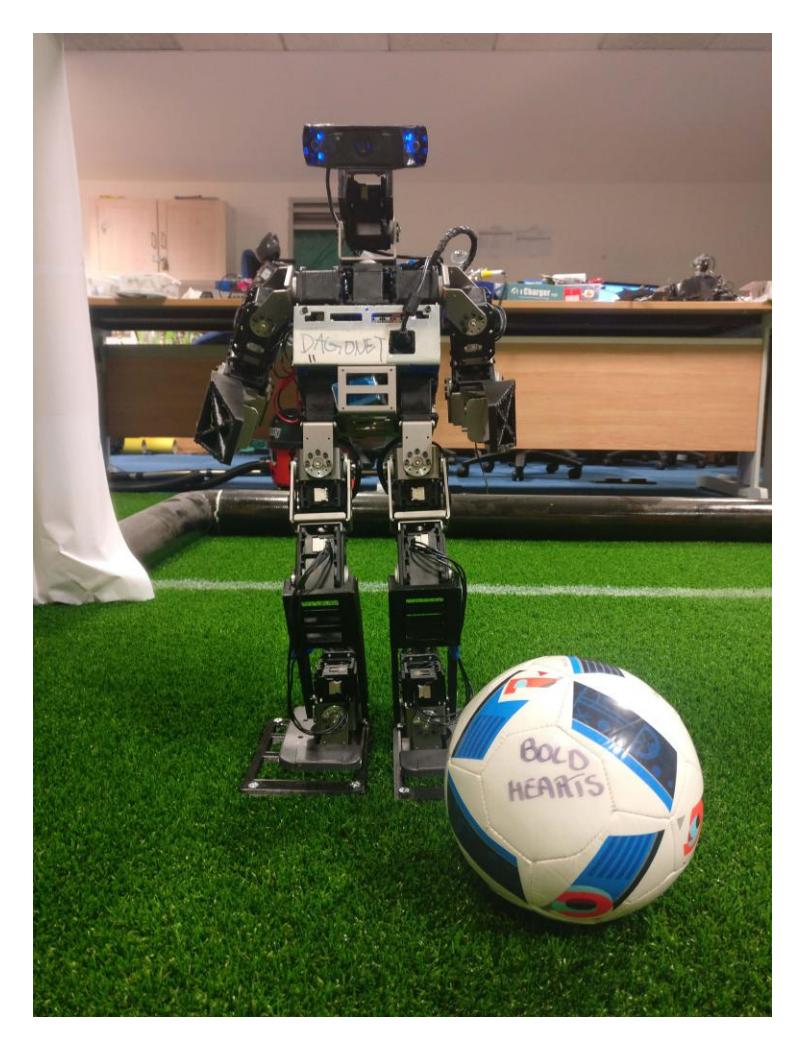
Adapting the electronics of the robot is also done step-by-step. We incrementally equip our robots with newer and more capable electronics and motors needed depending on new morphological changes. For the computational unit, we decided for Odroid-XU4 extending the computational power of our robots from Darwin's 1x1.6 GHz to 8x2 GHz computational units. This allows us investigating new advanced algorithms, such as machine learning techniques for vision (see 3) and walking problems. Figure 2 shows the new generation of our robots named "Boldheart". Boldheart robots are currently at version 2.
Robotic Hardware and Design (continued 2)
Our most recent tests involved the dynamics of the robot with its new extensions. We assume we will update the used Dynamixel MX28T in the close future. With the new changes, we expect our robots, which may gain 20 cm in height, to have a more stable walk behaviour.
Vision
Since last year we have worked on upgrading our vision pipeline from a highly optimised run-length encoding based connected component detection system, to better cope with the ambiguous and less structured environment of the current RoboCup Humanoid League scenario. For this, we have developed Convolutional Neural Networks (CNN) as a stage in the object detection pipeline. Such methods are very popular, however, often also very expensive to compute and used in the context of very large large datasets. Nevertheless, we start seeing applications of CNNs in the much more computationally restricted domain of humanoid football [1, 10], however, these report framerates up to 10 times slower than the 30 fps of cameras commonly used by the robots, and/or require an object proposal step prior to the actual detection/classification step.
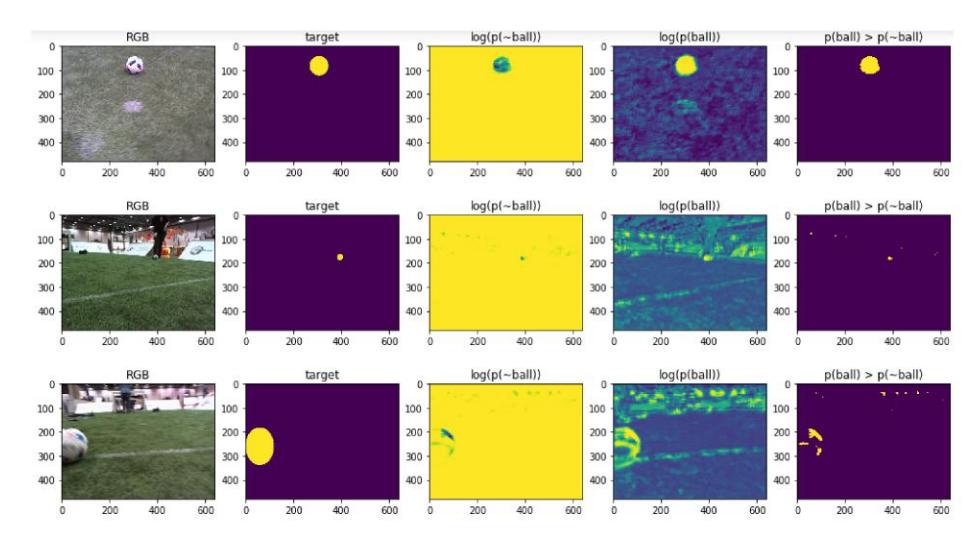
Instead of using "traditional" deep networks that consist of convolutional "feature detection" layers followed by one or more fully connected layers to arrive at an output over the whole input image, we apply so called Fully Convolutional Networks (FCNs) [8] that do not use very expensive fully connected layers. Morover, we integrate recent optimisations, such as those of MobileNets [3] and SqueezeNets [4]. With this, we are able to train and run an accurate CNN on a full VGA resolution image with only a fraction of the millions of parameters some other networks require, as shown in Figure 3.
Sensorimotor Modelling
One of the challenges with iterative body model design is the time cost of remodelling the robotic dynamics for every newly generated model. A continued part of the team effort is the concomitant development of techniques for sensorimotor modelling taking into account the possibilities of intelligent adaptation to novel robotic hardware (refer also to last years TDP [12]). An ongoing research agenda of our team over the last and in the coming years is complementing traditional control methods by more generic approaches to robot control.
We here continue our efforts in developing empowerment for generic behaviourgeneration [7]. To reiterate, empowerment was originally developed as a "taskless utility", and first demonstrated in a highly abstracted RoboCup-inspired "ball-kicking" scenario [6]. It implements an information-theoretic non-linear generalisation of the control-theoretic concept of combined controllability-observability and has been shown to work successfully in a variety of generic control scenarios, both discrete and continuous [9]. It provides a reward function for agent behaviour even when no explicit reward is defined.
In the past year, several breakthroughs were achieved which we successively wish to transfer to the humanoid robots. Empowerment computation for linear continuous-time/continuous-space Gaussian systems has now been fully solved [11] and methods to use it to model the dynamics of the robots are being developed. This will accelerate adoption of the methodology and incorporation into engineering, and our RoboCup team will offer a main opportunity to handle the variations of adaptively designed robots, in terms of stabilisation and other behaviours. Note that work by other groups [5] has already studied in which empowerment-like quantities can be used to stabilize a simulated walker; this shows the promise of the approach, which we will consider in more detail in the coming period. Additional work has shown that empowerment can be computed along trajectories [2] to a quite extended horizon, and this approach is being studied with respect to the possibility to ball-kicking in simulation (in preparation). Also here, we hope to begin including real robots into the consideration.
Experience and Achievements
Our team has been active in RoboCup since 2002, and hopes to participate in the Humanoid league in 2018 for the sixth year in a row. Besides the world championship, we always aim to participate at as many open competitions and related workshops and meet-ups. After last years RoboCup, for example, we participated in the "5th International School for Humanoid Soccer Robots" in Bordeaux/France in December 2017.
The following are the detailed achievements and contributions of team Bold Hearts in the Humanoid League over the last few years.
- Quarter-finalist RoboCup World Championchip 2017 (1st in group)
- 2nd round RoboCup World Championship 2016 (1st in group)
- 1st Iran Open 2016
- 2nd round RoboCup World Championship 2015 (1st in group)
- 3rd German Open 2015
- 2nd RoboCup World Championship 2014
Acknowledgements
Team Bold Hearts would like to acknowledge the crucial open source projects used to develop our team: OpenSCAD, libwebsockets, GitLab, RapidJSON, Google-Test, TensorFlow, and Bit-Bots Imagetagger.
https://www.openscad.org, https://libwebsockets.org/, https://gitlab.com/, https://rapidjson.org/, https://github.com/google/googletest, https://www.tensorflow.org/, https://imagetagger.bit-bots.de
References
- Dario Albani, Ali Youssef, Vincenzo Suriani, Daniele Nardi, and Domenico Daniele Bloisi. A deep learning approach for object recognition with NAO soccer robots. In RoboCup 2016: Robot World Cup XX [Leipzig, Germany, June 30 - July 4, 2016], pages 392–403, 2016.
- Nicola Catenacci Volpi, Daniela de Palma, Daniel Polani, and Giovanni Indiveri. Computation of empowerment for an autonomous underwater vehicle. In 9th IFAC Symposium on Intelligent Autonomous Vehicles (IAV 2016) in Leipzig, Germany, volume 49-2, pages 81–87, 2 2016.
- Andrew G. Howard, Menglong Zhu, Bo Chen, Dmitry Kalenichenko, Weijun Wang, Tobias Weyand, Marco Andreetto, and Hartwig Adam. Mobilenets: Efficient convolutional neural networks for mobile vision applications. CoRR, abs/1704.04861, 2017.
- Forrest N. Iandola, Matthew W. Moskewicz, Khalid Ashraf, Song Han, William J. Dally, and Kurt Keutzer. Squeezenet: Alexnet-level accuracy with 50x fewer parameters and <1mb model size. CoRR, abs/1602.07360, 2016.
- Maximilian Karl, Maximilian Soelch, Philip Becker-Ehmck, Djalel Benbouzid, Patrick van der Smagt, and Justin Bayer. Unsupervised real-time control through variational empowerment, 2017.
- Alexander S. Klyubin, Daniel Polani, and Chrystopher L. Nehaniv. All else being equal be empowered. In Advances in Artificial Life, European Conference on Artificial Life (ECAL 2005), volume 3630 of LNAI, pages 744–753. Springer, 2005.
- Alexander S. Klyubin, Daniel Polani, and Chrystopher L. Nehaniv. Keep your options open: An information-based driving principle for sensorimotor systems. PLoS ONE, 3(12):e4018, Dec 2008.
- Jonathan Long, Evan Shelhamer, and Trevor Darrell. Fully convolutional networks for semantic segmentation. In Proceedings of the IEEE Conference on Computer Vision and Pattern Recognition, pages 3431–3440, 2015.
- Christoph Salge, Cornelius Glackin, and Daniel Polani. Empowerment an introduction. In M. Prokopenko, editor, Guided Self-Organization: Inception, volume 9 of Emergence, Complexity and Computation, pages 67–111. Springer, 2014. Preprint available as http://arxiv.org/abs/1310.1863.
- Daniel Speck, Pablo Barros, Cornelius Weber, and Stefan Wermter. Ball localization for robocup soccer using convolutional neural networks. In Springer Lecture Notes on Artificial Intelligence, volume 9776, 2016.
- Stas Tiomkin, Daniel Polani, and Naftali Tishby. Control capacity of partially observable dynamic systems in continuous time. CoRR, abs/1701.04984, January 2017. To be submitted.
- Sander G. van Dijk, Alessandra Rossi, Daniel Barry, Daniel Polani, Marcus Scheunemann, and Masood Ahmed. Bold Hearts Team Description, RoboCup 2017, Kid Size. Technical report, 2017.