CIT Brains (Kid Size League)
Satoshi Shimada, Yasuo Hayashibara, Hideaki Minakata, Kiyoshi Irie, Ryu Yamamoto, Masayuki Ando, Joshua Supratman, Shota Hirama, Riki Hayashi, Ryohei Goto, Ryoma Aoki, Takaharu Nakajima, Shuto Takano, Naoki Takahashi, Yuta Hatakeyama, Kenta Kawamata, Kanta Takasu, Ayana Enosawa, Taisuke Otsuki, Koki Matsumoto, Morito Ito, Takumi Ogasawara, Nguyen Anh Quan, Youta Seki, Chisato Kasebayashi, Kensuke Saito, Shigechika Miki, Yoshitaka Nishizaki, Kenji Kanemasu, Hajime Sakamoto, Shuichi Yamaguchi
Chiba Institute of Technology, 2-17-1 Tsudanuma, Narashino, Chiba, JAPAN; Miki Seisakusyo Co, Ltd., 1-7-28 Ohno, Nishiyodogawa, Osaka, JAPAN; Nishizaki Co, Ltd., 1-7-27 Ohno, Nishiyodogawa, Osaka, JAPAN; Yosinori Industry,Ltd., 1-1-7 Fukumachi, Nishiyodogawa, Osaka, JAPAN; Hajime Research Institute, Ltd., 1-7-28 Ohno, Nishiyodogawa, Osaka, JAPAN; FrostyDesign
https://github.com/citbrains/OpenPlatform
Abstract In this paper, we describes the overall system of Accelite and CIT Brains' new open platform robot GankenKun-OP for KidSize humanoid robot. This year we developed a new robot with robust mechanism and improved image processing and strategy.
Keywords: humanoid robot, open platform, deep learning, segmentation, soccer strategy
Introduction
CIT Brains is a team consists of mainly undergraduate students from Chiba Institute of Technology. Our team collaborated with Hajime Research Institute to develop our fourth generation humanoid robot Accelite, humanoid robot capable of autonomously play soccer. Hajime Laboratories has developed the Accelite's mechanism and control system of the humanoid robot, and we developed computer systems such as image recognition, behavior decision, and the overall intelligence system and integrated them into humanoid robot.
We have developed the mechanism of the new-generation open platform robot GankenKun-OP[1] from scratch. GankenKun-OP is robust against the impact of falling. Ganken is meaning to be robust in Japanese. From there, it was named GankenKun. We are releasing the mechanism on our GitHub(URL:https://github.com/citbrains/OpenPlatform).
Our team has previous experience with RoboCup Humanoid KidSize, TeenSize and AdultSize League. We received 3rd place in KidSize 4on4 in RoboCup 2016 and 2017, and 1st and 3rd place in Technical Challenge and DropIn Game respectively in RoboCup 2017.
This year we developed an open platform humanoid robot, GankenKun-OP, for KidSize humanoid league. Based on our previous experience from participating in RoboCup, we develop a new robust hardware capable of withstanding various impact and forces. We improved image recognition using Deep Learning and our soccer strategy using ball exploration in our software development.
Overview of the system
Our team's robots, GankenKun-OP and Accelite, are shown in fig. 1 and fig. 2 respectively. The specification is shown in table 1. Although the hardware configuration of GankenKun-OP and Accelite are different, the same program is used for high layer such as image processing and strategy. The software architecture is shown in fig. 3. The overview of control system is shown in fig. 4. GankenKun-OP and Accelite both use Jetson TX2 and are specialized in Deep Learning. All process are operated on one board. Both robots use 19 servo motors. Accelite uses Futaba RS405CB. GankenKun-OP uses Kondo B3M-SC-1040-A and B3M-SC-1170-A.
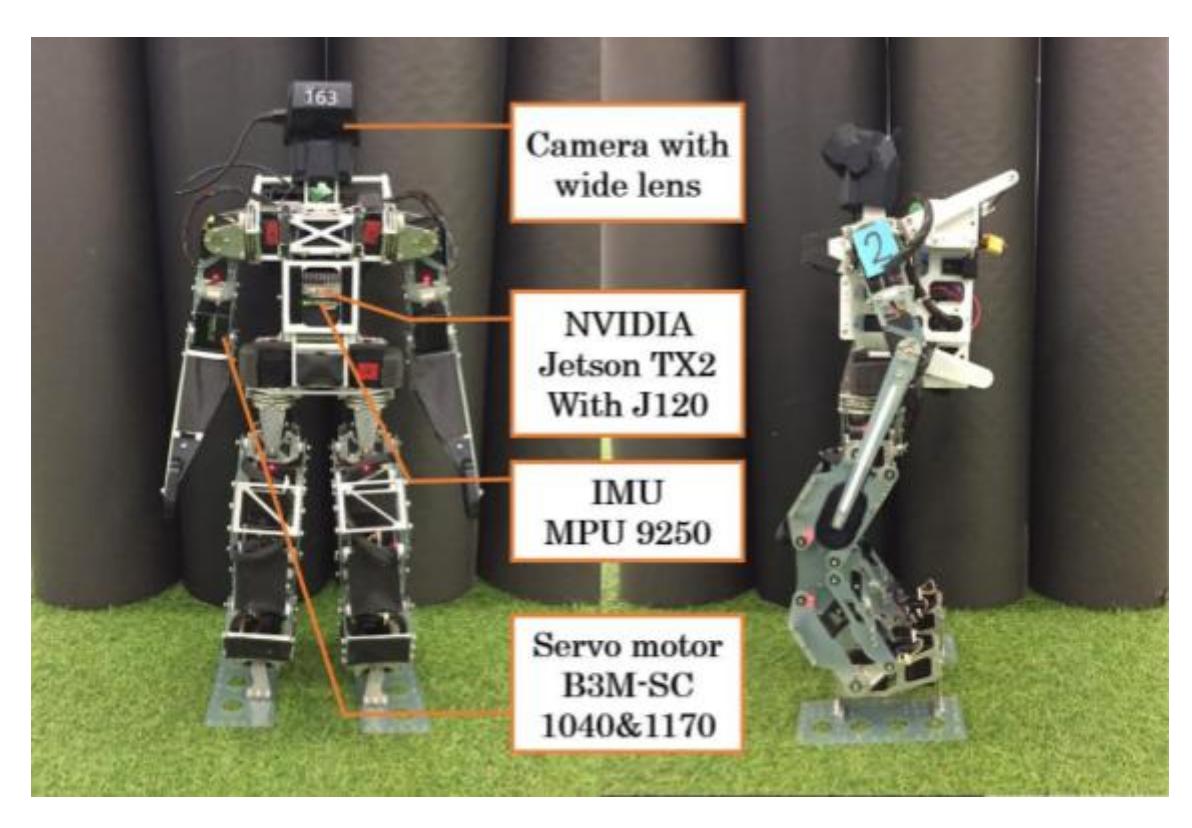
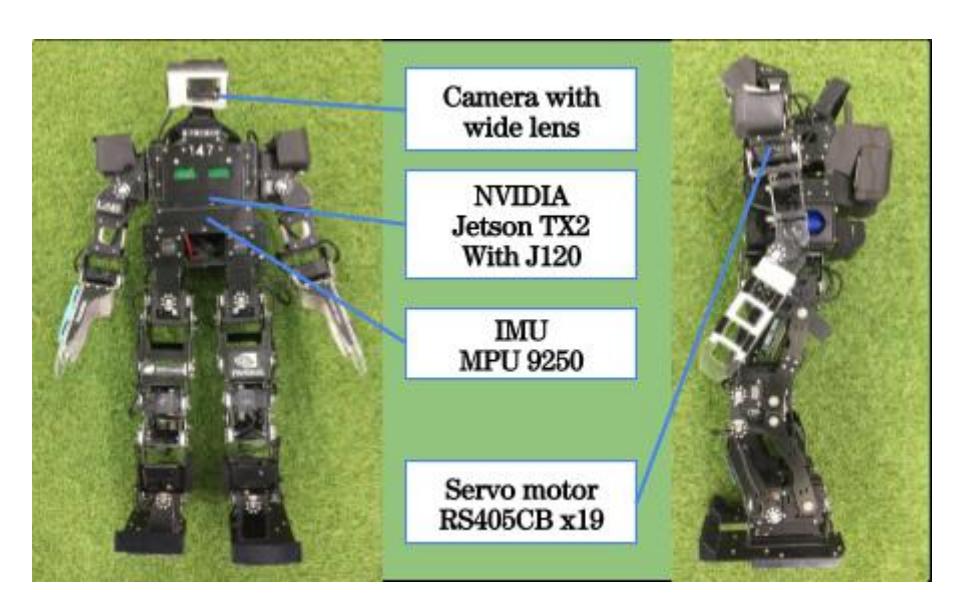
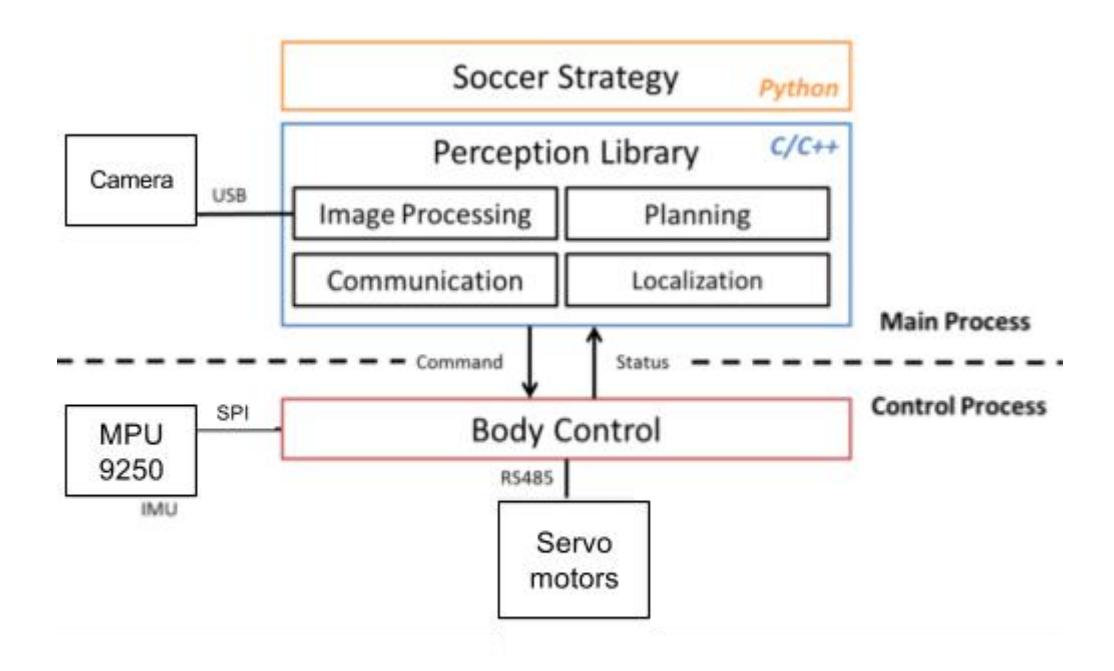
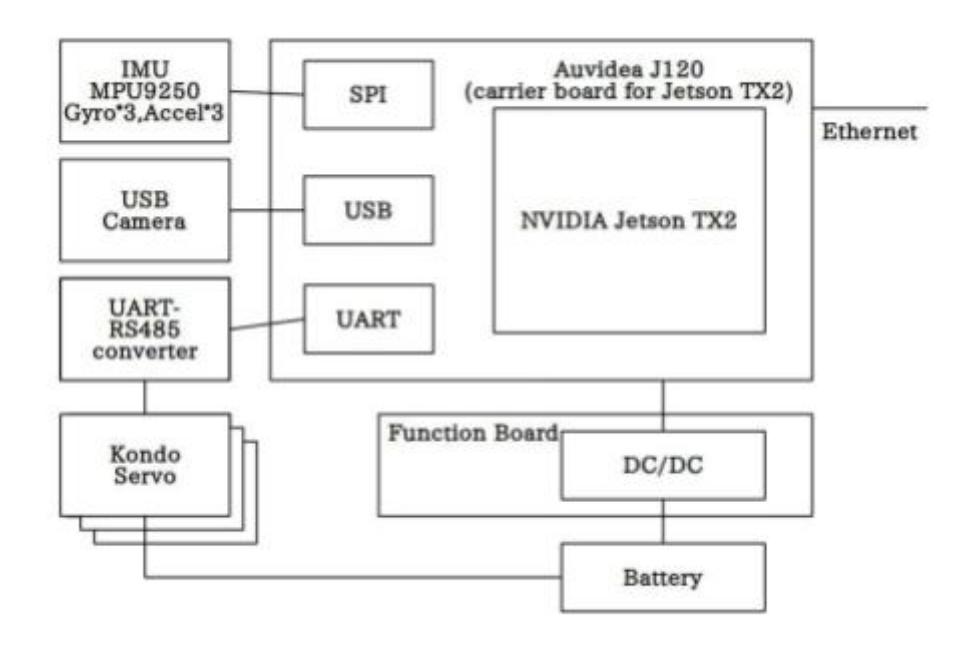
Table 1 Specification of the Robots
| Name | GankenKun-OP | Accelite |
|---|---|---|
| Weight | 4.4kg (Including Battery) | 4.2kg (Including Battery) |
| Height | 620 mm | 600 mm |
| Velocity (Forward) | 0.4 m/s (maximum) | 0.4 m/s (maximum) |
| Walking Directions | All Direction and Rotation (Select the Angle, Stride, Period and so on) |
All Direction and Rotation (Select the Angle, Stride, Period and so on) |
| CPU Board | NVIDIA Jetson TX2 | NVIDIA Jetson TX2 |
| Carrier Board | Auvidea J120 | Auvidea J120 |
| OS | Linux (Ubuntu 16.04) | Linux (Ubuntu 16.04) |
| Interface | Ethernet x 1, USB x 1, Speaker, DIP switch x 4, Push switch x 1 |
Ethernet x 1, USB x 1, Speaker, DIP switch x4, Push switch x 1 |
| Servo Motor | Kondo B3M-SC-1040-A x 9 B3M-SC-1170-A x 10 |
Futaba RS405CB x 19 |
| Battery | LiPo 3S (11.1V, 2400mAh ) | LiPo 3S (11.1V, 5000mAh ) |
Mechanism
GankenKun-OP uses POM(polyacetal), glass epoxy and aluminum for the frame material. These materials were selected considering availability and processability. In order to prevent shortage of torque and direct impact to the servo motor, the sliding-crank deceleration mechanism is adopted for the hip roll shaft. Thrust needle bearings were used to reduce the external forces exerted on the servo motor.
Software
This is the parent section for subsections on Object Detection and Ball exploration.
Object Detection
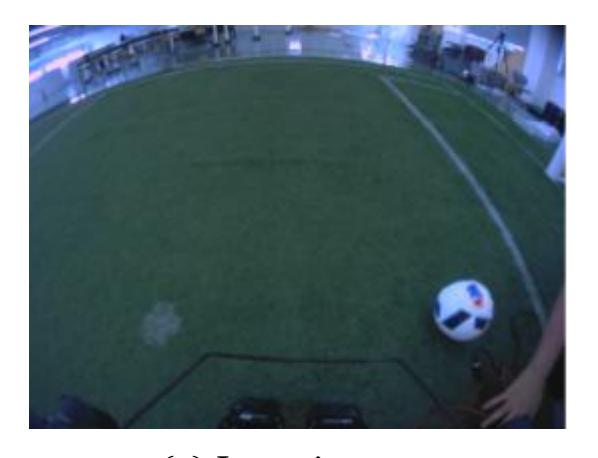
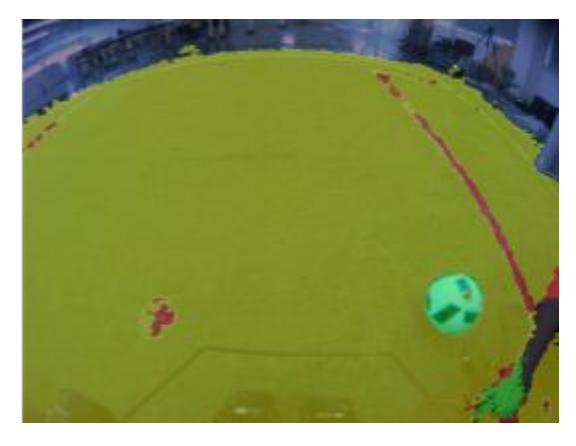
Last year, we were able to detect ball with high accuracy using Deep Learning. However, only the ball and goal post were detectable. For this reason, it is necessary to perform another process for detecting other objects such as the white lines. Previously, we used color based method to detect white lines however the process is difficult as white lines are heavily influenced by ambient light. This year, we changed the model of Deep Learning from YOLO[2] to FCN[3], which can not only detect ball and goal post but also other objects. FCN performs pixel wise segmentation and detects objects. Our model is classified into a total of 6 classes including balls, robots, white lines, field areas, people, and backgrounds. The detection results are shown in fig. 5.
Ball exploration
The introduction of Deep Learning improved the recognition range and recognition accuracy of the ball. However, the behavioral pattern in the strategy when the ball is not found is an important issue. By improving the behavior when the ball is undetected, it is possible to speed up the discovery of the ball and gain advantage over the situation.
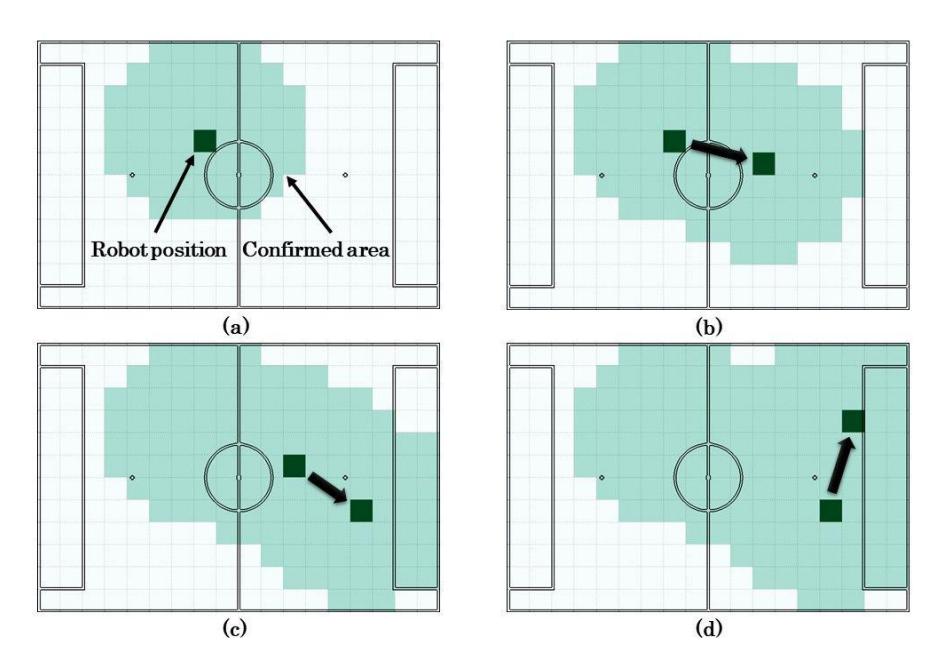
Therefore, we implemented a field search algorithm based on Frontier-Based Exploration[4]. The algorithm first updates the status of the map of fields, which is divided into square cells based on self position and field of view information. Then it determines the
coordinates to be searched by using the cost of the cells corresponding to the search condition. By repeating this, it is possible to efficiently search the ball.
This algorithm is implemented as one of actions of GOAP(Goal-Oriented Action Planning), and behavior is selected according to the environment and cost. By introducing this algorithm, it has become possible to take a more aggressive strategy. Currently, the search map is updated for each robot, but it is considered that the search efficiency can be improved more by updating the map using information from other robots through information sharing.
Acknowledgments
We are extremely grateful that NVIDIA Corporation has offered us Jetson TX2. Their provision allows us to successfully implement Deep Learning to our robot. We also appreciate Futaba Corporation and Kondo Kagaku Corporation, Inc. for sponsoring us. With their support, we can continue to participate in RoboCup.
Conclusion
In conclusion, we described the overall system of CIT Brains KidSize humanoid robot Accelite and GankenKun-OP. This year we made three significant changes, introduction of new hardware, ball exploration strategy and improved image processing using Deep Learning. Our humanoid robot has become more intelligent.
References
- Hiroaki Shimoyoshi and Yasuo Hayashibara. "Development of an Open Platform Humanoid Robot for the RoboCup." In:The Robotics and Mechatronics Conference 2017. The Japan Society of Mechanical Engineers, 2017. p. 2P1-J07. (In Japanese)
- Joseph Redmon, et al. "You only look once: Unified, real-time object detection." Proceedings of the IEEE Conference on Computer Vision and Pattern Recognition. 2016.
- Jonathan Long and Evan Shelhamer and Trevor Darrell. "Fully convolutional networks for semantic segmentation." Proceedings of the IEEE Conference on Computer Vision and Pattern Recognition. 2015.
- Brian Yamauchi. "A frontier-based approach for autonomous exploration." Computational Intelligence in Robotics and Automation, 1997. CIRA'97., Proceedings., 1997 IEEE International Symposium on. IEEE, 1997.