SYCU-Legendary Team Description Paper for 2018 RoboCup Humanoid Kid Size
Jia Haifeng, Fang Zhen, Wang Chun, Qiu Hao, Yao Yuzhu, Liu Shi, Wang Chao, Ying Shipeng, Huang Yiren, Li Liande, Yin Jingyao, Yang Zhehai, Wu Fenghua
Shenyang Key Lab. of Humanoid Robot; Shenyang City University, Shenyang, Liaoning Province, China
Abstract This paper presents the team of SYCU-Legendary with their Kid Size robots that intent to participate in 2018 RoboCup Humanoid competition of both regular and drop-in class as well as technical challenges. Concretely, the mechanical design, electrical system design, component selection, software design and realization of the robot are described thoroughly. The team of SYCU-Legendary was organized by Shenyang Key Lab. of Humanoid Robot and Shenyang City University two years ago when the Kid Size robot was started to be researched. Up to now all the robots are strictly complied with the requirement of RoboCup Kid Size class and even perform excellent in visual recognition and stability. The attendance of SYCU-Legendary will contribute to the 2050-year goal of the international RoboCup that humanoid robots being able to win against the official human World Soccer Champion team.
1 Introduction
Coming from Shenyang City in Liaoning Province of China, SYCU-Legendary is a new team for 2018 RoboCup competition. Our team has been preparing robots in accordance with the requirements of the Robocup competition since 2016 when we started to contract and learn from the teams of Zhejiang University, Tsinghua University, Southeast University and Beijing Information Technology University. SYCU-Legendary consists of nine members whose specialties cover mechanical design and manufacture, automation and computer engineering. The robots were developed by using many advanced equipment such as broadband oscilloscope, high-precision torque analyzer and infrared flaw detector with the help of some software including SolidWorks, Adams, MATLAB, and Python. Both supervisors and members of SYCU-Legendary are familiar with the RoboCup rules and often discuss the development trend of the rules with the peers. In 2017, we published a paper on the international journal "Artificial Intelligence and Robotics Research" [1] where the key technologies of humanoid robot were discussed including simultaneous localization and map construction (SLAM), optimization design and simulation, footprint planning and modeling, stability control with application, plus target recognition and tracking. In view of our research results, Shenyang Science and Technology Bureau ascertained our laboratory as the key laboratory in November 2017. Our team has been awarded the 2017 Top ten innovative team of our university.
Our four robots are named as "Zhuang Zhuang", "Optimus Prime", "Phantom" and "Master", respectively, all of which are completely autonomous humanoid soccer robots. The technical indices of these robots are listed in table 1 where the size, weight, DOF, speed, resolution, precision and identification distance are contained. A lot of breakthroughs in hardware and software system of these robots were experienced during the past year.
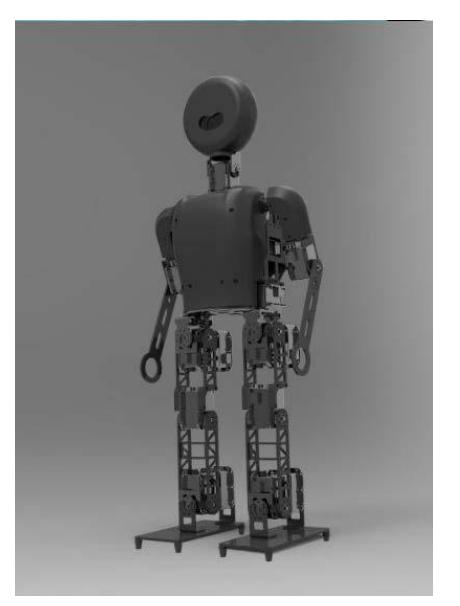
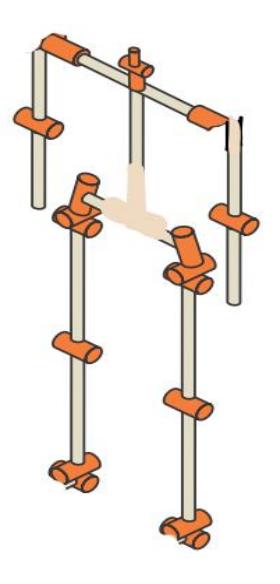
Fig. 1 shows the robot's 3D model and DOF configuration where 18 DOFs are designed that 6 on each leg, 2 on each shoulder and 2 on head.
Technical indices of SYCU-Legendary robot
| Items | Parameters |
|---|---|
| The name of the team | SYCU-Legendary |
| Height | 680mm |
| Wide | 270mm |
| Weight | <4.1Kg |
| Degrees of freedom | 18 |
| Walking speed | 20cm/s |
| Camera resolution | 800*600, 30 frames/s |
| Positioning accuracy | ±1cm |
| Visual identification distance | 2m |
2 Mechanical Design of SYCU-Legendary Robot
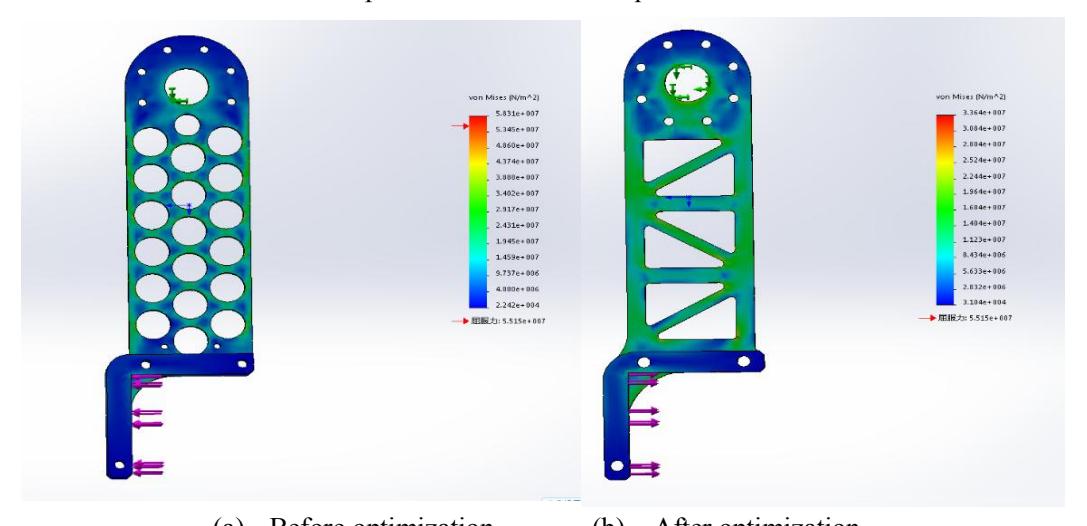
In accordance to the RoboCup requirements, the SYCU-legendary robot has two legs, two arms, one body and one head. The robot's hands and feet are made of carbon fiber while its arms, the legs and the trunk are of aluminum alloy. The firmware of the robot is designed through SolidWorks platform under Simulation environment where the finite element analysis method is adopted to design each component optimally by von Mises yield criterion [2], as shown in Fig. 2. The target of robot design is to make it as light and flexible as possible but its strength being satisfied. In order to let the robot walk on 3cm height artificial grass, four anti-slip protruding parts are equipped at the corners under each foot of the robot to provide enough supporting force, which has been proved to work well. Servo is the most important mechanical driving part of the robot, so we selected Dynamixel products of MX-64 and MX-28 since they are the most widely used brand on RoboCup. Each robot was driven by 18 servos: six for each leg, two for each arm and two for the head. The six servos on each leg ensure the robot acts flexible without hinder and this is undoubtedly crucial for football player. We will continue to improve the performance of the robot while reduce its cost. We believe RoboCup competition is the best opportunity for us to learn from other teams who we expect to share our technique with.
3.1 Electrical Card Design
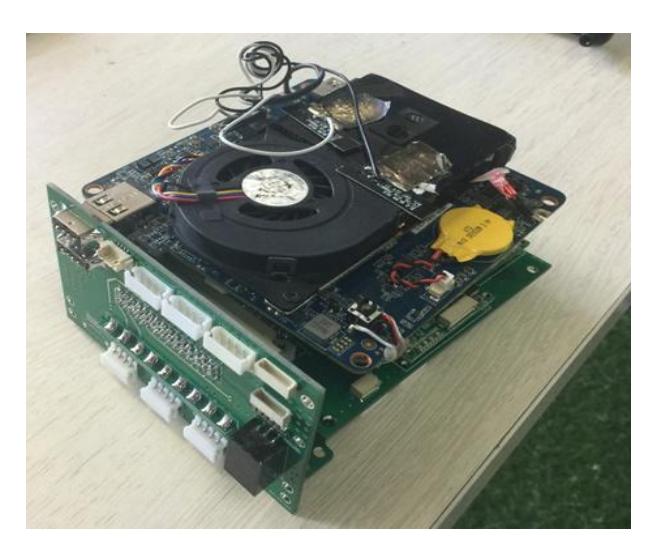
Reasonable electrical design is an essential guarantee for the normal work of robots. Based on sufficient analysis and demonstration, we design and develop the electrical control system as shown in Fig. 3 where the system is composed of upper computer, lower controller, front interface board and power supply board.
Technical parameters for upper computer and lower controller are given in Table 2.
The lower controller is designed by integration of three microcontrollers carrying related functions and embedded structures. Both upper computer and lower controller are pined on and communicate through front interface board which also connects camera and servo buses. Such simply design ensure effective utilization of the interior space of the robot. However we will optimize the composition and design of the electrical control system constantly so that the boards become smaller and smaller while perform better in communication.
Technical parameters of boards of SYCU-Legendary robot
| Items | Upper Computer | Lower Controller |
|---|---|---|
| CPU | Core i7-5500u | ATMEL mega128 |
| Frequency | Dual core 2.4 GHz | |
| Memory | 8 GB | 64KB |
| SSD hard drive/Flash | 64 GB | 128KB |
| Power consumption | 65W, 19V, 3.42A | |
| A peripheral interface | USB 3.0* 4, HDMI, Ethernet, mSATA, audio, etc | |
| OS | Linux | —— |
3.2 Sensor Selection
Since RoboCup humanoid competition requires the robot to be autonomous, the camera becomes the most important external sensor for our robot. In addition, the gyroscope, accelerometer and potentiometer are fixed as internal sensors.
C930e WEBCAMI of Logitech is employed as image sensor which configures HD lens, 1920*1080 pixel, 20-step auto focus, light insufficient automatic correction, high-speed USB2.0 interface directly connect front interface board, meeting visual recognition requirements of the robot.
Being firmly installed on the chest of the next machine board card, the Gyroscope can accurately measure the robot torso angular velocity and send it to the control system to adjust the robot's posture and maintain its balance.
The accelerometer is used to determine whether the robot falls or not, upon which the raise-up action of robot can be conducted.
The potentiometer is provided internally by the servo so that its angle can be obtained by the robot.
4.1 Software Architecture
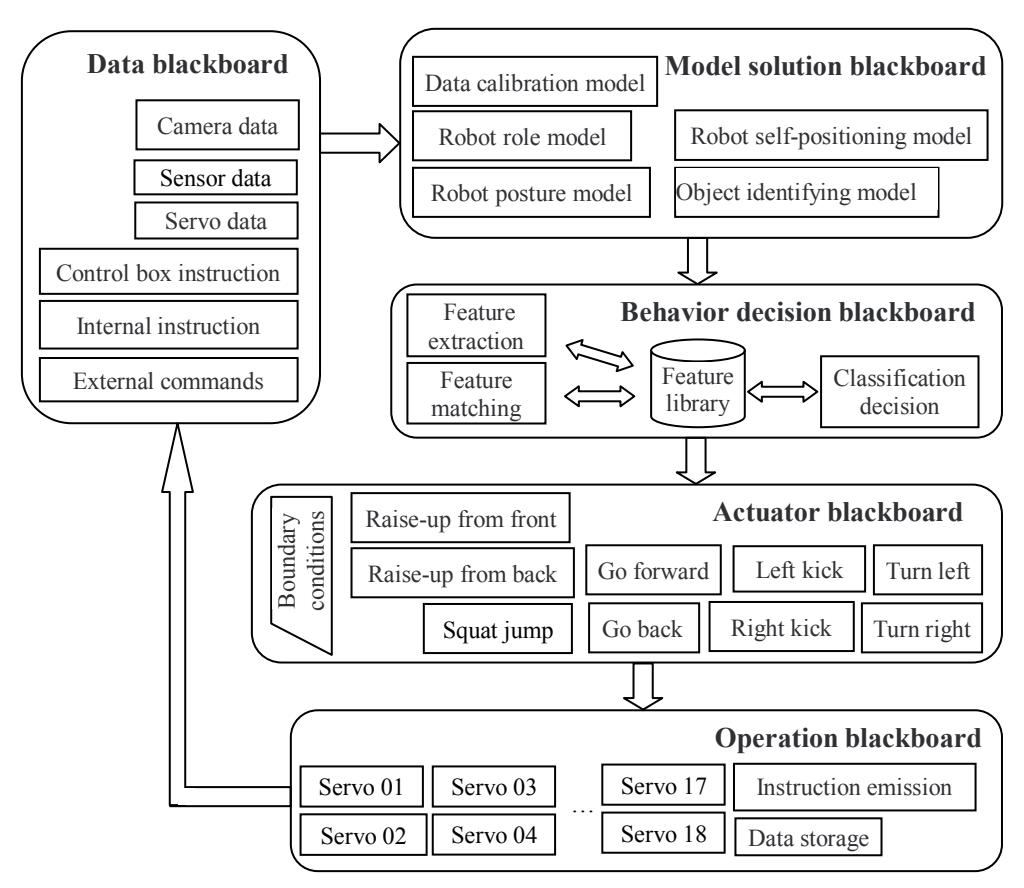
Robot playing football on the field is highly complex intelligent system that requires intact collection, timely delivery and effective usage of information. We adopted the software architecture of the blackboard structure [3] shown in Fig. 4 to ensure the real-time emission and timely sharing of various information which includes Data blackboard, Solution model Blackboard, Behavior decision-making Blackboard, Execution drive Blackboard, Action executive Blackboard.
The data blackboard contains camera data, sensor data, servo data, and control box instructions, internal and external instructions. Among them, the camera data is the image data, 30 frames per sec, taken by the robot in the field which is used for the target recognition. Sensor data contains gyroscopes, accelerometers and potentiometer data, helping the robot's position and posture judgments. The servo data includes temperature, torque, etc., for security. Robot must obey control box instruction comes from the field network. The partner instruction is delivered among field robots while the external instruction is used during technical challenge competition.
These data and instructions are provided to the model blackboard, which contains Data calibration model, Robot role model, Robot gait model, Robot self-positioning model and Robot target recognition model. Data calibration model normalize the robot data collected by the data blackboard and calibrate them according to the deviation of actual information and that generated from model of library so as to ensure that the results of the model meet the robot in field under actual conditions. The robot role model sets different roles for the robot according to the external instruction. The robot gait model adopts the D-H kinematics [4] representation method to establish the mathematical expression of the robot's gait and solves it on basis of the sensor data. The robot self-positioning model is built by employing particle filter (PF) [5] algorithm. In detail, a set of weighted particles (that is, a sample) are generated to indicate the probability of the robot being on certain position, expressed by posteriori probability density function. The probability of every weighted particle is calculated iteratively based on the value of the observation model of the robot. After repeated recursive and iterative calculation, the final collection of particles with largest weight represents the most probable position of the robot [6]. The robot's object recognition model identifies the field soccer [7], goal, mark line, opponents and partner, while marking their position and distance.
Behavior decision blackboard obtains the states of both robot and field through the information of model blackboard. Also the features in field are extracted to be matched with the feature library so that the robot knows what to do next. If the robot is set to be a striker, he would know where he should go and with what speed. If he is a goalkeeper, he would know how to react.
Actuator blackboard gives instructions to operation blackboard under different boundary conditions. These instructions mean what the robot should do to fulfill the decision from behavior decision blackboard, such as go forward, go back, raise-up from front, raise-up from back, left kick, right kick, turn left and turn right.
Operation blackboard converts the expected action of the robot to executive instruction to the 18 servos, including rotation angle, starting and ending time, etc. Meanwhile the decision-making instructions are sent to all the own players who can play cooperatively in field. All these data are stored and used in real time.
4.2 Code design
In order to take the advantages of the various programming environments, we write code by using two kinds of computer languages: Python for policy layer and C language for model layer. In the C language model layer, the codes are divided into several parts involving image processing, visual recognition, gait and many other aspects. When the robot is switched on, the main function in C is called, and then the strategy in Python is invoked to achieve all the works including goal finding, dribbling, shooting, and gatekeeper, etc.
OpenCV is a BSD licensed (open source) distributed Cross-platform Computer Vision Library that can run on Linux, Windows, Android, and Mac OS. This is a lightweight and efficient library because it use a series of C function and a small amount of C + + class and provides interface with Python, Ruby, MATLAB language. It is very convenient to process visual images since many common algorithms are embedded to realize image processing and computer vision. The boost library we adopted is a portable, source-coded C + + library, as a fallback to the standard library, is one of the development engines of the C + + standardization process.
5 Conclusions
This paper introduces the SYCU-Legendary team and robot description from the key laboratory of Shenyang humanoid robot and Shenyang City University. The mechanical design, electrical design and selection, software design and implementation of the robot are described in detail. It combines a lot of innovations with our team intelligence. This is the first time our team applies for RoboCup World competition. We attach great importance to this chance since our school and laboratory have invested a lot of manpower and material resources for robot development and commissioning. Currently all of our 4 robots work normally and can complete both soccer play and challenge competition as required by the RoboCup rules. Even our robot's ability on ball identification and walking stability are excellent. We are confident of gaining good achievements on 2018 World Games. Of course, we are looking forward to this opportunity to communicate with all the teams from various countries and areas. We also wish to assist both organizing committee and technical committee to make the competition favorable and successful.
Acknowledgements
This research has been supported by Shenyang Science and Technology Plan Project. Meanwhile, we express sincere gratitude to the teams from Zhejiang University, Tsinghua University, Southeast University and Beijing Information Technology University.
References
- Wu fenghua, Li Liande, Wang Hao, Wang Yueyong, Jiang Jiao, Chen Si. Research on Key Technologies of Humanoid Robot[J]. Artificial Intelligence and Robotics Research, 2017, 06(03): 97-105.
- IvanMarković, IvanPetrović. Speaker localization and tracking with a microphone array on a mobile robot using von Mises distribution and particle filtering[J]. Robotics and Autonomous Systems. Volume 58, Issue 11, 30 November 2010, Pages 1185-1196.
- FranciscoJurado, Miguel A.Redondo, ManuelOrtega. Blackboard architecture to integrate components and agents in heterogeneous distributed eLearning systems: An application for learning to program[J].Journal of Systems and Software. Volume 85, Issue 7, July 2012, Pages 1621-1636.
- Yuan-LungLai, Chien-ChihLiao, Zi-GuiChao. Inverse kinematics for a novel hybrid parallel–serial five-axis machine tool[J].Robotics and Computer-Integrated Manufacturing. Volume 50, April 2018, Pages 63-79.
- XiaoyanQian, LeiHan, YuedongWang, MengDing. Deep learning assisted robust visual tracking with adaptive particle filtering[J].Signal Processing: Image Communication. Volume 60, February 2018, Pages 183-192.
- Ryan A, Hedrick J K. Particle filter based information-theoretic active sensing[J]. Robotics and Autonomous Systems. 2010, 58(5): 574-584.
- SwarupMahato, ArunasisChakraborty. EKF Based Parameter Identification of LTI System from Seismic Response Measurements[J].Procedia Engineering. Volume 144, 2016, Pages 360-365.