CIT Brains (Kid Size League)
Riki Hayashi, Yasuo Hayashibara, Hideaki Minakata, Kiyoshi Irie, Joshua Supratman, Youta Seki, Chisato Kasebayashi, Satoshi Shimada, Takaharu Nakajima, Shuto Takano, Naoki Takahashi, Kanta Takasu, Koki Matsumoto, Morito Ito, Takumi Ogasawara, Nguyen Anh Quan, Shuta Takahashi, Takehiro Hasegawa, Satoru Negishi, Gaku Kuwano, Shunsuke Takami, Hayato Kitaura, Ryoko Shiojima, Keito Yamada, Ema Tamamizu, Kazuki Nakajima, Yuki Kimura, Shigechika Miki, Yoshitaka Nishizaki, Kenji Kanemasu, Hajime Sakamoto, Shuichi Yamaguchi
Chiba Institute of Technology, 2-17-1 Tsudanuma, Narashino, Chiba, JAPAN; Miki Seisakusyo Co, Ltd., 1-7-28 Ohno, Nishiyodogawa, Osaka, JAPAN; Nishizaki Co, Ltd., 1-7-2 Ohno, Nishiyodogawa, Osaka, JAPAN; Yosinori Industry, Ltd., 1-1-7 Ohno, Fukumachi, Osaka, JAPAN; Hajime Research Institute, Ltd., 1-7-28 Ohno, Nishiyodogawa, Osaka, JAPAN; FrostyDesign
https://github.com/citbrains/OpenPlatform · https://docs.google.com/document/d/1QVJw5iJPz-udtL7ehT3x4J-RgqrIynhghZphqU909LQ/edit?usp=sharing
Abstract This paper describes the overall system and design of CIT Brains KidSize humanoid league's open platform robot GankenKun. We introduce the new open platform robot last year in 2018 and made significant hardware improvements to the platform performance. We also made software improvements; developing a 2D strategy simulation for collaboration strategy, enhancing object detection system to detect ally/enemy robot, and implementing Walk-Kick method to enhance ball kicking.
Introduction
CIT Brains is a team consists of mainly undergraduate students from Chiba Institute of Technology. We previously competed in RoboCup KidSize Humanoid League and won first place on 4-on-4 competition in 2014 and 2015 and won first place consecutively in the Technical Challenge for 8 years.
Our previous humanoid platform robot, Accelite, was developed with Hajime Research Institute, where they developed the mechanism while undergraduate students from Chiba Institute of Technology developed the overall system such as image processing and behavior planning. Last year we introduce a new open platform robot GankenKun[1], where the whole system from hardware to software was developed by undergraduate students from Chiba Institute of Technology.
This paper describes the overall system and design of CIT Brains KidSize humanoid robot GankenKun. The first two sections describes the overview of the system and the hardware modification. The last sections discuss the software improvements in object detection, behavior planning and control system.
Overview of the CIT Brains System
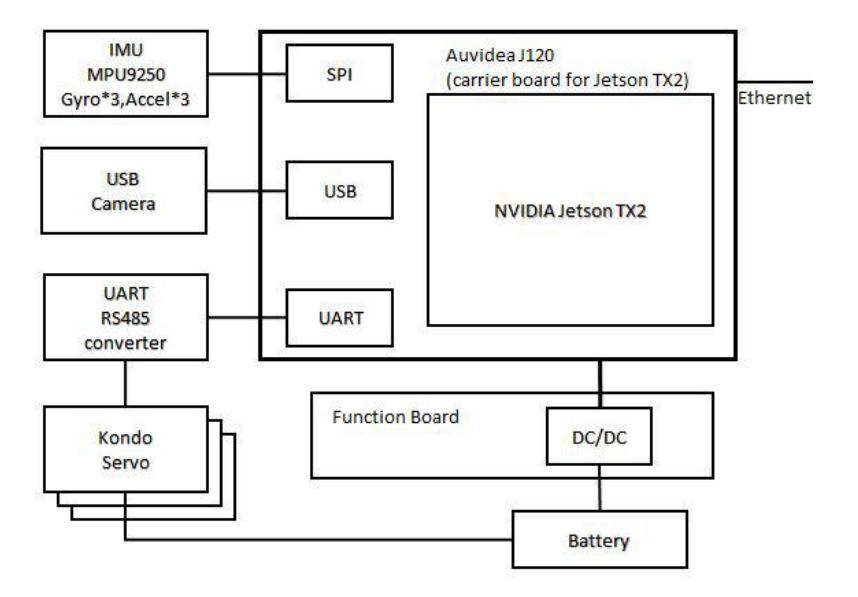
Our robot, GankenKun, and its specification is shown in Fig. 1 and Table 1 respectively. GankenKun uses Jetson TX2 with a Auvidea J120 carrier board which included a MPU-9250 IMU (compass is not used) and uses a total of 19 B3M Kondo servo motors. All processes is handle in the single board. The overall control system is shown in Fig. 2.
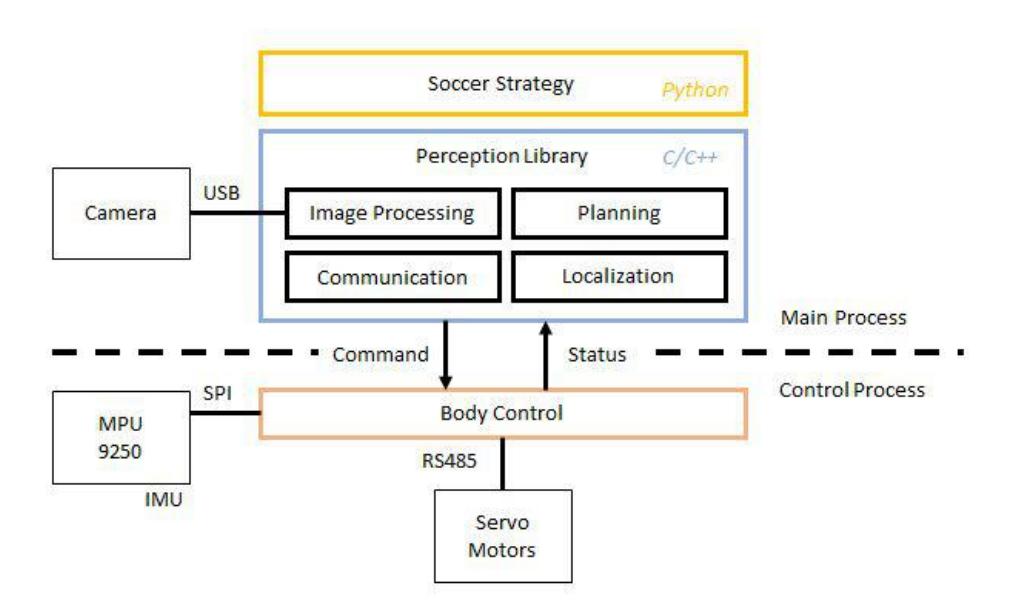
The software architecture is shown in Fig. 3 where the lower level control such as localization and body control is written in C++ and the higher level control such as soccer strategy is written in Python 2.7.
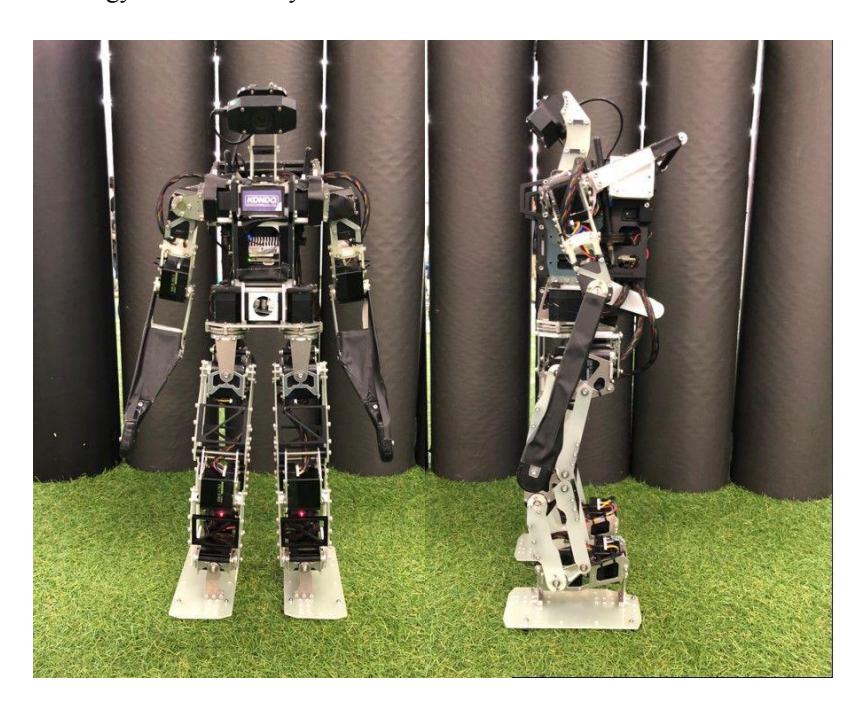
Table 1. Specification of the robot.
| Name | GankenKun |
|---|---|
| Weight | 4.6kg (including Battery) |
| Height | 640 mm |
| Velocity (forward) | 0.3 m/s (maximum) |
| Walking Directions | All Direction and Rotation (Select the Angle, Stride, Period and so on) |
| CPU board | NVIDIA Jetson TX2 |
| Carrier board | Auvidea J120 |
| OS | Ubuntu 16.04 |
| Interfaces | 1 x Ethernet, 3 x USB, 1 x Start Button, 1 x Stop Button, 1 x Emergency Stop |
| Servo motors | 9 x Kondo B3M-SC-1040-A, 10 x Kondo B3M-SC-1170-A |
| Battery | LiPo 3S (11.1V, 2400mAh) |
Hardware
GankenKun, a robust Open Platform Robot developed by undergraduate students from Chiba Institute of Technology, is developed for RoboCup KidSize Humanoid League. Its unique hardware is design to withstand against various impact and external forces such as falling down and robot clashing, a common occurrence in RoboCup matches.
The 3D CAD data is available at https://github.com/citbrains/OpenPlatform. This year, we removed the pitch axis speed reduction mechanism. In doing so, we improved the robot's walking speed and kick stability. We also optimize the servo motor gain to alleviate the damage to the servo motors caused by the impact from falling down.
Software
[This section contains subsections below]
Object Detection
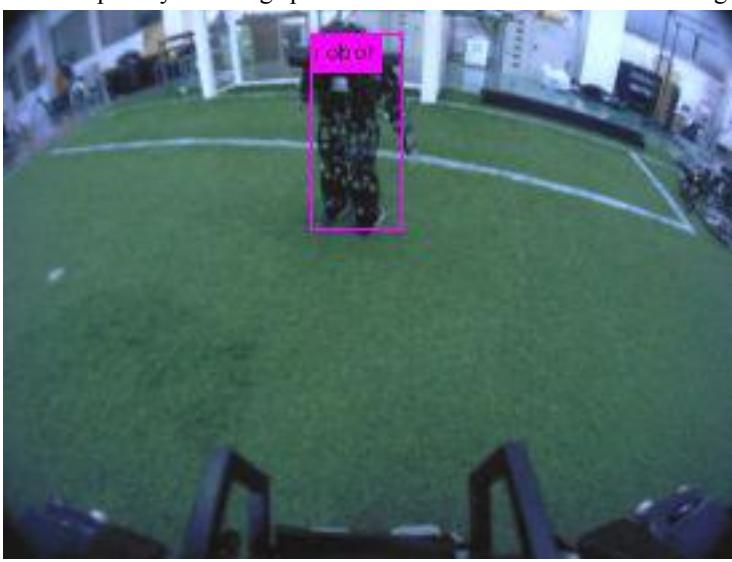
Our robot uses YOLO[2] to detect the ball and the goal post and uses color-based image processing[3] to detect the white line and field area. This year, we implemented a robot class to YOLO. Our robot can detect ally robots as well as unknown/enemy robots, without explicitly labelling specific robots. The result is shown in Fig. 4.
Behavior Planning
[This section contains subsections below]
GOAP
We are using GOAP (Goal Oriented Action Planning)[4] for behavior planning. The robot generates its own goal based on the current situation and plan optimal behaviors to achieve its goal.
Strategy Simulation
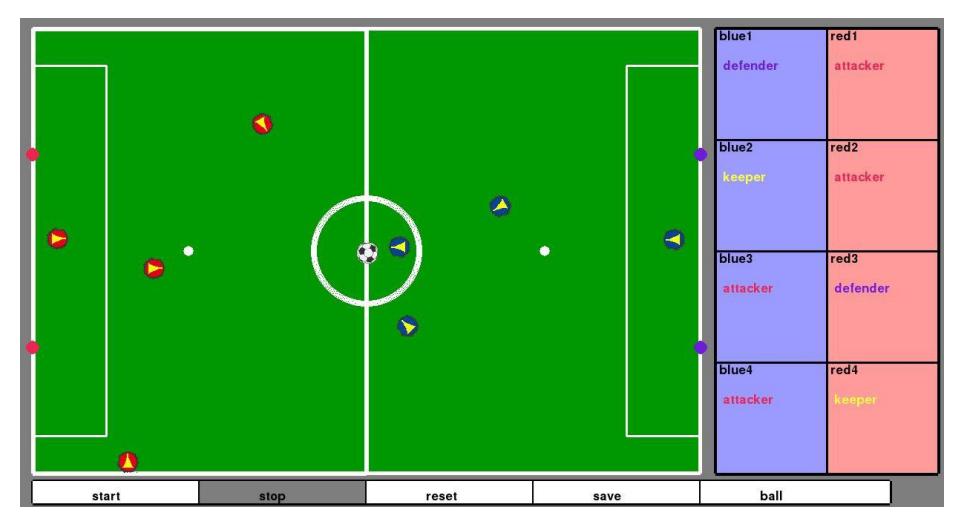
We are currently developing our own soccer simulator (Fig. 5) in order to create a noiseless environment to test our strategy software without using real robots. With this simulator, debugging and developing new strategy for our robots become more efficient.
Walk-Kick method
Until last year, our robot kick the ball using a predefined motion, which waste time switching between gait motion and kick motion. We implemented the Walk-Kick method [5], a walking pattern generation based on preview control, where our robot can kick the ball while walking. This method saves time as the robot no longer need to switch between gait and kick motion.
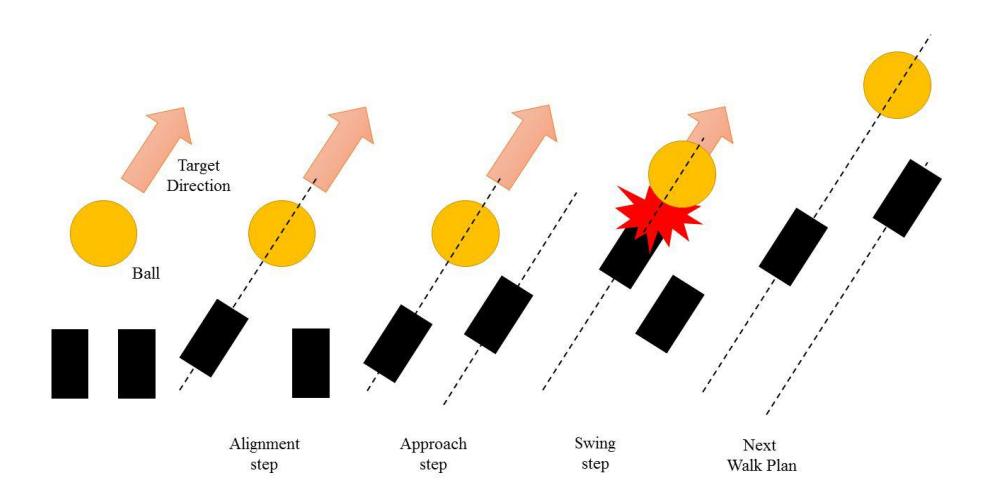
The ZMP pattern realizes the Walk-Kick method by planning in the step of adjusting, approaching, and swing as shown in Fig. 6. For the swing leg trajectory, we used the cycloid curve during walking and the Bezier curve when kicking so that the robot can cope with dynamic change pattern. Even if different curves are used, theres is no need to seperate by gait and kick motion as the kick motion can be generated in the same hierarchy as the walk pattern generation.
Conclusion
In conclusion, this paper describes the overall system and design of CIT Brain's open platform robot GankenKun. We apply modification to the hardware and software to improve the robot's performance.
Acknowledgement
This work was supported by NVIDIA Corporation, Kondo Kagaku Corporation Inc., Shikino High-Tech Co, Ltd., Mercury INC and Chiba Institute of Technology.
With their support, we can continue to participate in RoboCup.
References
- H. Shimoyoshi and Y. Hayashibara.: Development of an Open Platform Humanoid Robot for the RoboCup. In:The Robotics and Mechatronics Conference 2017. The Japan Society of Mechanical Engineers, 2017. p. 2P1-J07. (In Japanese)
- J. Redmon, S. Divvala, R. Girshick and A. Farhadi.: You Only Look Once: Unified, Real-Time Object Detection, In CVPR. (2016)
- Y. Hayashibara, H. Minakata, K. Irie, D. Maekawa, G. Tsukioka, Y. Suzuki, T. Mashiko, Y. Ito, R. Yamamoto, M. Ando, S. Hirama, Y. Suzuki, C. Kasebayashi, A. Tanabe, Y. Seki, M. Masuda, Y. Hirata, Y. Kanno, T. Suzuki, J. Supratman, K. Machi, S. Miki, Y. Nishizaki, K. Kanemasu, and H. Sakamoto.: CIT Brains KidSize Robot:RoboCup 2015 KidSize League Winner, RoboCup 2015, Robot World Cup XIX, Lecture Notes in Computer Science, pp.153– 164, 2016
- O. Jeff.: Symbolic representation of game world state: Toward real-time planning in games. Proceedings of the AAAI Workshop on Challenges in Game Artificial Intelligence. Vol. 5. 2004
- Y. Seung-Joon, S. McGill, and D. D. Lee.: Improved online kick generation method for humanoid soccer robots. The 8th Workshop on Humanoid Soccer Robots, Georgia USA(2013)
- Hiroaki Shimoyoshi, Yasuo Hayashibara.: Development of an Open Platform Humanoid Robot for the RoboCup. In:The Robotics and Mechatronics Conference 2017. The Japan Society of Mechanical Engineers, p. 2P1-J07.(2017) (In Japanese)