Team Description Paper for Team I-KID Robocup2019
Chen Min, Zhang Chongyang, Wang Jun, Yan Bixi
Beijing Information Science&Technology University, Beijing, China
Abstract In this Team Description Paper, we describe the main changes of our humanoid robot for RoboCup 2019 Australia. We mainly illustrate the improvements of the algorithm of our robot in ball detection, the improvements of hardware in core board, the new design of power board that aim to improve the performance of the robot.
Introduction
Founded in 2010, the I-KID team is composed of over twenty students including undergraduates and postgraduates at different levels. The machine vision, as one of core technologies in the field of robot, has become the important study direction of the Instrument Science and Technology discipline opened in our university. Since 2011 when our I-KID team participated in the China Robot Competition and The RoboCup China Open 2011 for the first time and won the First Prize (Runner-up) and took the first name in the Soccer and Race Competition in Kid-size group, we have made great achievements and won many prizes in some competitions at home and abroad in the following six years including the 2012 Mexico RoboCup Competition, 2013 Netherlands RoboCup Competition, 2014 Brazil RoboCup Competition. We won the second place of the team competition in the RoboCup China Open 2017 in Kid-size group, which is held in Shandong province. We won the fourth place in the Technical Challenge in 2017 Japan Robocup Competition in Kid-size group.
In 2018, we also took part in so many competitions especially RoboCup China Open 2018 held in Zhejiang province and 2018 Canada RoboCup Competieion. We won the 3rd place in KisSize Technical Challenge in China, the 4th place in the Technical Challenge and the 8th place in KidSize 4on4 in Canada RoboCup Competieion. Besides, we also participated various robot competitions held in Beijing, five regions in north China (Beijing, Tianjin, Hebei province, Shanxi province and Nei Monggol Autonomous Region) and domestic competitions jointly held by both sides of Taiwan Strait. We have ceaselessly improved and updated the structure of software and hardware so as to enhance the level of our robots in accordance with the competition rules of Robocup WorldCup.
This year we developed a new robust hardware capable of computing the data from Vision System. We improve the algorithm of our robot in ball detection and ball tracking using Deep Learning for KidSize Competition. In addition, we pay more attention to our hardware in core board and the new design of power board that aim to improve the performance of the robot.
Overview of the System
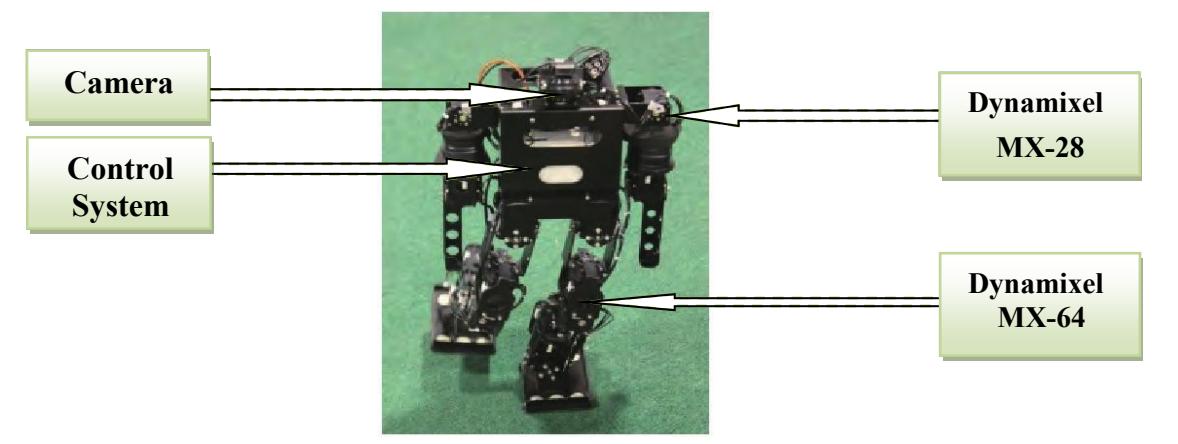
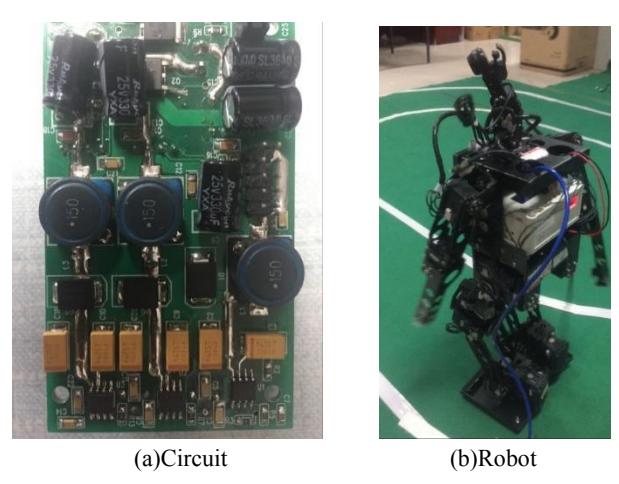
Our new robot is shown in Fig.1. It has twenty degrees of freedom (DOF), six RX-64/MX-64 in each leg, three RX-28/MX-28 in each armand two RX-28/MX-28 in the neck. Compared with old robot, the new one removes the DOF in waist, this change makes mechanical structure more stable and achieve a faster walking speed with 20%improvement.
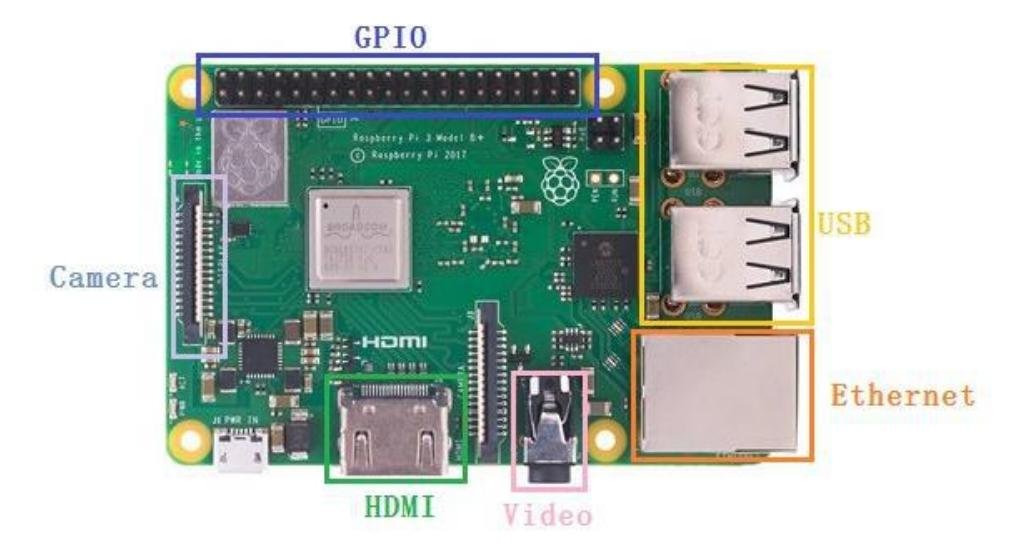
The newly designed robot makes a significant improvement with the computing speed. A cortex-A8 based CPU Samsung S5pv210 is replaced with a Cortex-A53 CPU, depicted as Fig.2. The processor clocked at 1.4GHz does not only exceed in frequency, but also in power consumption. 2GB memory combined with 1G FLASH is sufficient to load any algorithms for soccer, such as fast image processing, particle filter based world modeling. High data load on USB bus with YUV space image, which means noise vulnerable for transfer, is exchanged with smaller sized JPEG alternatives. While on PC104 computer, the time consumption for JPEG decompression is unable to fit system requirement. Raspberry Pi 3b+ is capable to decode the image at little cost,powered by its hardware JPEG codec.
Optimized visual recognition
With the change of RoboCup competition rules, we used a kind of object detection method to improve robots' ability in detecting ball which integrating a lookup table method and a connected domain method last year. However, the method above is difficult as white lines are heavily influenced by white blocks in ball and especially sensitive to light change and can only recognize four features such as ball, goals, field and white lines. This year we use a new network for performing feature extraction which called YOLOv3. In this method, it is possible to work really well in ball detection during competition. In addition, the new method will help our robots behave more stability and accuracy.
YOLOv3 is the third object detection algorithm in YOLO (You Only Look Once) family. It improved the accuracy with many tricks and is more capable of detecting small objects. It has fiftytwo convolutional layers and one connection layer, so we can call it Darknet-53. We use convolutional weights that are pre-trained on our own images during testing. The process about YOLOv3 in Fig.3..

Experiments
All of our experiments use YOLOv3 built on the Darknet framework, OpenCV3.2 image processing library, Ubuntu 16.04 system, GPU(GTX-1080), CUDA9.0 and cuDNN7.0. We use 3300 images photographed in robot competition, and 3000 pictures of them will be trained, 300 pictures of them will be tested. Our model is classified into a total of 6 classes including balls, white lines, field, people, and backgrounds.
Object Detection Evaluation
After the above training, in order to test the accuracy of the model, we use the soccer robot camera to take photos. The amounts of test pictures are almost 300, then we put them into YOLOv3 model. The experimental results are in Fig.4 and Fig.5.
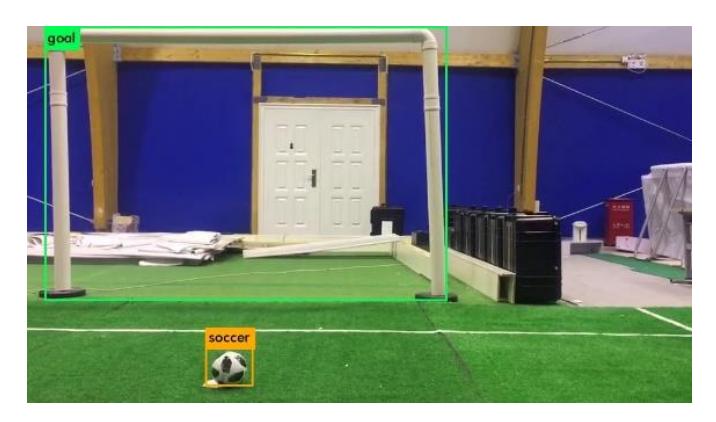
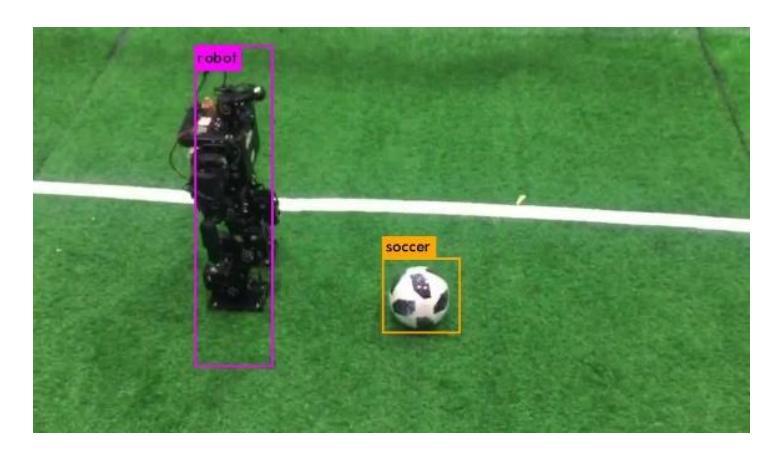
Table 1. The contrast of different algorithm results
| Algorithm | /% | /% | |
|---|---|---|---|
| SIFT | 59.3 | 57.2 | 0.76 |
| RCNN | 76.7 | 73.6 | 1/40 |
| Faster-RCNN | 94.5 | 90.3 | 2 |
| YOLOv3 | 93.8 | 89.7 | 40 |
We can conclude from the experimental results that YOLOv3 has higher accuracy rate, recall rate and FPS than SIFT, RCNN and Faster-RCNN. Although the accuracy rate about Faster-RCNN has a bit of worsen compared with Faster-RCNN, the recall rate and FPS of YOLOv3 are much higher than Faster-RCNN. So YOLOv3 algorithm can satisfy real-time detection and meet the request of soccer robot competition.
Optimization of Hardware
Core board Based On Raspberry Pi 3b+
In order to adapt to RoboCup's latest game requirements and improve the processing speed of robot vision and decision-making systems, this year we upgraded the new core board control system based on the core control module of the Raspberry Pi 3B+. It is verified by experiments that compared with the previously used tiny210 core board module, the core control module based on Raspberry Pi has faster processing speed and stable running effect. Table 2 compares the parameters of the old and new core boards.
Table 2. Comparison of two core board parameters
| Tiny210 | Rasberry Pi 3B+ | |||
|---|---|---|---|---|
| CPU | CortexTM-A8 | Cortex-A53 CPU | ||
| Main frequency | 1GHz | 1.4GHz | ||
| Data Bus | 32bit | 64bit | ||
| RAM | DDR2 512M | 2GB | ||
| port | 2 x 60 Pin 2.0mm space DIP connector 1 x 30 Pin 2.0mm space DIP connector 1 x 7 Pin 2.0mm space JTAG port | 40pin GPIO USB2.0*4 RJ45 |
Steering Engines Electric Source System
MX-64 steering engine is the joint driven module of small soccer robot's lower body and MX-28 steering engine is for its upper body. The design of electric source module is a very significant technology to guarantee whether the humanoid robot can run effectively. To meet two different kinds robots' demands of power, we designed the new electric source system with TPS5450 as core chips to power MX-28 steering engine and MX-64 steering engine.
The Technical Index of Steering Engine Power Supply Electric Source
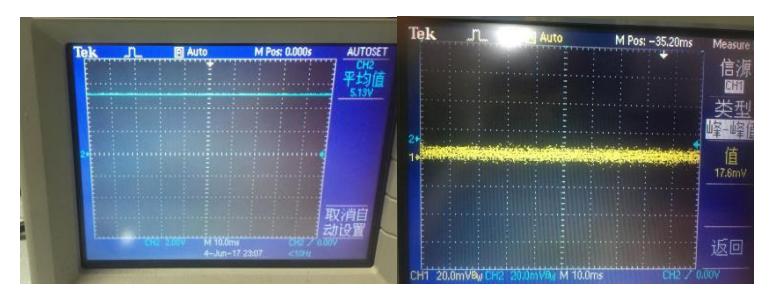
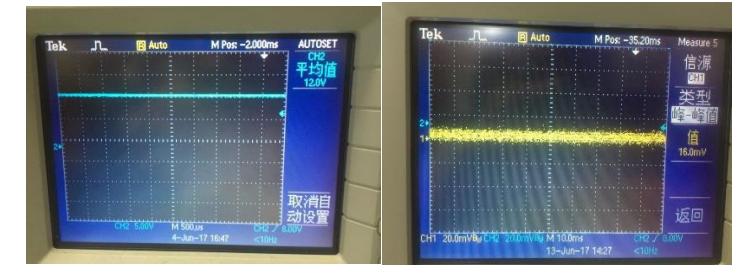
(1) Stander input voltage: direct voltage, 50Hz; (2) Output voltage/current: 12V/1.4A, 12V/4.1A,5V; (3) Temperature of work environment: -5℃~80℃; (4) Output voltage precision: ≤3%; (5) Voltage regulation factor: ≤3%; (6) Ripple factor: ≤2%; (7) Output ripple: ≤150Mv;
Debugging Results
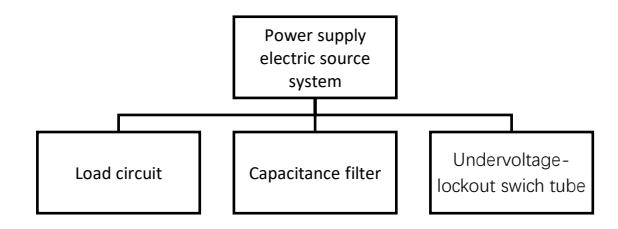
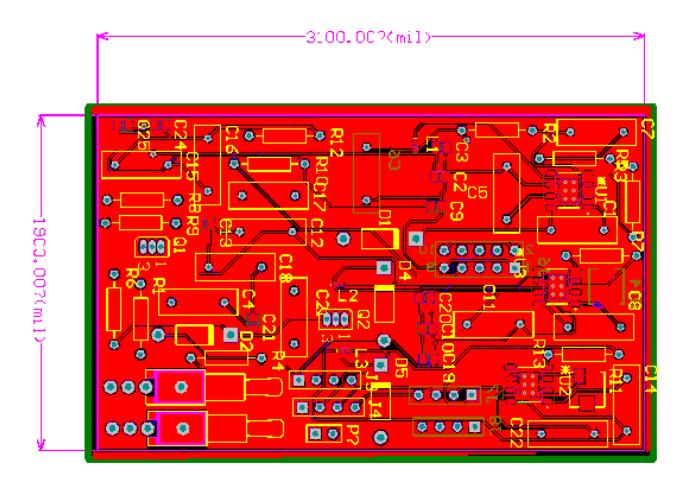
According to the requirements of steering engines' power supply, electric sources' function and performance, the overall structure diagram of this system design is plotted in Fig.6, and PCB is plotted in Fig. 7.
Conclusion
In this article, we describe the visual aspects of the target identification based on deep learning neural networks and improvements of hardware in coreboard, the new design of power board that aim to improve the performance of the robot. All the optimizations are aim to improve the ability of the robot, stability, and can have a better performance in the game. IKID will provide referees with an understanding of the rules of the league of people during RoboCup Australia in 2019, and will participate in the match in schedule.
References
- Gai Na, Ning Siheng, Wang jun, Yan Bixi, Lou Xiaoping, Dong Mingli, Zhu Lianqing: I-KID: Team Description Paper for Team I-KIDRoboCup2018(2018).
- Zhu lifu,Xu xiaofeng,Yan Bixi,Wang jun,Lou Xiaoping,Dong Mingli,Zhu Lianqing: I-KID: Team Description Paper for Team I-KIDRoboCup2017(2017).
- Bi Junxi, Xie Ning, Chen Shuo, Ren Kaike, Shang Tian, Lou Xiaoping, Yan Bixi, Zhu Lianqing.: I-KID: Team Description Paper for Team I-KIDRoboCup2014(2014).
- Bi Junxi, Tan Xiaofeng, Guo Yunkai, Xie Pengcheng, Zhang Jiwen, Lou Xiaoping.: I-KID: Team Description Paper for Team I-KIDRoboCup2013(2013).
- Yan Bixi, Wang Zhi, Fei Qi, Wang Zirun, Dong Mingli, "Kid size humanoid soccer robot design meeting the RoboCup specification and its object detection" Journal of Beijing Information Science & Technology University,2018.
- Zhang Chunlin, Cui Laiyou, Tan Cheng, Wang Guangqun, Kong Linjia,"Biom echanical M easurem ents and Analysis on the Sole of Human Foot"Beijing Institute of Technology,2013.
- Yuan Gang, Zhang Muxun, Zhang Jianhua, "The measurement systerm of dynamic foot pressure and its clinical application"Chinese Journal of Rehabilitation,2013.