SYCU-Legendary Team Description Paper for 2019 RoboCup Humanoid Kid Size
Wu Fenghua, Wang Hao, Li Liande, Wang Chengye, Yin Jingyao, Yang Zhehai, Jin Xin, Zhang Yuping
Shenyang City University, Shenyang Key Lab. of Humanoid Robot, Shenyang, Liaoning Province, China
Abstract This paper presents the team of SYCU-Legendary with their Kid Size robots that intent to participate in 2019 RoboCup Humanoid competition of both regular and drop-in class as well as technical challenges. Concretely, the mechanical design, electrical system design, component selection and software work on the robot are described thoroughly especially with contrast to last year. The team of SYCU-Legendary was organized by Shenyang Key Lab. of Humanoid Robot and Shenyang City University three years ago when they started to research Kid Size robot. Up to now all the robots are strictly complied with the requirement of RoboCup Kid Size league and even perform excellent in visual recognition and stability. SYCU-Legendary team has taken first place on 2018 RoboCup China Open Competition and has ranked the sixth on Montreal game. The attendance of SYCU-Legendary will contribute to the 2050-year goal of the international RoboCup when humanoid robots being able to win against the official human World Soccer Champion team.
Introduction
Being one of the ultimate research goals in robotics, humanoid has become the hot focus and preferred platform for artificial intelligent application[1] such as the RoboCup competition where a team consisting of fully autonomous humanoid robot soccer players is expected to beat the champion of the most recent World Cup under FIFA official rules by the mid-21st century [2]. Although many distinguished humanoid robots have been reported consecutively including Atlas [3], Hubo [4], HRP series [5], RoboCup competition requires the humanoid robot playing soccer game similar to human being especially from the point of view of the autonomous capability, the compliance with rules, the sensing system configuration as well as the whole-body structure. Hence many research teams have introduced their humanoids taking part in RoboCup annually [6,7]. Coming from Shenyang City in Liaoning Province of China, SYCU-Legendary[8] is a competitive team for 2019 RoboCup humanoid league since we won the champion on 2018 RoboCup China Open. Our team has been preparing robots in accordance with the requirements of the Robocup competition since 2016 when we started to contract and learn from the teams from Zhejiang University, Tsinghua University, Southeast University and Beijing Information Technology University. During 2018 we imported two robots from Rhoban team[9] who helps us improving the robot significantly in aspects of mechanical optimal design, electrical system design, sensor configuration and some software work [10]. All members of SYCU-Legendary are familiar with the RoboCup rules and often discuss the development trend of the rules with the peers. we have published a paper on the international journal "Artificial Intelligence and Robotics Research"[11] where the key technologies of humanoid robot were discussed including simultaneous localization and map construction (SLAM), optimization design and simulation, footprint planning and modeling, stability control with application, plus target recognition and tracking. In view of our research achievements, Shenyang Science and Technology Bureau ascertained our laboratory as the key laboratory in November 2017. This year we applied and gained a new scientific project that is High-level Innovation Talent Project 'AI education resolution based on humanoid robot'.
Overall Design of SYCU-Legendary Robot
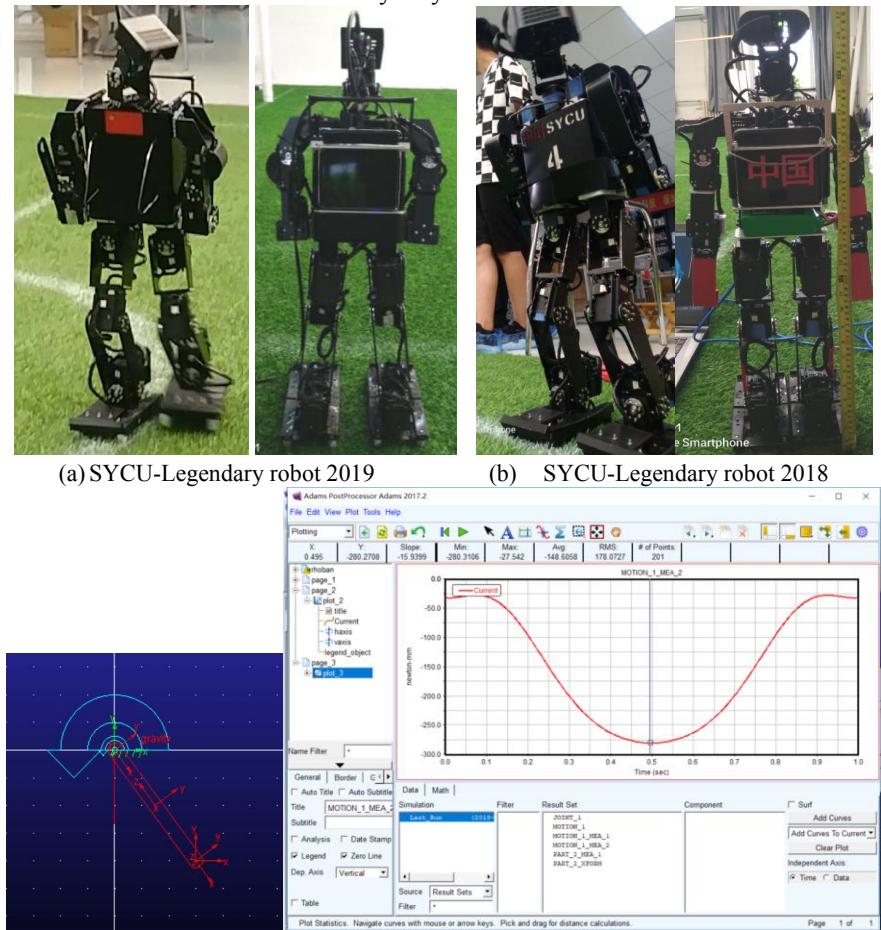
In accordance to RoboCup requirements, SYCU-legendary robot has two legs, two arms, one body and one head as shown in Fig.1. Except for the Servos, most structural parts of the robot are made of aluminum alloy while the protection block on each arm and some slight stress parts are made by 3D-print with ABS material. In order to let the robot walk on 3cm height artificial grass ground, four anti-slip protruding parts are equipped at the corners under each foot of the robot to provide enough supporting force, which has been proved to work well. Servo is the most important mechanical driving part of the robot, so Dynamixel products of MX-106T and MX-64AT are selected after ADAMS [12] dynamic analysis since they are well-designed for composition of humanoid. Each robot is driven by 20 servos: two for the head, three for each arm and six for each leg that ensure the robot acts flexible without hinder which is undoubtedly crucial for football player. We will continue to improve the performance of the robot while reduce its cost. We believe RoboCup competition is the best opportunity for us to learn from other teams who we expect to share our technique with.
Fig. 1 shows the robot' SYCU-Legendary for this year (a) and last year (b) as well as dynamic simulation analysis (c) that indicate all the servos can bear the maximum impact force of corresponding joints during soccer game.
Table 1 lists many differences that indicate our optimal design on the robot from last year to this year. The head of the robot is designed lighter and slimmer because in last year the robot head happened to scratch its shoulder when turning around. This year we decreased the width of the robot head and designed a good-looking shape for it. The shoulder is designed to express the sense of angular and stiff with an additional collapse protection block fixing on the Motor. The handle for the robot is improved to be more tactful and comfortable to use than last year. The front shell is changed to be a whole and larger board so that the color mark sticking on the trunk of the robot can be more outstanding. Considering that the single-line half-circle protection wire is easy to distort after fall-down backward, we have designed double-line protection circle this year to improve the resistance to impact. The cover for battery room last year was like a belt around the bottom trunk but the operation on the belt often led the operator's hand scraped by the robot therefore we have modified it to be a cover flip style which making the battery fix to be more convenient. The forearms of the robot are designed to be parallel to the side of the robot with regard to the structure of human body. Finally the shape of the legs is changed. The thigh is designed more muscular while the lower leg is more slender than prior one so that the new robot is more resembled to human being. Based on the changes in Table 1 and the software of Rhoban we have successfully created one robot that works well so we plan to make some more robots and take them to Sydney.
Changes on SYCU-Legendary robot from 2018 to 2019.
| Changed parts | 2019 | 2018 |
|---|---|---|
| Head | ||
| Shoulder | ||
| Handle | ||
| Front shell and protection wire | ||
| Battery room cover | ||
| Forearm | ||
| Legs |
Electrical Design of SYCU-Legendary robot
(See subsections below)
Sensor Configuration
As for the humanoid soccer robots designed to participate in RoboCup competition, their sensors is required to be equivalent in human senses so as to make an unbiased equipment configuration between robots and man-players, camera becomes the most important external sensor for the robot where the IMU sensor containing gyroscope and accelerometer is usually fixed as internal sensors that helps the robot fulfilling self-localization.
Last year we selected Logitech C930e WEBCAMI as image sensor. In order to improve the picture collection effect this year, we substitute it by industrial level camera Point Grey which combines highly sensitive sensors, industry-leading affordability, and a host of unique features for uncompromising value. Every camera model comes packed with functionality designed to maximize performance and reliability, including a 16 MByte frame buffer; LED status indicators; and an on-camera image processing pipeline that provides color interpolation, gamma, and lookup table functionality. The Point Grey camera weighs only 36 grams, measures 29 x 29 x 30mm uses 2 watts of power and is available supporting USB3 Vision or GigE Vision with Power over Ethernet so that it is desirable for robot vision system.
Last year we used expensive ADIS 16405 as IMU with the purpose of accuracy measurement on angular velocity for robot azimuth calculation. This year we improve the localization algorithm so that we change it to a low-cost and smaller piece of circuit named GY85, which outputs rough data indicating the robot's state that is compensated to an accurate description through visional information.
This year we add four pieces of force sensor on each foot so as to keep the robot stable during movement.
Electrical System Configuration
Elaborate design of the electrical system is an essential guarantee for the normal work of robots. By virtue of design of Rhoban team, we have developed and adjusted an electrical control system which is composed of an up-level computer, a low-level controller and a power supply board. The lower controller is designed by integration of three embedded microcontrollers driving different servo buses of servos and an IMU sensor while the camera is connected to up-level computer through USB port. Such simply design ensure effective utilization of the interior space of the robot. Apart from transferring power from the battery to up-level computer and low-level controller, the power supply board acts as a hot plug switch that ensures uninterruptible power supply if the battery needs to be changed when the robot are working.
Software Work for SYCU-Legendary
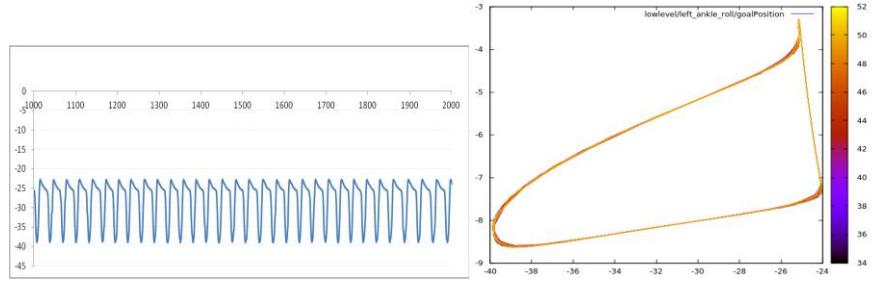
Robot playing football on the field is highly complex intelligent system that requires intact collection, timely delivery and effective usage of information. We adopted software system developed by Rhoban team [13] therefore the robot performs well during test. Concretely, Robot gait model adopts the D-H kinematics [14] representation method to establish the mathematical expression of the robot's gait and solves it on basis of the sensor data. For example the pitch angle of ankle joint and the phase plane portrait between pitch angle and roll angle of ankle joint calculated by the model for robot waking is given in Fig. 2, which is used by the robot that can walk stable. The robot self-positioning model is built by employing particle filter (PF) [15] algorithm. In detail, a set of weighted particles are generated to indicate the probability of the robot being on certain position, expressed by posteriori probability density function. The probability of every weighted particle is calculated iteratively based on the value of the observation model of the robot. After recursive and iterative calculation, the final collection of particles with largest weight represents the most probable position of the robot [16].
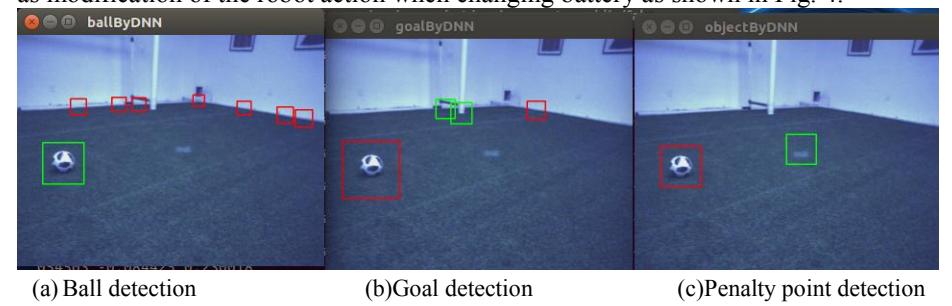
The robot's visual recognition model identifies the field soccer [17], goal, penalty point, opponents and partner, while marking their position and distance. However, the existing self-positioning model only use the information of goal which is sometimes incorrect as given in Fig. 3 (b) so that makes the robot lost itself. Therefore we develop a penalty point detection model (see Fig. 3 (c)) that provides more useful information for self-positioning.
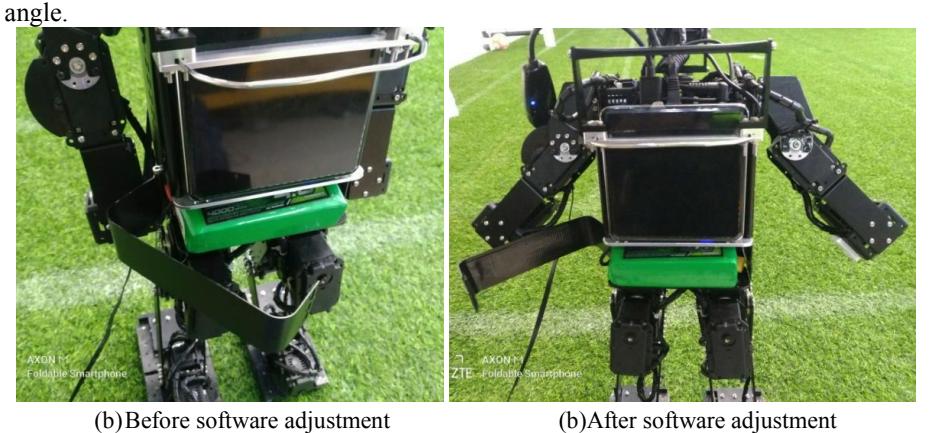
As mentioned above, we have made many changes on the overall structure of the robot, leading it different to the prior ones, especially for practical operation. By overall consideration we solve the problems through some software adjustment such as modification of the robot action when changing battery as shown in Fig. 4.
Before software adjustment, the battery room cover cannot open thoroughly when the robot is working because of the hinder of elbow joint. Then a new instruction can be send to the robot to lift its arm from sideway to let the cover open with a proper
Conclusions
In this paper we present the overall design and development of autonomous humanoid robot SYCU-legendary. The robot team of SYCU-legendary can fulfill soccer game without human control by virtue of its high intelligence that integrating the methods of D-H kinematics functions, particle filter, SLAM and deep-learning. The robot team of SYCU-legendary performed well and won the champion on 2018 RoboCup competition China Open. We are confident of gaining good achievements on 2019 World Games. Of course, we are looking forward to this opportunity to communicate with all the teams from various countries and areas. We also wish to assist both organizing committee and technical committee to make the competition favorable and successful. In the future we plan to establish an International Joint Laboratory with Rhoban team to research the key technologies to make the robot playing soccer with human as well as to popularize the humanoid robot to wide-spread application areas.
Acknowledgements
This research was financially supported by 2018 Shenyang Scientific and Technical Innovation Platform Establishment Plan Municipal-level Key Laboratory Project: Shenyang Humanoid Robot Key Laboratory (18-007-0-10). The authors would like to thank the State Key Laboratory of Industrial Control Technology of Zhejiang University and LaBRI in University of Bordeaux for collaborative research.
References
- Toshio Fukuda, Paolo Dario and Guang-Zhong Yang. Humanoid robotics—History, current state of the art, and challenges. Science Robotics. 20 Dec 2017: Vol. 2, Issue 13, eaar4043.
- H.Kitano,M.Asada,Y.K.I.N.and Osawa,E.(1997). Robocup: The robot world cup initiative. Robocup: The robot world cup initiative.
- R. J. Griffin, G. Wiedebach, S. Bertrand, A. Leonessa and J. Pratt, "Walking stabilization using step timing and location adjustment on the humanoid robot, Atlas," 2017 IEEE/RSJ International Conference on Intelligent Robots and Systems (IROS), Vancouver, BC, 2017, pp. 667-673.
- Taejin Jung, Jeongsoo Lim, Hyoin Bae, Kang Kyu Lee, Hyun-Min Joe, and Jun-Ho Oh. Development of the Humanoid Disaster Response Platform DRC-HUBO+. IEEE TRANSACTIONS ON ROBOTICS, VOL. 34, NO. 1, FEBRUARY 2018. 1-17.
- Albert Mukovskiy, Christian Vassallo, Maximilien Naveau, Olivier Stasse, Philippe Souères, Martin A. Giese. Adaptive synthesis of dynamically feasible full-body movements for the humanoid robot HRP-2 by flexible combination of learned dynamic movement primitives. Robotics and Autonomous Systems. Volume 91, May 2017, Pages 270- 283.
- Hofer, Ludovic and Rouxel, Quentin. An Operational Method Toward Efficient Walk Control Policies for Humanoid Robots. Proceedings of the Twenty-Seventh International Conference on Automated Planning and Scheduling, ICAPS 2017, Pittsburgh, Pennsylvania, USA, June 18-23, 2017.
- K. Genter, T. Laue and P. Stone, "Benchmarking robot cooperation without precoordination in the RoboCup Standard Platform League drop-in player competition," 2015 IEEE/RSJ International Conference on Intelligent Robots and Systems (IROS), Hamburg, 2015, pp. 3415-3420.
- https://www.robocuphumanoid.org/qualification/2018/KidSize/SYCU-Legendary/tdp.pdf
- https://github.com/Rhoban
- Feng-hua WU, Lian-de LI, Cheng-ye WANG, Xin JIN, Hao WANG, Zhe-hai YANG, Jingyao YIN and Yu-ping ZHANG. Design and Development of Autonomous Soccer Humanoid Robot CU-legendary. 2018 Global Conference on Robotics, Artificial Intelligence and Engineering Technology(RAET2018). (Accepted).
- Wu fenghua, Li Liande, Wang Hao, Wang Yueyong, Jiang Jiao, Chen Si. Research on Key Technologies of Humanoid Robot[J]. Artificial Intelligence and Robotics Research, 2017, 06(03): 97-105.
- Sudharsan, Jayabalan; Karunamoorthy, L. Simulation of 8-Degrees of Freedom Based Bio-Inspired Humanoid Robotic Arm Using MATLAB/ADAMS Co-Simulation Environment. Applied Mechanics and Materials. Vols. 799-800 (2015), Pages 1054-1057.
- https://github.com/Rhoban/
- Yuan-LungLai, Chien-ChihLiao, Zi-GuiChao. Inverse kinematics for a novel hybrid parallel–serial five-axis machine tool[J].Robotics and Computer-Integrated Manufacturing. Volume 50, April 2018, Pages 63-79.
- XiaoyanQian, LeiHan, YuedongWang, MengDing. Deep learning assisted robust visual tracking with adaptive particle filtering[J].Signal Processing: Image Communication. Volume 60, February 2018, Pages 183-192.
- Ryan A, Hedrick J K. Particle filter based information-theoretic active sensing[J]. Robotics and Autonomous Systems. 2010, 58(5): 574-584.
- SwarupMahato, ArunasisChakraborty. EKF Based Parameter Identification of LTI System from Seismic Response Measurements[J].Procedia Engineering. Volume 144, 2016, Pages 360-365.