Robo-Erectus Senior III (RESr-III): A Teen Size Humanoid Soccer Robot
Liandong Zhang, Changjiu Zhou, Guohua Yu, Wei Hong, Tianwu Yang, Torin, Hendra, Carlos Antonio Acosta Calderon, Rajesh Elara Mohan, Pik Kong Yue
Advanced Robotics and Intelligent Control Centre (ARICC) Singapore Polytechnic, 500 Dover Road, Singapore 139651
Abstract This paper provides a brief description of Robo-Erectus Senior III– a teen size soccer playing humanoid robot developed at Advanced Robotics and Intelligent Control Centre of Singapore Polytechnic. The mechanical and electrical specifications of the robot are described. This paper also covers the vision processing, locomotion control, state-driven Monte Carlo localization and force/torque sensors ZMP detection of Robo-Erectus Senior III. This robot is used as a platform for competing in RoboCup humanoid league, and for our ongoing research in humanoid robot localization and navigation.
1 Introduction
Robo-Erectus Senior (RESr-III) is a full-size humanoid robot developed by the Advanced Robotics and Intelligent Control Centre (ARICC), Singapore Polytechnic. The objective of the RESr project is to develop a humanoid robot with more human-like features and human-friendly character. The design concepts of RESr-III includes modular development, compact design and emphasis on the robot's ability to perform cooperative works in general and soccer (RoboCup) in particular [1, 2, 3] (www.robo-erectus.org).
RESr-I gave an outstanding exhibition in the Humanoid League of RoboCup2007 and won the 4th place in the penalty kick competition of Humanoid TeenSize League. It was also featured in CNN Live. The Robo-Erectus project has been initiated since 2002. It has 3 categories: (1) RE Junior for educational purpose; (2) RE Junior for Humanoid KidSize competition; (3) RE Senior for Humanoid TeenSize competition and also for research on full-size humanoid robotics. RESr-III is also incorporated into our R&D framework using Microsoft Robotics Studio. Force/torque control is also studied by installing ATI Force/Torque sensors Nano25 and Mini85 on the ankles of the humanoid robot REJr and RESr-III respectively [4].
Brief description on the hardware and software specifications of RESr-III is presented in the following sections.
2 Hardware of Robo-Erectus Senior
2.1 Mechanical Structure of Robo-Erectus Senior
Modular design concept is employed in the development of RESr-III. The modular biped robot system consists of a set of independently designed modules, such as actuators, passive joints, rigid links (connectors) that can be rapidly assembled into a complete robot of various configurations having different kinematics and dynamic characteristics.
Final dimensional parameters of RESr-III after repeated experiments and optimization are given in Table 1. It has 22 Degrees Of Freedom (DOFs). The joints are powered by rechargeable lithium-polymer battery matrix that can support biped walking for half an hour. The robot is controlled by a single board computer and a Sony VAIO ultra portable PC, which are in charge of robot navigation and localization and vision processing respectively.
Table 1. Mechanical and electrical parameters of RESr-III
| 1. Physical Specifications | ||||
|---|---|---|---|---|
| Weight | Dimensions | Speed | ||
| Height | Width | Depth | Walking | |
| 44kg | 140cm | 28cm | 20cm | 5m/min |
| 2. Degrees of Freedom | ||||
| Joint | Roll | Pitch | Yaw | |
| Head | ||||
| Shoulder | ||||
| Elbow | ||||
| Hip | ||||
| Knee | ||||
| Ankle | ||||
| 3. Sensors | ||||
| Sensor | Details | |||
| Camera | 320× | 240 Resolution 30fps | ||
| Compass | o 1 |
heading accuracy | ||
| Tilt | 6 dimensions | |||
| Sonar | Distance range 5cm-250cm | |||
| 4. Computing Unit | ||||
| Features | Main Processor | Vision | ||
| Processor | Intel Celeron | Intel Core Solo | ||
| Speed | 800MHz | 1.33GHz | ||
| Memory | 1GB | 1GB | ||
| Storage | 30GB | 16GB | ||
| Interface | CAN BUS, USB, WIFI | USB, WIFI |
2.2 Electrical Control Structure of Robo-Erectus Senior
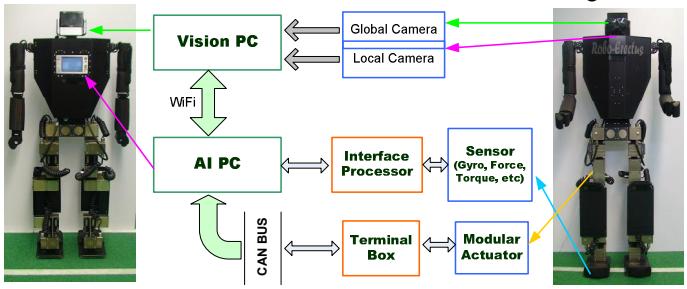
The active modules of the robot are self-contained mechatronic units with the control loop closed at the joint level. Each actuator module has its own individual motion controller. The inter-module communication is implemented using the CAN-bus protocol and the RS-485 serial interface. Low level trajectory generation and control are developed based on hierarchical control concept.
Besides visual sensor, tilt sensor and an electronic compass is installed in upper body to get the tilt information and to measure the moving direction. The block diagram for locomotion control and vision administration is shown in Fig. 1.
3 Biped Gaits Synthesis for Robo-Erectus Senior
3.1 Gait Generation and EDA Offline Gait Optimization
Biped walking is represented by three key poses extracted from one cycle. Poses between these key poses are approximated by third order spline functions. A technique of this type has been implemented using splines of class $C^2$. Basic gait pattern of walking, turning and kicking as required in soccer game is planned in a simple and an efficient way. It provides an easy way to operate the robot with simple mathematical form and smooth locomotion properties.
All these locomotion are generated following strict formulations. Further optimization via Estimation of Distribution Algorithm is given in [3].
For the simplified robot model with geometric and state constraints, searching for proper joint degree sequence would require the computation of a discrete-time map from $R^{N_q}$ to $R^{N_q}$, which is hard for analysis. So we transfer the joint degree searching in infinite dimensional space to probability distribution space modeling by finite vectors with EDA. EDAs can successfully generate expected biped gaits that minimize the predefined objective function in short learning iterations.
3.2 Markov Chain and Action Primitive for Online Gait Generation
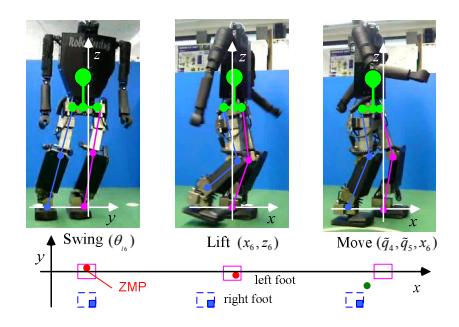
Unlike offline gait generation and optimization approaches, gaits are not generated by organizing the joint movement or with the distribution of actuated torques in online gait generation. Not gaits but three action primitives as Swing, Lift and Move (see Fig.2) are stored online. Gaits are constructed by candidate poses using Markov chain.
4 The state-driven Monte Carlo localization
4.1 Feature variables
Two feature variables, 'focus' and 'near', are associated with the sample set at each time. Focus is a Boolean variable created based on the concept of an occupied rectangle region R (L, W). Focus can be updated periodically according to
$$focus = \begin{cases} Y & \text{if } R(L, W) \le R(L_{thres}, W_{thres}) \ N & otherwise \end{cases}$$
Feature variable 'near' is given to express whether the real position is reached.
$$near = \begin{cases} +1 & \text{if } |d-d_k| \leq d_{\text{thres}} \text{ and } |\theta-\theta_k| \leq \theta_{\text{thres}} \ 0 & \text{if the token is not detected} \ -1 & \text{if } |d-d_k| > d_{\text{thres}} \text{ or } |\theta-\theta_k| > \theta_{\text{thres}} \end{cases}$$
where $d_{thres}$ and $\theta_{thres}$ are threshold values in the distance and direction.
Focus and near can be considered to estimate the state of particles from intrinsic structure and extrinsic sensor information respectively.
4.2 State Identification and Successive Action
During the process of filtering, the states of particles are divided into four kinds: messy, approach, cluster and error, which are determined by the combination of the values of the two feature variables mentioned above.
4.3 Experimental Results
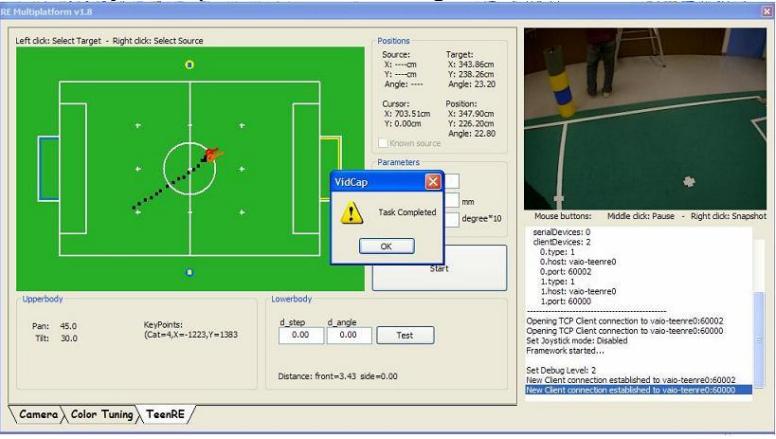
Interface for Physical experiment is shown in Fig. 3.
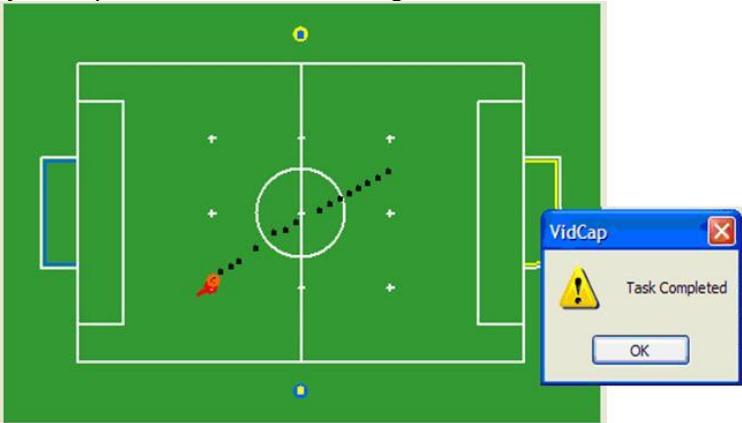
The physical experiment result is shown in Fig. 4.
5 Vision Detection and Recognition
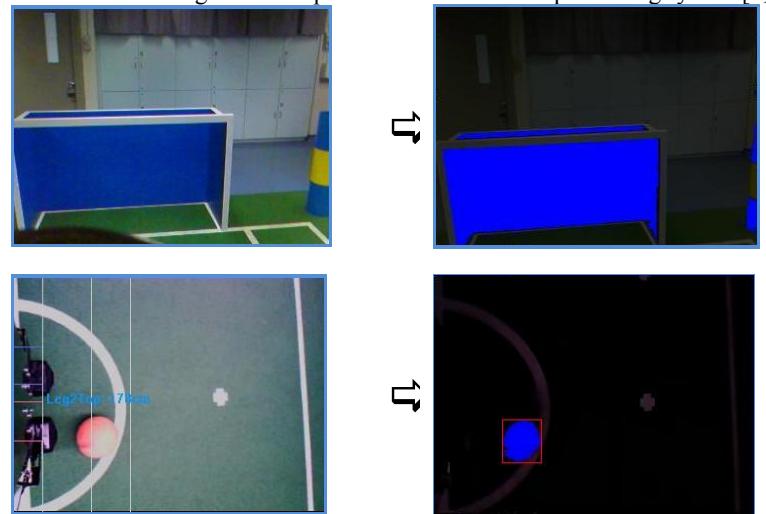
Fig.5 shows the raw images and the processed results of the processing system [5, 6].
6 Force/Torque Sensor for ZMP Control
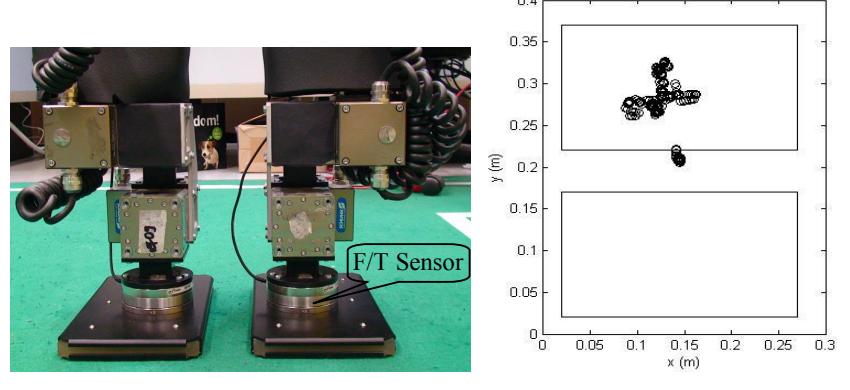
ATI Mini85 Force/Torque sensors are installed in the ankles of RESr-III (Fig. 6) and the ZMP detection research has been performed (Fig. 7).
7 Team Information
Robo-Erectus team is formed by about twenty robot enthusiasts coming from eight countries. Their hard works are expected to make it possible for RESr-III to put up an outstanding show in the coming RoboCup 2009. Their information is as follows.
Team Information
| Role | Name |
|---|---|
| Team Leader: | Changjiu Zhou |
| Operation Manager: | Rajesh Elara Mohan |
| Robo-Erectus Junior Captain: | Dr Carlos Antonio Acosta Calderon |
| Robo-Erectus Senior Captain: | Pik Kong Yue |
| Team Member: | Liandong Zhang |
| Tianwu Yang | |
| Wei Hong | |
| Guohua Yu | |
| Nguyen The Loan | |
| Hendra | |
| Jhohan Ng | |
| Sudirman | |
| Peter Zhaoyuan Lin | |
| Zhiwei Song | |
| Peijie Zhang |
8 Conclusion
The Robo-Erectus Senior project aims to develop a platform for competing in RoboCup Humanoid Teen Size League and for our ongoing research work in humanoid robot localization and navigation areas. As a part our research, we have developed simulation software using Microsoft Robotics Studio for the study and analysis of humanoid gait generation and optimization. A Linux OS based object oriented software framework is implemented for object recognition, motion control and communication to achieve real time capabilities in terms of robot localization and navigation. A state-driven Monte Carlo localization method has been developed and has been verified by experiments. Force/Torque sensors are installed in the RESr-III and the ZMP is measured. During the experiments conducted, Robo-Erectus Senior exhibited excellent walking and soccer skills. For more detailed information about Robo-Erectus humanoid soccer robots, please refer to the team's website www.robo-erectus.org.
References
- Zhou, C., Yue, P. K.: Robo-Erectus: a Low Cost Autonomous Humanoid Soccer Robot. Advanced Robotics, 18(7) (2004) 717–720
- Zhou, C., Hu, L., Zhang, L., Wu, B., Yang, T. and Yue, P. K.: Design and Control of a Humanoid Robot Using Standard Reconfigurable Modules. Proceedings of IEEE-RAS International Conference on Humanoid Robotics. Pittsburgh, USA, Nov 29-Dec 01 (2007)
- Hu, L., Zhou, C.: Gait Generation and Optimization Using the Estimation of Distribution Algorithm for Teen Size Humanoid Soccer Robot RESr-1. International Journal of Humanoid Robotics, 5(3) (2008) 437–456
- Zhang, L., Zhou, C.: Lie Group Formulation for Analysis of Kicking Motion in Humanoid Soccer Robots. International Journal of Humanoid Robotics, 5(3) (2008) 501–522
- Acosta Calderon C. A., Elara M. R., Zhou, C., Yue, P.K., Hu, L.: Integration of Robust Embedded Vision and Control for a Soccer Playing Humanoid Robot. Proceedings of the 4th Int. Conf. on Computational Intelligence, Robotics and Autonomous Systems, Palmerston North, New Zealand, Nov 28-30 (2007)
- Elara, M. R., Acosta Calderon, C. A., Zhou, C., Yue, P. K., Hu, L.: Using Heuristic Evaluation for Human-Humanoid Robot Interaction in Soccer Robotics Domain. IEEE-RAS International Conference on Humanoid Robots (Humanoids 2007), Pittsburgh, USA, Nov 29-Dec 01 (2007)
- Sven Behnke: Online Trajectory Generation for Omnidirectional Biped Walking. Proceedings of IEEE International Conference on Robotics and Automation (ICRA 2006). Orlando (2006) 1597–1603
- Reo Matsumura, et al: TeamOSAKA(TeenSize) Team Description Paper. (2008)
- Collins, H., Ruina, A., Tedrake, R., Wisse, M.: Efficient Bipedal Robots Based on Passive-Dynamic Walkers. Science, vol. 307 (2005) 1082–1085
- Sakagami Y., Watanabe, R., Aoyama, C., Matsunaga, S., Higaki, N. and Fujita, M.: The Intelligent Asimo: System Overview and Integration. Proceedings of International Conference on Intelligent Robots and Systems (2002) 2478–2483