Team MU-L8 Humanoid League – TeenSize Team Description Paper 2015
Adam Stroud, Kellen Carey, John. C Williams, Elise Russell, Raoul Chinang, Darryl Ramgoolam, Adrianna Williams, Andrew B. Williams
Marquette University Humanoid Engineering & Intelligent Robotics (HEIR) Lab 1637 W. Wisconsin Ave. Milwaukee, WI USA
http://www.eng.mu.edu/abwilliams/heirlab
Abstract This paper gives an overview of the hardware and software of the Team MU-L8 teen-size humanoid robot team. Team MU-L8 (pronounced "emulate") designed and built its own teen-sized humanoid robot platform, called MU-L8. This paper details our software architecture and autonomous behavior that we have built upon the works of well-established RoboCup teams, such as NimbRo and Baset Teen-Size. Team MU-L8's main contributions to RoboCup include SMILE, the first ever speech controlled humanoid robot in the TeenSize League and the continued development of open-platform low-cost humanoid robots. This is Team MU-L8's second application for qualification to the TeenSize league at RoboCup. Team MU-L8 competed in RoboCup 2014 Brazil in the TeenSize Humanoid League.
1 Introduction
Team MU-L8 is making its application to the RoboCup Humanoid – TeenSize league for the second time. In RoboCup 2014, Team MU-L8 placed 5 of 6 as a first time contender, yet absorbing a wealth of knowledge in the areas of bipedal locomotion and computer vision. Team MU-L8 is committed to competing in the RoboCup 2015 Humanoid – TeenSize competition in Hefei, China if selected and will provide at least one referee who is knowledgeable of the rules during the competition.
2 Mechatronic Design
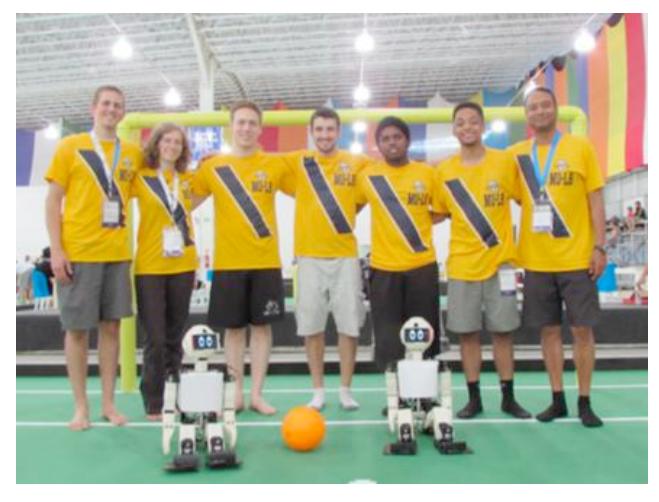
Team MU-L8 [1] has developed its own teen-sized humanoid robot platform, MU-L8, (pronounced "emulate"). The MU-L8 platform is currently undergoing a complete system redesign to improve the limb's range of motion, power distribution robustness, and manufacturing repeatability. One highlighted area of innovation in the new version of MU-L8 is in our implementation of a hot swappable, reliable, and commercially available power source as an alternative to the unstable RC airplane batteries commonly used in humanoid robots.
2.1 Specifications
MU-L8 measures 91.5cm tall and weighs 7.6kg. It has 20 total DOF provided by Dynamixel servos. Each leg has six MX-106T actuators, each arm has three MX-64T actuators, and the neck has two MX-64T actuators. All limbs are 3D printed ABS plastic and the torso is bent 5052 aluminum cut with an abrasive water jet. The power distribution system is based upon a commercial off-the-shelf M18 XC5.0 power tool battery manufactured by Milwaukee Electric Tool Company. This is a 5-cell (18.5V) battery with a capacity of 5Ah with a rugged housing that features a built in microcontroller to monitor charging, temperature, and low voltage.
2.2 Mechanical Design
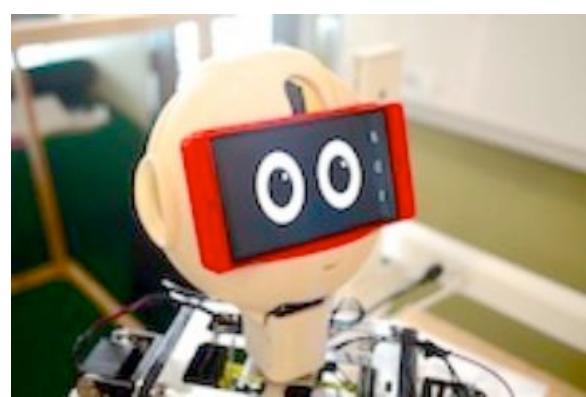
We designed MU-L8 to be 3D printed from ABS plastic so that others may easily replicate the robot and use it as platform for their own research. To encourage replication, we considered the affordability and availability of building materials, including off the shelf electronic components. Social interactivity was another important consideration because we will use the robot for HRI (human-robot interaction) research in addition to RoboCup competition. To satisfy social interactivity, the head of MU-L8 was designed to accommodate the Smartphone Intuitive Likeness and Engagement (SMILE) device, which is an Android OS-based phone that allows the robot to interact with a user through speech recognition, generation, and facial expressions.
There are several challenges associated with 3D printing. Strength and support are the most important aspects since playing soccer places punishing force on the robot's frame. For this reason we designed each part to withstand significant torque and impact. The prototyping process began with simply designing the limb around the Dynamixel motors. The initial MU-L8 prototype was printed using a commercial sized Dimension ES1200 rapid prototyper.
2.2 Sensors
The MU-L8 humanoid robot's embedded system controls communication between actuators, sensors, and other devices, allowing the hardware to communicate with higher-level software. The hardware used in MU-L8 consists of an Intel NUC 3rd generation i5 (1.8-2.8 GHz) mini-PC, Dynamixel Robot Actuators controlled by Xevel Labs USB2AX [8], Arduino Micro (ATMega32u4) using the MPU-9150 9 axis Inertial Measurement Unit (IMU), 720p Logitech C905 webcam, and the Nexus Android touchscreen Smartphone with 3-axis gyroscope, and 3-axis accelerometer.
3 Software Design
Team MU-L8 is building its own software including software to perform vision, motion, and behavior functions in an Ubuntu Linux environment using C++ and Java. This software will be used for developing motions for kicks, locomotion, and role behaviors for the attacker and goalie. It is desired that future MU-L8 software will incorporate ROS.
3.1 Software Architecture
The framework for MU-L8 primarily consists of three subroutines running concurrently. These subroutines consist of a vision module, a motion module, and a behavior module. The vision module is responsible for the identification and localization of the ball and other key objects. It relays its findings of MU-L8's surroundings to the motion module, which decides how best to act in response to the visual cues. The behavior module not only checks sensory inputs for falls and voltage drops, allowing proper corrections to be made as needed but also implements the team and individual soccer behavior functions by coordinating vision and motion.
The software system uses the C++ programming language to call low level hardware functions. The low-level hardware interfaces can access the camera, the gyroscope and accelerometer sensors located in the smartphone, and can modify joint angles and stiffness. The three main subsystems are the vision subsystem, the motion subsystem, and the behavior subsystem. The behavior subsystem interfaces with the camera and the servomotors respectively. The behavior module interacts with both the vision and motion subsystems to implement the sense, plan, and act cycle.
3.2 Vision
The vision subsystem uses the Logitech webcam to capture video images, process them, and localize objects of interest (e.g. soccer ball). We start with OpenCV imageprocessing functions to extract data from a video frame captured by a web camera. The image is passed through a threshold filter, resulting in a binary image where white denotes pixels contained within the threshold, and black denotes all other pixels. In order to eliminate background noise, linear convolution is utilized within a Gaussian filter. After the image is passed through the threshold filter, shown in Figure 3, objects are detected on the basis of size and shape. The largest circular shape is assumed to be the ball, and vertical parallel lines are assumed to be the goal. All other lines constitute the field lines.
Ball Localization
After the image processing has taken place all that remains is a black and white image where the black is color to be ignored, and white highlights the unique features of the desired color, as shown in Figure 3. In order to localize the balls position the robot first find the largest white object contained within the image.
In order to localize the robot with respect to its position on the field use the known geometry of the goals as well as the readings from a magnometer in the robot's embedded IMU.

3.3 Motion
The Motion subsystem is used to implement the control of the actuators for coordinated kicking, searching, and walking motions. The individual motions that MU-L8 is able to perform are stored as text files, and processed and loaded into memory at startup. This design allows for quick and easy changes to be made to the motions, and also allows for several backups to be made. The demonstration of the motions is located in the qualification video.
The walking engine used for the MU-L8 platform was inspired by the initial works of Missura's walking approach used on Team NimbRo-OP[4]. Currently, our walking engine is open loop and stable without disturbances, which is a significant upgrade from the static "key frame" walking engine that we used in RoboCup 2014. Leading up to RoboCup 2015, we plan to close the loop in the walking engine using the 9-axis IMU described in Section 2.2; this will provide MU-L8 with information to perform disturbance-compliant gait as well as fall protection behaviors.
3.5 Behavior
Our team behavior strategies will separate the roles of the robots for goalie and attacker/defender. One robot will implement both the defender and attacker mode. In the defenders mode, the behavior subsystem will guide the attacker/defender to work with the goalie to defend the goal. While in attacker mode, the robot will be an aggressive, forward charging attack on the opponent's goal. It is desired that we will make use of the inter-robot communication mechanisms in the software platform but this is currently not implemented in MU-L8.
5 Research Interests
Team MU-L8's interest and preparation for RoboCup soccer is evident in its participation and presentation in the 8th and 9th Humanoid Robot Soccer Workshops held at the IEEE Humanoids 2013 and 2014 conferences in Atlanta, GA [1] and Madrid Spain, respectively. MU-L8 is being developed to not only play soccer but to conduct research in human robot interaction applications for solving social problems [6][7].
Our team has focused on investigating the use of a conversational and emotional application called SMILE for interactive control and programming of humanoid robots, including MU-L8. In Russell, et al. [5], we presented our initial approach for the system. In Stroud, et al. [1], we outlined the design of our 3D-printed robot MU-L8 and then we discussed the incorporation of SMILE as the control interface of this robot [2]. At the Human-Robot Interaction Conference 2015, we will present research addressing the effects of different emotional models upon the user experience of SMILE. We are currently undertaking research into the emotional and topical modeling of users through verbal interactions with SMILE.
6 Qualification Video
Team MU-L8's demonstration of the working code with the required behaviors can be seen in the YouTube video https://www.youtube.com/watch?v=nIiiu-gR5-w . Improvements from last year's video include an improved walk engine, vision, and localization. Further refinement and improvements are planned if MU-L8 is accepted for qualification to compete in RoboCup 2015.
Commitment
Team MU-L8 commits to traveling to Hefei to participate in RoboCup 2015 if selected and will provide a referee knowledgeable of the Humanoid League rules. Please see attached video for details.
7 Summary
Team MU-L8 has demonstrated the minimal capabilities for qualification and request qualification to the RoboCup 2015 Humanoid TeenSize competition. If selected, the team will continue to make improvements to its soccer playing capabilities.
8 Acknowledgements
This work is funded by the John P. Raynor Endowment, the Marquette University College of Engineering and the Office of the Provost.
9 References
[1] A. B. Stroud, Matthew Morris, Kellen Carey, John C. Williams, Corey Randolph and Andrew B. Williams. 2013. MU-L8: The Design Architecture and 3-D Printing of a Teen-Sized Humanoid Soccer Robot. In Proceedings of 8th Workshop on Humanoid Soccer Robots, 13th IEEE-RAS International Conference on Humanoid Robots (Humanoids 2013), Atlanta, GA, 2013.
[2] A. B. Stroud, E. Russell, R. Chinang, K. Carey, J. C. Williams, D. Ramgoolam, and A. B. Williams. 2014. SMILE: A Verbal and Graphical User Interface Tool for Speech-Control of Soccer Robots. In Proceedings of the 14th IEEE-RAS International Conference on Humanoid Robots, 9th Workshop on Humanoid Soccer Robots (Humanoids 2014), Madrid, Spain, 2014.
[3] Schwarz, Max, Schreiber, Michael Schueller Sebastian, Missura, Marcell, Behnke, Sven. "NimbRo-OP Humanoid TeenSize Open Platform." In Proceedings of 7th Workshop on Humanoid Soccer Robots, IEEE-RAS International Conference on Humanoid Robots, Osaka. 2012.
[4] Missura, Marcell, and Sven Behnke. "Self-stable omnidirectional walking with compliant joints." Proceedings of 8th Workshop on Humanoid Soccer Robots, IEEE Int. Conf. on Humanoid Robots, Atlanta, USA. 2013.
[5] E. Russell, A. B. Stroud, J. Christian, D. Ramgoolam, and A. B. Williams. 2014. SMILE: A Portable Humanoid Robot Emotion Interface. In 9th ACM/IEEE International Conference on Human-Robot Interaction, Workshop on Applications for Emotional Robots (HRI 2014), Bielefeld University, Germany.
[6] D. Ramgoolam, E. Russell, A.B. Williams, "Towards a Social and Mobile Humanoid Exercise Coach", 9th ACM/IEEE International Conference on Human-Robot Interaction, HRI14, Bielefeld University, Germany, March 2014, to appear.
[7] A.B. Williams, A. B. Stroud, J. Panka, J.C. Williams, "Creative Concept Invention and Representation in an Interactive Child-Robot Healthy Snack Design Game" Computational Creativity, Concept Invention, and General Intelligence (C3GI) Workshop, International Joint Conference on Artificial Intelligence (IJCAI), Beijing, China, 2013.
[8] XeveLabs, "USB2AX." Available online: http://www.xevelabs.com/doku.php?id=product:usb2ax:usb2ax