ISePorto Robotic Soccer Team for Robocup 2010:Cooperative Behavior
Jose Almeida, Alfredo Martins, Eduardo Silva, Andr ´ e Dias, Lu ´ ´ıs Lima, Carlos Almeida, Nuno Dias, Hugo Silva
LSA - Autonomous System Laboratory Institute of Engineering of Porto Rua Dr Antonio Bernardino de Almeida 431 4200-072 Porto, Portugal
Abstract This paper presents the goals for the IsePorto Middle size team for Robocup 2010, and describe the major research efforts and achievements attained. Namely, this paper presents work done to improve team play capabilities and to deal with the current trend to increase the field size and the game dynamics, as well as, the research done in the ISePorto traction control system for wheeled mobile robots, in the vision system and the inertial navigation sensor integration in the self-localization.
1 Introduction
The ISEP Autonomous Systems Lab. (LSA) robotic football team provides an excellent tool to develop and demonstrate the research in the areas of interest associated with autonomous systems, like: sensor fusion, mobile robotics navigation, nonlinear hybrid feedback control, system architectures, coordination of teams of robots in dynamic environments, vision systems, and embedded systems.
The main goal for this year is keeping improving team play capabilities such as formation maneuvers and pass capabilities. The field size grow impose some additional requirements to perception and to the traction control. With the current trend to increase the game dynamics, the traction control issue takes an important role in order to achieve good levels of traction, and minimize the robot slippage improving the odometric information. Additionally an effort has been taken in order to increase the team reliability during games by improving some mechanical components.
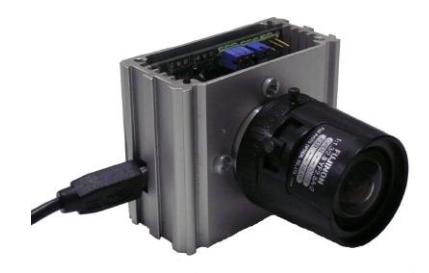
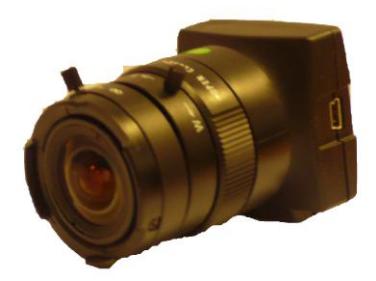
In terms of game playing capabilities some coordination requirements need to be addressed. Partial mechanic redesign with emphasis on the kicker and ball control guides, are under development. This entails a kicker with ball force control, ball stopping mechanism and retractable ball guides. Multiple robot coordination also requires better perception. Efficient detection of player marks, goal edges and goal exposed area is also under active study and continuous development. A critical problem to be addressed by dedicated hardware under development, is the image latency and lack of determinism. In addition image resolution is increased with particular relevance for the kicker mounted camera.
The current trend to increase both field size and number of players implies that fewer measurements from absolute landmarks might be available for navigation due to both larger distances and significant occlusion problems. These are the key issues motivating the use of additional sensors and research new localization and navigation methods. Concerning additional sensors, a low cost, small size (35x35x35 mm) inertial navigation system (INS) was introduced for robot heading and odometry slip correction. Additionally, vision field lines information are merged in the navigation filter providing better information of heading and position. With respect to new localization and navigation methods, one of the most promising avenues is to use teammates for collaborative localization and navigation. This approach entails additional complexity and requires a proper architecture enabling the arbitrage of conflicting objectives between control and navigation that may emerge. Regarding both the coordination requirements as well as the distributed perception ones, the communication subsystem can play an important role.
2 Real-Time Publisher-Subscriber Communication
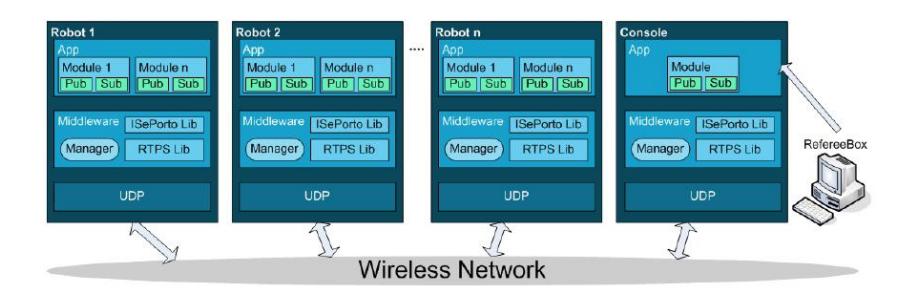
In the last years, the development of middlewares for multi-robot communication has been boosted by the research in multi-robot teams. Regarding this point, there is a variety of solutions[7], although we select the open-source middleware OCERA-ORTE [4]. The ORTE is an open-source implementation of the Real-Time Publish-Subscribe (RTPS). In the RTPS middleware there are publish-subscribe messages defined by an anonymous message exchange between components that produce data (publishers) and those that consume it (subscribers). Each message exchanged has an associated topic id that pairs together publishers and subscribers[4]. Data issued by a publisher or various publishers for a certain topic is delivered to all subscribers of that topic, allowing variation of components and types of data in the network over time. Publishers and subscribers are decoupled and do not need to know who their peers are; instead the middleware is responsible for dynamically enabling peer discovery and adapting to network changes at execution time (see figure 1).
3 Traction Control System
The concept of traction assume a preponderant role in the Robocup scenario caused by the robots are exposed to dynamic variations, like for example, changes in robot inertia, changes in center of gravity, variations in the friction between the surface and the wheels. This kind of variations will affect the traction properties and as a consequence it can occur situations of degradation of the motion and occurrence slipping[5][10].
For wheeled mobile vehicles the vast majority of work related to traction control systems relies in an a priori knowledge of the wheel-terrain interaction properties. However for many applications and in terrestrial mobile robotics in particular this information is not known apriori [6] [9].
In this work we study the problem of traction for a class of wheeled mobile robots. The robots have conventional wheels in a differential traction arrangement with electrical DC motors. The study of traction for this configuration used in the ISePorto Robocup MSL Soccer league robots has the advantage (in comparison with the more popular omnidirectional wheel MSL robots) of being applicable to many other land based robots (with conventional wheels).
The ISePorto traction control system has a capability monitoring applied torque and detect situations of slippage, blocked and pushing. Additionally, it has mechanisms to avoid the occurrence of slippage situations and to react to those situations when detected. Robocup MSL scenario provides both a good testbed and benchmarking scenario for the slip control and also induces novel control problems due to the stringent game robot performance.
3.1 Traction Control Hardware
The development of new power drives and motion controllers was motivated by the requirement of improving the traction control and the overall robot reliability, due to cabling simplification
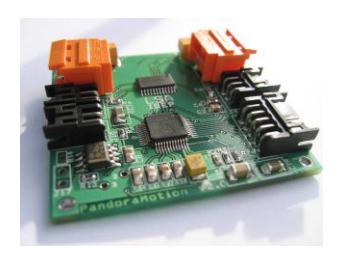
The new axis control node DATCOS (Distributed Active Traction Control System), based on hybrid DSP with CAN interface (see figure 3), allows the reduction of the number of cables, providing torque measurements for traction control, is small sized, low powered, and provides computational capabilities supporting relatively sophisticated control algorithms such as slip, velocity and traction/force.
3.2 Traction System Architecture
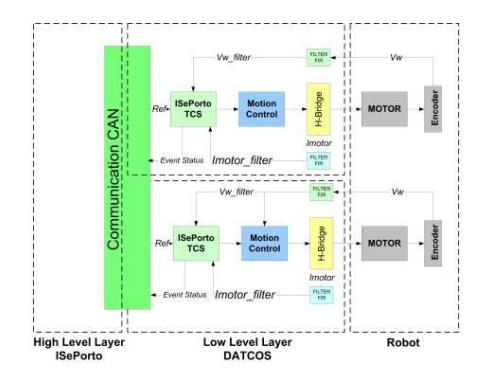
This traction system is characterized by the capability of having two levels of action (see figure 4). The low level has a responsibly of reduce the occurrence of slip, optimize the torque applied to the motor and send via CAN all the information, continuous values and discrete events, that allow the high level control maneuvers to deal and adapt to the detected event. If we are capable of interpreted the problems it will be possible to correct and adapt the path [11].
The solution of having a distributed active traction control system allows the improvement of the response time of electric motor torque in each wheel.
3.3 Characterization the of traction problems in the Middle Size League
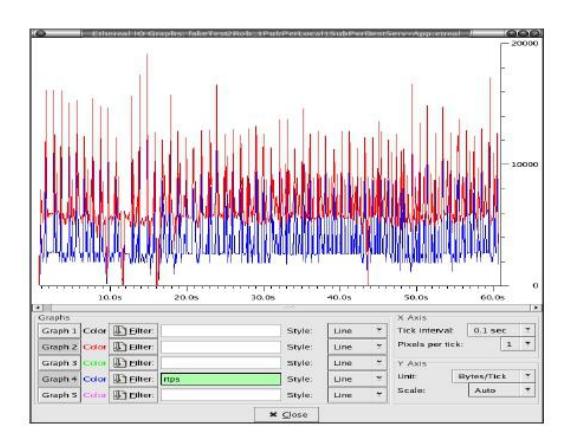
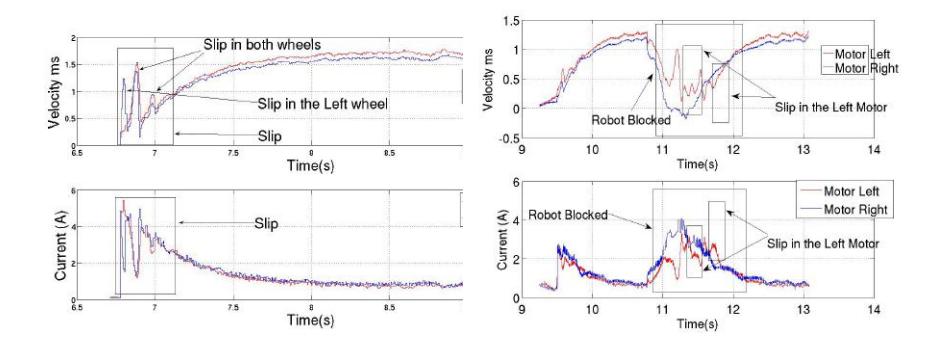
In a Middle Size game the robots are exposed to dynamic variations of the adherence [5] values between the surface of the middle size field and the wheels caused by events like pushing, blocked, collisions and crossing the lines of the field. All this perturbations can be observer in the current and velocity value in each wheel (see figures 5 and 5).
4 Inertial navigation system (INS)
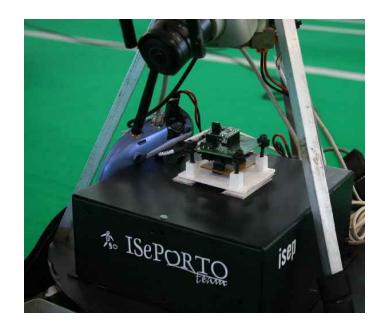
The ISePorto INS is composed by a ARM7 LPC2129 with CAN interface, a triaxial accelerometers LIS3LV02 from ST, a gyroscopes CRS10 from Silicon Sensing and a 3-axis magnetic field sensing module MicroMag from PNICorp.(see figures 4).
Using the measurements from the INS we can calculate the velocity, position and heading of the robot starting from some known initial point. This means that INS does not depend on any third party applications, like other type of sensor, and thus will always work regardless of external influences, however, the accuracy of the INS degrades with time (tend to drift exponentially from the true values) due to measurement inaccuracies, double integration from acceleration to position, collisions between robots and magnetic field. The robot self-localization in the game field will be obtained from the data fusion between vision landmarks information and the INS measures, resulting in a global game improvement.
5 Kicking Device
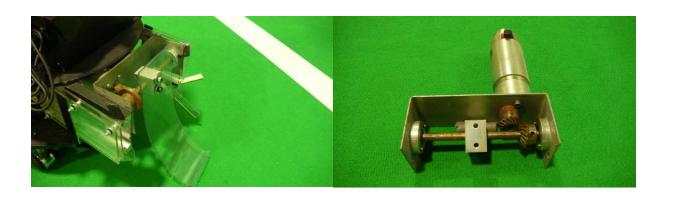
The kicking device was development with the main propose of having and improvement not only in the shooting process but special the pass ability between the team players. With the field size increase, the cooperative and behavior algorithms implementation in the game the robots are now capable to receive and pass the ball between them. To sustain this it was development a shooting device with force control and retractable ball guides. The kicking device has two loops of control: position and force control. The position control is responsible to ability the kicker to receive the ball, stop and prepare to pass, the force control loop will be applied in the kicking and the pass between teammates.
6 Vision System
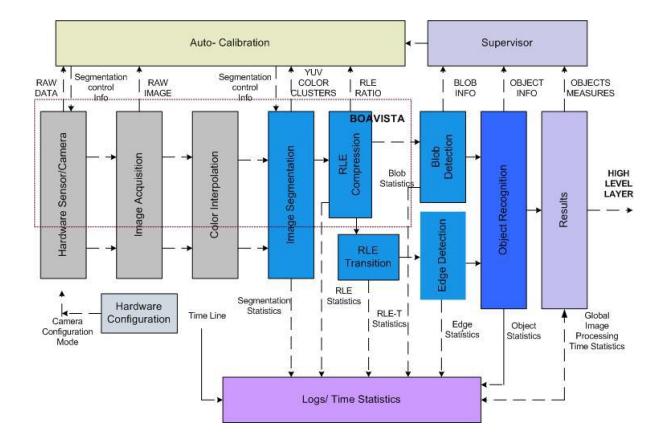
The ISePorto vision system is based on a real-time vision architecture (LSAVision) for mobile robotics. This vision system is characterized by: low computational cost, low latency, low power, high modularity, reconfigurability, adaptability and scalability. A pipeline structure further reduces latency and allows a paralleled hardware implementation.
7 Control and Navigation Architecture
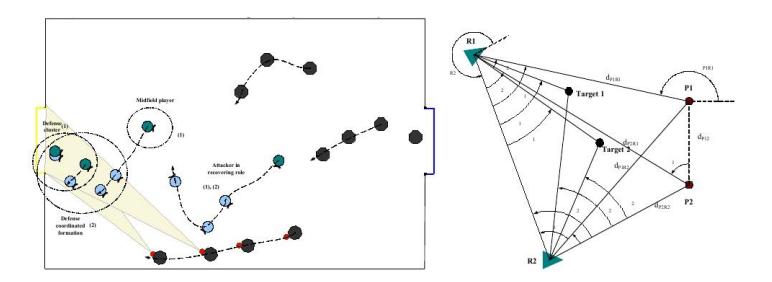
Regarding our goal to improve overall team coordinated playing capabilities, an integrated approach to control and navigation of teams of robots is taken, where the organization of both problems is strongly interdependent. This is an extension of our control architecture [2], [3] currently used in several robotic applications. The control and navigation architecture is designed in a hybrid systems framework [1]. Networks of hybrid automata represent and organize the robots behavior (either individually or in teams) and functionalities. The hybrid systems framework allows the description of the continuous processes involved (in control and sensing) and the conjunction with the discrete nature of occurring events and underlying decision processes. A relevant aspect of the system organization is the simultaneous consideration of control and navigation in the design process. By integrating the navigation and control in the maneuver design, significant additional advantages, such as a better sensor and actuator management (resolving many sensory conflicting requirements) and the availability of adequate sensory and navigation information for the control maneuver in execution, are obtained. Thus, specific navigation algorithms and sensor configuration can be optimized for each situation. One example in the robotic soccer context are the robot maneuvers to simultaneously attack the adversary goalie, maintaining good landmark line of sight for vision navigation purposes, and tracking targets that can interact with the vehicles action.
8 Conclusions and Future Work
Current developments in the design and implementation of the communication system, traction control, vision, control and navigation subsystems of the robotic soccer team ISePorto are presented. Much research and development effort is taken towards the goal of multiple robot coordinated play. Additional team improvements were made to increase game operation ranging from mechanical kicker device developments to a new traction control system. The implemented vision system provides an efficient edge and blob identification achieving real-time determinism of field lines and relevant objects used in navigation, coordination and obstacle avoidance. A dedicated hardware vision sensor is currently being integrated in the robots to decrease both image latency and computational costs, and provide much higher precision in the raw vision measures. The team has participated in several competitions namely in the Robocup 2003, 2004, 2006 and 2009, GermanOpen 2002, 2003, 2005 and 2008, Robotica 2002, 2003, 2004, 2005, ´ 2006, 2007, 2008 and 2009 in Portugal, with good results The test of the new integrated features needs to be validated in game conditions in Robocup 2010 competition.
9 Acknowledgement
The authors would like to thank the LSA team for their efforts and dedication in developing the robots and support on the participation of competitions and events. This work is sponsored by IPP and ISEP.
References
- Henzinger, T. The Theory of Hybrid Automata. U. C. Berkeley , UCB/ERL M96/28 1996.
- Almeida, J.A.,Pereira, F.L., Sousa,J. B. A Hybrid Feedback Control System for a Nonholonomic Car-like Vehicle. International Conference on Robotics and Automation 1993.
- Silva, E. P., Pereira, F.L., Sousa, J. B. On the Design of a Control Architecture for an Autonomous Mobile Robot. Advances In Intelligent Autonomous Systems, ed. S.G. Tzafestas, chap.15 Kluwer Academic Publishers 1993.
- P. Smolik, Z. Sebek and Z. Hanzalek. ORTE-open source implementation of Real-Time Publish-Subcribe protocol. 2003.
- Andre Dias, Jos ´ e Miguel Almeida, Alfredo Martins, Eduardo Silva. Traction characterization ´ in the Robocup Middle Size League. IEEE Robotica 2007 - 7th Conference on Mobile Robots ´ and Competitions, Paderne, Portugal, 2007.
- Yasushi Toyoda Yoichi Hori and Yoshimasa Tsuruoka. Traction control of electric vehicle: basic experimental results using the test ev uot electric march. IEEE Transaction on Industrial Applications, 34(5):1131–1138, 1998.
- Nader Mohamed, Jameeela Al-Jaroodi and Imad Jawhar. Middleware for Robotics: A Survey. In Proc. of the IEEE Intl. Conf. on Robotics, Automation and Mechatronics 2008.
- H Olsson. Control Systems with Friction. PhD thesis, Institute of Technoloy, 1996.
- Albagul A. Dynamic Modelling and Control of a Wheeled Mobile Robot. PhD thesis, University of Newcastle upon Tyne, 2001.
- Shiller, Z. F.L: Dynamics Motion Planning of Autonomous Vehicles, IEEE Trans. on Robotics and Automation Vol. 7,No.2,1991
- Kiam Heong Ang and Chong, G. and Yun PID control system analysis, design, and technology (eds.) Control Systems Technology, IEEE Transactions on Understanding Vol. 13, No. 4, JanuaryJuly, pp. 559-576, 2005.
- Lima, L., Almeida, J.M, Martins, A., Silva, E.P: Development of a dedicated hardware vision system for mobile robot navigation, Robotica 2004 International Conference.
- Martins, A., Almeida, J.M, Silva, E.P, Pereira, F.L: Vision-based Autonomous Surface Vehicle Doccking Manoeuvre, MCMC2006 7th IFAC Conference on Manoeuvring and Control of Marine Craft, Lisbon, Portugal, September 2006.
- Martins, A., Almeida, J.M, Silva, E.P, Santos, F., Bento. D: Forest Fire Detection with a Small Fixed Wing Autonomous Aerial Vehicle, submitted to IAV 2006
- Almeida, J.M, Martins, A., Silva, E., Baptista, J., Patacho, A., Lima, L., Cerqueira, V., Almeida, C., Picas R. ISePorto Robotic Soccer Team for Robocup 2003, In: RoboCup 2003 Int. Symposium, Padua, Italy.