BARELANG 63 Team Description 2022
Hendawan Soebhakti, Senanjung Prayoga, Rifqi Amalya Fatekha, Yogy Pratama, Nyoman Krisna Prebawa, Nawwafal Dzaki Musthofa, Wanda Eka Kurniawan, Muh. Yusup, Nadhif Suherryman, Muh. Revalba Ginggang, Muh. Sabiqul Himam, Tajdar Hal Ata, Irvant Glory Afryanto Tamba, Ridwan Bahari, Haidar Afnan Fakhruddin
Politeknik Negeri Batam, Batam Centre, Jl. Ahmad Yani, Tlk. Tering, Kec. Batam Kota, Kota Batam, Kepulauan Riau 29461; Barelang Robotic Artificial Intelligence Labs (Brail), Gedung Utama, Politeknik Negeri Batam
Abstract The BARELANG63 middle-size robotic soccer team explains in this paper. The team found in 2016 with the ambitious goal of competing in international robotics competitions. This team was designed and run by the author, from start to present. The team's previous experience in the Indonesian robot contest is very relevant. This paper presents BARELANG63 team middle league information belong team information, hardware information, and software information for RoboCup 2022. In this paper, the author will introduce the mechanical system, electrical system, and software of the BARELANG63 robot, such as the Yolo ROS, and also Monte Carlo Localization.
Keywords: RoboCup 2022, Yolo ROS, Monte Carlo Localization.
1 Introduction
BARELANG63 is a robotics team that competes in a soccer robotics competition focused on the Middle Size League. Team members are Batam State Polytechnic students consisting of 60 students. The team found in 2016 with the ambitious goal of competing in the international robotics competition. BARELANG63 every year participates in a medium-sized soccer robot competition held by the Ministry of Research, Technology and Higher Education of the Republic of Indonesia. This first competition was held in 2017, and our team has won several awards. Over time, our research has focused on mechatronics, computer vision, software architecture, and engineering.
2 Mechanic
Barelang63 started its research with its robotics platform. MSL is an autonomous robot that can play soccer. Therefore, Robots are designed and built with wheels as propulsion and programmed to use attack and defense strategies similar to those used in soccer games. Therefore the robot is designed to perform high speed, flexibility and strength.
2.1 Mechanical System
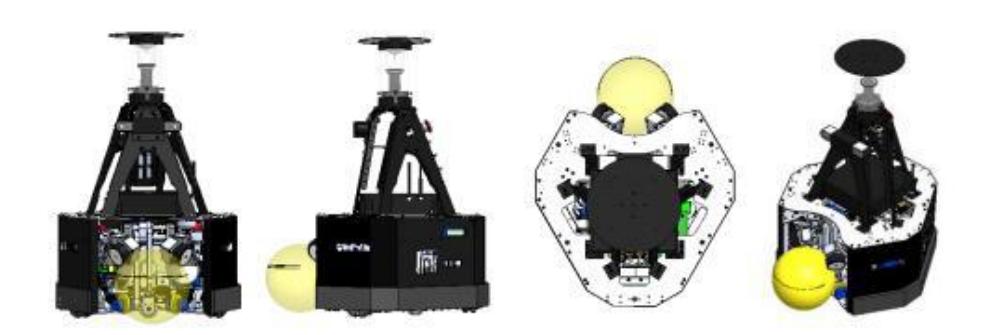
The mechanical system of our robot uses three Omni wheel motors that allow the robot to move in all directions easily. Robot size 48cm x 48cm. The average robot uses aluminum plate material. We use three large torque dc motors for the movement of the robot, two low torque dc motors for dribbling, and three external encoders located at the bottom of the robot that is useful for determining robot coordinates and mapping the terrain. The design can see in Figure 1.
2.2 Electrical System
This section covers the electrical systems of the BARELANG63 robot.
Driver Solenoid Kicker
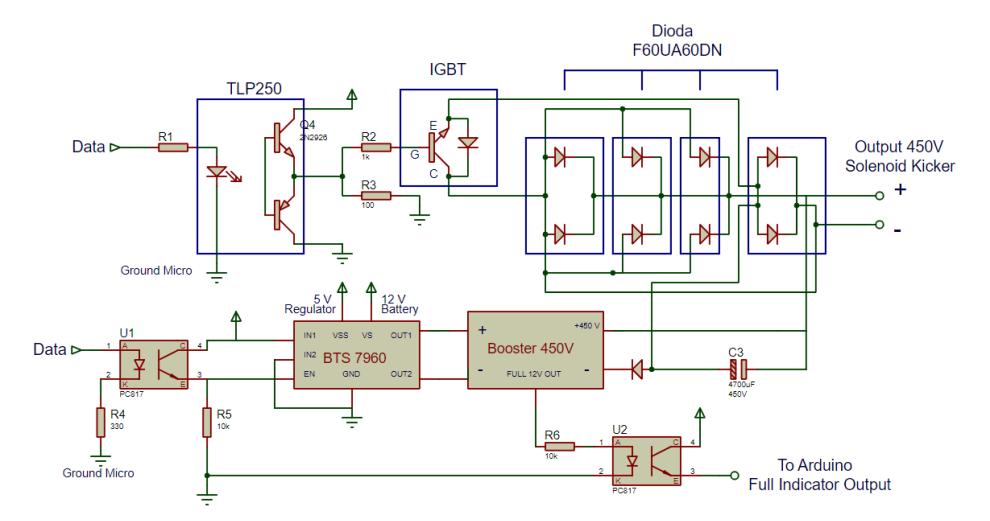
The Solenoid Kicker Driver is a circuit built to control the kicker solenoid that uses an actuator to kick the ball. The do controller in this circuit is the Arduino Mega 2560 microcontroller which functions as a logic provider to charge the capacitor or release power from the capacitor to the coil. When filling the capacitor, the signal from Arduino will activate the optocoupler and motor driver so that the capacitor charge module will work and will automatically turn off (cut-off) when the capacitor is full. When Arduino provides logic to kick in, the optocoupler will activate that makes the gate on the IGBT component open to transmit power from the capacitor to the coil with a millisecond count so that the coil can attract the iron plunger because it is a temporary magnet. The schematic driver solenoid kicker can see in Figure 2
3 Software
In this section, three main algorithms found in the BARELANG63 robot will explain that plays an urgent role in forming all the motion that will be has brought out by the robot. The three algorithms are vision, communication, and strategy planning. Each algorithm will explain in subsections 3.1, 3.2, and 3.3.
This section describes the system on the Barelang63 robot, wherein are three main algorithms for the role and formation of robot behavior in playing the three planning algorithms, namely image, robot control system (kinematics), and strategy.
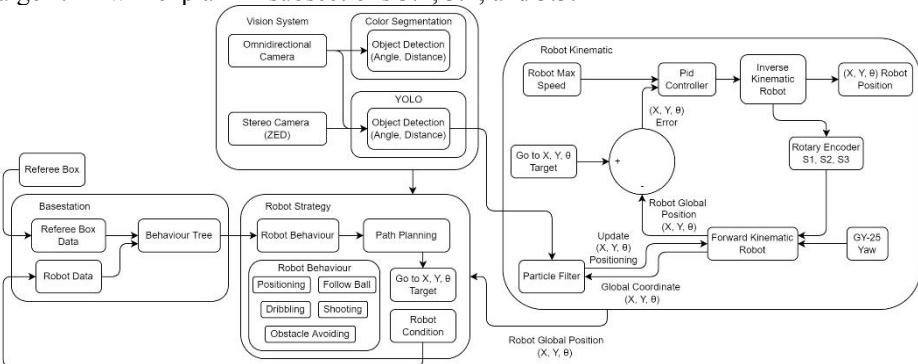
Vision uses the Yolo method and color segmentation, the movement uses the inverse method, forward kinematic, and the PID control system, the localization method used is a relatively adaptive particle filter method that gives the robot the ability to localize itself globally to a map or field. The flow chart can see in Figure 3.
3.1 Vision
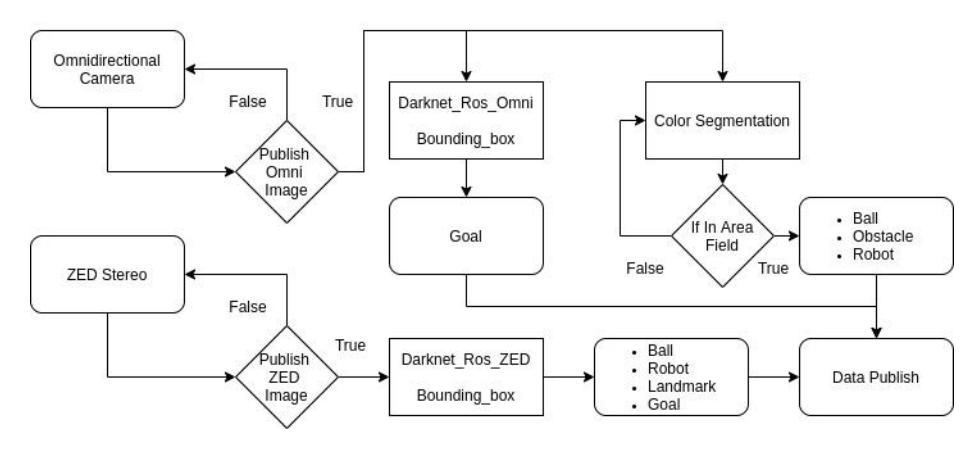
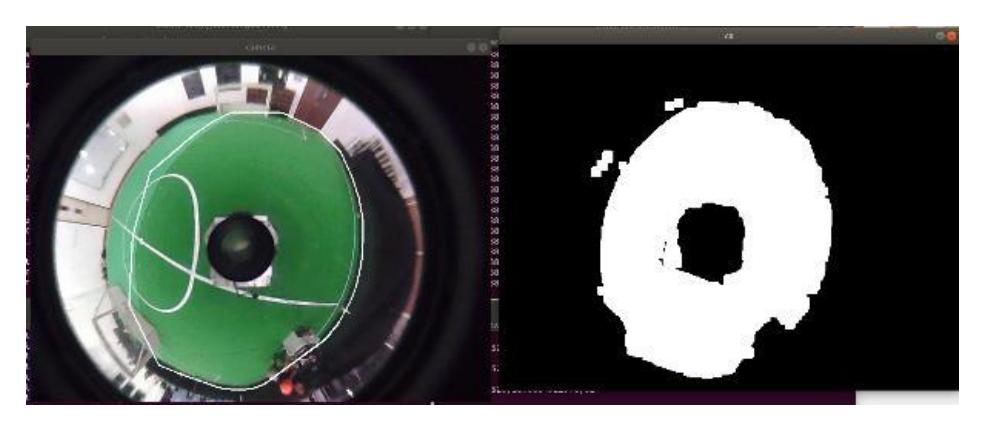
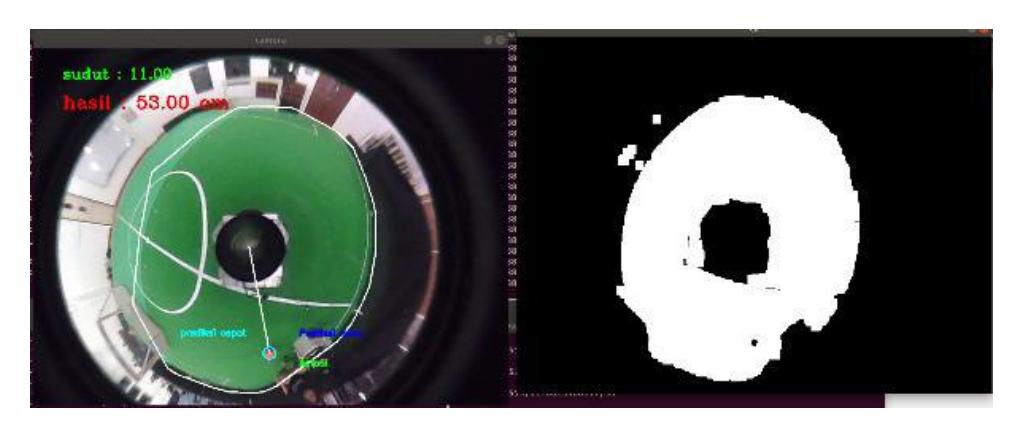
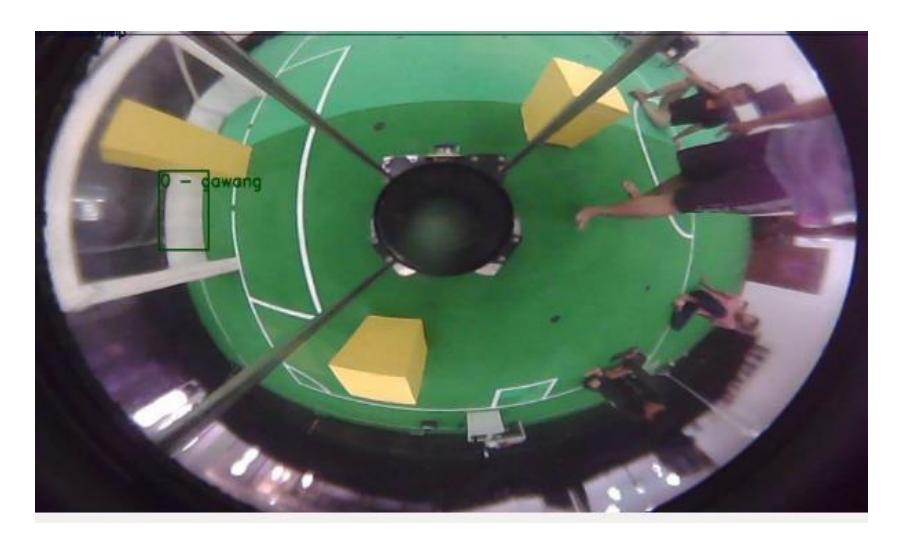
The omnidirectional camera function finds objects with a 360-degree viewing angle. Camera captures are Published using the ROS-based image method publish. The camera publication yield will be Subscribe to the color segmentation section. The Method used in Color Segmentation is the Morphology Transformation Method, RGB Convert Image, Kalman Filter, Gaussian Image, Thresholding, Angle Detection, and Distance Detection to Maximize the Detected objects in the form of Balls, Fields, Robots, and Obstacles, then the data is sent using ROS publish messages. The camera catches also subscribes to the Yolo Section and Yolo Functions to detect the Goal then sent using Ros Publish messages. The output of segmentation and even Yolo can see from Figure 5-7, and the flow chart can see in Figure 4.
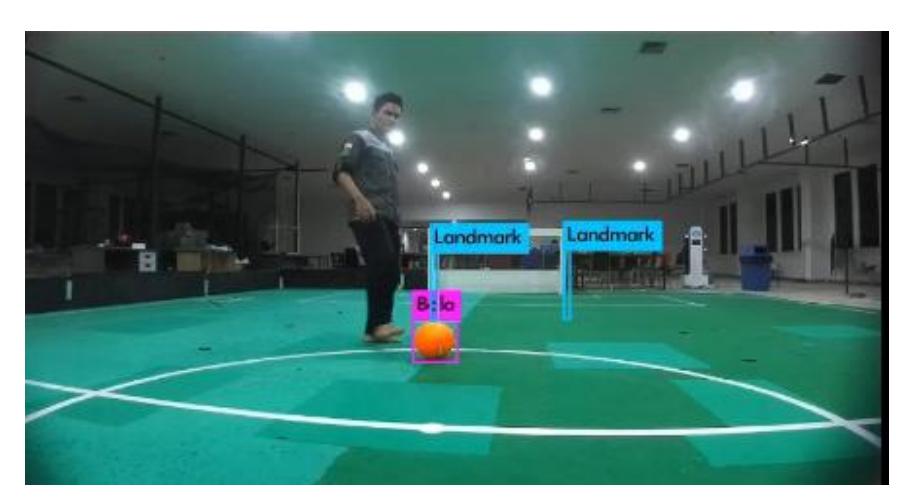
The YOLO ROS method implemented in KRSBI runs on wheels using a zed camera. The program will subscribe to the bounding box. After that, the program will detect objects according to the learning outcomes made according to the specified class, objects, or data entered in the program belonging ball, goals, obstacles, and landmarks. From the objects found, the distance and angle values for each object found will have got, the results of this detection, including the angle and distance, will be published. The output of object detection may be visible in Figure 8, and to find out the flow chart can be seen in Figure 4.
3.2 Communication
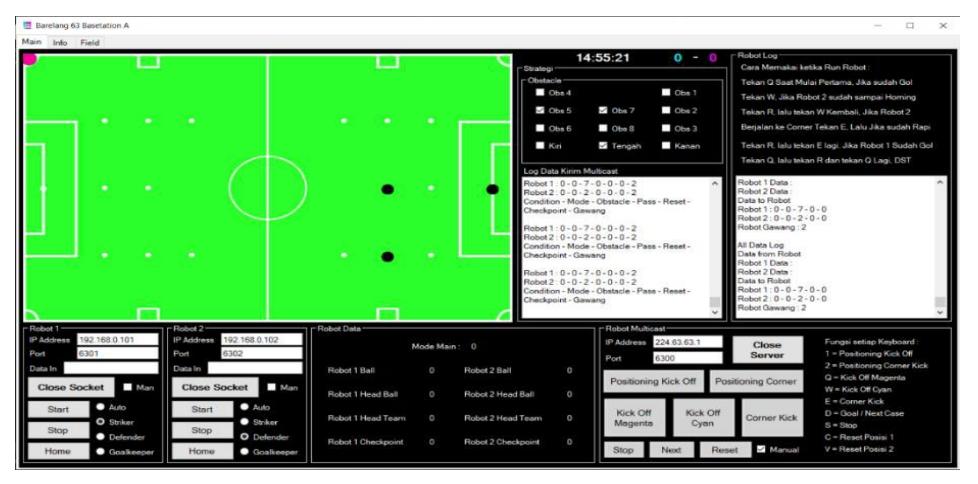
Basestation can perform two-way communication with the robot with a delay of 20 miliseconds for each new data. The communication method used to receive data from the robot is UDP Point to Point. The Communication Method used to send data to the robot uses UDP one-way communication. It can see in Figure 9, where the robot log section is the robot part in sending data to Basestation, where the multicast data log section is the Basestation part in sending data to each robot.
The monitoring system can display correct results directly from all robot movements in the field, starting from X, Y, and Z (Angle) movements. This Monitoring System can function with the data provided by the robot to use the UDP Point to Point Communication Method, then broken down into data (X, Y, Z) so that the Monitoring System can function well as a remote monitor from Robot movements.
3.3 Localization Of Robot Soccer
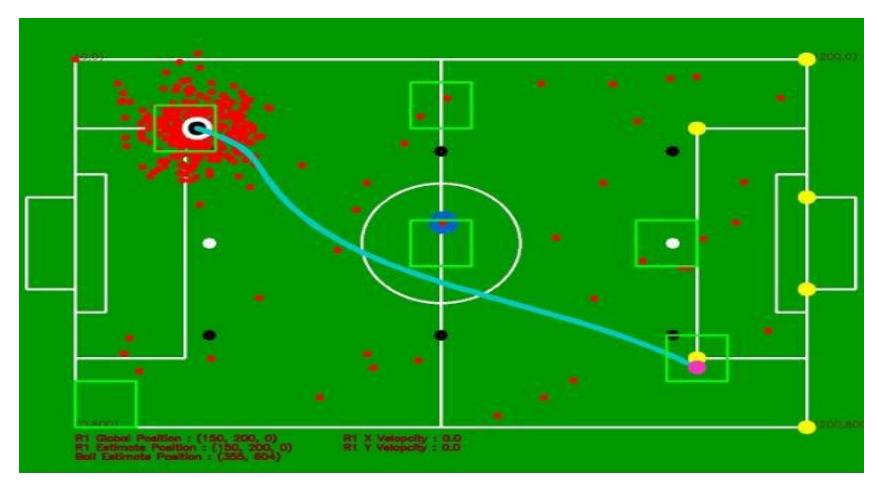
Localization is a field mapping system where robots can find out the position of objects in the field, and the localization system used today is MCL (Monte Carlo Localization). MCL is a probabilistic localization method derived from Bayes Filter through Markov Localization and Particle Filter. The work of Monte Carlo Localization is to uses the particle (as a robot representation) that poses to infer the estimation of the robot. In the context of probabilistic work, localization can define as the act of estimating posterior beliefs, armed with information about movement (control) and perception. The output results can see in Figure 10.
4 Conclusion
Based on the achievements of our team in the League National BARELANG63 has a solid commitment to join RoboCup 2022 as evidenced by the development of robots on software platforms and electronic systems. Begin with software development, namely the development of a localization system that developed to be more flexible and accurate in determining the position of one's robot and the position of a friend's robot, as well as in communication systems where AI development has taken place. At the same time, in the electronic system, there is the development of a kicking robot system, which can now perform hull or flat kicks. And on the particle filter, when the robot knows its position globally, the distance and angle of the object, then the range and angle of the object detected by the robot can be calculated using the rotation matrix equation.
References
- R. Afriza, POSITION CONTROL PADA MOBILE ROBOT OMNI DIRECTIONAL WHEEL KIWI DRIVE MENGGUNAKAN PERSAMAAN INVERSE DENGAN FEEDBACK FORWARD KINEMATIC BERBASIS PID, Batam, 2015.
- H. Soebhakti, S. Prayoga, R. A. Fatekha, and M. B. Fashla, "The Real-Time Object Detection System on Mobile Soccer Robot using YOLO v3", pp. 3–8, 2019.
- R. A. Fatekha, B. S. B. Dewantara, and H. Oktaviano, "Sistem Deteksi Bola pada Robot Kiper Pemain Sepakbola Beroda", pp. 2-8, 2021.
- K. V. Utama, S. Prayoga, R. P. Hudhajanto, R. A. Fatekha, D. S. Pamungkas, "Positioning and Maneuver of an Omnidirectional Robot Soccer", pp. 1-5, 2018.
- P. Yogy, "Football Wheel Robot Localization System (Barelang 63)", pp. 28-29, 2021.
- H. Mandala, E. R. Jamzuri and H. Soebhakti, "Sistem Deteksi Bola Berdasarkan Warna Bola Dan Background Warna Lapangan Pada Robot Barelang FC," Semin. Nas. Apl. Teknol. Inf, pp. 14-20, 2016.
- K. Adi and C. E. Widodo, "Distance Measurement With a Stereo Camera," International Journal of Innovative Research in Advanced Engineering (IJIRAE), pp. 24-27, 2017.