ERSOW 2022: Team Description Paper
I. K. Wibowo, U. Supriyadi, D. Yusuf, V. Kurnia, M. Zulkifly, S. Prasetyo, A. Najib, M. Tri, M. Reza, J. Roi, N. Achmad, E. Dwi, F. Tirto, I. Tantowi, R. Nur, M. Roy, A. Aisyah, N. Ayu
PENS Robotic Laboratorium, Politeknik Elektronika Negeri Surabaya, Surabaya 60111, Indonesia
Abstract This paper contains an introduction to PENS ERSOW robotic team which have been taking part in Indonesia Wheeled Soccer Robot Contest (adopted from MSL - Robocup) since 2017. ERSOW has carried out long and continuous research in building a soccer robot that complies with MSL Robocup competition rules. As our contribution as researchers, we have published many research results in reputable places. ERSOW robot soccer has many abilities such as object detection and classification, control and navigation system, self-localization and mapping, and also realtime communication between each other. This year will become the first time for ERSOW to take part in 2022 RoboCup middle size league. We will try to give our best performance.
1. Introduction
The ERSOW is one of the robotics team from Politeknik Elektronika Negeri Surabaya (PENS) Indonesia. ERSOW team was formed in 2016 to participate in the exhibition competition for the Small Size League (SSL) category in Indonesia. Then in 2017 until now, ERSOW participated in the Indonesian Wheeled Soccer Robot Contest which was adopted from the Robocup Middle Size League (MSL) competition. The journey of the ERSOW team has been quite long and has made many achievements at the regional and national levels in Indonesia. ERSOW tries to show its best ability in the Indonesia Wheeled Soccer Robot Contest at the regional and national level to win the championship. ERSOW's ability is always improved to meet the target in the competition every year. Our best achievement is the winner of the regional robot competition and runner up of the national competition in Indonesia. Several awards for ERSOW in the Indonesia Wheeled Soccer Robot Contest, namely, 1st regional in 2017, 3rd national 2017, 3rd regional 2019, 2nd national 2019, 2nd national 2020, best design and 1st regional 2021, 3rd national 2021. With experience in competitions in Indonesia, in 2022 we will try to take part in the Robocup competition in the hope of gaining a lot of knowledge from other teams from abroad.
The ERSOW team consists of 17 PENS students, each of whom has special skills such as computer vision, image processing, hardware, mechanics, etc. In 2017, the ERSOW team focused on kicker systems and ball detection systems using omnidirectional cameras. Meanwhile, in 2018 it focused on self localization. In 2019, the ERSOW team focused on the development of four-wheeled robots, the use of Robot Operating Systems, obstacle detection and obstacle avoidance. In 2020 to 2021, we focused on building cooperation between robots in passing the ball, corner kicks, avoiding obstacles, and kicking the goal accurately. ERSOW has three robots that have their own names and tasks. The striker robot is named Okto, defender robot is named Hendro, and the goalkeeper is named Jamil. This year, we are trying to build two additional four-wheeled robots to participate in the Robocup competition. Two additional robots are under construction. Previously, we also had a total of eight three- and four-wheeled robots. But on the way, we decided to use a four-wheeled robot because it was the most ideal design for our conditions in Indonesia. Wheels with four wheels have great power, so they are easier to control.
2. Robot Design
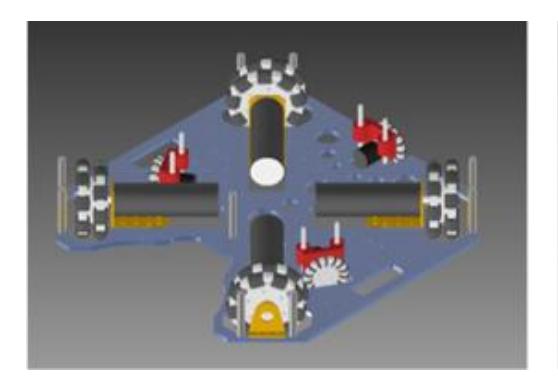
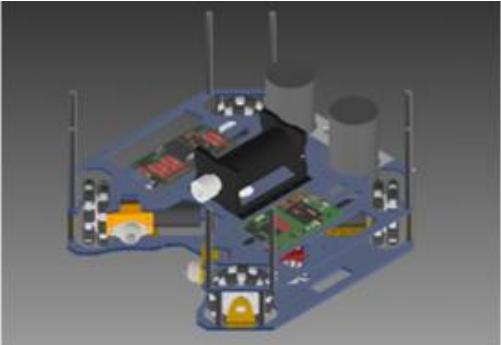
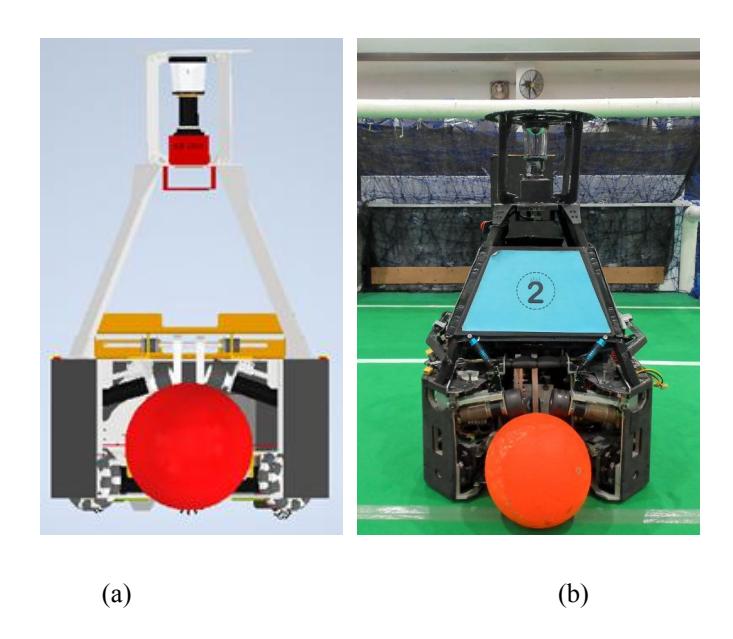
The general form of this robot is a wheeled robot. The structure of the robot form consists of 4 omni-wheels [1] for attacking robots and goalkeeper robots. ERSOW uses 4 omni-wheels as a robot driving mechanic because it is more balanced in moving in all directions, so it can be more stable and balanced when chasing the ball, and avoid obstacle. A ball thrower serves to kick the ball by lifting the ball and Kick the ball in a straight line. The head is equipped with a sensor system. They are visual organs that function as eyes in humans. This sensor will it functioned as a tool to track the whereabouts of the ball to be kicked, and it is also to see the position of the opponent who is blocking the direction of the kick. Structure in terms of mechanics, the omni wheel used has a diameter of 100 mm and each wheel has an actuator powered by a DC motor. The ERSOW robot has a physical shape like a cone with a diameter of 46 cm and height of 78 cm. The ERSOW robot has a ball launcher with specifications. The throwerhas to throw the ball up and also throw the ball straight at the forward at high speed.
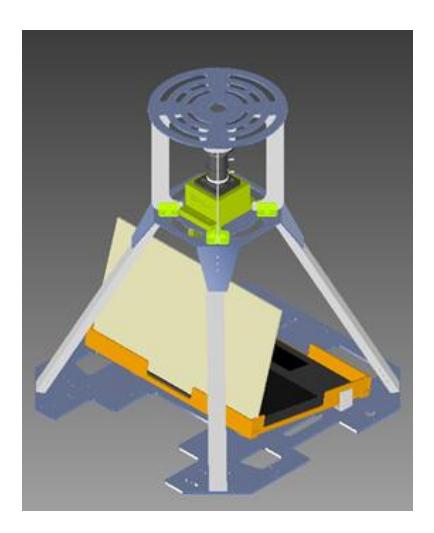
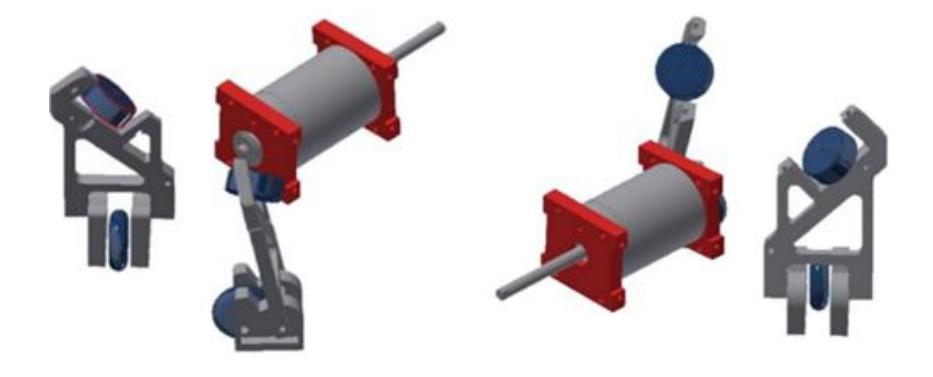
Mechanical design of the ERSOW robot is divided into 3 major mechanical parts, that is the upper body, the base, and the lower part (the actuator). Fig. 1 shows that the top of the robot has one camera, that is an omnidirectional camera to help map the field and find the location of the ball, and another robot which are then processed on a Laptop/PC using image processing.
3. Hardware
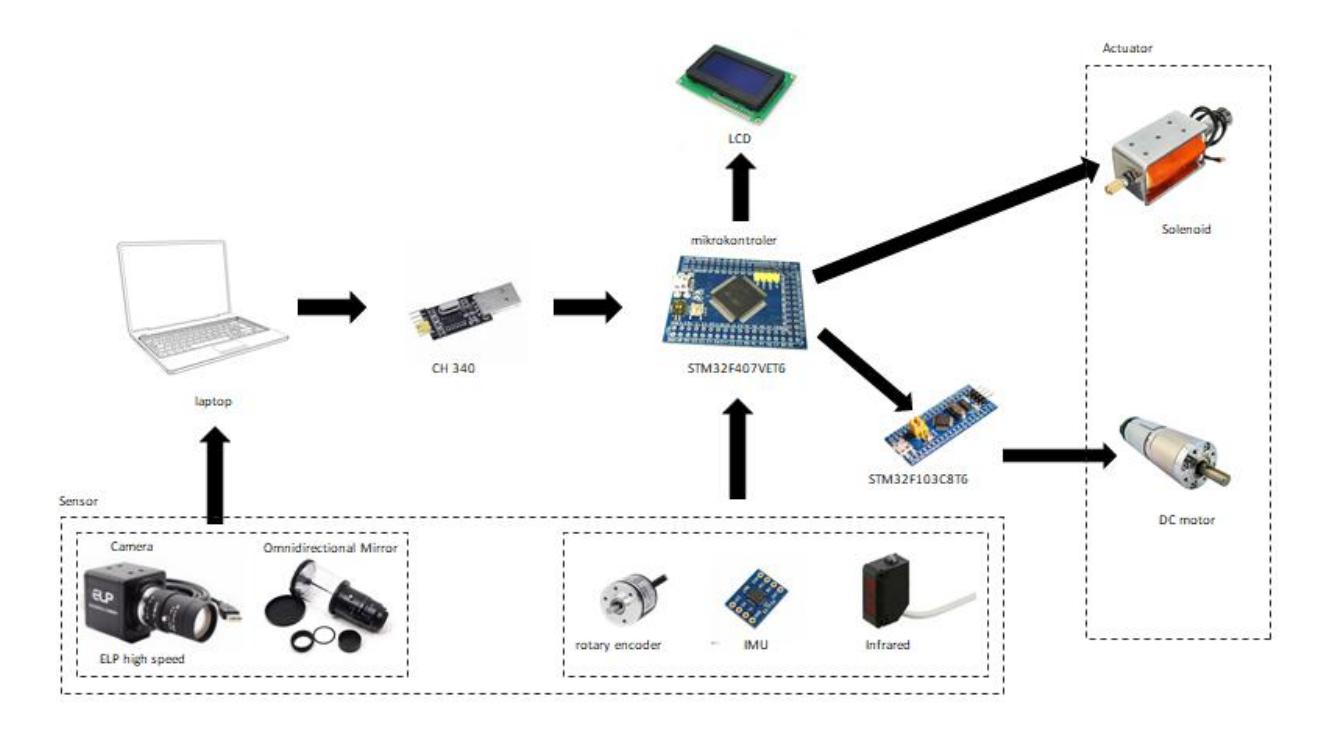
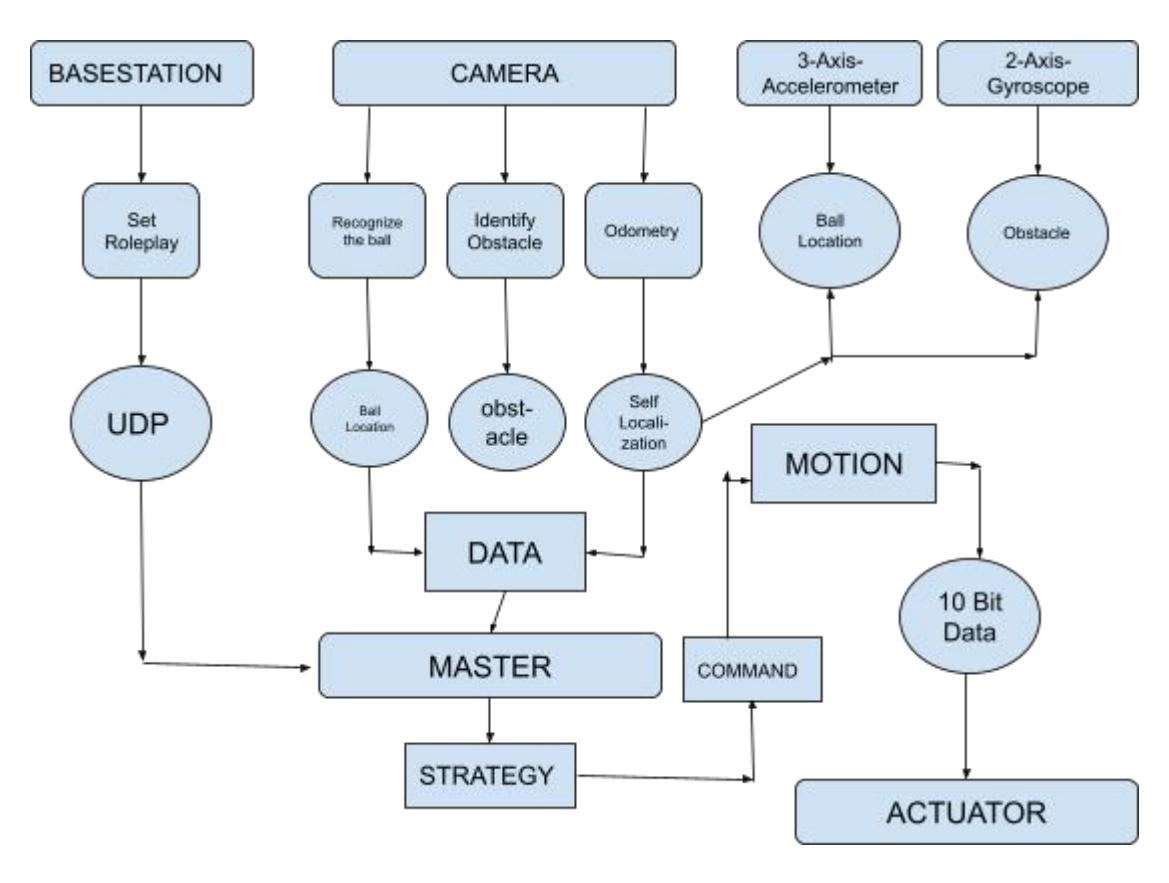
The ERSOW robot is designed to be able to run autonomously. Therefore, the robot must be able to detect the ball, its coordinates, the coordinates between the robots, and the goal, and enter the ball into the opponent's goal. So a systematic system must be put in place that can describe all the ways the system works and get maximum results.
4. Software
This section covers the software systems of the ERSOW robot.
4.1 Robot Operating System
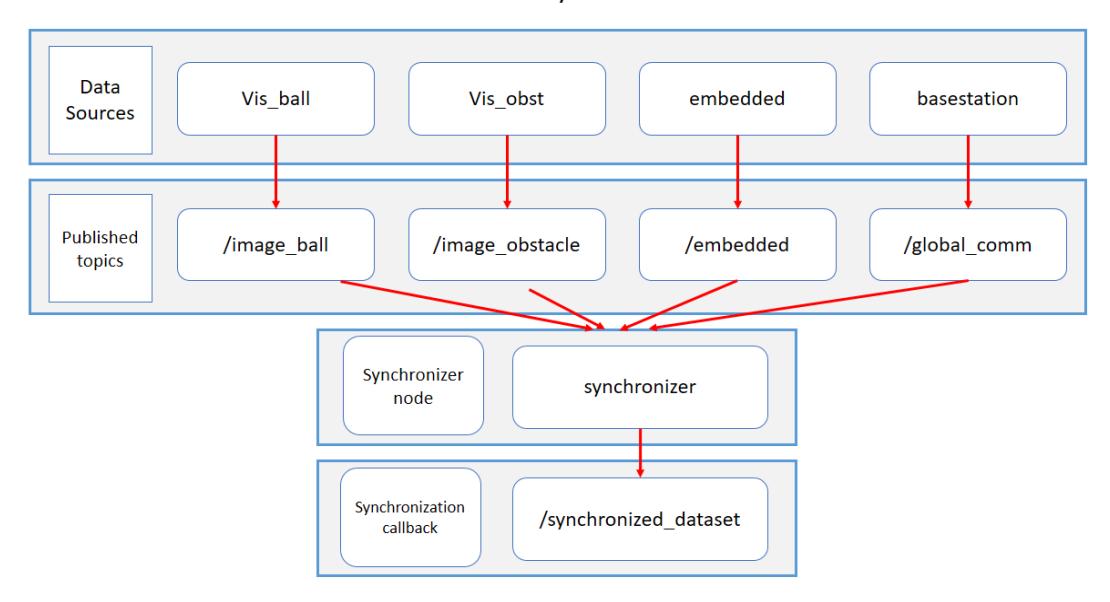
ERSOW Robot soccer uses several data sources available. Typically, Execution time for each sensor that is attached varies depending on what kind of sensor it is. Ersow robots are working with respect to real-time system autonomous models that mean all the sensor data must come in at the same time. In order to achieve that term, we could use the Robotic Operating System synchronization mechanism [2]. In this section, we could form a synchronized dataset by one ROS node as a synchronizer of all data sources.
Fig. 7 shows that the synchronizer nodes subscribe to 4 incoming channels then by using a generated timestamp included in each of the topics, it publishes a single synchronized dataset callback. Each data source will be represented by at least one node to set up and maintain its transfer rate frequency.
4.2 Image Processing
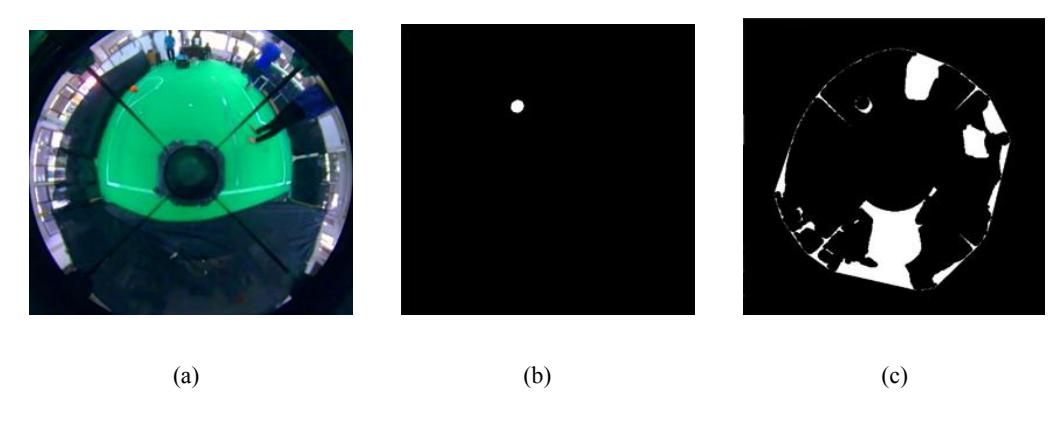
The vision system on ERSOW robot use image classification method [3,4] for detect allies robot, ball, field, and obstacle object. Image classification is the process of categorizing and labelling groups of pixels or vectors within an image based on specific rules, for specific rules ERSOW robot use color for differentiate each object in one frame. Frame in ERSOW robot camera obtain RGB colorspace, ERSOW robot change colorspace into HSV (Hue, Saturation, Value) to get object contour. Then from object contour, ERSOW robot count the mid point of object by using contour height, width, x, and y area, then ERSOW robot count distance pixel between robot and object based on the middle point of robot and object. In every x, y, and distance pixel change into the real value of x, y, and distance by using ab-Exponential regression. ERSOW robot use image classification method because this method has low or light computation.
4.3 Communications
In a match, it is forbidden to use a program that directly communicates with the robot. So there must be an external system that becomes a medium of communication between the five robots [5]. Wireless communication uses the IEEE 802.11/n access point standard. Base Station is a program that has the main function of receiving orders from the referee box and then make decisions based on the referee and data from all robots after which the data will be broadcast to all robots. The base station program receives data from the referee box directly using the TCP protocol. At the same time, the base station also receives data from all robots using the UDP protocol to determine the position of the robot and the ball.
4.4 Strategy
The strategy used by the ERSOW robot depends on the target challenge in each type of match. Generally, the ERSOW robot uses an initial position strategy, takes the ball at the kickoff point, kicks the ball towards a friend`s robot, receives feedback from a friend's robot and dribbles it towards the opponent's goal. .
To optimize the movement of the ERSOW robot in dribbling and kicking the ball towards the opponent's goal, an accurate position estimation is needed [6]. ERSOW robot implements pose estimation which aims to determine the initial position and target position using position coordinate calculations obtained from the rotary encoder sensor. The robot ERSOW consists of 5 robots all coordinated by the base station, the goalkeeper robot is responsible for keeping watch and catching the opponent's ball, then 2 attacking robots are responsible for attacking or passing the ball and scoring goals into the opponent's goal direction. Robot ERSOW performs obstacle avoidance [7] to avoid the opponent's robot while dribbling towards the opponent's goal, the method used to avoid obstacles is the substrate method. With the obstacle avoidance feature, the ERSOW robot will not hit the opponent's robot and minimize the opponent's chance to loop the ball from the ERSOW robot.
5. Conclusion
This paper describes the development of the latest Ersow robot form and system for the 2022 version.The main points in the development of this robot are the use of four omni-wheels, a dribbling system, a kicker and the use of ROS in robots. Based on the results of trials and research, the ERSOW robot has good abilities in movement, electronic systems, vision processing, and communication systems. ERSOW has also been customized according to standard soccer robot match wheels in general and Robocup 2022 in particular.
References
- Kozlowski, K.R., & Pazderski, D. (2004). Modeling and control of a 4-wheel skid-steering mobile robot. International Journal of Applied Mathematics and Computer Science. 477-496.
- Saito, Y., Azumi, T., Kato, S., & Nishio, N. (2016). Priority and synchronization support for ROS. Proceedings - 4th IEEE International Conference on Cyber-Physical Systems, Networks, and Applications, CPSNA 2016, 77–82.
- Nurrohmah, E. A., Wibowo, I. K., Bachtiar, M. M., & Lathief, M. M. (2021). Improvement of the Processing Speed of the Robot's Vision System Using Robot Operating System. International Electronics Symposium 2021: Wireless Technologies and Intelligent Systems for Better Human Lives, IES 2021 - Proceedings, 482–487.
- Xu, D., Huang, Q., & Liu, H. (2016). Object detection on robot operation system. Proceedings of the 2016 IEEE 11th Conference on Industrial Electronics and Applications, ICIEA 2016, 1155–1159.
- Haq, M. A., Wibowo, I. K., Dewantara, B. S. B., Bachtiar, M. M., & Anwar, K. (2020). The base station application of ERSOW team for communication between robots. Proceedings of the 2020 27th International Conference on Telecommunications, ICT 2020.
- Li, X., & Zell, A. (2009). Motion Control of an Omnidirectional Mobile Robot. Lecture Notes in Electrical Engineering, 24 LNEE, 181–193.
- Priambudi, R. A., Wibowo, I. K., Deby Ariyadi, B. N., Dewantara, B. S. B., Bachtiar, M. M., & Nurrohmah, E. A. (2021). Dynamic Obstacle Avoidance on Middle Size League Robot Soccer ERSOW Using Subtargets. 479–485.