RobotSports Team Description Paper
Ton Peijnenburg, Jürge van Eijck, Noah van der Meer, Charel van Hoof, Rob Burgers
VDL ETG, De Schakel 22, 5651 GH Eindhoven, The Netherlands
Abstract Robot Sports is an open industrial team, meaning that its participants are all employed by or have retired from various high-tech companies in the Dutch Eindhoven region or are active students. This year, the team will report on initiatives which aiming to accelerate innovation within RoboCup MSL: standardisation to increase the re-use of components by existing teams and allow new teams to quicker participate in the MSL competition; Mixed Team Protocol: ability to combine teams with a few robots to a complete team and to make steps towards matches where humans can play with (or against) robots.
1 Introduction
The Robot Sports team is an open industrial team supported as main sponsor by VDL, an international industrial family business with 105 operating companies, headquartered in Eindhoven the Netherlands. The team shares a dedicated facility with the ASML Falcons team in the city of Veldhoven, near Eindhoven. The team developed new robots, which have evolved from the previous generation. The previous generation robots of the Robot Sports Team were developed as a mix of the Philips robot design used in the MSL competition [1] and the Tech United TURTLE robot design from the year 2012 [2]. A new generation of robots enabled with our latest insights and improvements.
2 Robot hardware
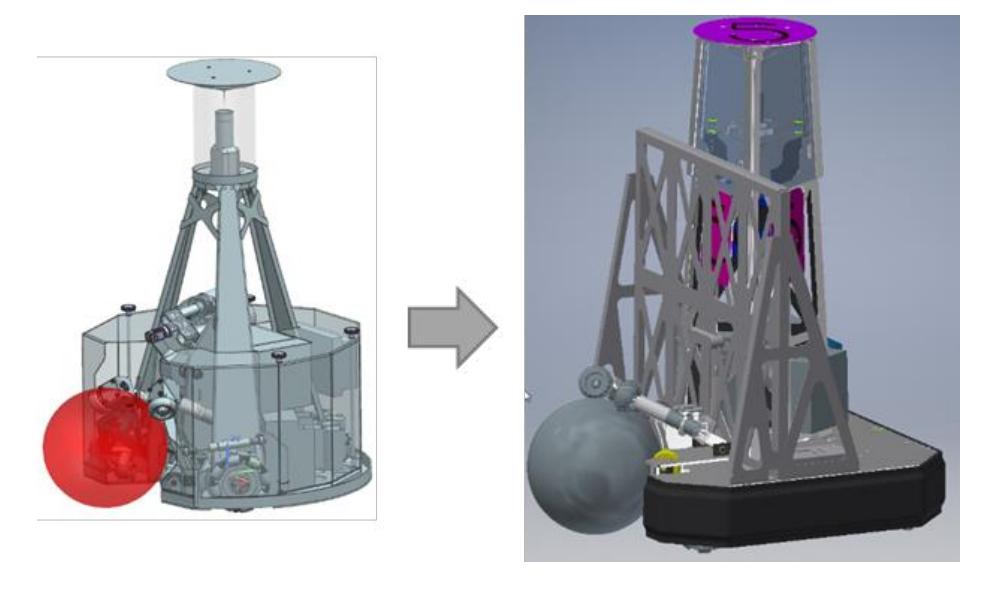
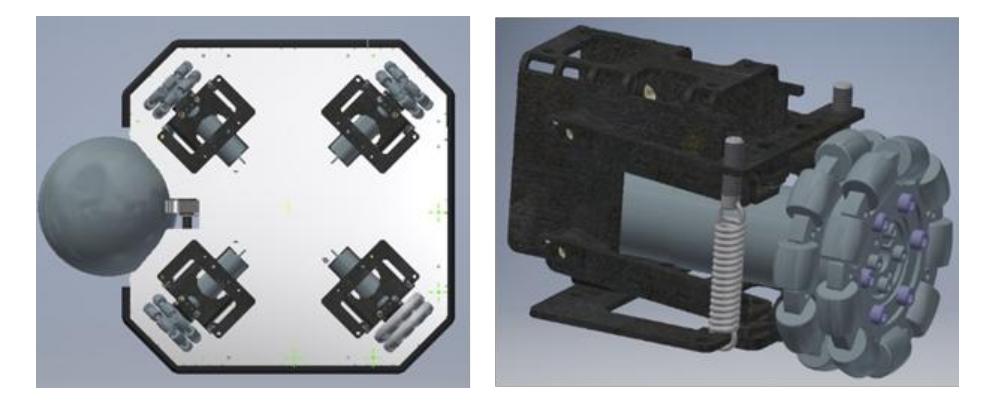
The revisions to our robots' hardware are aimed at making them faster, more reliable, easier to service, safer and more efficient to transport. Robots will have four omni-directional wheels for better stability and traction, an improved ball handler mechanism with better placement of passive and active wheels, and a new camera tower that can be separated for transport and provides more easy access for camera adjustments. In addition, the control electronics will be modified to include off-the-shelf motion controllers as well as custom designed, micro-controller based I/O, control and safety modules. The new design also facilitates the housing of a stereo depth sensor camera.
The robot frame is designed entirely in sheet aluminum, which keeps the weight down while still providing the required sturdiness and keeping cost down. A four-wheel configuration is chosen, combined with individual suspension for all wheels to avoid over-constrained design and secure proper traction.
Robot control is hosted on an AAeon 8251AI system. The 8251AI brings high performance AI capabilities to the edge in an extremely compact formfactor. In addition, the unit has a small mass, possesses excellent IO facilities and has low power consumption (15W, 6-Core power mode). On the 8251AI we are running an Ubuntu 20.04 64-bits OS in combination with custom control software. Motion control tasks for the drive- and ball handler wheels are hosted on three dual axis Roboclaw motion controllers [3] which are coordinated by a Teensy 4.0 microcontroller [4]. Interfacing to the main PC is via the LAN Ethernet bus. General I/O control is centralized on a customer board based on a microcontroller which includes PLC functionality for (main) power control, and safety circuits. During demonstrations and experiments an 900 MHz RF module is connected with with the robot's safety controller to provide remote kill switch functionality. We have an electromagnetic kicking mechanism. Automotive solenoids are used for actuation of a lever. One of two "feet" can be selected which will kick the ball. One foot kicks low over the floor, the other kicks a lob shot. A new charging circuit has been developed to charge a capacitor stack. Discharge is done through a novel custom IGBT based switch that can be pulse modulated to control shooting power and -duration. Control is implemented on a microcontroller that interfaces via LAN Ethernet to the AAeon 8251AI.
3 Visual sensing
Our robots have a GigE camera from Point Grey with a 1280 x 1024pixel image sensor and omnimirror combination. To resolve north south playing field ambiguity, an electronic compass unit is used. With the camera, a ball sized object can be detected up to 7 meters. Discrimination between a ball and environment is done based on color segmentation in the YUV domain. Color segmentation for field and ball colors is based on (semi) auto calibrated segmentation parameters. An additional stereo vision system to supplement the omni-directional vision system is installed on the robot. Specifically, we have worked with the ZED2 2K Stereo Depth sensor developed by Stereo-Labs [5]. The ZED2 contains two synchronized high-resolution RGB cameras which can deliver frames up to 100fps. Through specific calibration and triangulation, these two cameras can be used to estimate the depth of objects present in the image. The ZED2 device can be used to determine distances between 0.5m and 20m with a very tolerable error [6]. The main advantages of using the ZED2 are that the estimation of positions of objects is typically more accurate than what can be achieved using the omni-directional vision system, and the fact that it allows for the detection of airborne objects such as balls passing through the air. In the past, we have used similar devices such as the Microsoft Kinect to supplement the omni-directional camera with great success. In indoor environments with artificial lighting, these devices that essentially employ active IR projection and detection to estimate depth perform quite well. On the other hand, performance in out-door conditions under direct illumination from the sun is typically severely limited. The ZED2 does not suffer from this constraint due to the passive nature of the depth estimation. As the RoboCup community moves closer to its 2050 goal of challenging human opponents, this is highly relevant as it would allow for outdoor matches. In order to detect objects such as the ball and other robots in the frames delivered by the ZED2 sensor up to high distances, we have worked with Deep Neural Network frameworks such as Tensorflow [7] and PyTorch [8]. Recently we achieved very promising results with the YOLO neural network using the latter framework [9]. We are currently also investigating the use of the MobileNetV3 network developed by Google, which is supposed to be particularly suitable for resource-constrained systems [10].
4 Behavior and reasoning
We believe that the reasoning that is required for soccer should be responsive. Our robots must react quickly, making a non-optimized but appropriate decision. This is a trade-off between timing and quality. The robot behavior is implemented as a set of executable skills. These skills have dedicated responsibilities and effectively run parallel. A finite state machine (FSM) controls the highestlevel states of the robot. The FSM decides when and which transition is made. When a transition is made the set of skills that are relevant for that state are made active. We are using a heuristic based team planner, which calculates for every available player a path to an objective, until no players are available. The team planner combines dynamic role assignment and strategic positioning. The dynamic role assignment is made more robust by taking previous assignments into account and allowing some hysteresis. The Robot Sports Team uses RTDB [11] to exchange and synchronize data between team players, which results in a fast and accurate shared world model.
5 RobotSports Open API
Robotsports has opened up their robots for students to design, implement and test robot control software. In collaboration with Fontys University of Applied Sciences Eindhoven, Robotsports has created an API that offers students the necessary tools to use soccer robots of Robotsports in their practical studies.
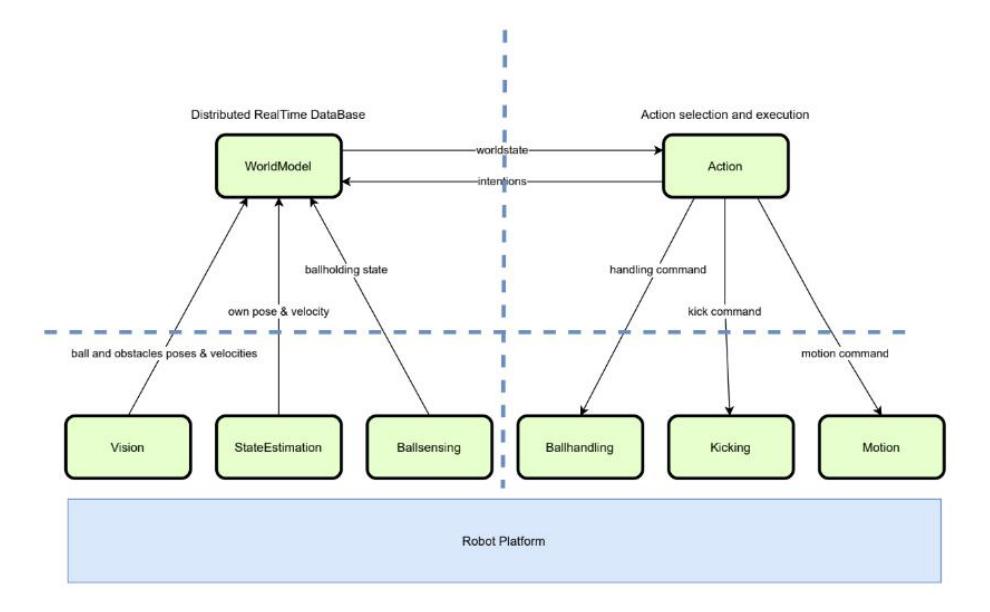
The software architecture of a soccer robot can be divided in four main sections (see Figure 3): sensing, sensor fusion (world model), action/command selection logic, and command execution. For students to work on the action/command selection logic, the other three sections need to be in place. This is the case with the Robotsports soccer robots.
A next hurdle for a student is to familiarize with the Robotsport software, in order to replace the action/command selection logic with some of their interest. Robotsports now facilitates this step with an API called rsopenapi [13]. It offers a RTDB-based API providing status information and robots controls to move and kick. It also comes with a dockerized simulator.
6 Mixed Team Protocol
The team considers the development of a mixed team protocol as an important element for accelerating innovation by allowing more teams to participate in RoboCup MSL, even with less than five robots, and to make steps towards matches where humans can play with (or against) robot. Members of Robotsports and Falcons defined together a first version of a mixed team protocol. This was a follow-up of the 2020 MSL workshop. The team with robots from Robotsports and Falcons demonstrated a freekick during the Technical Challenge of RoboCup 2021. Robotsports has an active role in the further development of the mixed team protocol. This will be done with other teams. The progress and developments will be aligned with the MSL league. The ambition is to demonstrate a full game a mixed team with the co-developpers at RoboCup 2023.
7 Standardisation
Standardisation will be the key element for accelerating innovation within RoboCup MSL. We believe that the ROS2 platform is the generic platform which allow the MSL to share developments. Standardisation will lead to more re-use of components by existing teams and allow new teams to quicker participate in the MSL competition. Robotsports defined a roadmap for the transition of the current software into a new design. The key elements of the new design are easy replacing the software components by other implementations and designed for sharing with other teams. A new team should be able to use our new implementation as basis and adjust it with a limited effort to make it running on their robots. This will significant reduce the time between the start of a MSL team and the first match. In the first match the team can already play according to the MSL rules.
The transition roadmap supports that during development the software always can be running on the robot.
- Phase 1: identifying explicit and implicit interactions within the existing software, which development started at end of 1999.
- Phase 2: two activities will be done in parallel. Learning ROS2 in a practical way, therefor the existing software will be wrapped in 2 ROS2 components. A ROS2 component for controlling the platform and a ROS2 component which contains the rest of the software. This helps to build up knowledge about ROS2. In parallel we evaluated the software architectures of the active MSL teams based on the MSL MES data of 2022. From the evaluation a software component decomposition will extracted.
- Phase 3: design a generic concepts for the ROS2 components like intercomponent communication, configuratie etc.
- Phase 4: Transition for the 2 ROS components from phase 2 to the new component structure with the existing interfaces. The new ROS2 components will use the generic concepts for interaction.
- Phase 5: Refactoring to more generic interfaces between the components and apply design patterns to make the software better shareable.
8 Wheelchair kicker
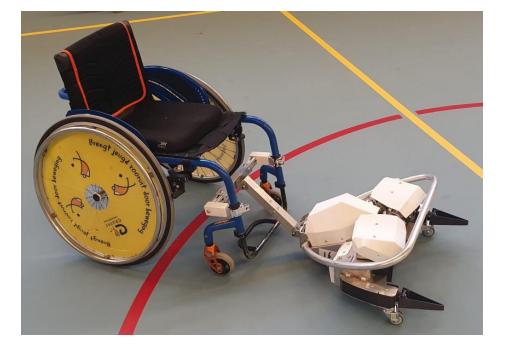
Inspired by the MSL electronic kicker Tech2Play developed a kicker (AmiGo)for a wheelchair [14] [15]. The wheelchair kicker allow kids in wheelchairs to fully participate in sports. Robotsports members act as consults for the project. The team active co-developed the electronics for this project and the mechanical redesign to reduce the cost price and size of the wheelchair kicker.
9 Outlook
For a future generation of robots, we are considering two-wheeled robots. We aim for a cost-effective platform based on technology of a hoverboard, e.g., an Oxboard [16]. Key advantages include a much higher wheelbase than the typical MSL robots, creating compatibility with natural sports environments including artificial and natural turf, and the ability to create mixed settings with human players. After finalizing our current platform revision, we plan to continue our work on the design of this two-wheeled robot platform.
10 Conclusion
We continued with the revision of our robots. The team contributes to initiatives which aiming to accelerate innovation within RoboCup MSL. RobotSports takes initiative to continue with development of the Mixed Team Protocol. We started refactoring our software to provide a reference implementation for a standardized MSL software design on ROS2. RobotSports expects that after the introduction of a standard MSL software platform allow the team to specialize in some areas.
We benchmark our performance against European teams: specifically the ASML Falcons during our regular practice matches in our shared facility and during the European RoboCup 2022. This brought us to the level where we are now: we can play a basic level of robot soccer. In order to close the gap to the top teams, we need to make our robots more robust and at the same time, more advanced. Making the hardware more robust prevents downtime during tournaments and automating calibrations reduces the time we need unboxing our robots to be ready for a fist match. This challenge is not unlike installation and calibration of high-tech equipment in its production environment. More robust also includes more robust sensing for different/changing environments. More advanced in our case implies faster motion, better ball control and faster responses. Especially the latter is performance characteristic that has systemwide impact when improving. When improvements for these aspects have been made, more advanced robot and team behavior will become more relevant.
References
- A.T.A. Peijnenburg, T.P.H. Warmerdam et.al.: Philips CFT RoboCup Team Description. In: preliminary proceedings 2002 RoboCup conference, July 2002.
- Turtle Robot description on robotic open platform, http://www.roboticopenplatform.org/wiki/TURTLE, last accessed: 2020/01/30.
- Basicmicro RoboClaw Dual 34VDC, https://www.basicmicro.com/motorcontroller2, last accessed 2021/03/20.
- PJRC Teensy 4.0 Development Board, https://www.pjrc.com/store/teensy40.html, last accessed 2021/03/20.
- Stereolabs, "StereoLabs Website," 2021, accessed: 2021-03-18. [Online]. Available: https://www.stereolabs.com/.
- Ortiz, L. E., Cabrera, E. V., Gonçalves, L. M. (2018). Depth data error modeling of the ZED 3D vision sensor from stereolabs. ELCVIA: electronic letters on computer vision and image analysis, 17(1), 0001-15.
- Abadi, M., Barham, P., Chen, J., Chen, Z., Davis, A., Dean, J., ... Zheng, X. (2016). Tensorflow: A system for large-scale machine learning. In 12th USENIX symposium on operating systems design and implementation (OSDI 16) (pp. 265-283).
- Paszke, A., Gross, S., Massa, F., Lerer, A., Bradbury, J., Chanan, G., ... Chintala, S. (2019). Pytorch: An imperative style, high-performance deep learning library. arXiv preprint arXiv:1912.01703.
- Bochkovskiy, A., Wang, C. Y., Liao, H. Y. M. (2020). Yolov4: Optimal speed and accuracy of object detection. arXiv preprint arXiv:2004.10934.
- Howard, A., Sandler, M., Chu, G., Chen, L. C., Chen, B., Tan, M., ... Adam, H. (2019). Searching for mobilenetv3. In Proceedings of the IEEE/CVF International Conference on Computer Vision (pp. 1314-1324).
- Santos, F. , Almeida, L., Pedreiras, P. ; Lopes, L.S.: A real-time distributed software infra-structure for cooperating mobile autonomous robots. In Proceedings of 14th IEEE International Conference on Advanced Robotics, Munich, Germany (2009).
- MacAlpine P., Stone P. (2017) Prioritized Role Assignment for Marking. In: Behnke S., Sheh R., Sarıel S., Lee D. (eds) RoboCup 2016: Robot World Cup XX. RoboCup 2016. Lecture Notes in Computer Science, vol 9776. Springer, Cham.
- https://github.com/RobBurgers/rsopenapi
- https://www.tech2play.nl
- https://www.sportknowhowxl.nl/achtergronden/sport-knowhow-xl-news–inenglish-/item/145138/
- Oxboard homepage, http://www.oxboard.eu, last accessed: 2020/01/30.