Tech United Eindhoven Team Description 2024
A.S. Deogan, D.M.J. Hameeteman, I. Kolodko, H.L. Chen, R.M. Beumer, J.J. Olthuis, S.T. Kempers, W.H.T.M. Aangenent, W. Bocian, R. van den Bogaert, P.E.J. van Brakel, M. Briegel, D.J.H. Bruijnen, S. Doodeman, Y.G.M. Douven, A. Guillot, G.P.M. van Hattum, D. Joshi, K. de Koning, K.A. Knapik, P.H.E.M. van Lith, H.C.T. van de Loo, T. Nisslbeck, F.B.F. Schoenmakers, J.P. van der Stoel, P. Teurlings, M.J.G. van de Molengraft
Tech United Eindhoven De Rondom 70, P.O. Box 513 5600 MB Eindhoven, The Netherlands
Abstract The Tech United Eindhoven Middle-Size League (MSL) team is a seven time world-champion, and achieved second place in the technical challenge of RoboCup 2023. In the past year, the team has made a considerable amount of developments in: incorporating quadrupeds into the team, implementing high-level plays to make the robots more proactive, and using AI vision for robot localization based on the goal posts instead of the field lines.
1 Introduction
Tech United Eindhoven represents Eindhoven University of Technology (TU/e) in the RoboCup competition. The team joined the Middle Size League (MSL) in 2006 and played in 14 finals of the world championship, winning it 7 times. The MSL team consists of 6 PhD, 2 MSc, 2 BSc, 5 former TU/e students, 8 TU/e staff members, and 3 members not related to TU/e. This paper describes the major scientific improvements of the Tech United soccer robots over the past year and elaborates on some of the main developments for future RoboCup tournaments. The paper starts with a description of the fifth generation soccer robots to be used during the RoboCup 2024 competition in Section 2. Section 3 outlines the advancements made in the MIT mini Cheetah quadruped robots. In Section 4, we delve into our approach of employing high-level plays to increase the proactive nature of the robots. The methodology for localization using AI vision is expounded upon in Section 5. Lastly, Section 6 serves as the conclusion of the paper.
2 Robot Platform
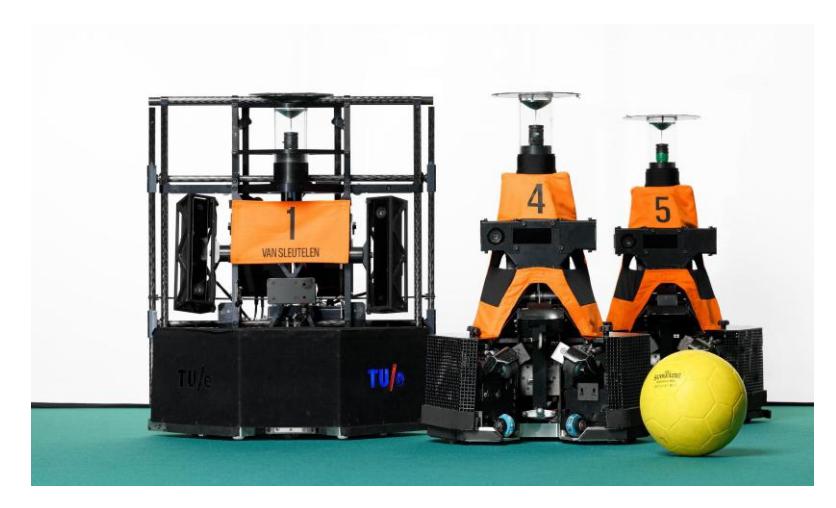
The Tech United soccer robots are called TURTLEs, which is an acronym for Tech United Robocup Team: Limited Edition. Their development started in 2005, and through years of experience and numerous improvements they have evolved into the fifth generation TURTLE, shown in Fig. 1.
The software controlling the robots consists of four modules: Vision, Worldmodel, Strategy, and Motion. These modules communicate with each other through a real-time database (RtDB) designed by the CAMBADA team [2]. The Vision module processes the vision sensors data, such as omni-vision images, to obtain the locations of the ball, opponents, and the robot itself. This position information is fed into the Worldmodel. Here, the vision data from all the team members is combined into a unified representation of the world. The Strategy module makes decisions based on the generated Worldmodel using the Strategy, Tactics and Plays (STP) framework [4]. Finally, the Motion module translates the instructions from Strategy into low-level control commands for the TURTLE's actuators.
3 Mini Cheetah
Currently, the matches in the MSL are taking place between wheeled robots, all having a separate system to handle the ball and shoot the ball. Nevertheless, humans are able to move towards and around the ball and handle/kick the ball all with their legs. This poses additional challenges, such as balancing while kicking the ball and being able to catch a fall. With bipedal robots, used in the humanoid leagues, this has shown to be one of the major challenges.
By using quadrupedal robots, we hope to find a stage in between wheeled and bipedal robots. This shift entails numerous adjustments in ball handling techniques such as shooting, dribbling, passing, and goalkeeping. For this purpose, we acquired two MIT Mini Cheetah robots [3], a small lightweight quadruped engineered for highly dynamical manoeuvres, for experimenting with developing new soccer skills. While strategic concepts can be transferred across different types of robots, the execution of skills could vary significantly. Legged robots, for instance, require a different skill set to maintain ball control. Therefore, even if the game strategies are still applicable, the skills must either be redeveloped or reprogrammed. The main challenge in integrating legged robots into soccer is mastering these new skills.
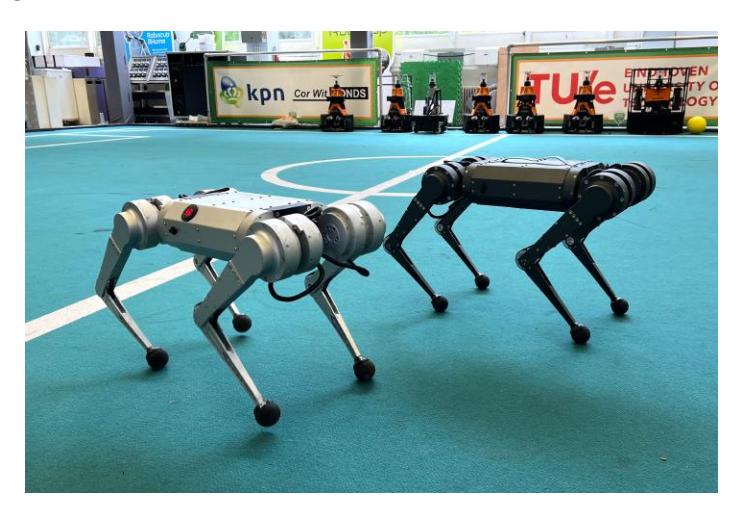
The primary emphasis is on mastering dribbling, shooting, and goalkeeping, as they encompass the Dribbling, shooting, and goalkeeping are the essential skills needed to play the game, and the primary emphasis is on achieving mastery in them. To move around the field, avoid the opponents, and score goals, one needs to control the ball with the feet and keep it close to the body. Shooting is the act of kicking the ball to the goal with precision and force. Goalkeeping is blocking the other team's shots with the feet and body.
3.1 Dribbling
We employ a model-based approach to dribble with a ball, by combining Model Predictive Control (MPC) together with Whole-Body Impulse Control (WBIC) for locomotion controller. This approach incorporates swing leg trajectory planning that considers the timing of when the swing leg of the Mini Cheetah should make contact with the ball, ensuring it imparts the desired post-impact momentum and achieves the expected foot velocity upon contact. The dribbling strategy uses the ball's position relative to the robot, and minimises the error between the reference path and the actual trajectory of the ball over a finite horizon, resulting in following a desired path.
3.2 Shooting
The shooting algorithm focuses on exploring the potential of Generative Adversarial Imitation Learning (GAIL) architectures, particularly those utilising Generative Adversarial Networks (GANs), to develop a versatile control framework that efficiently learns agile skills for robots. This approach uses the demonstration data formatted as the temporal-spatial-coordinates, meaning each key point is represented by three-dimensional coordinates tracked over time, combined with a dataset for a soccer-shooting quadruped utilising partial demonstration data as a reference.
3.3 Goalkeeping
Designing the quadruped-goalkeeper will involve locomotion control, trajectory generation, state estimation, and strategy development. The idea of the hierarchical structure of the control policy is that the planner is mainly used for the 'thinking' while the multi-skill controller is used for the 'doing'. Therefore, the planner policy receives the current location and orientation of the goalkeeper, and decides the best action to take. For example, the multi-skill control policy consists of a set of four distinct control policies for four separate skills: sidestepping, diving, jumping, and walking. These skills enable the quadruped-goalkeeper to perform full-body translational movements across the field and intercept the ball.
4 Less reactive robots via high-level plays
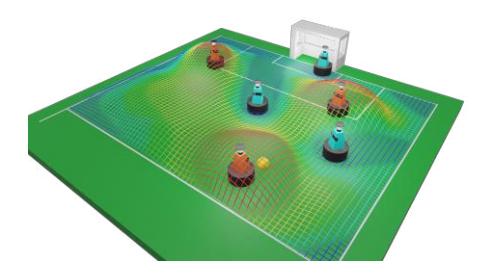
Currently the turtles reacts to the opponents via potential fields, where a grid map is designed on which cost functions $f_i$ are applied which are related to physical properties as, e.g., "distance to goal" and "occluded areas behind opponents from ballholder perspective". An example is visualized in Fig. 3 where the red colored grid points are good values and the blue colored grid points bad values. The grid points x are scored according to the function $U = \sum_{i=1}^k w_i \cdot f_i(x)$ where $w_i$ is a tuneable weight value and k an integer value representing the number of cost functions.
Currently the main components to adjust behavior is either to adjust the number of cost functions $f_i$ or their corresponding weight values $w_i$. In case the number of cost functions grows, it becomes more difficult to manage the behavior of the robot. Thus, research was done in reducing the number of cost functions for the grid point evaluation function U. But the problem persists that the potential field approach does not allow us to instruct specific motion sequences, as the turtles each search for their own optimal grid point x according to U. And therefore the current turtles can only react to the opponents, but can not be proactive via a high-level play involving motion sequences. And being capable of following high-level plays is necessary with our desire to play against humans, as the highest level of human soccer do adhere to some high-level play(s). An additional benefit is the increased capability of changing the turtles behavior (in-between games). And the relevance of high-level plays is also observable in the simulation league.
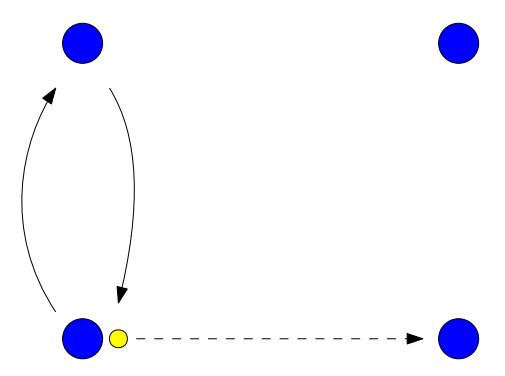
Current research is thus focused on implementing some form of high-level play into the soccer robots, allowing the robots to become more proactive. The STP framework [4] on the turtles facilitates the incorporation of those highlevel plays. An implemented example is visualized in Fig. 4 where we actively instruct the bottom-left robot to pass the yellow ball to the bottom-right robot and afterwards change positions with the top-left robot. It is not straightforward to instruct such a high-level play by solely using the potential field approach as in Fig. 3.
5 Goalpost Detection for Robot Localization
In order to solve the localization problem, the TURTLEs currently rely on the field border white lines detection. This provides a respectable localization accuracy of +/- 1 cm in position and +/- 1 degree in orientation. However, in the absence of such lines on the field, the robots risk becoming inoperative. To overcome this drawback, we have designed an object-detection based localization system.
The game of soccer is centred around the goalposts and is not possible without them. You want to score a goal into opposite goalposts and defend yours. Additionally, the goalposts are static objects on a field, which makes them a great candidate for a localization landmark instead of field lines.
The workflow of the system can be delineated into two phases: offline and online. The offline phase is needed to run specific system components on Hailo chip (a special integrated circuit by Hailo AI company designed to process neural networks). The phase is divided into the following steps:
- Data Collection. In our case the raw data were images of the goalpost from several angles. These are the 2D images of RGB format.
- Data Annotation. These images were later processed so the objects of interest on them were marked with bounding boxes.
- Model Training. For the object detection we have used YOLO v7 model
- HEF (Hailo Executable Format) Model Building. This step is necessary to compile the model so that it is inferable on Hailo chip.
Another part of the solution involves the online phase, essential for fulfilling the system's primary objective of estimating the robot's pose. It is divided into two subsystems: Detection subsystem and pose estimation sub-system. This encompasses the following steps:
- Input Acquisition. The initial step involves the acquisition of raw image data from the camera source.
- Rescaling to Standard Size. Consistency in data dimensions is imperative for efficient neural network processing.
- Neural Network Inference. The neural network inference step entails executing the YOLOv7 model on the specialized hardware. This phase leverages the computational capabilities of the chip to process input data and generate predictions.
- Bounding Box Extraction. Following the neural network inference, the system extracts bounding boxes from the model's output.
- Bounding Box Filtering. To enhance the precision of object detection, a filtering mechanism is employed to discern a true positive detection from potential false positives. The filtering is based on a bounding box position and aspect ratio its width and height.
- Horizontal lines finding. With the filtered bounding boxes identified, the system proceeds to crop the input image to isolate the region of interest (ROI) corresponding to each detected goalpost object bounding box. This ROI image is further processed to find edges. The Hough lines transform [1] is further used to find the horizontal lines in each image. More specifically, the crossbar is found at each detection. Basing on the horizontal lines inclination, the finder decides if the robot's camera is positioned to the left of the goalpost or to the right of it.
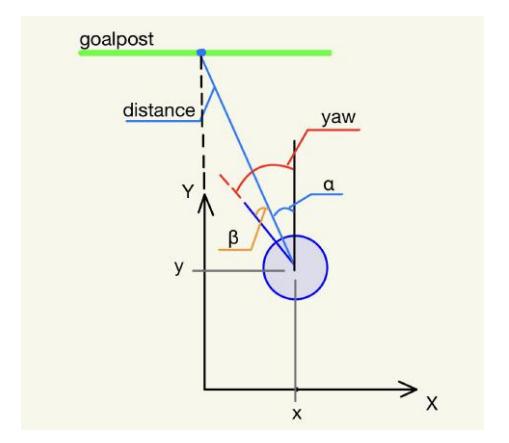
- Distance Estimation. This component is responsible for estimating the distance between the goalpost and the robot. Figure 5 shows the estimated distance and further described angles.
- Yaw Angle Estimation. The yaw angle estimation module provides an estimation of the robot's orientation (yaw angle) within the scene.
- Beta Angle Estimation. This is the angle between the robot's camera axis and the goalpost center. It is essential to know it for accurate estimation of the alpha angle
- Alpha angle Estimation. Alpha is the angle between the normal to the goalpost plane and the distance axis of the robot.
- X-Coordinate and Y-Coordinate Estimation. These two blocks are responsible for estimating robot's X and Y position on the soccer field basing on the found distance and alpha angle values.
Basing on comparison with ground truth data, the designed system provided next results. The position estimation accuracy was 1.39 meters for X coordinate and 0.85 meters for Y coordinate. The estimation of orientation is implemented with 24.75 degrees accuracy. This approach may be improved by applying different filtering techniques. However we can conclude that a properly trained Pose Estimation network is likely to perform better. Because geometry analysis still sticks to pre-defined objects (goalposts), it makes the system less environmentindependent. In the meantime, the environment independence is a long-term goal for this system.
6 Conclusion
In summary, the major scientific and technological developments of the Tech United soccer robots over the past year have been outlined. The integration of quadrupeds enables the robots to navigate more rugged and uneven terrain. While the strategic framework remains applicable, focusing on honing the fundamental skills, such as dribbling, kicking, and goalkeeping, is necessary for playing in competitive matches. This development aligns with the long-term objective set for 2050, marking a step towards legged robots.
Furthermore, a more adaptable strategy design was discussed, incorporating fixed plays to simplify the implementation of new tactics. This approach reduces redundancy and reactivity compared to the current utilization of potential fields, enhancing the overall strategy's configurability.
Lastly, the utilization of AI vision for robot localization was introduced, showcasing the capability to localize based on goalposts instead of the existing method of using field lines. This adaptation parallels human localization techniques in soccer, rendering the system less reliant on specific environmental cues.
These advancements contribute to an even higher level of dynamic and scientifically advanced soccer matches for future RoboCup competitions.
References
- Opencv: Hough line transform.", https://docs.opencv.org/3.4/d9/db0/tutorial_hough_lines.html, accessed on 2023-11-21
- Almeida, L., Santos, F., Facchinetti, T., Pedreiras, P., Silva, V., Lopes, L.S.: Coordinating distributed autonomous agents with a real-time database: The CAMBADA project. In: Computer and Information Sciences - ISCIS 2004. pp. 876–886. Springer Berlin Heidelberg, Berlin, Heidelberg (2004)
- B. Katz, J.D.C., Kim, S.: Mini cheetah: A platform for pushing the limits of dynamic quadruped control. 2019 International Conference on Robotics and Automation (ICRA) p. 6295–6301 (2019)
- de Koning, L., Mendoza, J.P., Veloso, M., van de Molengraft, R.: Skills, Tactics and Plays for distributed multi-robot control in adversarial environments. In: RoboCup 2017: Robot World Cup XXI. pp. 277–289. Springer International Publishing, Cham (2018)