AUA 2D Soccer Simulation Team Description Paper
Jinyang Zhou, Ende Zhu, Runmei Zhang
Lab. of Robot Innovation, Department of Electronics and Information Engineering, Anhui University of Architecture, Hefei, Anhui Province, China
Abstract This paper briefly describes our new techniques both in high level and low level, which we apply to AUA2D 2010. We put forward a new approach based on Back Propagation Algorithm to do research on Multi Agent System. Many improvements and innovations have been made on AUA2009, both in low level and high level strategies.
1 Introduction
The AUA RoboCup Team was established in 2003, starting with only the 2D soccer simulation team. In the following years, the 3D soccer simulation team, MSRS team and Rescue simulation team have joined the AUA. We participated actively in RoboCup China Open since 2003 with not bad results.AUA 2D took the 7th place in RoboCup China Open 2008.
This year, we have developed a new team structure based on BP algorithm. This paper briefly describes our new techniques both in high level and low level, which we apply to AUA2D 2010.
2 Back Propagation Algorithm
People have proposed a variety of learning algorithms since 1940s.Among them, BP algorithm is the most widely used, which is mainly proposed by Rumelhart. Even today, BP algorithm is still the most important and effective algorithm in automation.
BP algorithm is a generalization of the LMS algorithm to learn the weights of network of hierarchical structure.LMS algorithm is proposed by D.E.Rumelhart by simplifying the method of steepest descent, which is one of the optimization methods. This method allows adaptive signal processing techniques to have a rapid development.
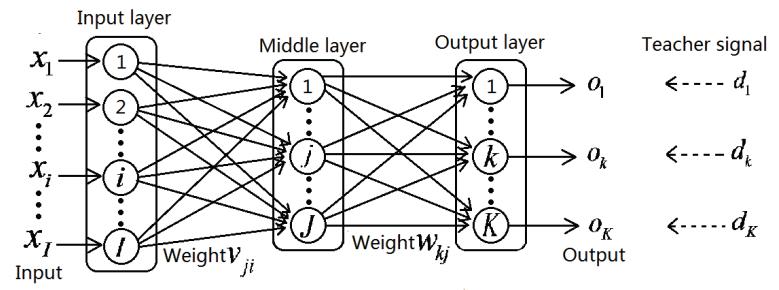
LMS algorithm not only have a small amount of calculation, but also have lots of other advantages. BP algorithm can apply to the hierarchical neural network, which is shown as Figure 1,and there is no connection among neurons.
The step of BP algorithm can be described as follows:
Step1:The input signals act on the output node through lnter-node, producing output signals through the non-linear transform. The samples of network training include input vector and expected output.
Step2:If there exist deviation between output of network and expected output, then the deviation will be propagated back to layers.
Step3:Adjust the connection strength between the input nodes and hidden layer nodes. The intensity between the hidden layer nodes and output nodes will be adjusted at the same time to make the deviation de-crease along the gradient direction.
Step4:The minimum deviation that corresponds to the network weights will be decided after learning and training many times.
In the process of practical application, the well trained network that is able to process the input information of similar samples, and output in-formation. Each agent will receive a large number of visual and auditory information from the Sever, and make corresponding pass decision based on it. This information includes:
- (1)Agent's own information: agentpositionX, agentpositionY, agentspeed, agentBodyangle, agentNeckangle.
- (2)Ball's information: ballpositionX, ballpositionY, ballDirection.
3 AUA2D's new skills
The low level action is the player's basic perceptions and abilities, such as search ball, get own position, adjust own status and so on.
3.1 Search Ball
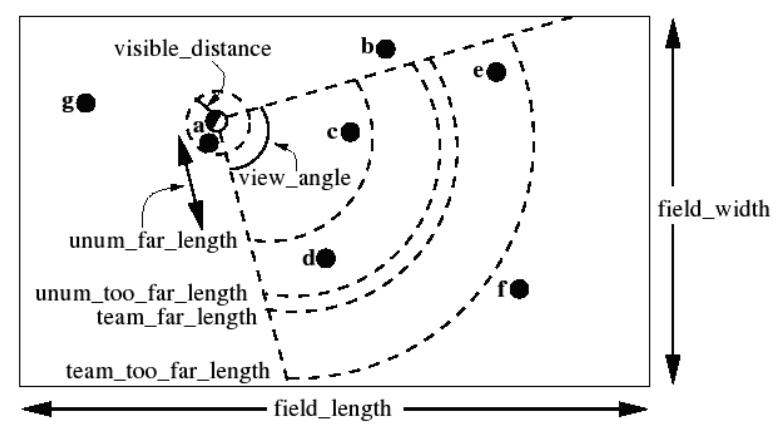
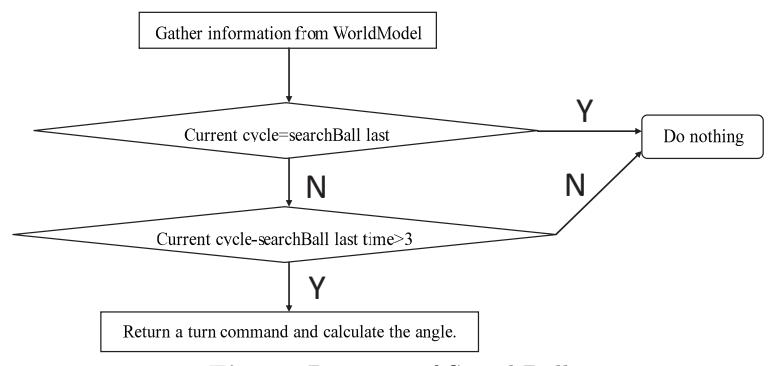
This method let the player try to search the ball when he can not see the ball. and return a turn command. The player will turn a angle equivalent to the angle of he's current visual cone range. So that the player will get a new visual range in a absolutely different direction, and increase the possibility of seeing the ball in the next cycle. The player's visual range(visible range) is shown as Figure 2.
The visual range is composed of visual angle(visible angle) and visual distance(visible distance).The results of the application of searchBall are not only increase the possibility of seeing the ball, but also players, including own and opponent.
Figure 3 shows the diagram of searchBall.
3.2 Dash to Point
This method generate a movement toward a given position. It receives a positional parameter and returns an action command, so players can be as close to given points. The step of this method can be described as fol-lows:
Step1:Get the speed of running by the method of getPowerForDash in World-Model.
Step2:Assign to the SoccerCommand class to generate the action.
3.3 Intercept
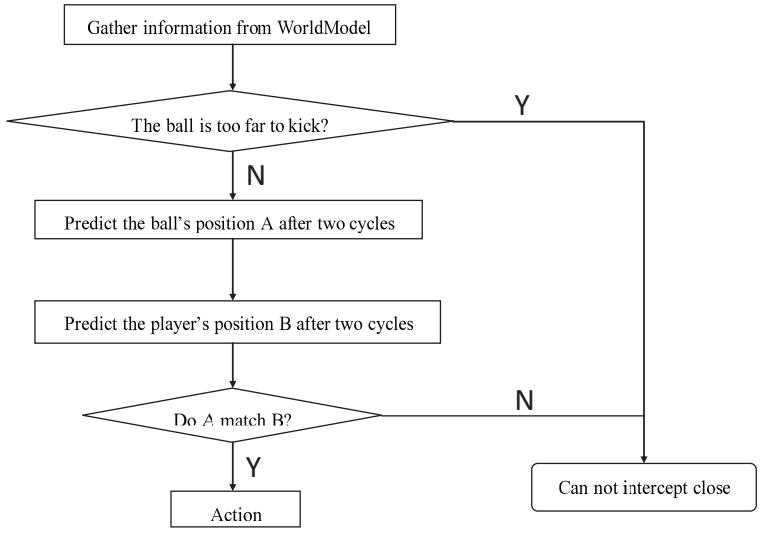
This method allows the player to intercept the ball close to himself. The goal of this method is to find a combination,so the player can move the range to kick the ball in two cycles. In order to achieve this goal, call the prediction method in WorldModel to predict the ball's position in the next one or two cycles. Then determine if there exist at least one logic combination of turn and dash method allow players to move to the goal place. Figure 5 shows the diagram of interceptClose.
4 Conclusion and Future Works
As is shown above, we quickly addressed some improvements in our new soccer simulation team,AUA2010.For future work, we will still working on BP algorithm to improve more aspects of our team. We will further optimize this algorithm and our skills both in low level and high level. We are trying to extend our ideas to solve known issues and apply our ap-proach to more complicated problems.
References
- Longshu LI,Ruifeng GE,Huiping WANG.Application of Batch Reinforcement Learning Based on NN to Robocup.Computer Technology and Development.Vol.19(7).Jul,2009.
- Runmei ZHANG,Hongliang YAO.Separators Introduced BK Inference Algorithm and its Application in RoboCup.Computer Science.Vol.36(6).June,2009.
- Zhulin AN,Jingjing YU,Hao WANG.RoboCup Simulation League Goalie Design.st Proceedings of 1 Austria Open of RoboCup.2003.
- Xiaoping Chen,et al,Challenges in Research on Autonomous Robots, Communications of CCF,Vol.3,No.12,Dec,2007.
- Gang WANG,Mubin CHEN,Fuhong LIANG,Shumei ZHENG.A Study of the Passing Strategy on the RoboCup Simulation Game.Computer Engineering and Science.Vol.29(10).Oct,2007.
- Satje A.Reintbmement Learning of Player Agents in RoboCupSoccer Simulation[A].Proc of the 4th Int'I Conf on Hybrid Intelligent Sys-tem[C].2004.
- Stone P, Sutton R. Scaling reirforcement learning toward RoboCup soccer[C]**Pro.of the 18th International Corf on Machine Learn-ing .Berkshires, Massachusers:ACM,2001.