Apollo2D 2011 Team Description Paper
Chuanfei Zhang, Haizhong Qian, Zhongbao Jin, Zhihan Li, Zhiyong Zhang
Department of Automatization Science, Nanjing University of Posts and Telecommunications, Nanjing, 210003, P.R.China
Abstract This paper describes the main features of the Apollo soccer simulation team. Apollo2D won the RoboCup China Open 2004 Simulation league champion in Guangzhou and first prize award in RoboCup China Open 2007 and RoboCup China Open 2008 2D Simulation League and 2nd place in IranOpen 2010. In this paper, we briefly present our current research effort and some newly introduced techniques of improvement, since the last competition.
1. Introduction
Apollo is a robot soccer team of 2D Simulation League. It comes from Nanjing University of Posts and Telecommunications. We have been participating in RoboCup since 2004. Although Apollo2D has achieved good results in its previous matches, there are many deficiencies and shortcomings.
Due to the dated program code, it has been amended for many years. Although these two years we have made a lot of improvement in this program, we did not obtain very good effect. Due to several defects such as the imprecision of location; too little information interaction between the players and so on, the upper level decision cannot be support very well. So in RoboCup 2010 we drop to 13th place. In view of such situation, we solved several problems and rewrite all the code of Apollo2D. Compared to Apollo2D2010, Apollo2D2011 has made great progress.
In this paper, we present a brief description of location in the WorldModel and the dribble skill.
2. Location
2.1 Raise the issue
In the SoccerServer, in order to introduce noise in the visual sensor data noise, the value sent from the server is quantized. For example, the distance value of the object, in the case where the object in sight is a ball or a player , is quantized in the following manner:
$$d_0 = \text{Quantize}(\exp(\text{Quantize}(\log(d), \text{quantize_step})), 0.1)$$ (2.1.1)
Where d and are the exact distance and quantized distance respectively, and 0 d
Quantize(V,Q) = $$\text{rint}(V/Q) \times Q$$ (2.1.2)
In terms of flags and lines, the distance value is quantized in the following manner:
$$d_0 = \text{Quantize}(\exp(\text{Quantize}(\log(d), \text{quantize_step_l})), 0.1)$$ (2.1.3)
wherequanti and is constant in SoccerServer, , . ze_step quantize_step_ l quantize_step 0.1 = quantize_step_ l 0.01 =
This means that players can not know the exact position of a very far object. For the adjusting formation and players' movement, also the player's execution of the upper strategy, how to get the exact position information is of great significance.
2.2 Figure out
We through studying the quantitative formula establish the mathematical model. We propose a method for getting exact position-----"Half—Reverse—Infer".
To introduce the method of locating the dynamic objects with formula (2.1.1), Quantitative formula is made up of logarithmic function, index function and integer function. In the game we only get the quantized data. According to quantitative formula figure 2.2.1 is made. The corresponding mapping graphics with logarithmic function, index function and integer function are as shown in figure 2.2.1.
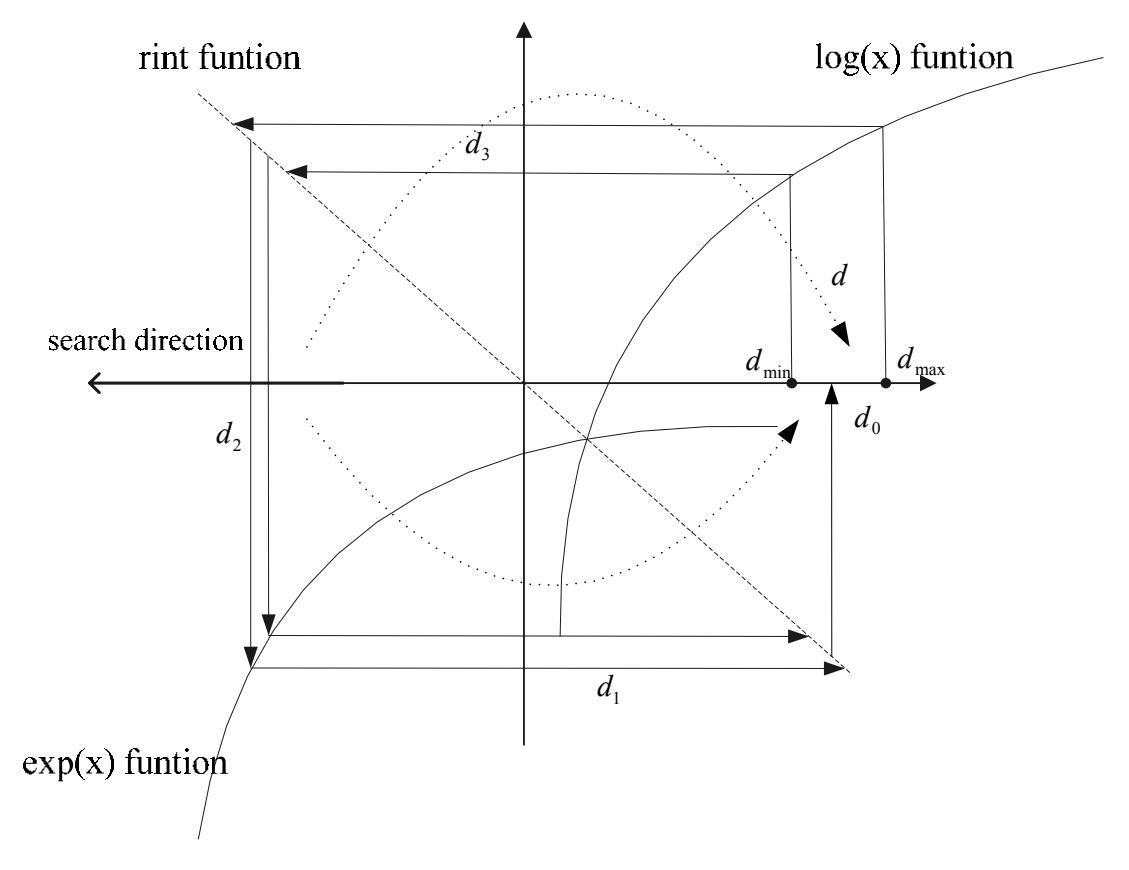
Table 2.2.1 The corresponding relationship between d0 and d
| d0 | min d | max d | mid d | ±Δδ |
|---|---|---|---|---|
| 0.0 | 0.0 | 0.0523 | 0.0262 | 0.0262 |
| 0.1 | 0.0523 | 0.1572 | 0.1048 | 0.0525 |
| 0.2 | 0.1572 | 0.2592 | 0.2082 | 0.0510 |
| 0.3 | 0.2592 | 0.3499 | 0.3045 | 0.0454 |
| 0.4 | 0.3499 | 0.4724 | 0.4112 | 0.0613 |
| 0.5 | 0.4724 | 0.5769 | 0.5246 | 0.0522 |
| M | M | M | M | M |
| 5.0 | 4.7115 | 5.2070 | 4.9592 | 0.2478 |
| 5.5 | 5.2070 | 5.7546 | 5.4808 | 0.2738 |
| 6.0 | 5.7546 | 6.3598 | 6.0572 | 0.3026 |
| 6.7 | 6.3598 | 7.0287 | 6.6943 | 0.3344 |
| M | M | M | M | M |
| 134.3 | 127.7404 | 141.1750 | 134.4577 | 6.7173 |
| 148.4 | 141.1750 | 156.0225 | 148.5987 | 7.4238 |
From the table, we can conclude that: exact distance is continuously, but the quantitative distance is a discrete point, and the quantization noise is bigger as exact distance value bigger, error value also becomes bigger. Apollo2D make some processing on the data, and then apply to the actual games, make our location in the world model is more exact than before, the same as, the upper decision is more reasonable.
3. Dribble
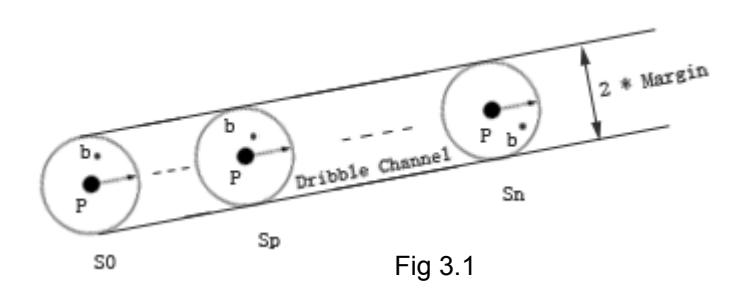
In figure 3.1, we defined a Dribble Channel. It is in fact an open area constructed with two rays and a semicircle. The solid disk represents the body of Player P and the bigger circle shows the control area of P. The location of ball is marked with b. The vertical distance of two rays is twice the length of Margin, which is defined as:
Margin=kickable_margin+player_size+ball_size
Since the movement of the objects is discrete in every single cycle, a successful process of dribble can be described as: from the beginning status S0 to ending status Sn , the ball b always stays in this Dribble Channel and Player P always stays closer to the ball b than any other opponent.
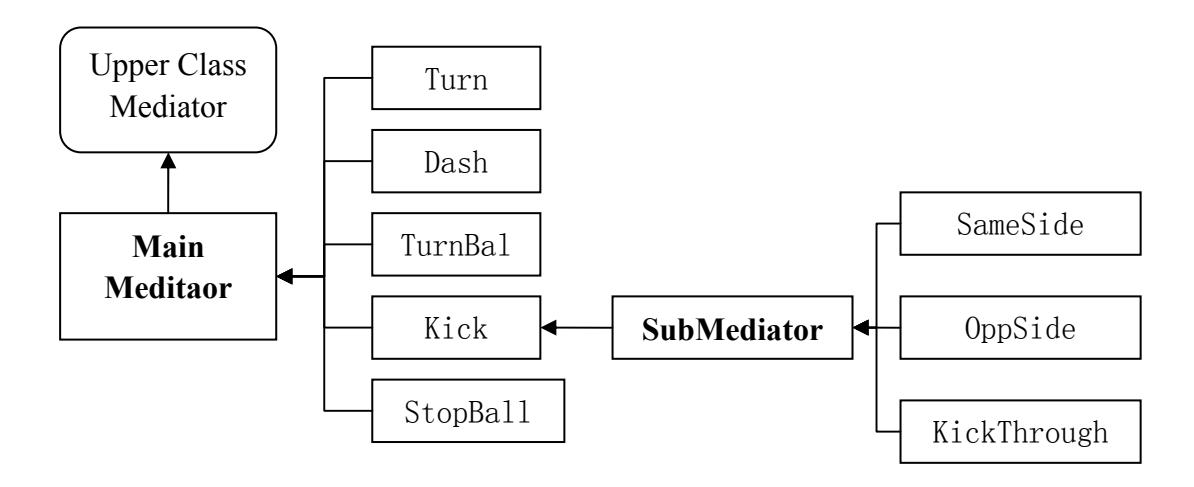
Dribble Actions
| Action Type | Effect of the action |
|---|---|
| StopBall | Stop the ball |
| Turn | Adjust the player's body to the proper direction |
| Dash | Dash for a cycle |
| TurnBall | Turn the ball to certain position |
| SameSide | At the end of the dribble process the ball is located on the same side as the current position |
| OppSide | At the end of the dribble process the ball is located on the opposite side as the current position |
| KickThrough | Kick the ball through two opponents |
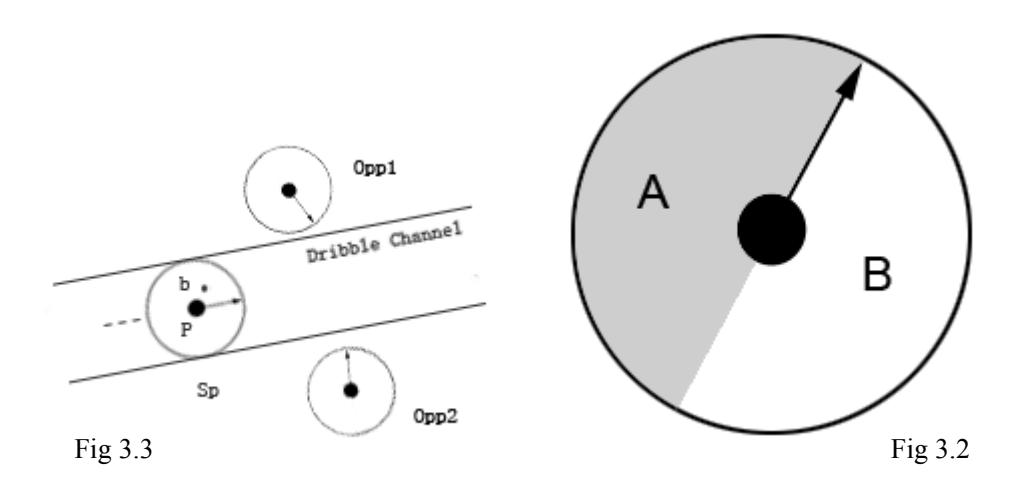
As is shown in Fig 3.2, we divide the field that one player can control the ball into two sections, A and B, based on the facing direction of the player. If the ball is located in the same section, then the dribble action is defined as SameSide. Otherwise, it is defined as OppSide.
Also in Fig 3.3, there's such a occasion usually occurs that it is unwise to choose either SameSide or OppSide. In this occasion, it is better to kick the ball through two opponents rapidly to get rid of them and we define this action as KickThrough.
4. Conclusion and Future Work
In this paper, we introduced the Apollo2D 2011 simply and exhibit our work. Because some improvement of the program is put forward comparatively late, and the rate of improvements are subject to the development team, we don't test effect of the latest changes by the numbers.
For future directions, we are interested in formation, the role of player and coach, and how to improve agents act intelligently.
References
- Mao C., Klaus D., Ehsan F., Fredrik H., ZhanXiang H., Spiros K., Kostas K., Johan K., Jan M., Itsuki N., Oliver O., Pat R., Timo S., Yi W. and Xiang Y.: RoboCup Soccer Server for Soccer Server Version 7.07 and later(2003)
- Ma,J.:Distributed Intelligent Decision and Optimized Learing in RoboCup Simulation. Bachelor Degree Thesis. Nanjing University of Posts and Telecommunications. First prize awarded in Jiansu thesis competition, China (2006)
- JianFeng C.:Multi-Agent System and 2D simulated autonomous robotic soccer team. Master Degree Thesis. Nanjing University of Posts and Telecommunications.(2009)
- Zhongbao J.: RoboCup2D simulated soccer team and Multi-Agent cooperation. Master Degree Thesis. Nanjing University of Posts and Telecommunications.(2011)