RoboCup 2013 - 2D Soccer Simulation League Team Description Ri-one (Japan)
Yosuke Tamura, Nobuhiro Nakamura, Shun Kittaka, Higashi Toshiki, Takuya Takahashi, shoota Shiraishi, Reina Wada, Mari Hikichi
Ritsumeikan University, Japan
Abstract This paper describes the characteristics of Ri-one, the agents for RoboCup 2D soccer simulation, and improvements from last year's competition. In 1993, RoboCup was proposed by Japanese scientists to advance technology of robotics and artificial intelligence. [1] We are participating in RoboCup 2D soccer simulation, which is the oldest league of RoboCup. This league uses teams that are composed of eleven agents made of artificial intelligence program on a virtual field inside a computer. [2] In this paper, we logged past games and analyzed with cluster analysis. Then, we try to consider optimal action from result of this cluster analysis.
1 Introduction
Ri-one is a student organization which is organized in 2004 in the Information Science and Engineering at University of Ritsumeikan. [3] We are learning algorithm and design of software through team development. Our organization participates in 2D soccer simulation league and RoboCup simulation league. Our team has been developing based on UvA Trilearn 2003 Base (Trilearn) since our team has organized. We changed our base code from Trilearn to Agent2D last year in order to implement a new idea. In this year, we decided to use Trilearn again. We create new concept and implement original algorithm and implement original algorithm by making use of Gravity Field which was implemented in 2008. This paper is structured with the following sections.
- Introduction
- Efficient intercepting
- Action clustering
- Experiment
- Summary and conclusions
2 Efficient intercepting
From many log files, the team which wins the match has a lot of actions to influence the score. To increase the number of the action to influence the score, an effort for improvement of intercepting the ball from an opponent effectively, namely acquisition rate of the ball is necessary. Therefore, this study aim increasing the acquisition rate of the ball in order to strengthen the team by actuating agent. In this section introduces Action Clustering and Gravity Field Method for taking acquisition rate of the ball.
2.1 Action clustering
When an agent does not hold on the ball, we focus on how the agent can get the ball so that a rate of getting a ball is increased. This proposal technique uses the clustering to accomplish a purpose. Thereby it is optimized that the decision-making of agents in some situation from past action. To cluster, we record the action of the agent and the information of current position in a log. This time, the action pattern we used is as follows:
- False Tackle
- True Tackle
- Intercept
- Fast Move
- Normal Move
- Slow Move
- Rest
We count about situation each agent does not hold on the ball. Under the situation that the agent cannot control the ball directly, necessary action is restricted the tackle and the intercept. In addition, actions except above patterns (shoot, dribble, and so on) does not count in this clustering, because these actions are taken only under state of holding ball.
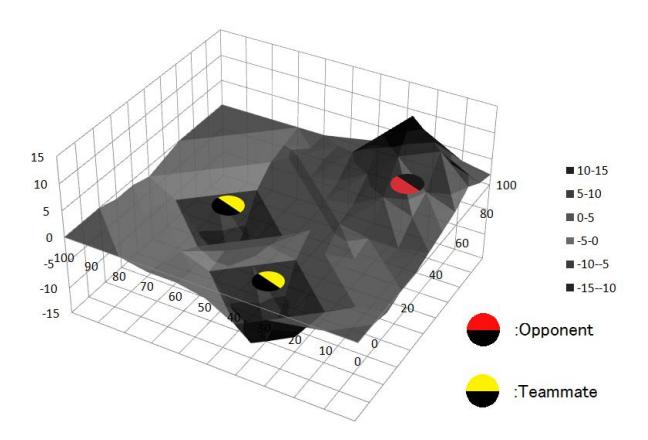
Gravity Field Method In addition to existing WorldModel, we introduced a concept on the world named PowerField(PF). [4] PF is a evaluation function which takes a point of soccer field, and is generated using the 6-elements (Each agent's position, Direction of body, Speed and Last cycle of each agent was confirmed, Distance from the goal of the enemy, Distance from the border at field).
K-means K-means method is one of the clustering techniques. This method does classifying using K(s) centers of gravity given beforehand. [5] These are the virtual vectors which become the average of the cluster. Each vector is classified in the closest center in these. This method classify the action in the past situation K(s). The vector of this method is composed by two factors (variation of the evaluation value of the ball from the last cycle, variation of the evaluation value of the agent from the last cycle). In addition, information about the action taken in corresponding cycle is also assigned to a vector. Nevertheless, the additional information is not take into account during K-means clustering. We set the distance of two vectors is the euclidean distance of them.
Agent decides the action using past and current two-dimensional vector. For example, when K = 3, G1, G2, G3 clusters occur, S is two-dimensional vector of situation to judge the current cycle. Deciding the action process of agent is following.
- Calculating the distance of S and three center of gravity of each cluster g1, g2, g3.
- Determining which the closest cluster S belongs to.
- In the closest cluster, reproducing a action pattern belonging to the biggest value in the equilateral direction of the X and Y-axis.
This method is particularly effective at the intercept, for the situation at the intercept is often a resemblance, it is easy to classify. On other hands, the situation of the intercept succeed and failed tend to be similar too. Therefore, reproducing the situation of the intercept succeed only, it is more likely to improve the success rate of the intercept.
3 Experiment
We conducted an experiment to examine usefulness of the action clustering to decide action to be taken.
3.1 Setting
We have experimented with the following process.
- Obtain the position of the ball and the agent's current position using PF.
- The data acquired for every agent is outputted to a file.
- Get the game data n times.
- Integrate each data.
- Divide acquired points into clusters using K-means method.
- Information on the requested cluster is used for the decision making.
These processes take place more than once, decision-making is optimized.
3.2 Result
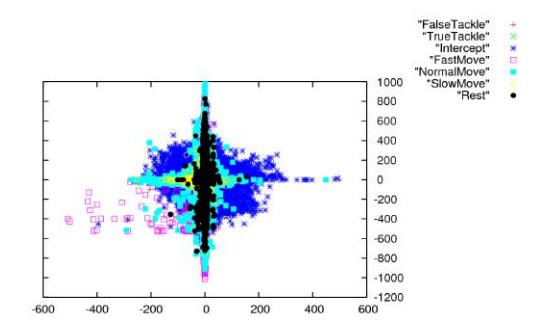
We performed several matches with agent2d to obtain two-dimensional vectors. Fig. 2. shows mapping of obtained vectors.
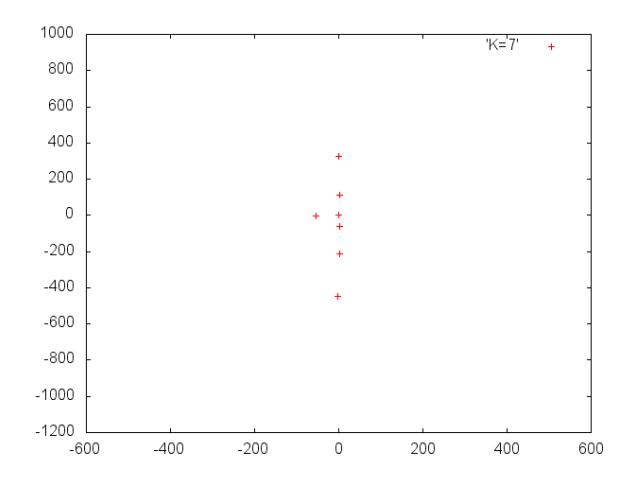
Cycle and the Y-axis indicates the ball's PF value difference from the previous cycle. We could find concentration of vectors in the center of Fig. 2. It shows that there is slight difference in PF value from last cycle. The difference of initial distribution could cause large difference in clustering results. Therefore, we calculated average of result values in this experiment. The result appears in Fig.3.
Fig. 3 shows centers of each cluster in Fig. 2. The number of the action pattern equals the number of cluster (K = 7). During the games, an agent identifies the nearest center based upon the situation. An agent chooses action assigned to the center preferentially.
The average number of successful interception trial of both before and after introducing the proposal method
| Uniform number | Before | After | % |
|---|---|---|---|
| 2 | 14.050 | 15.254 | 8.6 |
| 3 | 19.264 | 20.546 | 6.7 |
| 4 | 18.748 | 20.022 | 6.8 |
| 5 | 15.346 | 17.840 | 16.3 |
| 6 | 23.792 | 25.862 | 8.7 |
| 7 | 25.400 | 27.570 | 8.5 |
| 8 | 16.616 | 17.548 | 5.6 |
| 9 | 7.902 | 8.740 | 10.6 |
| 10 | 4.982 | 5.478 | 10.0 |
| 11 | 6.482 | 6.538 | 0.9 |
4 Conclusion
In this paper, we proposed a method which would increase number of successful trials to obtain ball by making an attempt to intercept using clustering. Power Field evaluates situations of the ball and the agents. Then, the situations are classified by K-means method. The results from the classification can be used to decide action in next cycle. The result of the experiment revealed that the proposal method contributes to making better judgement of action to be performed.
References
- Minoru, A.: A brief history of robot world cup http://www.sonycsl.co.jp/person/kitano/ RoboCup/RoboCup-old.html#ROBOCUP97.
- The RoboCup Japanese National Committee: About robocup soccer http://www.robocup.or. jp/soccer.html.
- Kazuma Okada, Shun Kittaka, Takuya Takahashi, Yosuke Tamura, Nobuhiro Nakamura, Toshiki Higashi: Robocupsoccer 2012-2dsoccer simulation league-team description ri-one (japan). Ritsumeikan University Japan (2012)
- Tatsuro Bito, Y.N., Kamei, K.: Ri-one 2008 team description. Ritsumeikan University Japan (2008)
- Segaran, T.: Programming collective intelligence. First edn. O'Reilly (2007)