YuShan2015 Team Description Paper for RoboCup2015
ZeKai-Cheng, ZhaoLong-Ling, GenShen-Zhang, WenWen-Jin, TanQi-Yu, LiQin-Zhu, TingLi-Wang
Department of Computer Science, AnHui University of Technology, MaAnShan, P.R.China
Abstract This paper describes the overall framework of YuShan2015. The focus and recent advancements implemented in the team are Data Mining in logfiles as well as analyzing and recognizing the basic formations. In evaluating strategies and identifying the direction of formations, YuShan2015 has made great progress and improved the team's overall strength significantly.
1 Introduction
YuShan 2D Simulated Soccer Team was established in 2009 and affiliated with the Computer Department of Anhui University of Technology, China. Since established, we have participated in RoboCup three times, RoboCup China Open six times and RoboCup Iran Open twice. Among these, we have achieved the seventh place in RoboCup2012, the third place in RoboCup2013, the second place in RoboCup China Open, the third place in RoboCup Iran Open and the champion in Robot Competition of Anhui Province. We have also got the sixth place in RoboCup2014, the second place in RoboCup China Open and the second place in RoboCup Iran Open.
The development of YuShan2015 is based on the Agent2D-Base in version 3.1.0. (Further information can be accessed via the downloading address from reference[1]).
2 Overall Framework
YuShan2015's development tools are shown as follows: Librcsc, Agent2D, Soccerwindow2 and Fedit2 [2].
YuShan2015 has not only rewritten the Makefile on the basis of the original Agent2D in version 3.1.0, but has renamed YuShan-Base. The new base has proved itself more powerful, for compiling all the source code and rcsc libraries can now be operated at the same time. The past several years have witnessed an extraordinary evolution. YuShan2013 and YuShan2014 had further developed its technological sophistication on YuShan-Base. With the highly increased efficiency of compiling, YuShan was successfully granted permission to participate in the RoboCup2014 directly by AKIYAMA(copyright). YuShan-Base source code was published in RoboCup2014 China Open. As regards YuShan2015's developing processes, we has used partial related material of Helios2008's and Marlik2012's code [3] for reference. For all these, it is thanks to Hidehisa AKIYAMA and all other related open source developers that our team can achieve so much within these years. We tender all of you our deepest thanks here. (Problems/suggestions please mail to [email protected]).
YuShan2015 carries forward the good traditions of the architecture and basic framework of YuShan2014, and the architecture is shown below in section Fig 1-2.
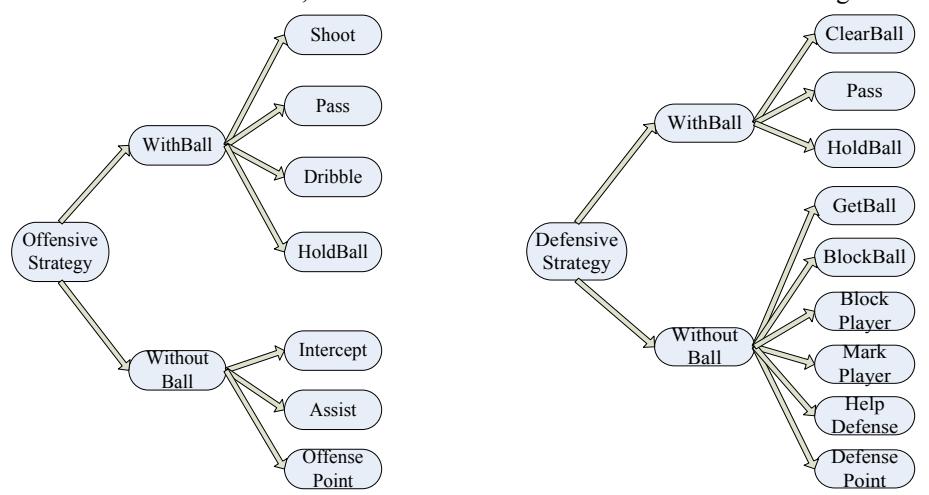
YuShan2015's main work is as follows: Kick model, Block model, Tackle model, learning formations, optimizing object points, etc. We plan our work to be simultaneous with using the data mining technology so as to calculate the length of pass-chains and action-chains much more accurate. The specific tasks are as follows:
3 Kick Optimization Model
YuShan2015's Kick model is on the basis of the Agent2D-Base, which helps to strengthen the fast-kick behavior. YuShan divides the behavior which consists of Shoot, Pass and Dribble into two parts, namely Kick-Turn-Dash and Kick-Dash-Dash, so the key of essential actions is Kick model. There's no doubt that what affects one team's strategy implementation most is whether a good Kick model exists or not. Aimed for improving the quality of the model, Yushan2015 has done the following work:
- Optimize the search algorithm and add turn behavior before kick behavior;
- Increase the sample search space to make the ball kicked out more easily. The search space of original Kick model is only 3535, but now extends to 6060;
- Optimize evaluations to adapt to YuShan2015's new model assessment.
4 Block Model
Selecting a defensive point is a very important decision. YuShan2015 focuses on optimizing the Block model. YuShan2015 depends mainly on the strategies, divides the Block model into Block-Dribble, Block-Pass, Block-Opp and Block-Shoot as well. Block point bases on the position of the ball and the other players dynamically. YuShan2015 uses data mining technology to find interesting patterns from the logfiles of WrightEagle, HELIOS2014 and Gliders2014, and then builds upon these points to find and adjust a suitable Block model that only belongs to our own team. Different regions and players' heterogeneous characteristics should also be taken into account in terms of the defensive point[4].
5 Formation Factors
Both in offensive and defensive strategies, a decision made by the player without ball is very important. His movement generally depends on the home-point, and what generates the home-point is mainly the formation file. The layout of opposing players can be identified more quickly through the formation file. According to it, we will recognize opponents' intensive defence lines and try to avoid crossing the lines when we execute our attacking strategy. Therefore, the formation is one of the most important factors of one team's development. YuShan2015 increases its emphasis on the research about formations, combining with the Agent2D-Base, Gliders2014 and Helios2014. In addition, YuShan is always single-mindedly devoted to finding our own inherent laws so as to formulate a set of suitable strategy formations for YuShan2015.
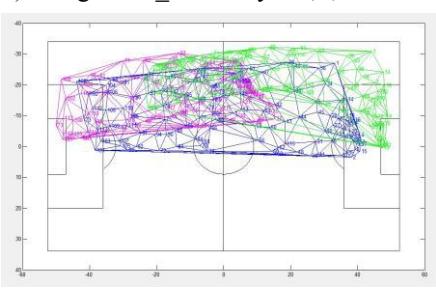
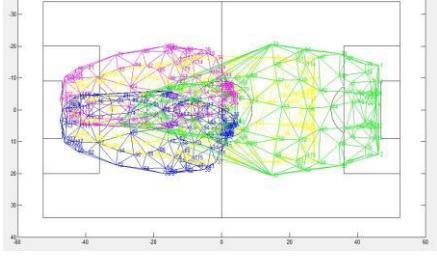
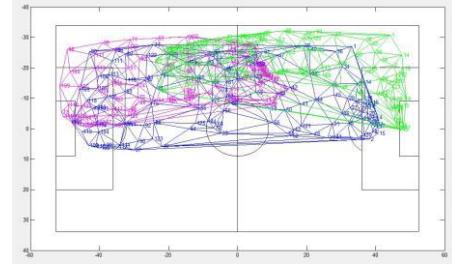
YuShan2015 uses the Matlab and analyzes the defensive formation. As shown in section Fig 3-11 below, Player 2 and 3 play an important role of the CenterBack, Player 4 and 5 are SideBacks, Player 6 is a defensivehalf, Player 7 and 8 are offensivehalves, Player 9 and 10 are SideForwards, Player 11 is a CenterForward.
- Agent2D_base Player 4,7,9 as shown in Fig 3, Player 2,3,6,11 as shown in Fig 4:
- Gliders2014 Player 4,7,9 as shown in Fig 5, Player 2,3,6,11 as shown in Fig 6:
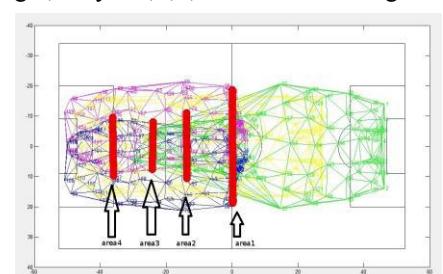
- Helios2014 Player 4,7,9 as shown in Fig 7, Player 2,3,6,11 as shown in Fig 8:
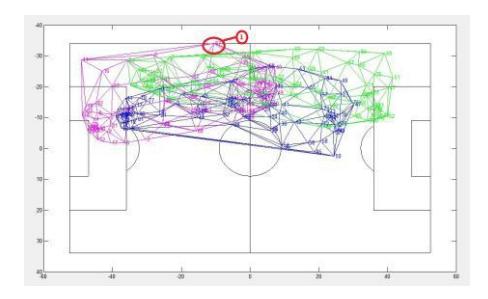
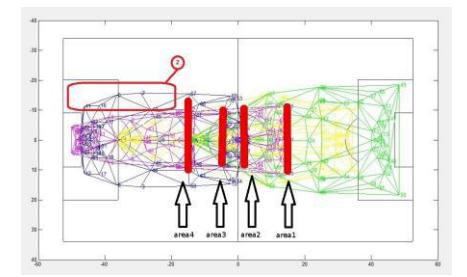
By analyzing the results of data mining from Fig 3-8, we can learn:
- Fig 3,5,7 show that Gliders2014's formation has some advantages relative to other teams. The coverage of Player 7 on the pitch is significantly larger, so is a wider range of defensive.
- Fig 3,5,7 show that the defensive zone in the sidewalks y <-20.0 region, HELIOS2014 and Gliders2014 did well, especially what the Fig 7 (1) has shown, while the Agent2D-Base's defensive vacancy occurred in a large area of this region.
- Fig 4,6,8 show that HELIOS2014 and Gliders2014 adjusted the formation points on the basis of Agent2D-Base. Teams' compact defensive regions can be seen from figures, where they are marked with red spray. The regions are key fortifications to the teams above. In the actual combat could also be seen the defensive intensity in the area that is higher than in other areas significantly. However, the Agent2D-Base's defenders are uniform, and there's no obvious or relative intense defence region.
To sum up, we come to the conclusion:
- A good Delaunay triangulation formation area is distributed more evenly, so you cannot put players in these regions respectively because the fact that a Delaunay triangulation area is too large for a player to run back to the home-point should never be ignored.
- In the course of the wings, formation points should be comprised, because one of the weak points of Agent2D-Base is the opponents dribble to the bottom.
- Should we add a few defence lines in our own half, our players would greatly weaken opponents' ThroughPass and other related attacks.
At the same time, YuShan has analyzed a virtuoso performance between Gliders and HELIOS in RoboCup2014. In the game, one player dribbled to the bottom, passed the ball to the middle through a side-kick, and then combining with a Delaunay triangulation screen shot by Helios's player 4, which helped Gliders score two precious goals. YuShan finds Helios's player 4 is on the sidewalk after x=-50.0 defensive gaps exist obviously, and Helios's player 4 is in the vicinity of the Delaunay triangulation area that is too large (such as in Fig 8 (2) below), eventually leading to a weak defence in this area. Helios's ThroughPass tactic is very aggressive. As everyone knows, in the face of Gliders, the existence of four intensive defence areas above, which makes Helios's ThroughPass tactic fails to wear out the defence of Gliders.
6 Formation Recognition
YuShan2015 tries to learn the formations by using the data mining and introducing the player relationship matrix function. With the combination of matching the formations of template library and analyzing the game logfiles, we're sure to obtain the highest possible accuracy of information about the uses of the formations in each cycle and count formations which team uses most frequently respectively. We analyze the features of different formations from the logfiles in order to arrange our offensive and defensive tactics accordingly[5].
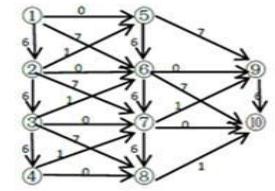
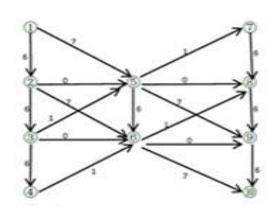
Some of the players' position relationship formation templates are shown in Fig 9. Arrows from 1 to 10 represent the relationship among the degrees of the players. Numbers on the arrows represent different directions. Number 0 represents positive direction. When it meets 45 degrees, it usually adds one in a counter-clockwise direction, so number 4 represents negative direction.
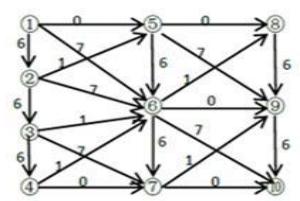
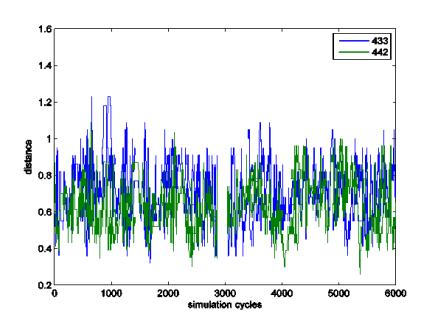
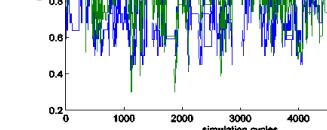
YuShan has analyzed the final logfiles of RoboCup2013. The result of WrightEagle is shown in Fig 10 and HELIOS2013's is shown in Fig 11. We can obviously find that WrightEagle used 4-4-2 formation more than 4-3-3 from Fig 10, and HELIOS2013 used more 4-3-3 formation from Fig 11.
7 Analysis action chain and pass chain
In recent years, YuShan has used data mining technology to develop the team. For YuShan2015, the effective method, mining the data generated from every Rcg and every Rcl which contain a flood of information, has been applied in depth. YuShan uses data mining to analyze pass chains and action chains. Statistically action chains and pass chains are classified into certain types according to length. The actions are generally divided into pass and dribble. Passes are further divided into short-pass, middle-pass and long-pass, and dribbling skills are also divided into short-dribble, short-self-pass and long-self-pass. A rich supply of related data can be accessible, as shown in table 1 and table 2 below. Data of RoboCup 2013 and RoboCup 2014 is being collected.
Table 1 length of pass_chain
| WrightEagle | HELIOS2013 | Gliders2013 | Oxsy | Cyrus2013 | Axiom | YuShan2013 |
|---|---|---|---|---|---|---|
| 4.15 | 4.59 | 4.29 | 3.63 | 4.19 | 3.74 | 3.84 |
Table 2 length of action_chain
| WrightEagle | HELIOS2013 | Gliders2013 | Oxsy | Cyrus2013 | Axiom | YuShan2013 |
|---|---|---|---|---|---|---|
| 6.29 | 9.03 | 6.39 | 4.76 | 9.17 | 3.87 | 6.08 |
From the data presented above, we can draw a conclusion:
A longer pass-chain usually indicates that the team's players can lose consecutive dribble more difficult. Again a longer action-chain often means a good and constant attack. As seen from the table, what make YuShan inferior to other strong teams are not only the weak long-pass and long-self-pass, but the significant gaps in different lengths of action-chains. The maximum length concerning the action-chains, WrightEagle is 48, HELIOS is 45, while YuShan is only 32.
8 Conclusion
YuShan2015 study on continuous innovations about technical characteristics and the application of data mining technology is in depth.
The RoboCup 2D Simulated Soccer is a kind of confrontation of the project, the general idea of using the software engineering in team development. Yushan has always committed to the underlying platform through the effective conclusions to guide the team's development. In the early stages, major progress was made by the team. YuShan2015 has encountered a bottleneck now, but still strives to achieve a good rank in the new round of competition. YuShan hopes, by the year of 2050, to develop a team having fully autonomous humanoid robots that can defeat the human world champion soccer team.
References
- Akiyama, H.: Agent2D Base Code. http://www.rctools.sourceforge.jp.2015.
- http://rctools.sourceforge.jp/pukiwiki/.2015.
- http://www.robocup.org/. 2015.
- Mikhail Prokopenko, Peter Wang. Gliders2014Team Description Paper. 2015.
- Ayanegui-Santiago H. Recognizing team formations in multiagent systems: applications in robotic soccer[C]//Computational Collective Intelligence. Semantic Web, Social Networks and Multiagent Systems. Springer Berlin Heidelberg, 2009: 163-173.
- ZeKai Cheng,WenWen Jin.YuShan2014 Team Description Paper.2015.