Team RaiCube05
Tomomi Kawarabayashi, Isamu Takahashi, Jou Koroiwa, Tomohiro Odaka, Hisakazu Ogura
Graduate School of Engineering, University of Fukui, Fukui-shi 910-8507 Japan; Dept. of Information Science, University of Fukui, Fukui-shi 910-8507 Japan
Abstract We have been developing a 2D simulation soccer team RaiC. The Real-time Adaptive module for Shoot decision has been developed for 2D team. We are trying to apply the module for our 3D team RaiCube05.
1 Introduction
We have been developing a 2D simulation soccer team RaiC. The Real-time Adaptive module for Shoot decision has been developed for 2D team.[?] We are trying to apply the module for our 3D team RaiCube05. In this paper, we address the concept of real-time adaptive from experiment and observation and our agent architecture.
2 Real-time Adaptation from experiment and observation
People may adapt its own acquired rules to a new environment. The agent tries to adapt its selecting action to a new environment by not changing the combination of the situations and the behavior but recognizing situations adaptively. The agent learns a "Environmental Knowledge" representing a situation in real-time. The Environmental Knowledge is a knowledge which is difficult to know in advance or/and may be changed in real-time. It depends on an environment.
When the agent tries to adapt in real time in a multi agent environment, there is a problem that its learning chances is limited. The agent learn from not only its own experiment but also observing others' so as to increase learning chances and adapt more.
Two learning modules are designed for the agent's learning system. One is the "Self Behavior Learning Module" the other is the "Observation Learning Module".
The input into The "Self Behavior Learning Module" is a prediction of a behavioral result P and an environmental knowledge Kn. The output is Kn. In the module, a prediction of its behavioral result P and the actual result of a behavior Res are evaluated. If the behavior ends in failure, an environmental kowledge Kn is revised by the equation Adj(Kn). If it succeeded, Kn is changed Adj(Kn) by for next learning chance.
The input into the "Observation Learning Module" is an other's behavior $B_{other}$ , an other's surrounding information changed into mine $I_{other}$ , an environmental knowledge Kn, and an other's actual behavioral result $Res_{other}$ . The output is Kn. In the module, an prediction of other's behavioral result $P_{other}$ is produced using an other's behavior $B_{other}$ , an other's surrounding information changed into mine $I_{other}$ , an environmental knowledge Kn. If the prediction of other's behavioral result $P_{other}$ is difference from the other's actual behavioral result $Res_{other}$ , Kn is revised by $Adj _OBS(Kn, C, C_{other})$ . Where C is an physical capability of the agent and $C_{other}$ is an physical capability of an other agent. In case of Observating learning, agents' pysical capabilites should be taken into account.
3 Agent Architecture
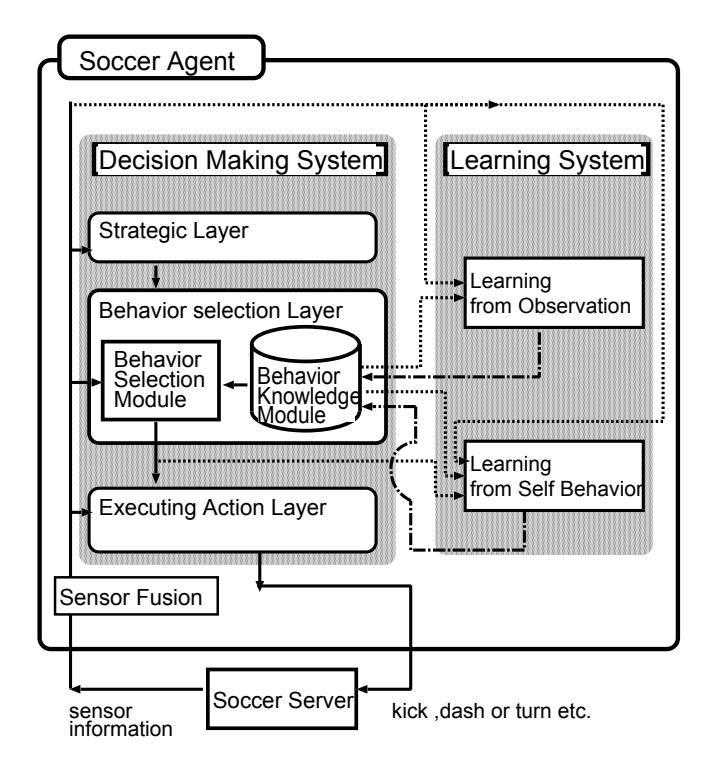
The agent architecture consists of a "Decision Making System" and a "Adaptive Learning System'1. The "Decision Making System" is based on a three layered control model [?]; the "Strategic Layer"; the "Behavior Selection Layer", which includes a behavior selection and a behavior knowledge modules; and the "Executing Action Layer". The "Strategic Layer" decides on the strategy using the strategic knowledge and sensor information. The "Behavior Selection Layer" selects a particular behavior such as a pass or a shoot. The "Behavior Selection Module" resolves matched rules obtained from the "Behavior Rules" (stored in the "Behavior knowledge" module). A "Behavior Rule" may be represented as follows:
$$IF(Situation_1ANDSituation_2AND...Situation_N)THEN(Behavior_1)$$
Based on the information received from the server (through the sensor fusion module) the "Decision Making System" is updated in intervals depending on the vision angle and the resolution quality.
The learning system contains two modules; "Self-Behavior Learning Module" and "Observation Learning Module". The first module learns from its own behavior, while the latter learns by observing other teammates'behavior. The "Observation Learning Module" also monitors teammates and opponent's behavior (action and response) and evaluates it before deciding on learning from this behavior.
The souce coudes of the team Tubamegaeshi[?] is used as our base codes. Learning module will be applied for the Shoot desition.
4 Conclusion
Our learning agent architecture and learning module are explained. The agent architecture consists of a "Decision Making System" and a "Adaptive Learning System. The learning system contains two modules; "Self-Behavior Learning Module" and "Observation Learning Module".
References
- Tomomi Kawarabayashi, Takenori Kubo, Takuya Morisita, Junji Nishino, Tomohiro Odaka and Hisakazu Ogura .: Real-time Adaptive Learning from Observation for RoboCup Soccer Agents. Distributed Autonomous Robotic Systems, 5(2002)207– 214.
- Jens Rasmussen .: Skills, rules, and knowledge; signals, signs, and symbols, and other distinctions in human performance models. Journal of IEEE Trans. SMC, 13(1983)257-266
- Takenori Kubo.: Team Description Team Tubamegaeshi 2004. Proceedings CD RoboCup 2004 Symposium