Apollo3D 2010 Team Description Paper
Juanjuan Li, Yejin Zhao, Yanda Ren, Lisen Li, Zhiwei Liang, Zhiyong Zhang
College of Automation Nanjing University of Posts and Telecommunications
Abstract Apollo3D is a team in RoboCup soccer simulation 3D league. We mainly aim at building a systematical architecture of intelligent and skillful robots. During the past year we achieved to create the turn-neck behavior to handle the new restricted vision. And given to the noise added to the server, Apollo 3D Soccer Simulation Team adopts another new method of localization and WorldModel construction. Moreover, Kalman filter is available in Apollo3D in order to increase the accuracy. We also rewrite part of the walking gait to avoid too many turning and adjustments during walking because they are one of the slowest parts. The goalkeeper now plays a more important role since the blocking behavior is much more skillful and it is more intelligent itself.
Keywords: RoboCup soccer simulation; Kalman filter; humanoid robot
1 Introduction
Apollo Simulation 3D Team was established in 2006, and successfully attended several competitions. We have won the third place in the last Iran Open. The Nao robot is much like the real robot. This creature attracts a large amount of students to devote to this field. Thanks to the devotion and cooperation of these students, several achievements had been made in the past year. In the following section 2, the new method of localization is presented. Section 3 presents the Kalman filter theory adopted in our team.
2 Localization
Compared with the previous server, the biggest challenge of the Robocup 3D Simulation teams are the restrictions placed on the vision sensor. In the last years, the simulated robots have perfect 360-degrees omni vision cameras, but now this sensor has a rang of only 120 degrees on both the horizontal as the vertical axis and supplies noisy data about the objects within its filed of sight. If the sensor catch only less three flags or the flags are not the designated ones, the old method of localization will not be available. Therefore, we adopt another method of localization.
First of all, we should detect the number of the flags in the vision information. If the robot can see more than three flags, we use the method of the localization with three flags. This method can be described by the equations as follow:
$$\begin{cases} (x-x_1)^2 + (y-y_1)^2 + (z-z_1)^2 = d_1^2 \ (x-x_2)^2 + (y-y_2)^2 + (z-z_2)^2 = d_2^2 \ (x-x_3)^2 + (y-y_3)^2 + (z-z_3)^2 = d_3^2 \end{cases}$$ (1)
where (x, y, z) means the position of the center of the robot, and $(x_1,y_1,z_1),(x_2,y_2,z_2)$ and $(x_3,y_3,z_3)$ separately means the position of each one of the three flags. And $d_1$ means the distance between the center of the robot and the flag1 of the filed, the same as $d_2$ and $d_3$.
According to the difference of the relative positions of the three flags, we solve the equations in three different conditions.
3 Kalman filter
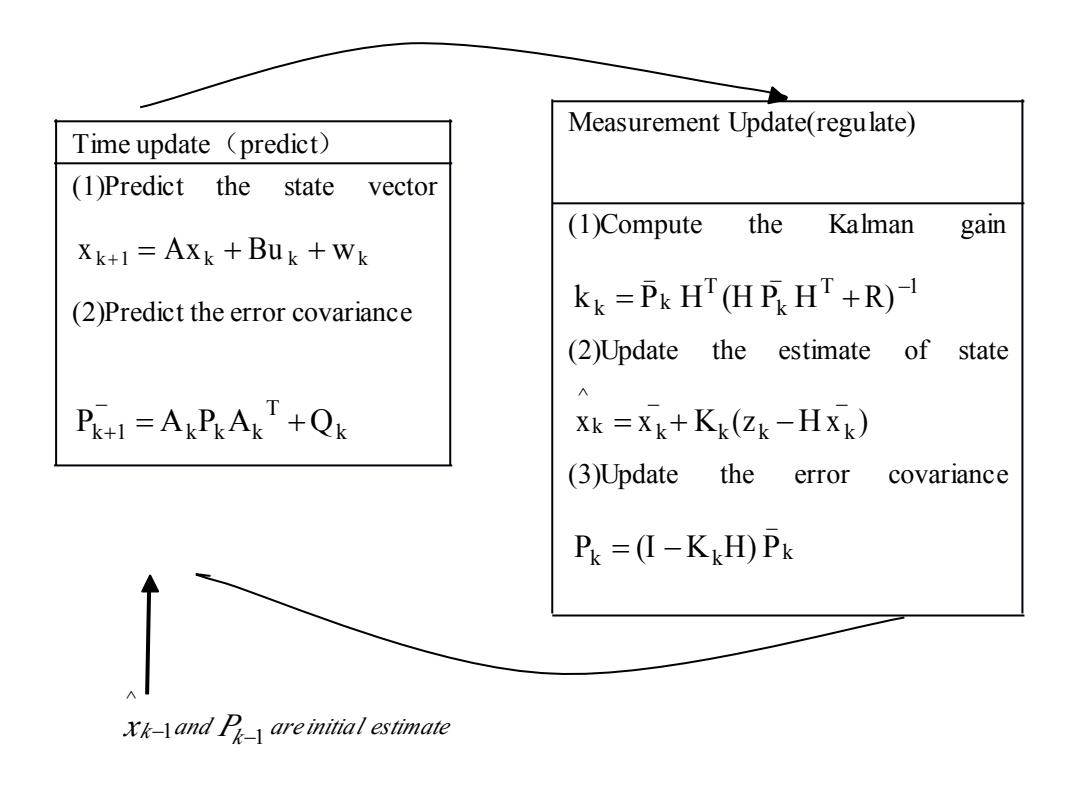
In many engineering fields, we obtain number of great successes because of using Kalman filter and Kalman filter is broadly applied. For the Machine linear system, when the model is accurate and the system process noise and observation noise is Gaussian white noise ,and the sequence of variance are known, using Kalman filter can obtain a near-perfect result. Therefore, the method of Kalman filter is applied to the agent location.
The theory of the Kalman filter is shown pictorially in Figure 1.
4 Conclusion and Future Work
Humanoid robot research is a popular and trends in robot research, many researchers and engineers focus their research on this field. The planning method in this paper based on given parameters, it is not easy to implement this method to general robots. Our further work will focus on this field as well as the improve the tactic of the robot
References
- Obst, O., Rollmann, M., Spark --- A Generic Simulator for Physical Multi-agent Simulations. Koblenz-Landau University[D]. 2005.
- Kalman, Rudolph, and Emil. A new approach to linear filtering and prediction problems. Transactions of the ASME-Journal of Basic Engineering, 82(SeriesD):35-45, 1960.
- KÖgler, M., Simulation and Visualization of Agents in 3D Environments. Technical report, Koblenz-Landau University[R]. 2003.
- Smith, R., Open Dynamics Engine (ODE) User Guide. 2004.
- Rollmann, M., Spark --- a generic simulator. Diploma Thesis, Koblenz-Landau University[D]. 2004.
- Gienger, M., Loffler, K. and Pfeiffer, F., 2002, Walking control of a biped robot based on inertial measurement, in Proceeding of the Third IARP International Workshop on Humanoid and Human Friendly Robotics, Tsukuda, Japan, December 22–29.