Apollo3D Team Description Paper
Kuihan Chen, Wenzhao Liang, Huijie Zhou, Tianjian Jiang, Liu Chen, Xuhui Chen, Zhiwei Liang
College of Automation, Nanjing University of Post and Telecommunications
Abstract Apollo3D is a team in RoboCup soccer simulation 3D league. We mainly aim at building a systematical architecture of intelligent and skillful robots. As the 3D simulation group continues to evolve, there are higher demands on the bottom moves and upper strategies of each 3D soccer team. With the accumulation of technology in recent years, our team has successfully designed new kicking movements, a new movement optimization framework, and a better upper layer strategy. In this paper, we will present a general overview of our team, including the upper-level strategy and the bottom level movements.
Introduction
Apollo Simulation 3D Team was established in 2006, and successfully attended several competitions. The simulated Nao is much like the real one that attracts a large number of students to devote to this field. Thanks to the devotion and co-operation of these students, several achievements have been achieved in the past years.
In this TDP we will describe some of the work we have done in recent years and our vision for the future.
With the development and improvement of the RoboCup3D platform, such as the addition of 'passmode', the addition of self-collision to actions and other platform improvements, these changes have made the game more demanding in terms of player actions, as well as in terms of team player cooperation and role assignment. To accommodate these changes, we designed a new framework for movement optimization which can gain faster walk and faster kick behavior, as well as optimizing the fit strategy between player roles. Section 2 will describe our new action optimization framework, and Section 3 will describe the coordination system between different roles.
Optimization Framework
Since the 3D simulation platform has a new passing mode, there is a higher requirement for the player's walking speed in order to prevent the opponent's players from entering the passing mode and our support to our own players. At the same time, in order to have a more accurate landing point for the pass, which is to allow our own players to catch the ball better, there are higher requirements for the accuracy of the kicking action used in the pass mode. Due to the existence of the passing pattern, once the ball is lost it will cause the opponent's front line to advance quickly, so how to improve our ball possession rate is also the direction of our research, for which we deliberately studied the optimization of dribble and extended the original optimization framework.
Walking
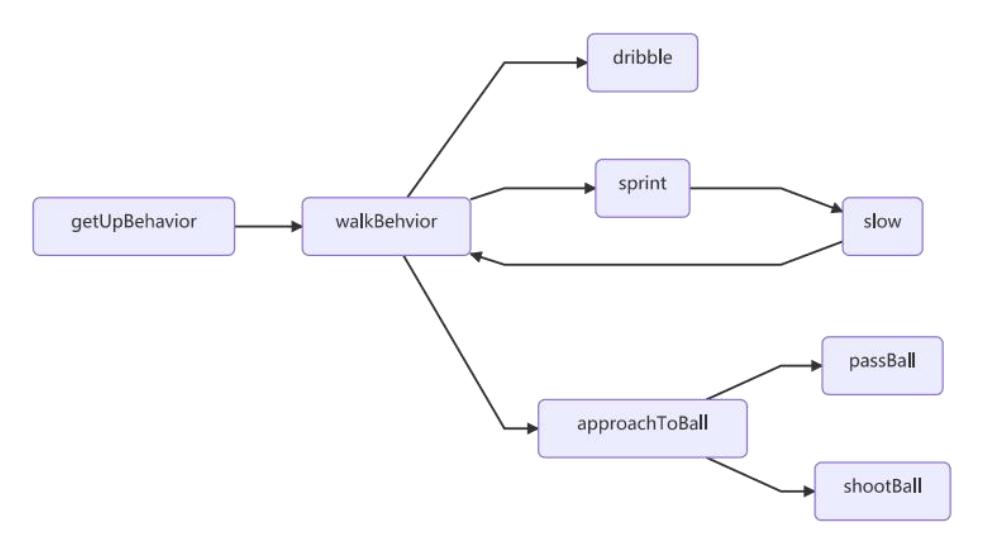
With the existing walking framework, we have to sacrifice the ability of humanoid robots to steer in order to obtain faster walking movements. Therefore, to avoid such a problem, we divide the fast-walking state into three states: normal walking, sprint walking and deceleration walking, and analyze the requirements for each of the three states, using deceleration walking as the transition between sprint walking and normal walking. This can take into account both the flexibility of normal walking and the speed of sprint walking, which can make the humanoid robot reach the destination faster and complete the established action to get a better performance in the competition.
Kicking
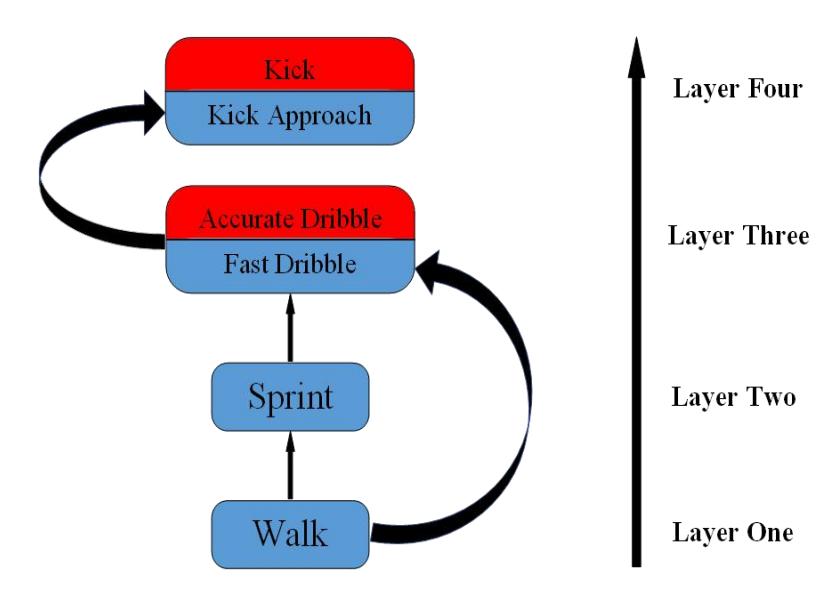
At the same time, in order to obtain a more accurate landing point for the kicking action which is to enable teammates to catch the ball better, we divide the kicking types into two categories, one is the kicking action which is fast in execution but not particularly accurate in landing point for shooting, and the other is the kicking action which is slower in execution compared to the former category but accurate in landing point for passing. The position of the two types of kicking actions in the optimization framework can be seen in Figure 1.
Dribble
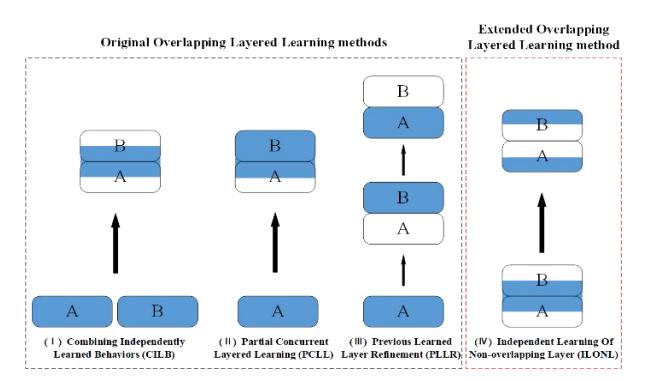
In addition to several original models of Overlapping Layered Learning, we extended a new paradigm which called Independent Learning Of Non-overlapping Layer (ILONL). The following is a brief description of the model's rationale. First, the gap parameter set between two related behaviors is learned, and then fixing the gap parameter set, the parameters in the non-gap parameter set part of the two behaviors can be openly learned separately, and the other independent behaviors are learned based on the fixed overlapping part of the behaviors to finally fuse to form a complex behavior.
The Coordination System
Since there are 11 players on the field, and a soccer game is not a one-man battle, the cooperation between players is especially important.
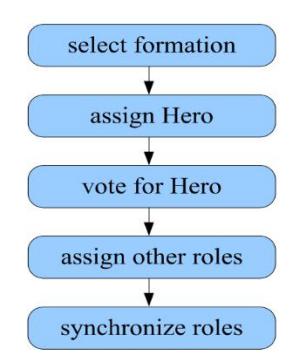
We have dynamically assigned each of the 11 players to 11 roles, and each role has its own special task. The figure below shows our role assignment system. The ball carrier, which we also call HERO, holds the most important position in the game. In our strategy, we first select the currently required formation by the situation on the field, then select our HERO by the formation, and subsequently assign the roles of the other players. Since the humanoid robot has noisy information visually and has a limited field of view, the role sequence selected by each person at the same time may be different, which requires us to do a vote on the role sequence to ensure that the role sequences of all players on the field are consistent, in order not to have the problem of two players competing for a role position.
Conclusions and Future Work
This paper is a general description of the work we have done in recent years, and detailed information about our work can be found in our published papers.
The 3D simulation project has a long history and there are still many great teams doing exciting work on the project, and we hope that more teams will join the growing 3D simulation project. With artificial intelligence on the rise, our team will also explore how to make the robot smarter in the future, as well as research how to make the robot walk more quickly and kick the ball more accurately and quickly.
References
- Chen, Li, et al. "Efficient Role Assignment with Priority in Robocup3D." 2020 Chinese Control And Decision Conference (CCDC). IEEE, 2020.
- Cui, Tongxin, et al. "Role allocation tactics of soccer robots on RoboCup3D simulation platform." 2018 Chinese Control And Decision Conference (CCDC). IEEE, 2018.
- He, Hao, et al. "Dynamic Kick Optimization Of Humanoid Robot Based on Options Framework." 2019 Chinese Control And Decision Conference (CCDC). IEEE, 2019.
- He, Keji, et al. "Formation optimization of RoboCup3D soccer robots using delaunay triangulation network." 2018 Chinese Control And Decision Conference (CCDC). IEEE, 2018.
- Lu, Yulei, et al. "3D Humanoid Robot Multi-gait Switching and Optimization." 2019 Chinese Control And Decision Conference (CCDC). IEEE, 2019.
- MacAlpine, Patrick, Mike Depinet, and Peter Stone. "UT Austin Villa 2014: RoboCup 3D simulation league champion via overlapping layered learning." Proceedings of the AAAI Conference on Artificial Intelligence. Vol. 29. No. 1. 2015.